
A cooler and a couple of bags of ice a week cost very little and work fine. That is the fair starting point for any 12V refrigerator buying guide, and any article that skips it is selling you something.
What a cooler won't do is stop draining meltwater into your food, survive a week between store runs, or hold a steady 37°F in August. The four below were picked on one basis: what each manufacturer is willing to put in writing about the power its fridge uses. Picks first, then how to live with one, then the evidence behind the choices.
Table of Contents
The four picks
Dometic CFX5 45
Best overallThe default choice. It performed near the top of the only proper climate-chamber comparison anyone has run, it's the most widely stocked and serviced unit in this category, and the CFX5 line is the first from Dometic to name its insulation as vacuum insulated panels.
What it doesn't do is document itself. Dometic publishes no compressor, no test conditions for its energy figures, no IP rating, and its manual says plainly that the unit shouldn't be exposed to rain. By this article's own standard that counts against it. The case here rests on independent test results and availability rather than on disclosure.
What You'll Love
- Near the top of the only proper climate-chamber comparison anyone has run
- Vacuum insulated panels on the CFX5 line
- Best availability and service network in the category
- Manual states a 30° tilt tolerance and a 61°F to 109°F (16 to 43°C) ambient range
Worth Considering
- Publishes no compressor and no test conditions
- Advertises three-stage battery protection but publishes no cutoff voltages
- No IP rating. The manual says keep it out of rain
- Check the recall if you're buying a used CFX3
ICECO VL60 Dual Zone
Best dual-zoneTwo compartments with separate temperature settings, which is the one thing a single-zone box can't do. The manual gives a range of 0°F to 50°F on each side, so you can run one end as a freezer and the other as a fridge without buying a second appliance.
It's also the better-documented of the dual-zone options. Dometic is the only brand that tells you how its dual-zone models divide inside, 45 and 30 liters on the 75DZ, and ICECO publishes nothing per compartment. But Dometic publishes no battery cutoff voltages at all, and ICECO prints the whole table. On an article about what manufacturers are willing to put in writing, that settled it.
What You'll Love
- Separate setpoints per side, stated in the manual
- Publishes the full cutoff table, cut-out and restart
- Five-year compressor warranty
- Names its compressor supplier, which almost nobody does
Worth Considering
- Doesn't publish how the 60 liters divides between the zones
- Power figure is a rated wattage with no test conditions
- No IP rating. The manual advises against moderate or heavy rain
EcoFlow Glacier Classic 45L
Best documentedIf this article has a thesis, this is the product that fits it. EcoFlow is the only manufacturer we found that publishes its power figures with the conditions attached: 165 Wh per 24 hours at a 39°F (4°C) setpoint, tested at 77°F (25°C) ambient in Eco mode, stated on its spec page. Everyone else gives you a number and lets you guess.
It also publishes its insulation as two inches of foam, its cutoff voltages, an IPX4 rating, and a manual that explicitly says it's suitable for outdoor use. That combination doesn't exist anywhere else in this article.
The downside: it did not do especially well in the Expedition Portal chamber test, taking roughly twice the pull-down energy of the ARB. Best documented and best performing aren't the same thing, and pretending otherwise would undercut the entire point of measuring documentation in the first place.
What You'll Love
- The only brand publishing test conditions with its power figures
- IPX4, and the manual explicitly permits outdoor use
- Publishes a storage temperature range, which nobody else does
- The newest design here, which is why the documentation is better
Worth Considering
- Sold with and without an add-on battery, this is the cheaper version, without
- Mid-pack on pull-down energy in independent chamber testing
- Too new for its review count to mean much yet
ICECO VL45
Best valueThe sensible middle. A five-year compressor warranty is the longest here by a wide margin, the low-voltage cutoffs are published in full, and the cutoff triplet of 9.6 / 10.1 / 11.1 volts tells you it's running a Secop BD-series controller even though the manual never says so.
ICECO claims a Secop compressor in its marketing and warranty copy. It doesn't repeat that claim in the actual product manuals, which is a gap worth noticing. Its published consumption figure carries the phrase "laboratory data for reference only" with no ambient temperature or setpoint given. At least it admits the figure can't be checked.
What You'll Love
- Five-year compressor warranty, the longest here
- Publishes the full cutoff voltage table
- The only brand that names its compressor supplier at all
- Rated to a 131°F ambient, the highest in this group
Worth Considering
- Names the supplier but never the compressor model
- Consumption figure has no stated conditions
- No IP rating or insulation detail published
Quick comparison
| Product | Capacity | Zones | Compressor named | Power figure with test conditions |
|---|---|---|---|---|
| Dometic CFX5 45 | 46 L / 49 qt | Single | No | No |
| ICECO VL60 Dual Zone | 60 L / 63 qt | Dual | Supplier only | No |
| EcoFlow Glacier Classic 45L | 45 L / 48 qt | Single | No | Yes |
| ICECO VL45 | 45 L / 48 qt | Single | Supplier only | No |
Living with one
Most of what follows comes straight out of the manufacturers' own manuals. Where it doesn't, where it's just what people do, we say so, because a fair amount of the advice passed around on RV forums has nothing behind it, and some of it is contradicted by the manual in the box.
Give it room to breathe
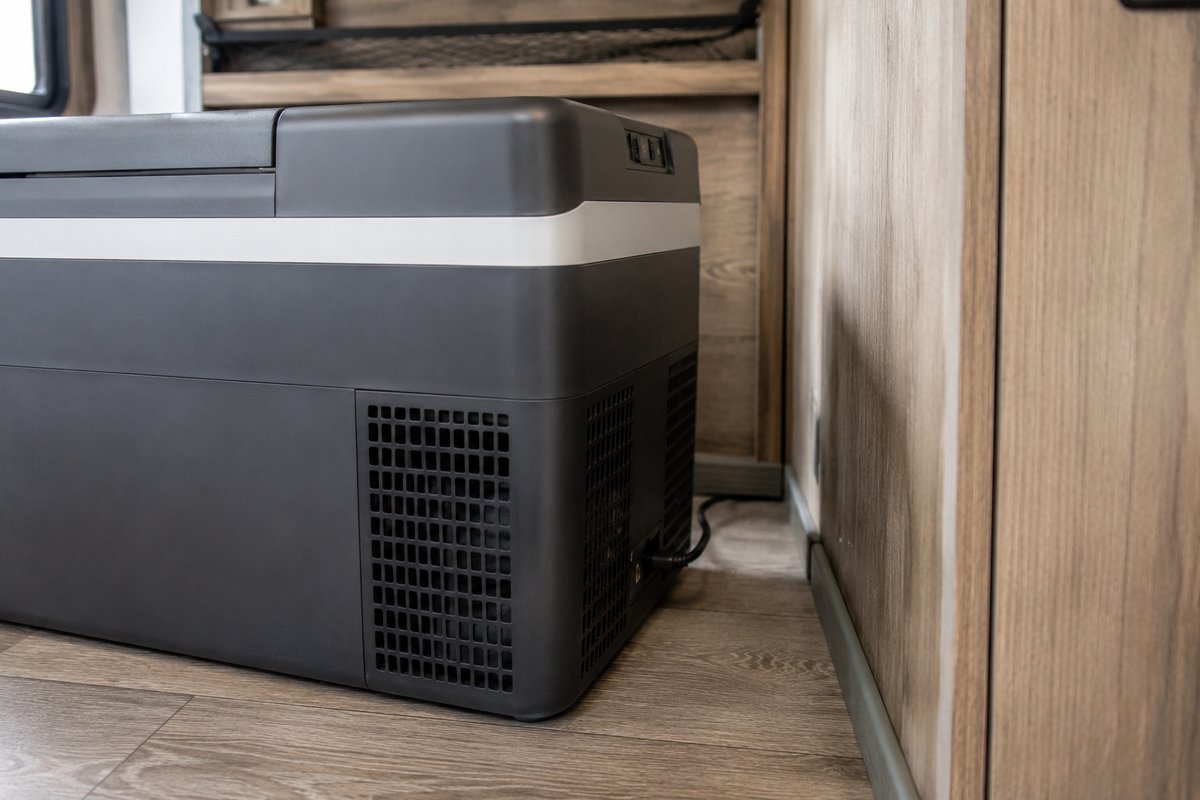
Dometic, ARB and EcoFlow all ask for the same thing: two inches of clear air on every side. Dometic goes further and says not to run the fridge in a closed compartment at all. Engel asks for six inches, so don't treat two as a universal number.
This is the mistake that costs the most, and it's the one people make on purpose. Building the fridge into a cabinet, a bench seat or a sealed pass-through bay looks tidy and starves the condenser. The compressor then runs longer to hit the same temperature, which comes straight out of your battery. No manufacturer publishes how much longer, so nobody can tell you the exact cost, only that you're paying it.
You do not need to level it
This is worth saying clearly, because the opposite advice is everywhere. A compressor fridge doesn't need to be level. Dometic, ARB, Engel and EcoFlow all rate theirs to 30 degrees of tilt. Engel says outright that unlike other brands, theirs doesn't need to be level to perform.
The leveling rule is real, but it belongs to a different appliance. Absorption fridges, the propane-and-ammonia type built into many older trailers, stop circulating when they're off level, and the advice got carried across to portables where it doesn't apply. Your trailer should still be leveled for the door, the plumbing and your own comfort. The fridge doesn't care.
One quirk: past 30 degrees an EcoFlow shuts itself off deliberately. If it stops on a steep driveway, nothing is broken.
Wiring, and the shutdown that is not the battery's fault
If a fridge keeps cutting out, the wiring is the first suspect, not the battery. Thin cable loses voltage over its length, so the fridge reads a lower voltage than the battery has and trips its own low-voltage protection early. No manual explains that, but it's the most common version of this complaint.
- ARB asks for a dedicated circuit with a 15-amp fuse, and 6mm cable for runs up to 20 feet.
- Engel wants a 10-amp fuse near the battery, and says never to substitute wire for a proper fuse.
- Setpower says plainly: don't use a DC extension cord.
- ARB ships an adapter collar so you can take it off and use a Merit-type socket instead of a cigarette lighter socket, which it recommends. Victron rates cigarette plugs at 10 amps and advises limiting their use.
Dometic, ICECO and Setpower publish no cable gauge guidance at all. And Engel's warranty excludes damage from incorrect voltage, so poor wiring isn't only a performance problem.
Which battery protection setting to use
Every fridge here has a low-voltage cutoff, usually marked Low, Med and High. It switches the compressor off before your battery gets too flat to be useful. The short version: Med for a house battery, High if the fridge is running off the vehicle's starting battery. Dometic gives that same advice in its manual.
Two things nobody tells you. First, the labels aren't standard. ICECO's Med cuts out at the same voltage as ARB's Low, so a setting you copied from a friend with a different fridge may not mean what you think. Second, and this is reasoning rather than anything printed in a manual: these thresholds were designed around lead-acid batteries, whose voltage falls steadily as they empty.
A lithium battery holds a nearly flat voltage until it's almost done, so High will trip while the battery is still more than half full, and Low sits below the point where the battery's own protection has already shut things down. On lithium, the fridge's cutoff does very little.
Heat costs more than anything else you can control
National Luna is the only manufacturer that has published measurements across a range of temperatures, and the result is stark: roughly three times the energy at 109°F as at 70°F. ARB states its fridges can't reach their rated cooling above 90°F ambient, which isn't a high bar in an American summer.
So shade, airflow and keeping the fridge out of a hot locker aren't comfort decisions. They're the difference between a fridge your battery can carry and one it can't. Worth knowing too that Dometic rates the CFX5 down to 61°F ambient at the bottom end, it isn't specified for a freezing trailer.
Cleaning
Every manual here says the same two things: wipe it out with a damp cloth and a mild detergent, and never clean it under running water. Engel is specific about why, water gets into the insulation and the electrics, and that is a failure, not a stain. Keep the vents free of dust while you're at it.
Nobody publishes how often. Nobody says anything at all about looking after the lid seal. Wiping the seal and keeping grit out of it is sensible, but that's our suggestion, not a manufacturer's.
Putting it away for the season
This is the part most people get backwards. Dometic, EcoFlow and ARB all give effectively the same instruction, and it ends with the lid open:
- Switch it off and defrost it.
- Clean it, then dry it completely.
- Leave the lid open or propped ajar. All three brands give the same reason: mold.
- Unplug it. ARB, EcoFlow and Engel all say to disconnect it from power.
Leaving it latched shut is the instinctive thing to do and the wrong one. A sealed, slightly damp box left for five months smells like a sealed, slightly damp box.
On leaving it connected to the house battery over winter: don't, and don't rely on the low-voltage cutoff to protect the battery. Not one manufacturer publishes what these fridges draw when switched off but still plugged in, so there's no number to reason from.
The cutoff was designed to save your groceries for a weekend, not to nurse a battery through February. Disconnect it, and if the trailer is stored cold, remember that most lithium batteries won't accept a charge below freezing, which is a separate problem worth checking on your own setup.
If the fridge has been carried on its side, stand it upright for 24 hours before switching it on. ICECO and Setpower both state that in writing. Dometic and ARB say nothing about it, which doesn't mean it doesn't apply.
One last thing, because it comes up constantly: no manufacturer tells you to run the fridge periodically while it's in storage. Not one. Every storage instruction in every manual we read says the opposite, off, dry, open and unplugged.
What one of these costs you in power
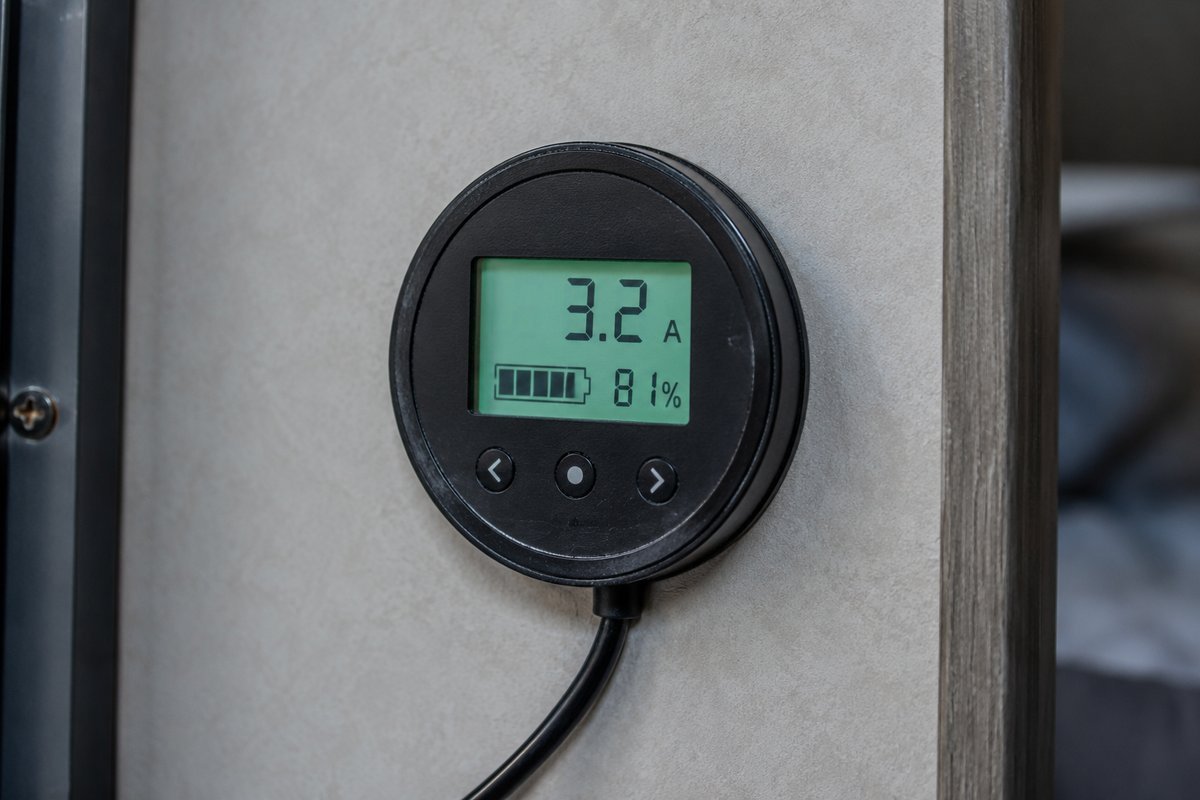
If you have read our guides on portable power stations or camping batteries, you already think in amp-hours. Apply the same thinking here, because a fridge is almost always the largest continuous 12V load in a travel trailer.
A compressor fridge doesn't run constantly. It cycles, and the fraction of the time it runs determines your daily draw. Measured figures from builders and owners who instrumented their own RVs cluster around the compressor running 20% to 35% of the time in moderate conditions. In practice, that lands most 45-liter units somewhere around 15 to 30 amp-hours a day, but that range is wide because of temperature.
National Luna is the only manufacturer we found that has published its own measurements across a range of ambient temperatures. On a unit with 60mm (about 2.4 inches) of insulation set to 39°F (4°C), it reports the compressor running 18 to 20% of the time at 70°F, 25 to 30% at 90°F, and 30 to 50% at 109°F, roughly three times the energy at 109°F as at 70°F. Treat that as a manufacturer's own figure rather than an independent result, because no independent lab has published a consumption-versus-ambient curve for these products at all.
One consequence worth planning around: the temperature that matters is the air around the fridge, not the shade temperature outside. A closed trailer in the sun runs far hotter than the forecast predicts, and nobody has measured it systematically either.
No standard governs these power claims, so none of them are comparable
This finding changes how to read the whole category, and you can check it yourself.
Portable 12V compressor fridges fall outside every appliance efficiency standard in the developed world, and in two cases they're explicitly excluded. The US Department of Energy's definitions in 10 CFR 430.2 cover appliances using "single-phase, alternating current electric energy input only", a DC fridge is simply not a covered product, so there's no DOE test procedure and no FTC EnergyGuide label.
The EU's Regulation 2019/2016 explicitly excludes "mobile refrigerating appliances," defined as those running on under 120V DC. Australia's GEMS rules exclude 12 and 24V transport appliances outright. There's no ENERGY STAR category, and no ASTM, ISO or IEC standard that applies.
So every manufacturer picks its own ambient temperature, its own internal setpoint, its own thermal load, its own door-opening regime, and whether to quote steady-state or averaged consumption, and most of them don't tell you which they chose. A number published under undisclosed conditions can't be compared to another number published under different undisclosed conditions. That isn't a criticism of any one brand. It's the state of the category.
Judged on that basis, the disclosure ranking is stark. EcoFlow is the only brand we found that publishes its conditions: ambient 77°F (25°C), setpoint 39°F (4°C), Eco mode, stated plainly in the manual. Dometic publishes annual kWh figures with no conditions attached, and its own support pages concede that per-ambient consumption data is still "upcoming." ARB's US pages quote a "current draw" in amp-hours, which is a quantity rather than a rate and has no time base. Everyone else publishes a wattage and leaves it there.
Nobody will tell you whose compressor is inside
The compressor is the part that determines efficiency and the part most likely to fail. It's also the specification the entire industry declines to publish.
We checked Dometic, ARB, ICECO, BougeRV, Setpower, EcoFlow, Alpicool, Whynter and National Luna. Not one publishes a compressor model number. The closest anyone comes is ARB, whose Elements service manual names Danfoss without a model. ICECO names Secop on its listings and in at least one of its own documents, the only brand here that names a supplier at all, but never a model number. BougeRV mentions an LG compressor in a blog post and nowhere in its specifications. Dometic offers "VMSO3," which is a Dometic marketing name, not a component.
There's a workaround worth knowing. The low-voltage cutoff table gives the controller away. ICECO and Setpower both publish cut-outs at 9.6 / 10.1 / 11.1 volts, which are the Secop BD-series thresholds, although ICECO's low-setting restart is 10.6V where the stock table says 10.9V, so somebody there changed one number. ARB publishes 10.1 / 11.4 / 11.8. Dometic advertises three-stage battery protection and publishes no voltages at all. So the controller family is often inferable even where the compressor isn't named.
One caution against over-reading a Secop badge, though. Secop publishes rigorous datasheets rating its compressors to EN 12900 and ASHRAE at a stated ambient temperature of 90°F (32°C). Those figures describe a compressor on a test bench, not a finished fridge with its own insulation, cabinet and controller. Since no appliance-level standard exists, a Secop compressor tells you the part was properly rated, but nothing verifiable about the box it ends up in.
What the independent tests found
Two controlled comparisons exist, and together they constitute the best evidence in this category.
Expedition Portal ran six units in a climate chamber at 72°F (22°C) with a regulated supply, an identical thermal load of 39 cans in every unit, and certified data loggers inside. They measured how long each took to cool to 39°F (4°C), how many amp-hours it took, and, the interesting one, how long the interior took to warm from 39°F to 50°F (4°C to 10°C) after the power was cut.
The ARB Elements 60L led on both, pulling down in 3h45m for 11.6Ah and holding temperature for 14h40m. A Dometic CFX5 45L was close behind on pull-down. The EcoFlow Glacier 55L and ICECO APL35 took roughly twice the energy to pull down.
4x4 Worldwide ran ten units for 179 hours with simulated door openings and probes in the cabinets, and again found ARB near the top on insulation, with an ARB Zero dual-zone warming only about 16°F (9.1°C) over seven hours without power.
Both deserve caveats we would rather state than bury. Expedition Portal measured pull-down energy at one mild ambient, not steady-state daily consumption, and the units ranged from 35 to 60 liters, so they aren't clean efficiency comparisons. 4x4 Worldwide ran everything on 220V AC, so its numbers exclude the DC conversion losses you would see. And no one, anywhere, has published a controlled, multi-brand, steady-state, amp-hours-per-day test at stated ambient temperatures for the US market. That test doesn't exist.
A recall worth thirty seconds of your time
Dometic recalled CFX3 and CFF coolers built between 1 December 2019 and 18 June 2020: models CFX3 35, 45, 55IM, 75DZ, 95DZ and 100, plus CFF 35 and 45. If 120V AC and 12V DC were connected at the same time, a failed protection device could back-feed 28 volts through the cooler into other DC appliances. The CFX3 25 isn't affected.
This one went through NHTSA rather than CPSC, which is why it's easy to miss: the campaign number is 20E-040. If you own a CFX3 from that window, or are buying one used, check it before you run AC and DC together.
The setting that saves your trip
Every fridge here has a low-voltage cutoff with High, Medium and Low settings, and it's the most consequential thing you will configure.
The labels don't mean the same thing on every brand, which is worth knowing before you set it. On High, an ARB shuts off at about 11.8V and restarts at 12.6V. An ICECO on High cuts out at 11.1V, and ARB's Low is the same voltage as ICECO's Medium. That protects a starter battery you need to drive home. On its lowest setting an ICECO runs down to 9.6V, which will happily flatten a lead-acid battery to the point of damage but keeps your food cold longer.
The rule of thumb: if the fridge is on your tow vehicle's starting battery, use High. If it's on a dedicated house battery you can afford to run down, especially lithium, which tolerates deep discharge, Medium or Low gets you more runtime. Set it deliberately rather than leaving it wherever it shipped.
How we picked these
This started as five picks and ended as four. The budget slot went to three different products in turn and each failed the same test. BougeRV publishes no manual we could open. Setpower publishes manuals but no test conditions, no compressor, and a warranty that reads two years in one of its own documents and three in the rest. Bodegacooler advertises an "IPX4 waterproof and dustproof" rating, and IPX4 by definition makes no dust claim at all. We would rather run four picks we can stand behind than pad the list to five.
The best fridge for mounting out in the weather isn't on this list, and we earn nothing by saying so. The ARB Elements is the only unit in the category built for exposed mounting. 304 stainless, UV-stable corner moldings, a sealed control panel, and it won the one proper chamber test outright. It's sold through ARB, Summit Racing and NAPA rather than Amazon. Worth knowing too that no fridge in this category, ARB included, publishes a waterproof rating in its manual. EcoFlow's IPX4 is the closest anyone comes.
Specifications come from Dometic, ARB, EcoFlow and ICECO's own manuals and product pages. Where a manufacturer doesn't publish something we say so, and in this category that includes the compressor model for every single brand, and the country of manufacture for every single brand.
Performance claims come from the two controlled independent tests that exist, with their limitations stated. We haven't run these fridges ourselves, and we aren't going to imply otherwise.
We didn't rank these on reliability, because nobody publishes failure data for this category. Complaint threads exist for every brand, and complaint volume tracks sales volume, so the brand you see mentioned most is mostly the brand that sells most. That isn't evidence and we won't dress it up as evidence.
A 12V refrigerator is judged on what it draws overnight rather than on how cold it can get, because the battery is the part that runs out first. That assumes the battery is healthy, so it's worth testing what yours holds before blaming the fridge for a flat morning.
Whatever unit you choose, the target is the same as a kitchen fridge. FoodSafety.gov says to keep a refrigerator at 40 degrees Fahrenheit or below, so a cheap fridge thermometer is worth adding on the first hot trip.
Quick Answers
What are the disadvantages of a 12V fridge?
Three, and they're all versions of the same thing: it's a compressor that never stops needing power. It draws from the battery around the clock, so it forces you to think about how much battery and solar you have. It makes noise when the compressor runs, which matters at night in a small trailer. And it costs several times what a cooler and a bag of ice costs.
Against that, it holds a set temperature in weather that would turn a cooler into a bucket of water, and it doesn't need a store every second day.
How long will a battery run a 12V fridge?
Longer than people expect, because the compressor isn't running most of the time. The figure that matters is how much of each hour it runs, and in moderate conditions that's roughly a fifth to a third.
Which is also why any single runtime number is close to useless. Hot weather, a full fridge, a door opened often and a badly ventilated cabinet all push that fraction up, and the draw goes with it.
Can I run a 12V fridge while driving?
Yes, and it's one of the real advantages over an absorption fridge, which doesn't like being run on propane down the highway. The fridge simply keeps working from the battery.
The thing to check is whether the circuit you have plugged it into stays live with the engine running and the trailer under tow. Some don't, and you find out when you arrive with a warm fridge.
How many amp-hours a day will it use?
Most 45-liter units land somewhere around 15 to 30 amp-hours a day in moderate weather, with the compressor running roughly 20% to 35% of the time. Hot weather can push that far higher, one manufacturer's own testing shows about three times the energy at 109°F as at 70°F. Anyone quoting you one precise number for all conditions is guessing.
Can I compare the power figures between brands?
No, and this is the part worth taking away. No efficiency standard covers 12V portable fridges. The DOE, the EU and Australia all exclude them, two of them by name. Each manufacturer chooses its own test conditions and usually doesn't disclose them.
Does a Secop or Danfoss compressor mean it's better?
It means the compressor was rated to a real standard on a test bench. It tells you nothing verifiable about the finished fridge, because no standard covers the finished fridge. There's no independent data comparing Secop against LG or generic compressors in actual cabinets.
What should I set the battery cutoff to?
High if it's running off your tow vehicle's starting battery, because you need that battery to start the truck. Medium or Low if it's on a dedicated house battery, especially lithium.
Do I need solar to run one?
Not necessarily, but it helps enormously on longer stays. Sizing depends on the same uncertain consumption figure everything else here depends on, so measure your own draw with a battery monitor before buying panels.
Final thoughts
Top pick: Dometic CFX5 45, on independent test results and the best service network, while acknowledging it documents itself poorly.
Best documented: EcoFlow Glacier Classic 45. The only brand that tells you the conditions behind its own numbers, even though it didn't top the performance testing.
Mounted outside: ARB Elements 60, which won both insulation tests and is the only unit built for weather exposure.
And the thing to remember when you're comparing spec sheets: the numbers on them weren't measured the same way, because no rule says they have to be. Buy on insulation, warranty, cutoff behavior and whether the company is willing to tell you how it tested, not on a wattage figure with nothing behind it.
Sized to the space and to the battery bank behind it, a 12V refrigerator is one of the few upgrades that pays for itself in ice alone.