
Most advice on towing a travel trailer splits into separate topics. Tire pressure over here, hitch weight over there, wheel chocks somewhere else, brake controller wiring on its own page, as though picking the right tire and wiring the right controller had nothing to do with each other.
They have a great deal to do with each other. A trailer that's underinflated pulls differently than one that isn't, which changes how much a weight distribution hitch has to correct for, which changes how a brake controller's gain should be set. This RV towing guide walks through how tires, hitch, chocks and brake controllers work together as one system, then points to the page covering each part in depth.
Quick answer
Towing a travel trailer safely comes down to five things working together: tires sized and inflated correctly for the load, a weight distribution hitch sized to the trailer's actual tongue weight, wheel chocks used every time the trailer is parked, a brake controller wired correctly through all four wires, and a controller type and gain setting that matches how the tow vehicle brakes. Each one has its own detailed guide. This page explains how they connect.
Table of Contents
Tires: the part touching the road
Every pound of a loaded trailer rides on four tires, and travel trailer tires age out long before they wear out. The reasons why, and how to read the date code on a sidewall, are covered in travel trailer tires. Because a slow leak or heat buildup on a trailer axle isn't something a driver in the tow vehicle can feel, most owners run a tire pressure monitoring system rather than relying on a visual check at the last fuel stop. Setting up a TPMS correctly covers sensor placement and alert thresholds that make the warnings useful instead of noise.
The hitch and weight distribution
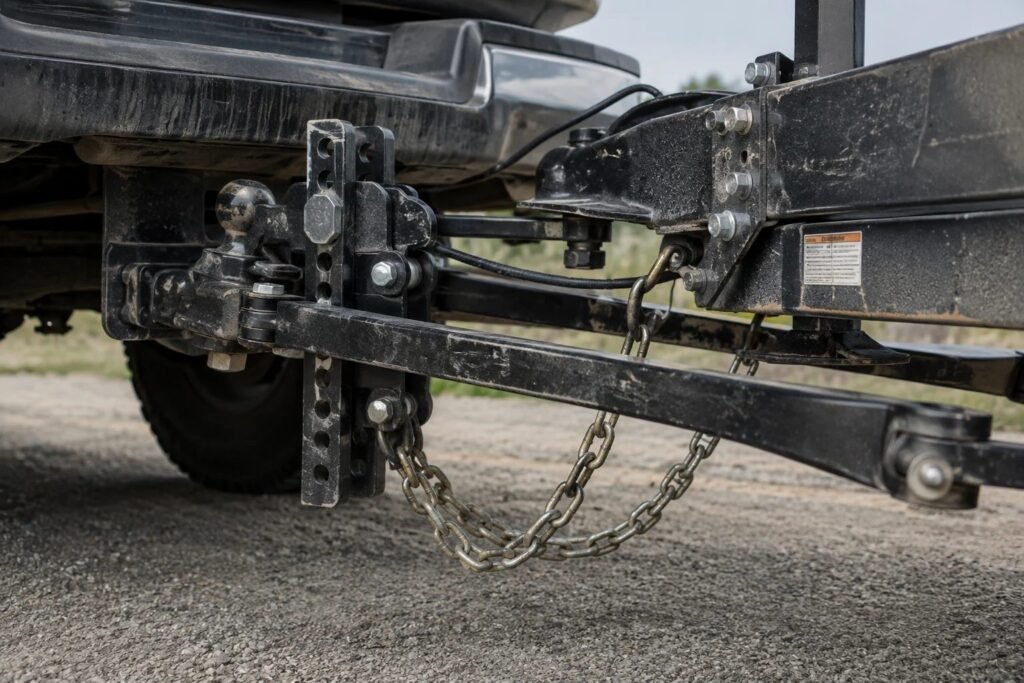
A trailer's tongue weight pushes down on the back of the tow vehicle, and past a certain point that's enough to lift weight off the front axle, which makes steering and stopping worse, not just less comfortable. A weight distribution hitch spreads that weight back across all the axles on both vehicles. Whether a specific setup needs one comes down to the real tongue weight, not a rule of thumb, which is the starting point in weight distribution hitch for a travel trailer.
Parking and chocking safely
A trailer that's uncoupled, or parked on any kind of grade, needs to be physically kept from rolling, and a parking brake by itself doesn't always guarantee that. The difference between a wheel chock and an X-chock, and when each one is doing its job, is covered in trailer wheel chocks. Getting the trailer sitting level once it's parked is a separate job, covered in RV leveling blocks.
Brake controllers: the core of the towing safety system
Tires, hitch, and chocks all matter, but the brake controller is the one piece of the system that actively does something every time the pedal is pressed. It's also the piece most first-time trailer owners understand the least, which is why it gets four sections here instead of one.
What a brake controller does, and whether one is required
A brake controller reads the tow vehicle's brake pedal and sends a matching signal out to the trailer's own brake magnets, so the trailer helps stop itself instead of just being pushed along by the truck. Whether one is legally required depends on the trailer's weight and the state, and the threshold is lower than most owners expect in a lot of states.
The full state-by-state breakdown, along with why the answer is almost always yes for a loaded travel trailer, is on the wiring diagram page. This RV towing guide keeps that state-by-state detail on the wiring page rather than repeating it here, but the source is the RV Industry Association's state requirements summary.
Time-delay or proportional
The two common controller types brake very differently. A time-delay controller applies a preset ramp every time, regardless of how hard the tow vehicle is braking. A proportional controller reads the vehicle's own deceleration and matches it in real time, which is why the two feel different from the driver's seat and why the gain setting matters so much more on a proportional unit. Proportional brake controller covers that distinction and how to set the gain once one is installed.
Wiring it correctly
Every controller, whatever the brand, comes down to the same four wires: black for battery power, white for ground, red for the brake light signal, and blue for the output that applies the trailer brakes. Brake controller wiring harness walks through where each wire goes and the two different 7-way connector color standards still in use.
When something's wrong
A controller that worked on the last trip and doesn't work on this one is usually a wiring or ground fault, not a failed controller. Trailer brake controller repair covers the checks worth running before assuming the unit itself needs to be replaced.
What each part does, and what it feels like when it is wrong
The useful thing about treating this as one system is that the symptoms overlap. A trailer that pushes the tow vehicle at a stop sign might have a gain set too low, or it might have brakes that aren't being asked to do anything because a wire came loose. A trailer that wanders might be short of air in the tires, or carrying its weight too far back, or both. Working out which part is causing the problem is most of the job.
| Part of the system | What it's doing | What it feels like when it's wrong | Where it's covered |
| Tires | Carrying the whole loaded weight and holding the line | Sway that gets worse with speed, and uneven wear across the tread | Tires and monitoring |
| Hitch and weight distribution | Moving tongue weight forward onto the tow vehicle's front axle | A light, vague steering feel and headlights aimed too high | Weight distribution |
| Chocks | Holding the trailer still once it's uncoupled or parked | The trailer shifting under you as you step through the door | Chocking |
| Controller wiring | Carrying power and the brake signal from truck to trailer | Trailer brakes that do nothing at all, or a fault the truck can't explain | Wiring and harness |
| Controller type and gain | Deciding how hard the trailer brakes and how soon | Grabbing on light stops, or a shove from behind on hard ones | Proportional versus time delay |
That overlap is the reason this page exists rather than seven separate ones. The specific fixes live on the pages below, and each of them goes far deeper than a summary could: travel trailer tires and tire pressure monitoring, weight distribution hitch, wheel chocks, the brake controller wiring harness, choosing a proportional brake controller, and what to check first when it stops working, in brake controller repair.
If you're starting from nothing, the order that saves the most trouble is the order the weight travels. Get the tires right, because everything above them inherits their behavior. Then the hitch, because it decides how the load sits. Then the brakes, because they're the part that has to work on the one day everything else has gone wrong.
Putting it together: the RV towing guide checklist
Working through this RV towing guide as a checklist before a trip catches most of the actual causes of trailer sway, brake failure, and rolled trailers, in the order they matter:
- Check tire pressure on the trailer and the tow vehicle against the load, not just the sidewall maximum.
- Confirm the weight distribution hitch is set up for the trailer's actual tongue weight, not guessed.
- Chock the trailer before unhitching, every time, regardless of how level the spot looks.
- Verify the brake controller display shows a connected trailer and the wiring is intact.
- Confirm the gain setting still matches the current load, especially after adding or removing cargo.
- Test the trailer brakes manually at low speed before merging onto the highway.
What do people get wrong most often?
Reading the socket instead of the dash. A 7-way socket on the bumper with a blue pin proves the truck can carry a brake signal. It doesn't prove anything is sending one. Plenty of trucks leave the lot wired for a controller that was never fitted, and some owners only find out on a steep downhill.
Matching the harness to the truck and forgetting the controller. The two ends of a harness answer two different questions, and the plug on the controller end isn't shared between brands. Buying on the truck alone is how people end up with a part that fits the dash and not the box they bought to plug into it.
Setting the gain once. Gain is set for a load, not for a trailer. The same RV full of water for a two-week trip and empty on the way home wants different numbers, and a setting that felt right in June can grab in September.
Judging tires by how much tread is left. Trailer tires usually age out before they wear out, so a tire that looks barely used can still be the oldest and least trustworthy part of the RV.
Using the truck's tire pressure on the trailer. The number on the tow vehicle's door jamb has nothing to do with the trailer. The trailer carries its own placard, and that is the number that matters, taken cold.
What is safe to do yourself, and what is not?
A fair amount of this is owner-level work. Checking and setting cold tire pressure, fitting chocks, plugging in a vehicle-specific harness that was designed to click into a connector already in the dash, and setting the gain on a test road are all reasonable things to do in an afternoon with no special tools.
Some of it isn't, and the line is worth drawing clearly. Running a new power line to the battery means getting through the firewall and working at the battery terminal. Anything that involves cutting into the vehicle's own wiring, opening a brake assembly, or getting under a trailer that's held up by anything other than proper stands belongs with a shop. None of that is off-limits because it's complicated. It's because the failure modes are expensive and, in the case of the brakes, shared with everyone else on the road.
It helps to know what failure looks like here. A brake controller that has stopped working doesn't usually announce itself. The trailer simply stops helping, the tow vehicle takes the whole load, and you may first notice it during a hard stop.
What this guide does not cover
This page is written for a travel trailer pulled behind a pickup or an SUV, which is what most people mean when they talk about towing an RV. A motorhome towing a car behind it is a different arrangement with different equipment. A fifth wheel carries its weight over the rear axle rather than behind it, which changes the hitch and the weight math enough that the advice here doesn't transfer cleanly.
It's also worth knowing that the rules written for commercial trucking aren't the rules that apply to you. A lot of what turns up in a search about trailer brakes is about air brakes and federal carrier regulation, which govern a working truck and a paid driver. Anything on this page about what is required refers to state law for personal towing.
Where to go next
If nothing has gone wrong yet and you're setting up for the first time, work along the trailer in the order the checklist lists, because that is the order the weight travels. If something is already wrong, go at it by symptom instead. Brakes that do nothing point at the wiring. Brakes that grab or lag point at the controller type and its gain. A trailer that wanders points back at the tires and the hitch.
What it comes down to
No single piece of this system fails in isolation. A tire problem changes how the trailer handles, which changes what the hitch has to correct for, which changes how the brake controller needs to be set. That is the whole point of this RV towing guide: tires, hitch, chocks, and brake controller are one system, and the specific page for each part goes into the depth a single overview page can't.
Quick Answers
Do you need a brake controller to tow a travel trailer?
Whether trailer brakes and a controller are legally required depends on the trailer's weight and on state law, not on federal commercial trucking rules. Nearly every travel trailer clears the thresholds, so in practice a controller is almost always required.
Does a 7-pin socket mean a brake controller is already installed?
No. A 7-way socket on the bumper with a blue pin proves the truck can carry a brake signal. It doesn't prove anything is sending one. Plenty of trucks leave the lot wired for a controller that was never fitted.
What tire pressure should a travel trailer run?
Whatever the trailer's own placard says, taken cold. The number on the tow vehicle's door jamb has nothing to do with the trailer, and using it is one of the more common mistakes.
How often should the gain be set on a brake controller?
Gain is set for a load rather than a trailer, so it should be revisited when the load changes. The same RV full of water for a two-week trip and empty on the way home wants different numbers.
What towing work is safe to do yourself?
Checking and setting cold tire pressure, fitting chocks, plugging in a vehicle-specific harness that clicks into a connector already in the dash, and setting the gain on a test road are all reasonable owner-level jobs. Running a new power line to the battery, cutting into the vehicle's wiring, opening a brake assembly, or getting under a trailer on anything but proper stands belongs with a shop.
For more on towing setup and tire care, see our other Towing and Tires guides.