
The factory day and night shades that came with most travel trailers were never meant to fully darken a room. They cut glare and give privacy, but a well-lit RV park at night or a sunrise through a thin window will still get through. RV blackout curtains are the fix, and the fabric matters less than most people expect.
Table of Contents
What blocks the light: the fabric, or the fit?
Both, but the fit is where most blackout curtains fail in an RV specifically. An RV window has almost no overhang, unlike a house window with trim and a deep sill. A curtain sized for a living room window leaves a strip of light down both edges and along the bottom, because there's nothing for the fabric to seal against.
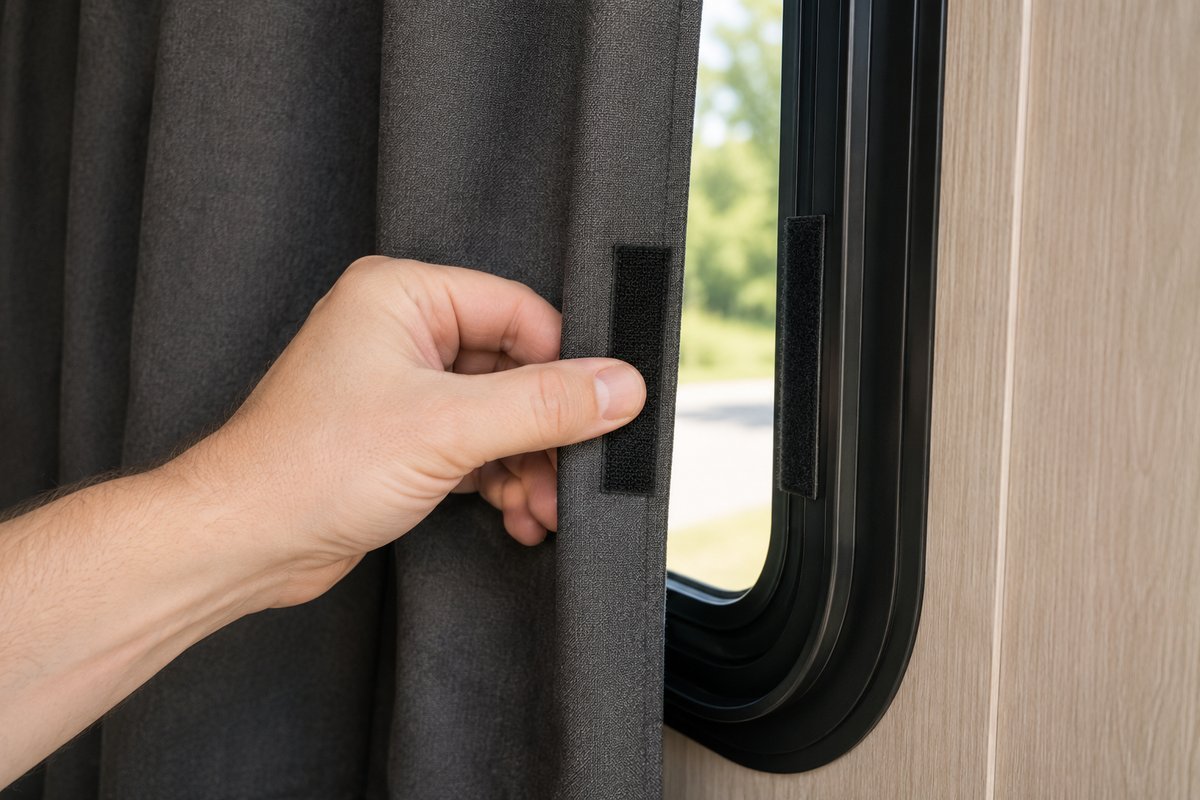
The practical fix is a couple of inches of Velcro at the outer edges of the curtain, closing the gap where the fabric would otherwise hang loose past the window frame. It's a small addition, and it's the difference between a curtain that looks dark in the store and one that darkens the room at 6 a.m. in a campground.
Do RV blackout curtains cause condensation or mold?
They can, if a window gets sealed too tightly in cold weather with the heater running. A blackout curtain pulled flush against cold glass traps humid cabin air right at the coldest surface in the room, which is exactly where condensation forms first. The workaround isn't to give up on blackout curtains. It's to leave the bottom edge or the shade behind it cracked open an inch or two on cold nights, so air keeps moving across the glass instead of sitting still against it.
That's the same principle behind the EPA's general guidance on moisture and mold, written for homes rather than RVs specifically: increasing ventilation and air movement is one of the primary ways to prevent condensation in any enclosed space.
Mildew shows up first as small dark spots that look like dirt more than fabric damage, usually near the bottom hem where moisture collects. Wiping down the window track and letting the curtain fully dry before it's left closed for days cuts most of that risk before it starts.
Curtains or shades, which works better in an RV?
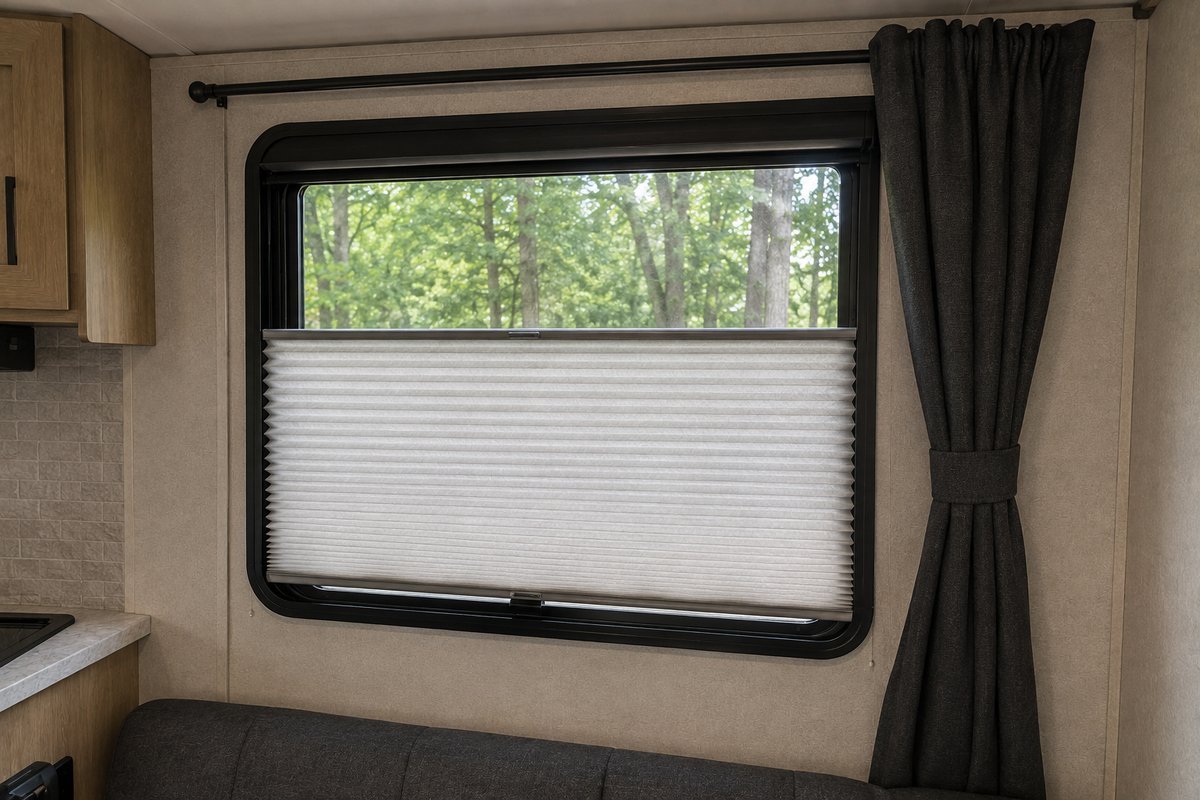
Factory day and night shades are convenient and they roll flat, but they're not built to fully darken a room, which is the whole point of a blackout curtain in the first place. A blackout curtain hung over or in addition to the factory shade gets you both: the shade for daytime privacy and airflow control, the curtain for the nights you need it dark.
What to look for
NICETOWN RV Blackout Curtains for Camper Windows, Cappuccino
Most proven at scaleNICETOWN has the longest track record on this list by a wide margin, and it comes in more than 40 width and length combinations, which matters more for RV windows than for house windows since so few of them are a standard size.
Light blocking runs 85 to 99%, and the maker is upfront that darker colors block more than lighter ones.
What You'll Love
- Largest proven track record on this list, with over 47,000 ratings at a 4.6 average
- Sold in more than 40 width and length combinations, so odd RV window openings have a good chance of an off-the-shelf fit
- Rod pocket fits rods up to 2 inches, covering most RV curtain rod sizes
- Machine washable
Worth Considering
- Some reviewers describe the fabric as thinner than expected, especially in lighter colors
- One reviewer specifically wished the panels came in longer lengths for their window
- Light blocking is rated 85 to 99%, with darker colors performing better, so a light color trades away some blackout performance
RYB HOME Bedroom Blackout Curtains, Black
OEKO-TEX certifiedRYB HOME sits right behind NICETOWN on review volume, and it's the only one of the three with third-party OEKO-TEX certification on the fabric itself.
The maker's own numbers say darker colors block 85 to 99% of light while lighter shades only manage 60 to 70%, and at least one verified reviewer confirmed exactly that gap by buying a lighter colorway expecting full blackout.
What You'll Love
- OEKO-TEX certified fabric
- 30,210 ratings at a 4.6 average, nearly as proven as NICETOWN
- Rod pocket fits rods up to 3 inches, wider than the other two picks here
- Reviewers report a noticeable drop in room temperature and outside noise
Worth Considering
- One verified reviewer specifically found the lighter colorway definitely not blackout, matching the maker's own 60 to 70% figure for light colors
- True blackout performance on this one depends on picking a dark color, not just any color in the line
- Same single-layer construction as NICETOWN, so it shares that model's minimum thickness
H.VERSAILTEX Linen Look Blackout Curtains, Natural
Blackout regardless of colorThis one solves the color problem the other two have. A white blackout lining sewn into the panel does the light blocking, so the outer color you pick doesn't trade away performance the way it does with NICETOWN or RYB HOME.
It's marketed as linen, but the material is 100% polyester with an acrylic coating, not real linen, which is worth knowing before you buy on the name.
What You'll Love
- True 100% blackout from a white lining sewn into the panel, so the dark-color requirement the other two have doesn't apply here
- Best textured, decorative look of the three, described by reviewers as looking more expensive than the price
- 2,754 ratings at a 4.4 average
Worth Considering
- Amazon flags this listing as a frequently returned item
- Marketed as linen look but is 100% polyester with an acrylic coating, not real linen, and at least one reviewer felt misled by the name
- Some reviewers report the panel length running shorter than advertised
- Narrower rod pocket than the other two picks, fitting rods only up to 1.5 inches
Whatever curtain gets picked, measure the actual window opening first, not the trim around it. RV windows run smaller than the equivalent house window size names would suggest, and a curtain bought a size too large is what ends up needing the Velcro fix in the first place.
What can you put on the window instead of curtains?
Curtains aren't the only answer, and on some windows they're the wrong one. A short window over a dinette has nowhere to hang a rod, and nobody wants fabric flapping against the glass down the whole side of the RV at highway speed.
Window film. This is the option people talk themselves out of, usually because somebody told them film can't go on double pane glass. Gila answers that directly in its own window film FAQ: all of its films can be applied to dual pane windows if used correctly, and only two products in the range, Glare Control Smoke and Privacy Control Black, have to go on the outside instead of the inside. That is an instruction about which side to use, not a ban.
Film is also the only option in this article that publishes a number you can compare. Automotive film is sold by visible light transmission, so a 5 percent film passes 5 percent of the light and stops the rest. Nothing sold as an RV shade is labeled that way.
Static cling film is the version worth knowing about for an RV you don't own outright, or a window you might change your mind about. It uses no adhesive and comes off by hand.
One caution that comes from the film industry rather than from us. 3M's own sun control film warranty covers thermal shock breakage on glass the film has been properly applied to, up to a stated value per window. A manufacturer doesn't warranty against a risk that doesn't exist. Dark film absorbs heat, and Gila says as much, noting that filmed glass feels warmest on clear sunny days.
Reflective bubble panels cut to fit the opening are the cheap standby, and they do block light completely. Be aware of what isn't published: Reflectix gives R-values for attics, crawl spaces and ductwork on its performance page and gives none for windows, and we found no guidance from them at all about using the material against glass. The panels work. The performance claims people repeat about them in windows aren't coming from the manufacturer.
Why will the factory shades not stay up?
This is the most common complaint about RV window coverings and it has a fix, which almost nothing written on the subject mentions.
The pleated day and night shades fitted at the factory aren't held by a cord lock like a house blind. On the MCD American Series, which is what a lot of RVs carry, the shade runs on spring tension, and the owner manual publishes the adjustment. A shade that creeps down, or that rises too slowly to stay where you put it, is a tension setting rather than a broken part.
- Find the black speed adjuster on the shade assembly. It's at the end of the roller, behind the valance.
- Push the adjuster in with a flat blade screwdriver before you turn it. Turning it without pushing it in does nothing.
- Turn it clockwise to increase spring tension and ascent speed.
- Test the shade at half height between adjustments rather than running it to the top each time.
Don't keep going once it holds. The manual warns that over tensioning makes the shade stick at its upper limit, which trades one annoying problem for a worse one.
Worth knowing before you buy anything: MCD calls the mesh one a day shade and the vinyl or Teflon treated one a night shade, and only the second is meant to black out. An RV with both fitted already has a blackout layer, and the fix may be tension rather than buying something.
How do you block the light temporarily?
Rentals, borrowed RVs and one bad campsite all call for something that comes off again without a mark. Two things work.
Static cling film goes on with water and no adhesive, and peels off by hand. It's the only reversible option that darkens the glass itself rather than covering it.
Fabric covers that attach with hook and loop tape are the other, and they're the only product in this category that sits against the frame rather than inside it, which is what gets at the edges. Read what the sellers claim carefully though. Blackout EZ says its RV covers block out all light, and publishes no measurement behind that.
What we wouldn't do temporarily is drill anything. A rental that needs a rod is a rental that needs a bedsheet and two clamps for a week.
Why does light still get in at the edges?
Because a shade is narrower than the opening it covers. The gap runs down both sides, along the bottom, and across the top behind the valance, and on a sunny morning that thin outline is bright enough to wake somebody who sleeps light.
Fabric weight does nothing for this. A heavier curtain blocks more light through the panel and exactly the same amount around it. What closes the gap is coverage that goes past the opening: a cover that mounts to the wall rather than inside the frame, a curtain wider than the window with a return at each end, or film on the glass itself, which is the only one of the three with no edge at all.
Nobody publishes a number on this. We looked for one from MCD, Lippert, Carefree and Blackout EZ, and none of them quantifies edge leakage or what a valance or a side channel recovers. The only percentages we found came from a company selling side channels, which isn't a source we will quote.
Light and heat are two different jobs
People shop for one and expect the other. They're measured separately, and film is the only product category that publishes both.
Gila lists solar energy rejection and visible light transmission as different specifications, and its Privacy Control Mirror film claims to reject up to 79 percent of total solar energy while its automotive films are sold by how much light they pass. A film can stop most of the heat and still let you see out, and a curtain can black out a window completely and do very little about the temperature, because the sun has already hit the glass by the time the fabric gets involved.
If the problem is a bedroom that's 95 degrees at four in the afternoon, the answer is on the outside of the glass or in the glass. If the problem is a streetlight at two in the morning, the answer is on the inside and cheap.
What nobody publishes
Every shade in this category is sold on a phrase rather than a figure. MCD describes its night shades as 100 percent privacy and blackout material. Blackout EZ says all light. Neither publishes a light transmission percentage, and neither cites a test.
We checked the manufacturers' own documents for this article: MCD's American Series owner manual and product pages, Lippert's window and shade pages, Reflectix's performance information, Gila's window film FAQ and product specs, 3M's sun control film warranty, and Blackout EZ's product page. The only measured light figures in the whole set come from window film, because automotive film has to be labeled that way for legal reasons.
That doesn't make the shades bad. It means the words on the package are the manufacturer's opinion of the product, and the only way to compare two of them is to hang them up. Buy the one you can return.
What it comes down to
A blackout curtain works when it seals the edges, not just when the fabric itself is dark. Add a small strip of Velcro at the sides where light leaks through, and crack a shade or curtain slightly on cold nights so air can still move across the window. That's the whole difference between a curtain that looks like it should work and one that does.
Quick Answers
What blocks the light: the fabric, or the fit?
Both, but the fit is where most blackout curtains fail in an RV specifically. An RV window has almost no overhang, unlike a house window with trim and a deep sill.
Do RV blackout curtains cause condensation or mold?
They can, if a window gets sealed too tightly in cold weather with the heater running. A blackout curtain pulled flush against cold glass traps humid cabin air right at the coldest surface in the room, which is exactly where condensation forms first.
Curtains or shades, which works better in an RV?
Factory day and night shades are convenient and they roll flat, but they're not built to fully darken a room, which is the whole point of a blackout curtain in the first place. A blackout curtain hung over or in addition to the factory shade gets you both: the shade for daytime privacy and airflow control, the curtain for the nights you need it dark.
Why will my RV shades not stay up?
On spring tension shades like the MCD American Series, a shade that creeps down is a tension setting rather than a broken part. Push the black speed adjuster in with a flat blade screwdriver and turn it clockwise, a little at a time, until it holds.
Can you put window film on dual pane RV windows?
Yes. Gila states that all of its window films can be applied to dual pane windows if used correctly, with two products that have to go on the outside instead of the inside. Dark film does absorb heat, and 3M warranties its sun control film against thermal shock breakage.
What can you put on RV windows to block light without curtains?
Window film, static cling film, reflective panels cut to the opening, or a fabric cover that attaches with hook and loop tape outside the frame. Film is the only one sold with a published light transmission figure.
Related Guides
- Best RV recliners: why "wall hugger" is the spec that matters, the other comfort upgrade worth doing to the same living area.
- RV mattress replacement, for the sleep problem curtains alone don't solve.