
A trailer closed up from November to April doesn't get wet from rain. It gets damp from itself, which is why choosing the best RV dehumidifier for winter storage starts with a question most buying guides skip: does your storage spot have power? Almost nobody's does, and that single fact rules out every plug-in unit on the shelf at the hardware store. None of it replaces winterizing the plumbing, which is a separate afternoon and the one that prevents the expensive damage.
Four of the five below need no power at all, and the fifth is there for the minority whose lot has a working outlet. All five were picked on what each manufacturer is willing to put in writing. Picks first, then how to live with one, then the evidence.
Table of Contents
The 5 Best RV Dehumidifiers for Winter Storage
Eva-Dry E-500 Renewable Dehumidifier
Best overallSilica gel doesn't turn into liquid, and for something that'll sit unattended for five months, that's the whole argument. The E-500 holds moisture in beads inside a sealed plastic shell. When the window turns green you take it home, plug it into a wall outlet, and the unit bakes itself dry overnight. Nothing to empty, nothing to tip over onto the dinette carpet. Buying the pair also lets you follow the spacing advice further down this page instead of working against it.
Be careful with the capacity number, though. Eva-Dry's website says the E-500 absorbs up to 20 ounces. The instruction manual for the same unit says 8, and Home Depot's listing splits it at 6 to 8. That's a two-to-one spread on the figure that matters most, and Eva-Dry can't settle it from its own site. Every older manual PDF link has been broken since the company moved its website. Buy this one for the mechanism, not the headline ounces.
What You'll Love
- Nothing to empty and nothing to spill
- Recharges from any wall outlet, no refills to buy
- Color window tells you when it's saturated
- 500 cubic feet each, and two of them, so you can put one at each end rather than hoping a single unit reaches the bedroom
Worth Considering
- The website claims 20 oz. The manual for the same unit says 8
- No manual on the manufacturer's current site, and the older PDF links are broken
- Regeneration takes 16 to 18 hours by the manual's own figure
- You have to retrieve it from storage to recharge it, then put it back, and with two units that's two trips, or both of them off duty at once
Dri-Z-Air Classic Moisture Absorber
Best for a whole trailerDri-Z-Air is the only brand here that tells you how many to buy. The manufacturer recommends one unit per 10-by-10-foot space, and for a 25-foot motorhome it says specifically to put one in the rear, one in the middle and one up front. Everybody else leaves the sizing entirely to you.
The unit itself is a pot. Crystals sit in a basket up top, brine collects in the bowl underneath, and you pour it out and refill. Cheap to run, and that open bowl is also the failure mode: Dri-Z-Air warns that the liquid won't evaporate but keeps collecting moisture, so a bowl knocked over on carpet during a tow doesn't dry out. It stays wet and gets wetter. Put it in the sink or the shower pan.
What You'll Love
- The only manufacturer publishing a sizing rule you can follow
- Names its chemistry plainly on its own website
- Refill crystals in three sizes, so running costs stay low
- Made in the US, and the company has been at it since 1948
Worth Considering
- An open bowl of brine, so where you put it matters more than with a sealed unit
- Spilled liquid won't dry out on its own, it keeps drawing moisture in
- No published duration figure, so refill intervals are guesswork
- Calcium chloride corrodes metal it stays in contact with
Star brite No Damp Dehumidifier, 36 oz
Best documentedStar brite came at this from boats, where a damp locker ends a season, and the No Damp bucket is the same idea moved into a trailer. Crystals in the top tray, brine in a sealed reservoir below, discard the whole thing once the white crystals are gone.
What earns it a place is the safety data sheet. Star brite's SDS names the active ingredient as calcium chloride at 77 to 80 percent and states that it will corrode most metals exposed to air and attack aluminum and yellow brass. That's your trailer's framing and a fair few of its fittings. The product page itself says none of that, it calls the contents "specially designed crystals", so the packaging doesn't tell you. At least the document exists, which is more than DampRid manages on this point.
What You'll Love
- The SDS names the exact chemistry and the specific metals at risk
- Sizes from a 12 oz locker unit up to 48 oz refills
- Sealed reservoir, so the brine isn't sitting in an open bowl
- No power needed at any point in the season
Worth Considering
- The product page hides the chemistry its own SDS discloses
- No coverage rating in square or cubic feet anywhere
- No published duration, so you check it rather than schedule it
- Retail listings disagree on the hanging bag's size, 14 oz versus 16 oz
- Very few ratings on the 36 oz listing, and they aren't glowing. The case for it is the paperwork, not the reviews
Hydrosorbent 900 gm XL Pack
Best for closets and cabinetsThis is the one that never needs an outlet at either end. Hydrosorbent's packs regenerate in a kitchen oven, the bag lifted out of its carton and given at least three hours at 240°F, which suits anyone whose storage is a field and whose recharge station is a stove.
It also has the most disciplined spec page of the five. Every model in the range gets a coverage figure and physical dimensions: 66 cubic feet for this pack, in a carton six inches by three by eight and a half. What's missing is moisture capacity in grams or ounces, for any model, which makes a direct comparison against Eva-Dry impossible. Size on the cubic-foot number and accept that you'll want more than one.
What You'll Love
- Recharges in an oven, so no power is needed at either end
- Coverage and dimensions published for every model in the range
- US-made, and the reactivation instructions are unusually specific
- A built-in indicator goes blue to pink, so you read it without opening the bag
Worth Considering
- No moisture capacity published for any model in the range
- Three hours in an oven per recharge, and the temperature isn't optional
- 66 cubic feet is a closet, not a trailer, you'd need several
- The bag comes out of its carton to be baked, so there's a hot bag to handle each time
Davis Instruments Air-Dryr 1000
Best if your storage lot has powerThe Air-Dryr isn't a dehumidifier and Davis Instruments never claims it is. No fan, no compressor, no tank. A 130-watt element warms air as it rises through the housing, and warmer air holds the moisture that would otherwise condense on a cold aluminum wall. It works by keeping the air warm enough that the moisture never turns into water, rather than by collecting it.
Where there's an outlet, that's a real advantage. Nothing to empty, nothing to recharge, and no minimum operating temperature to worry about, because there's no refrigeration cycle to frost up. It draws 1.1 amps continuously, which is nothing on shore power and hopeless off it.
A trailer that stays connected to a lot outlet all winter is also the strongest case for an RV surge protector, because it's plugged in and unwatched for months. At 130 watts it would empty a 100Ah lithium bank in roughly ten hours. If your storage lot has a working outlet, this is the least fussy thing on the page. If it doesn't, it isn't an option at all.
What You'll Love
- No tank, no crystals, nothing to recharge all season
- Rated for 1,000 cubic feet, which is the whole interior
- The clearest manual of any product on this page
- No minimum operating temperature, unlike every powered alternative
Worth Considering
- Needs to stay plugged in for the entire storage season
- It raises air temperature. It doesn't remove water
- The manual bans outdoor use and warns about high-pile carpet blocking the intake
- 130 watts running around the clock is about 3.1 kWh a day
Quick Comparison
| Model | Type | Rated coverage | Power needed | Recharge or refill |
|---|---|---|---|---|
| Eva-Dry E-500 | Renewable silica gel | 500 cu ft | To recharge only | Plug in, 16 to 18 hrs |
| Dri-Z-Air Classic | Calcium chloride pot | One per 10 x 10 ft | None | Refill crystals |
| Star brite No Damp 36 oz | Calcium chloride bucket | Not published | None | Replace the unit |
| Hydrosorbent 900 gm | Renewable silica gel | 66 cu ft | None | Oven, 240°F, 3 hrs |
| Air-Dryr 1000 | Warm-air convection | 1,000 cu ft | 130 W continuous | Nothing to recharge |
Living With One in a Stored RV
Where it needs to go
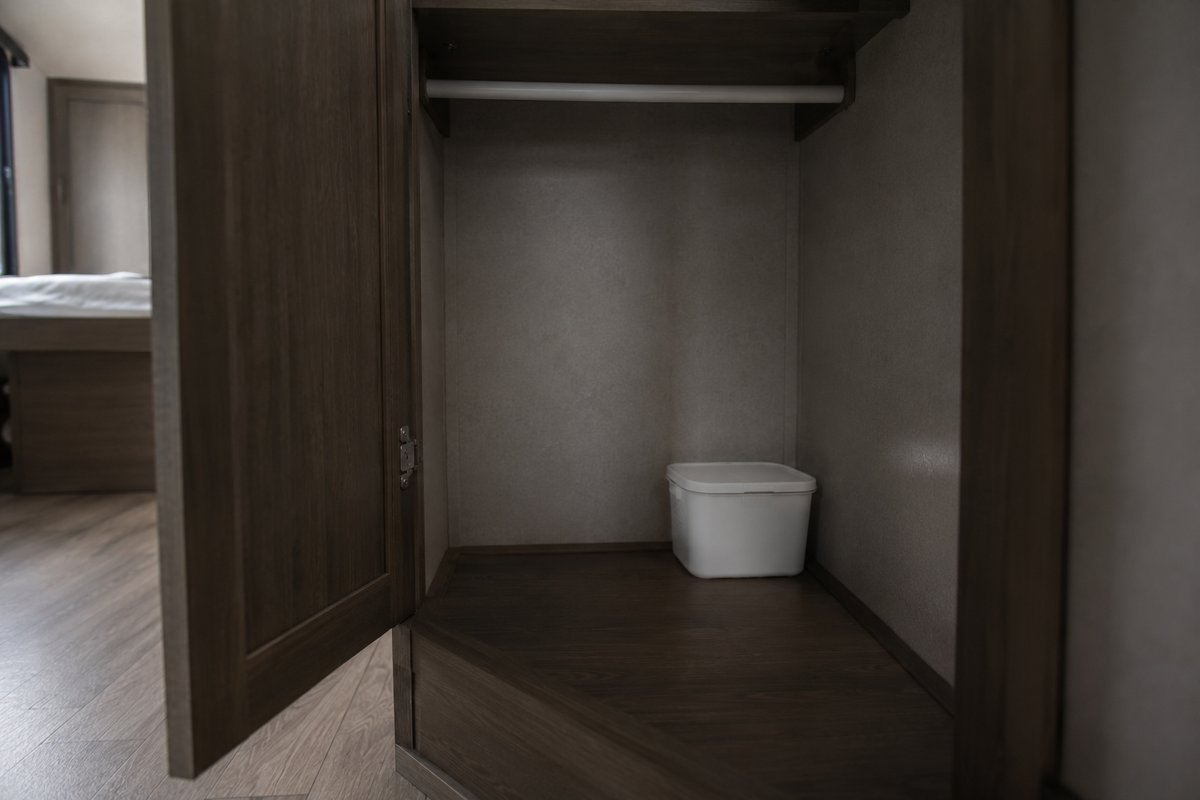
Moisture doesn't sit politely in the middle of the room. It condenses wherever the surface is coldest. The skin behind a wall panel, the inside of a single-pane window, the back corner of a closet that's built against an outside wall. Closed cabinets are the worst of it, because nothing moves through them from October to April.
Dri-Z-Air's advice for a 25-foot motorhome is one unit in the rear, one in the middle and one at the front, and that spacing logic carries over to a trailer of similar length. A single absorber sitting by the door isn't reaching the bedroom, where the mattress is the biggest sponge in the trailer. Leave interior doors, cabinet doors and the closet propped open while you're at it. Keystone tells owners to leave cabinets and closets partially open and not to overpack storage, and it costs nothing to do.
The spill nobody warns you about until it happens
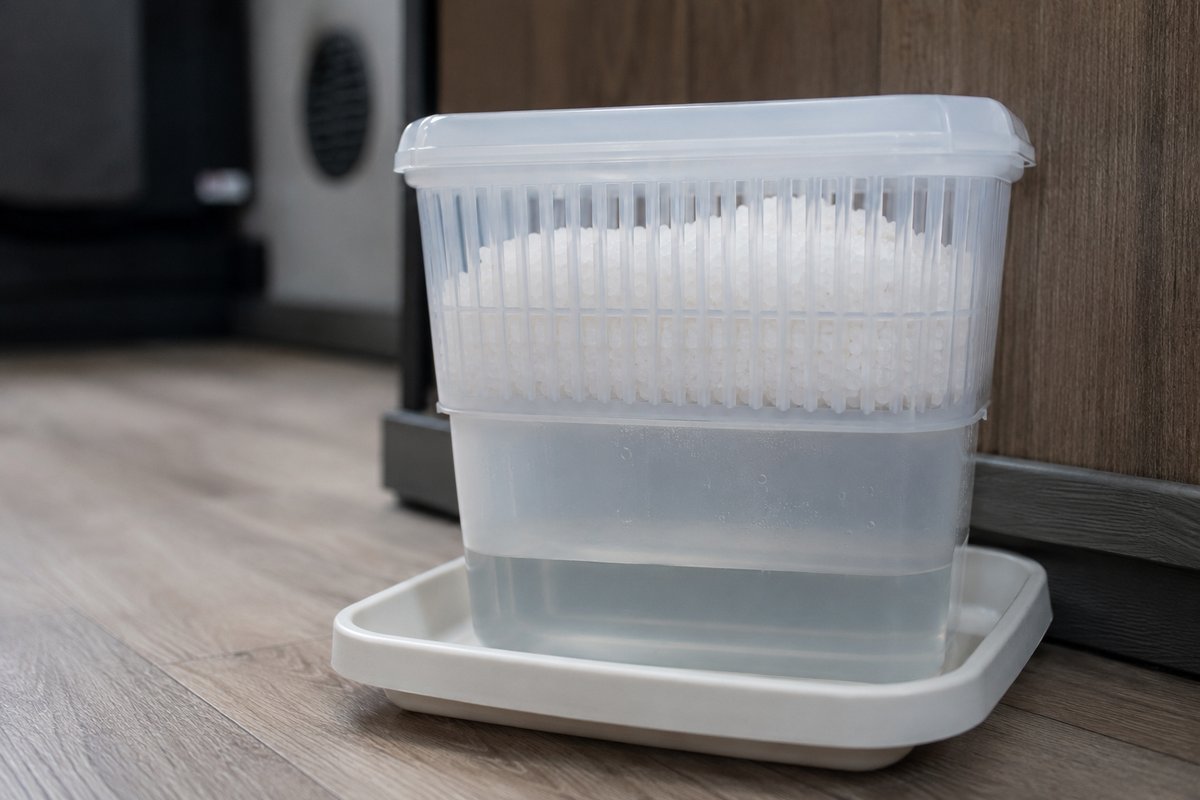
Both calcium chloride products collect a brine in the bottom, and that liquid behaves differently from water. Dri-Z-Air puts it plainly: the liquid won't evaporate, it keeps collecting moisture. Star brite's safety data sheet adds that calcium chloride corrodes most metals exposed to air and attacks aluminum and yellow brass. Put those two facts together and a bowl tipped over on the floor during a tow is a wet patch that never dries, sitting on the metal your trailer is framed with.
So: the sink, the shower pan, or a plastic tray with a real lip. Not a dinette table, and not on a slide-out that's going to move. If you're nervous about it, that's the argument for the sealed silica gel units, which have no liquid in them at any point.
Airflow does half the work
None of these replace ventilation. Grand Design's own cold-weather guidance says ventilation or the addition of a dehumidifier may be required to reduce condensation, note the "or." Winnebago puts a number on the target, suggesting relative humidity of 60 percent or less. Cracking a roof vent under a cover gives the moisture somewhere to go, and it makes whatever you've bought last longer, because it isn't fighting the same air all winter. Which cover you use matters here too, because a breathable cover lets that moisture out while a plastic tarp seals it in. And if you're cracking vents, screen vents against mice first. An open vent in a stored trailer is an invitation to mice.
Knowing what's going on in there
This part surprises people. None of these products tell you anything from a distance, and a saturated absorber does exactly as much good as no absorber. If you can't get to the RV monthly, pair whatever you buy with something that reports humidity back to you, that's covered in the guide to smart temperature sensors for RVs in storage. A sensor that also reads humidity turns a guess into a date on the calendar.
When you do open it up in spring, pull every unit before you start loading. A forgotten pot of brine behind the couch is how a small maintenance job becomes a floor repair.
How These Were Chosen, and What Nobody Publishes
There is no cold-weather data. Anywhere.
Eva-Dry, Wisedry, Hydrosorbent, Wisesorb, DampRid, Star brite and Dri-Z-Air were all checked for a minimum operating temperature or any statement about cold performance. Not one publishes anything. The only temperature figures printed across the whole category are oven and microwave regeneration settings, plus a single 105°F upper storage limit from Eva-Dry.
That's worth noting. These products are marketed for boats, seasonal cabins and stored RVs, cold storage isn't an edge case, it's the main case, and the performance data for it doesn't exist.
Cold air holds less moisture to begin with, so an absorber in a 35-degree trailer is working on a thinner supply than the same unit in a summer basement. How much thinner, none of them will say. If you find a guide quoting grams per day for a stored trailer in January, that number came from somewhere other than a manufacturer.
Why the plug-in units didn't make the list
Four of the five picks need no power because most storage doesn't have any, but there's a second reason worth knowing. Compressor dehumidifiers, the pantry-sized ones, are rated by their own manuals down to 41°F and no further. Frigidaire's manual says the unit won't operate satisfactorily below that. Midea's says the coils can frost below 41°F (5°C) and warns against placing the unit where the temperature will fall past it.
The little Peltier units sold as "mini dehumidifiers" are worse for this. Pro Breeze's own support page says they work best in warmer temperatures above 59°F (15°C), a temperature a stored trailer won't see between November and March. Afloia's manual gives an ambient range starting at 41°F (5°C). Desiccant-wheel machines do go lower, with Ivation rating its unit from 34°F (1°C) and Meaco saying the DD8L will run normally down to 37°F (3°C), but that's still above freezing, and they all still need an outlet.
Coverage ratings barely exist, and they don't share units
Only three products in the entire category publish a coverage figure you can act on: Dri-Z-Air's one unit per 10-by-10 space, DampRid's 250 square feet for the refillable tub, and 300 square feet for the RV charcoal tub. Eva-Dry and Hydrosorbent both publish cubic feet instead, which is the more sensible measure for a sealed box but can't be compared against a square-foot rating without inventing a ceiling height. Star brite publishes nothing at all. Its sizing guidance is a list of rooms.
One thing a lot of owners don't realize is that the color conventions aren't standard either. Eva-Dry goes orange to green, and green means full. Hydrosorbent uses both conventions. Its orange canisters go orange to clear, while the XL Pack recommended here goes blue to pink. Wisedry's medium packets go blue to pink. Same idea, different colors, and on two of those brands green is the color you want to see least. Read the housing before you assume.
Why DampRid isn't one of the five
It's the most available product in the category and the one most people buy, so leaving it out needs a reason. Two, in fact. The hanging bags carry no coverage rating whatsoever, so there's no manufacturer-backed way to work out how many a 30-foot trailer needs. And DampRid's safety data sheet, which lists calcium chloride at 80 to 100 percent, a higher concentration than Star brite's, contains no warning about metal corrosion or fabric damage, where both competitors state one plainly.
That isn't evidence DampRid is more dangerous. It's the same chemical doing the same thing. It means two companies tell you something about it that DampRid doesn't, and for a product you're leaving unattended on an aluminum-framed floor for five months, the company that warns you is the one that earns the recommendation. DampRid's tips page does at least say to place it where it won't tip over, since a small amount of leakage is possible.
The best-selling option won't tell you what's in it
Search for an RV dehumidifier and the bucket you'll meet first is Camco's. It's the 44282, five pounds of beads in a tub, sold by the RV brand people already know, and it carries about 4.5 stars from roughly 1,100 ratings. Far more feedback than anything on this list has collected.
It isn't one of the five because nothing published says what's inside it. The listing calls it a "fast-acting moisture-absorbing agent" with "no-fragrance beads." Camco's dealer page says a "powerful, fragrance-free moisture absorbing agent." Home Depot and Ace repeat the same phrasing. We couldn't find a safety data sheet for it anywhere. The only Camco SDS that surfaces is for their roof sealant.
The behavior described is familiar enough: beads that gel as they work and get thrown away once they have. That's how the calcium chloride products on this page behave too. But familiar isn't stated, and it matters here for one specific reason. If it's calcium chloride, then the corrosion warning Star brite prints in its own SDS, attacks aluminum and yellow brass, corrodes most metals exposed to air, applies to the Camco bucket as well, and you'd be putting it next to your trailer's framing without ever being told.
None of that says it doesn't work. Eleven hundred people rating it well is real information, and more than we have on some of the picks above. It says you're buying on trust rather than on disclosure, and this article was put together the other way round.
Two things that were considered and cut
Wisedry's 500-gram rechargeable packets have the best written user guide in the category. 35 cubic feet per packet, up to 180 grams of water, eight minutes a side in a 700-watt microwave. They're out on one detail: the flagship 500-gram packet is non-indicating, and Wisedry's stated method for knowing when it's full is putting it on a kitchen scale and checking whether it's gained 30 percent. That's fine in a workshop and useless in a storage lot in February.
Eva-Dry's EDV-2500 gets recommended in a lot of RV roundups and shouldn't be, at least not for this: it's a thermoelectric unit that has to stay plugged in, which puts it in the same bracket as the Peltier machines above. And if you see an "E-500 Edge" listed anywhere, that isn't an Eva-Dry model. The company's own range is E-250, E-333, E-500 and the EDV-365 system. "Edge" is a name resellers made up for the plain E-500.
Why there is no plug-in compressor dehumidifier on this list
The obvious question about a list of moisture absorbers is why none of the picks is an actual dehumidifier. The kind with a compressor and a tank. Two reasons, and the second one is the one nobody writes down.
The first is power. Most storage lots have none, which rules the whole category out before any spec matters. That is the premise this article is built on.
The second is that the number on the box doesn't mean what a stored trailer needs it to mean. Every compressor dehumidifier sold in the US carries a capacity in pints per day, and that figure comes from a federal test procedure, 10 CFR Part 430 Appendix X1, measured at a single fixed condition: 65°F and 60% relative humidity.
The rating scale changed in 2019, so older advice is on the wrong ruler
The test used to run at 80°F. In June 2019 it moved to 65°F. Same machines, lower readings. ENERGY STAR publishes the conversion: an old 30-pint unit is a new 20, an old 50 is a new 30, and an old 70-pint unit is a new 40 to 45. A machine sold today as a 50-pint is roughly the same hardware that was sold as a 70-pint in 2018. Nothing got worse. The ruler changed.
Any sizing chart, forum thread or article written before 2020 is quoting the old scale. Comparing across that line gives you an answer that's wrong by about a third.
Your trailer will never be 65 degrees
This is the bigger problem. A compressor dehumidifier condenses moisture onto a cold coil, and as the air gets colder that coil frosts, so the machine spends its time defrosting rather than drying. Midea puts the working range at 41°F to 95°F and tells owners not to site the unit anywhere the temperature drops below 41. Frigidaire gives the same floor.
A stored trailer spends the entire season below the temperature its dehumidifier was rated at, and much of it below the temperature the manufacturer says to run it at.
No consumer brand publishes a capacity-versus-temperature curve. You get one number, at one condition, with no way to work out what happens at 45°F. Commercial suppliers publish curves for grow rooms. Nobody publishes one for the machine you would put in an RV.
Desiccant units are not measured by that test at all
A desiccant unit has no compressor and no refrigeration system, so it sits outside the definition, isn't tested to Appendix X1, and can't carry ENERGY STAR. Manufacturers pick their own conditions instead. Ivation rates its unit at 68°F. Meaco, a British maker, rates at 68°F (20°C). Three products, three rulers, nothing you can line up side by side.
An ENERGY STAR label doesn't rescue the comparison either. The specification certifies energy efficiency in liters per kilowatt-hour and contains no low-temperature criterion of any kind. Useful for a heated basement. Irrelevant to a storage yard.
A recall worth thirty seconds, if you are using something secondhand
Dehumidifiers have a serious fire history, and it's worth being precise about it, because the story usually gets garbled.
In August 2023 the CPSC announced a recall of about 1.56 million units built by Gree and sold between January 2011 and February 2014 under the Kenmore, GE, SoleusAir, Norpole and Seabreeze names. At least 23 fires, 688 reports of overheating, roughly $168,000 in property damage. The wider Gree action goes back to 2013 and touches a dozen more brand names, Frigidaire and Danby among them.
Every recalled unit was built by Gree and sold between 2011 and 2014. The familiar names on that list were licensees. None of it implicates a Frigidaire or GE dehumidifier bought today, and we aren't going to imply that it does. We found no CPSC dehumidifier recall dated 2024 or later, and nothing relevant at NHTSA, which regulates the trailer rather than what you put inside it.
It matters here for one specific reason. A secondhand dehumidifier from that era, running unattended in a locked trailer for five months with nobody within earshot, is exactly the machine and exactly the situation the recall was written about. If you're using something you inherited or bought used, check the model number before you plug it in and drive away.
Quick Answers
What size dehumidifier do I need for an RV?
Nobody can answer this accurately with a number, and that is a fact about the category rather than an evasion. As this guide sets out further up, the makers don't publish coverage figures in units you can compare, so a square footage answer would be invented.
What decides it is how often you can get to the trailer. A passive absorber holds a fixed amount of water and then stops working until it's emptied or dried out. If you visit monthly, a single larger unit is fine. If the trailer is going to sit untouched until spring, you want more capacity than you think, spread around rather than concentrated in one place.
Are dehumidifiers worth it in an RV?
For a trailer that sits closed up for months, yes, and the thing you're buying isn't dry air for its own sake. It's not having to open the door in April to mold on the ceiling and a smell that never quite leaves the cushions.
For a trailer in regular use, much less so. Doors and windows open, air moves, and the problem mostly solves itself. The point worth remembering from further up this page is that airflow does half the work either way, so cracking a roof vent matters as much as what you buy.
Does a dehumidifier need power in a stored RV?
Not the ones on this list, which is why they're on it. Every pick here works with no electricity at all, because a trailer in a storage lot usually has none and its battery has better things to do.
Plug-in units move far more water and are the right answer if you have shore power where the trailer sits. That case is covered further up, in the section on why the plug-in units didn't make the list.
Will a moisture absorber even work in a freezing trailer?
It'll work, but no manufacturer will tell you how well. Calcium chloride and silica gel both pull moisture from the air without needing heat or power, so nothing stops working the way a compressor does at 41°F. What changes is the supply: cold air simply carries less water, so an absorber will last longer through a winter than it would through a humid August, and it also has less to catch. Nobody in the category publishes a rate at any temperature, so plan on checking rather than calculating.
How many do I need for a 30-foot trailer?
The only manufacturer rule to work from is Dri-Z-Air's one unit per 10-by-10 space, which puts a 30-footer at three, spread front, middle and rear. Sealed silica gel units are rated in cubic feet instead: the Eva-Dry E-500 covers 500 cubic feet and the Hydrosorbent XL Pack covers 66, so the silica gel units are a closet-and-cabinet solution rather than a whole-RV one. Most people end up with a mix, something bigger in the main living space, something small in each closed cabinet.
Can I just leave a regular dehumidifier running all winter?
If your storage spot has power, and the space stays above 41°F, a compressor unit will work, but you'd have to empty its tank, since a hose to a drain isn't usually available and a full tank shuts the unit off. Below 41°F the manuals say it won't operate satisfactorily and the coils frost. The Air-Dryr sidesteps both problems by not collecting water at all, which is why it's the powered pick here.
Do I still need to leave a vent open?
Yes, and it makes the absorber last longer rather than shorter. Grand Design lists ventilation and a dehumidifier as alternatives to each other, but in practice they work together: a cracked roof vent under a cover lets damp air leave instead of recirculating past your crystals all winter. Winnebago's figure to aim at is 60 percent relative humidity or less.
Will any of this fix mold that's already there?
No. These lower the humidity that lets mold get started. They don't remove what's grown. Clean the affected surface first, find where the water came in, and then dry the space. If the source turns out to be a leak rather than condensation, that's a different problem, the guide to water leak detectors for travel trailers covers where to look and where the sensors go.
Final Thoughts
If your storage has no power, and it almost certainly doesn't, the Eva-Dry E-500 is the one to start with, because there's no liquid in it to spill and no consumable to buy. Add a Dri-Z-Air pot or a Star brite bucket at the other end of the RV if it's longer than about 20 feet, keep them in the sink or shower pan, and put a Hydrosorbent pack in the closet where the air never moves.
If there's an outlet, the Air-Dryr 1000 is a simpler life for about three kilowatt-hours a day. Either way, crack a vent, prop the cabinets open, and take everything out before you load up in spring.