
If your shore power cord ends in a four prong plug, you need a 50 amp RV surge protector, and you have more to lose than a 30 amp owner does. This page is about which one to buy for 50 amp service. How the protection works, and what an EMS adds over a plain surge protector, is in the main surge protector guide. A 50 amp RV surge protector is only useful if it's plugged in before anything else is.
Table of Contents
What 50 Amp Service Gives You
Two 120 volt legs, 50 amps each, sharing a neutral. That's 120/240 volts at the pedestal and roughly 12,000 watts in total, which is why a 50 amp RV runs two air conditioners and a residential fridge without thinking about it.
The plug is a NEMA 14-50, four prongs: two hots, a neutral and a ground. It looks like an electric range outlet because, electrically, it is one.
More capacity means more connected load, and more connected load means a single wiring fault takes out more of your trailer at once. That is the real reason the protection matters more here.
Why Open Neutral Is the Fault That Should Worry You
On 50 amp service the two legs are balanced against the neutral. Lose the neutral and that balance goes with it: the 120 volt circuits in the trailer are suddenly in series across 240 volts, and they divide it according to whatever is switched on.
In practice that means one side of the trailer sees far more than 120 volts, briefly, and everything plugged into it dies at the same moment. Televisions, converters, control boards, the residential fridge. It's the one fault that produces a five figure insurance claim rather than a repair.
A basic surge protector doesn't see it. An EMS with open neutral detection disconnects before the fault reaches your trailer.
What to Look For in a 50 Amp Unit
- Open neutral detection, stated explicitly. On 50 amp service this is the headline feature, not a bullet point.
- Does it disconnect, or only report? A unit that lights a warning and passes the power through has told you about the fault after your equipment met it.
- Voltage thresholds on both legs. Around 102 volts low and 132 volts high, monitored per leg rather than averaged.
- A restart delay, anywhere from about 15 seconds to over two minutes depending on the unit and how it's set, so compressors aren't handed power back into pressure.
- Current display per leg. Useful on 50 amp because it shows how unbalanced your load is, which is what trips one leg while the other sits idle.
Balancing the Two Legs
A 50 amp panel splits the trailer between two legs, and the split is decided by whoever wired it rather than by how you camp.
The result is that one leg can be near its limit while the other is barely used, which is why a pedestal breaker trips while the display shows plenty of headroom overall. A unit that reports current per leg turns that from a mystery into a number.
The fix is usually behavioral: run the second air conditioner and the electric water heater at different times, or move a portable heater to an outlet on the quiet leg. None of that is possible if you can't see which leg is which.
Portable or Hardwired on a 50 Amp RV?
Both exist in 50 amp, and the calculation is different from the 30 amp case.
A 50 amp portable unit is large, heavy and expensive, which makes it both awkward to hang at a pedestal and worth stealing. It also spends its life outdoors in weather. A hardwired unit sits inside near the transfer switch, is invisible to thieves, and protects even when you forget.
The argument for portable is that you can test a suspect pedestal before committing the trailer to it, and that it moves with you if you change RVs. The usual answer on a larger fifth wheel or travel trailer is hardwired with a remote display, plus a plug-in tester in the bay.
The Order to Plug In
Same discipline as any hookup, and it matters more with 50 amps behind it.
- Pedestal breaker off first. Plugging a 50 amp cord into a live outlet is how contacts get pitted, and pitted contacts make heat.
- Check the outlet with a tester, or let the protector run its own check before the cord goes on.
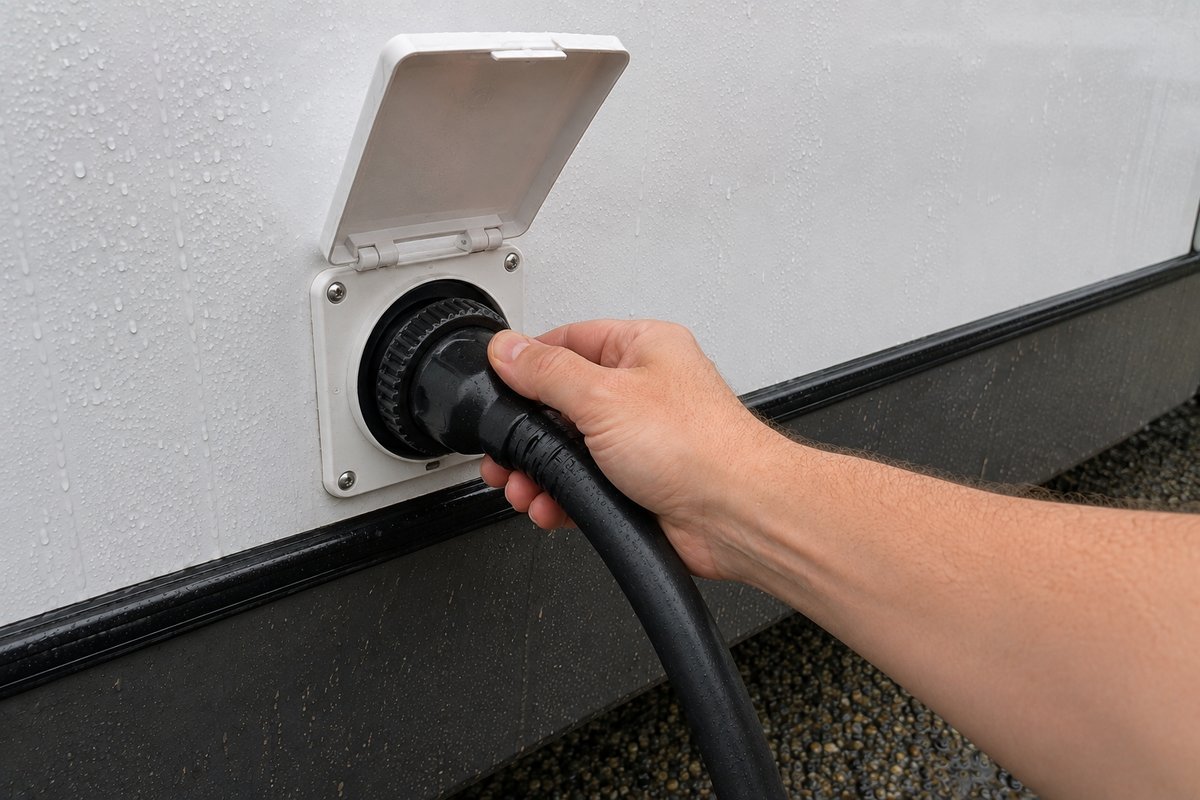
- Protector on, then the shore cord, each pushed fully home. A 14-50 plug that isn't seated fully is a heat problem waiting for a hot afternoon.
- Breaker on, then wait out the delay. The pause before power passes is the unit working.
- Look at the plug an hour later. Warm is normal. Hot, or a smell, means stop and investigate.
Generators and 50 Amp Service
Most portable generators can't supply a true 50 amp service, so a 50 amp RV on generator power is usually running through an adapter at 30 amps, with the same missing leg question as any 30 amp pedestal.
Where the protector helps is that generator output can wander, especially under a starting compressor, and an EMS watching voltage will disconnect before that reaches the appliances. Expect the unit to sit out its restart delay after the generator starts before power passes.
Adapters, and the 30 Amp Pedestal Problem
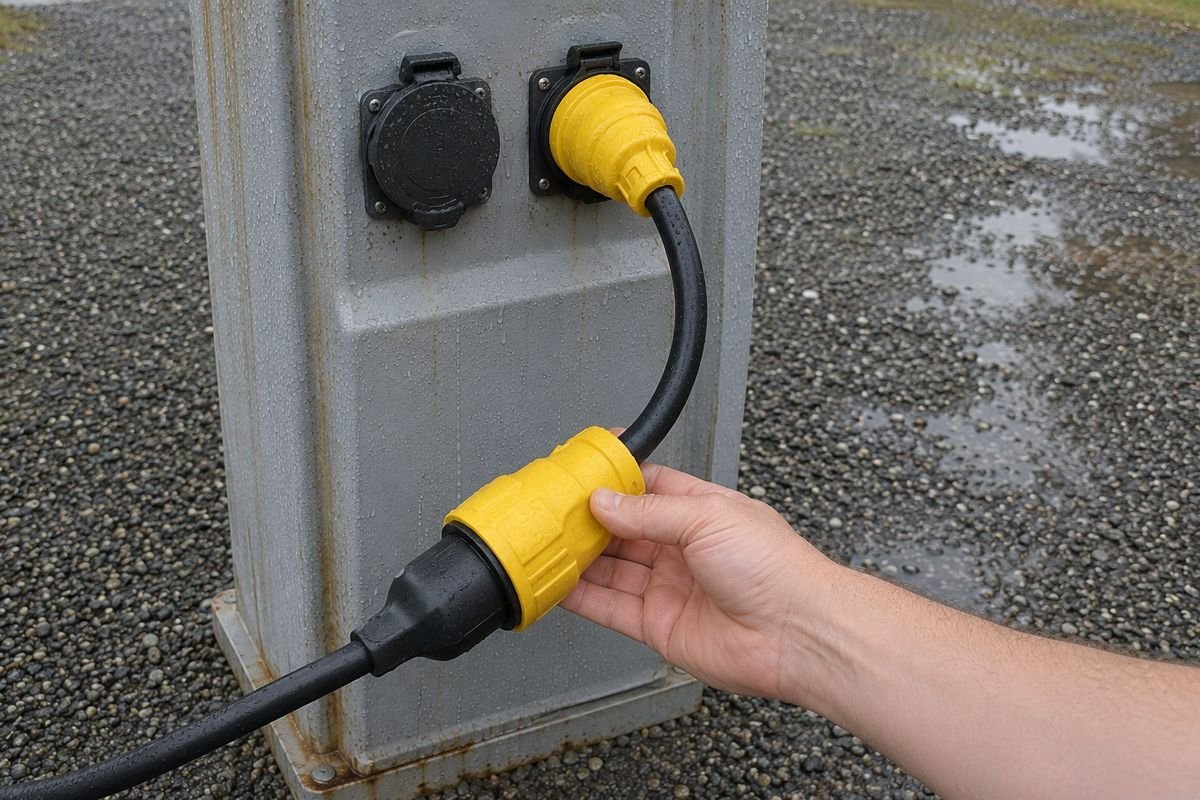
Sooner or later a 50 amp RV lands on a site with only a 30 amp outlet, and a dogbone adapter goes on.
That's fine as far as the trailer is concerned, provided you accept the ceiling: you now have 3,600 watts to work with, not 12,000, and one leg of your panel is being fed from the other. What matters for protection is that a 50 amp unit fed through a 30 amp adapter sees a missing leg, and some units will report a fault and refuse to pass power.
If you travel to older parks often, the practical answer is a separate 30 amp protector for those sites rather than fighting the adapter chain, since every extra connection is another place to make heat.
Which 50 Amp Surge Protector to Buy
Progressive Industries EMS-PT50X
Both legs, watched separatelyThe portable unit that does what this article asks for: it watches each leg on its own rather than averaging them, and it opens the circuit rather than reporting a fault after the fact.
Protection runs five ways, line one to neutral, line two to neutral, neutral to ground, line to line and line to ground, which is a set only a two leg service needs. It cuts below 104 volts and above 132, holds 136 seconds before restoring, and names open neutral, open ground, reverse polarity, an accidental 240 volt feed and frequency drift. The display scrolls voltage and amperage for each leg in turn.
What You'll Love
- Each leg monitored on its own rather than averaged
- Five mode surge protection, which a 30 amp unit can't offer
- Per leg amperage, so you can see an unbalanced load
- Lock bracket for cabling it to the pedestal
Worth Considering
- Large, heavy and awkward to hang off a pedestal
- Expensive, and obviously worth stealing
- The reading is out at the post rather than inside
- Easy to spot if you leave it on a busy site
Progressive Industries EMS-HW50C
Fitted once, out of sightThe same protection wired into the RV, which on a 50 amp trailer is the version most owners end up wanting. A portable 50 amp unit is heavy and conspicuous. This one is neither.
It monitors both legs independently and reports voltage and current for each on a remote display you can mount somewhere useful. Cutoffs are 104 and 132 volts, surge protection is 3,580 joules, and the restart delay is selectable at 15 seconds or 136. It catches open neutral, open ground, reverse polarity, accidental 240 volts and frequency drift.
What You'll Love
- Nothing on the pedestal to steal, carry or hang
- Both legs monitored and displayed separately
- Remote display mounts where you will look
- Restart delay is selectable rather than fixed
Worth Considering
- Wiring job on a properly disconnected 120/240 volt circuit
- Can't be moved between RVs in an afternoon
- No reading available out at the pedestal
- Faults are only visible if you look at the panel
Southwire Surge Guard 44270
4,200 joules, and no disconnectThe surge only option for 50 amp service, and the same trade the 30 amp guide describes: it absorbs and it indicates, then passes everything else through.
Southwire publishes this one properly, 50 amps at 120/240 volts, 12,000 watts, 4,200 joules, which is the top of their joule range. What the rating doesn't buy is any awareness of voltage. A park sagging on an August afternoon looks the same to it as a park behaving.
What You'll Love
- 4,200 joules, published on the manufacturer's own site
- Indicator lights name the pedestal wiring faults
- Far cheaper than any 50 amp EMS
- Nothing to configure or install
Worth Considering
- No voltage monitoring, so low voltage passes through
- No restart delay for the compressors
- Lights only, with no per leg reading
- Joule rating isn't what protects a 50 amp RV
RVGUARD 30 Amp to 50 Amp Adapter Cord
Still 30 amps, handled properlyFor the night the only site left has a 30 amp pedestal. A TT-30P plug on one end, a 14-50R receptacle on the other, so your RV's cord connects without improvisation.
Two feet of cord means the weight hangs from the cord rather than twisting in the pedestal outlet, which is how connections loosen and then overheat. It's ETL listed and carries overload protection. What it can't do is invent a second leg.
What You'll Love
- Correct direction, 30 amp male into the pedestal
- Two feet of cord takes the strain off the outlet
- ETL listed rather than unlisted
- Overload protection built into the cord
Worth Considering
- It doesn't give you 50 amps, and nothing can
- One air conditioner at a time on a hot afternoon
- A second thing in the chain that can fail
- Easy to leave behind on the post at checkout
Specifications above are taken from each manufacturer's own documentation rather than the retail listing.
What Else Belongs in the Bay
A plug in pedestal tester for checking a pedestal before connecting, and a lock if a portable unit stays out overnight. What else lives outside the trailer is covered in our guide to RV storage and security, and the water side of the same hookup is in the RV water pressure regulator guide.
A 50 amp RV surge protector has more to protect than its 30 amp counterpart, because more of the trailer is connected at once and a single fault reaches all of it.
Plug-in protection has limits worth knowing. The Electrical Safety Foundation International notes that no surge protection device can handle a direct lightning strike, so unplugging from the pedestal when a storm is close is still the safest move. Check the 50 amp RV surge protector's display at every new pedestal before you connect the RV.
Quick Answers
Can I use a 30 amp surge protector on a 50 amp trailer?
No. That runs a 50 amp service through a device rated for 30, which is the one direction that's unsafe rather than merely awkward.
Do I need one on each leg?
No. A 50 amp unit covers both legs. What you should check is that it monitors them separately rather than reporting an average.
Does it help when I am plugged in at 30 amps through an adapter?
Only if the unit accepts a missing leg without faulting. Many don't, which is the argument for carrying a 30 amp protector for those sites.
Is a hardwired 50 amp unit hard to fit?
It goes between the shore inlet and the panel, usually beside the transfer switch. Straightforward for anyone comfortable working on a disconnected 240 volt feed, and an hour of technician time if not. This isn't the circuit to learn on.
Do I need one if the campground is new?
New parks fail differently rather than less. Fresh installations are where miswiring turns up, and a new park in a hot region still sags under load in August.
Will it protect a residential fridge?
It protects it from the supply, which is the main risk in a 50 amp RV. It can't do anything about a fridge that fails on its own.
On a 14-50 RV, a 50 amp RV surge protector with open neutral detection is the one accessory that can prevent a whole-trailer loss rather than a single repair.