
Most RV water heater problems aren't repairs at all. They're a reset button, a tripped breaker, or a tank full of sediment. The broken ones are rarer than the forums suggest, and most RV water heater repair jobs come down to ten minutes of checking in the right order.
There's one thing worth knowing before any of that, because it changes what you're allowed to do to your own water heater, and getting it wrong can put a hole in the tank. It's covered two sections down, and it's the part many articles on this subject get wrong.
Table of Contents
Why Is My RV Water Heater Not Working?
Work through these in order. The order matters, because each one is cheaper and more likely than the one after it, and RV water heater troubleshooting done out of sequence usually ends with somebody buying a part they didn't need.
Is it on? Both switches. Most RVs have one inside on the wall panel and, on gas and electric models, a second one for the electric element. Owners routinely flip the inside switch and forget the heater has been in electric mode since the last campground.
Is there propane getting to it? Light a stove burner. If the burner lights and holds a steady flame, you have gas at the appliance and the problem is downstream. If the burner sputters, the problem is the tank, the regulator, or a valve, and the water heater isn't the cause.
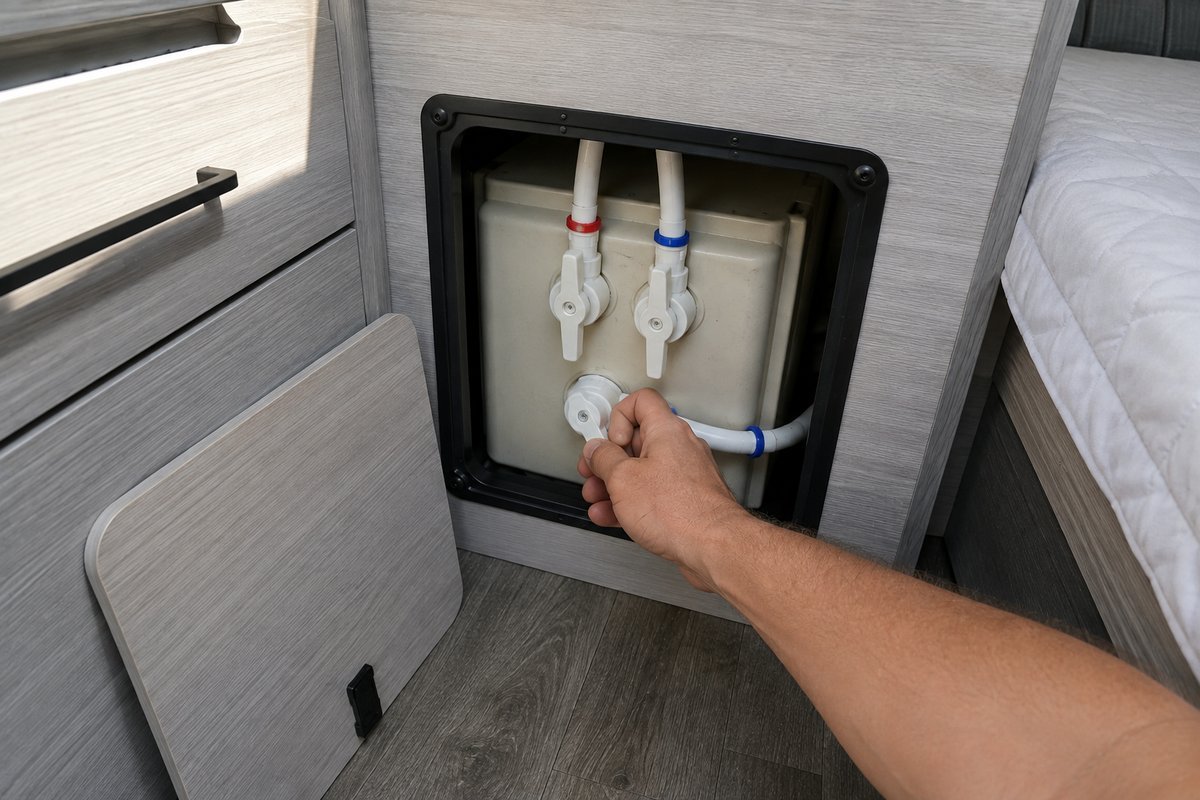
Is the bypass still closed? If you winterized, the bypass valves send water around the tank instead of through it. The heater then runs on an empty or half empty tank and either won't light or heats nothing. This is the single most common cause of a water heater that stopped working over the winter, and it isn't a fault at all.
Is the tank full? Open a hot water faucet and let it run until water flows steadily. Air in the tank is normal after storage and takes a minute to clear.
Has it locked out? Gas models attempt ignition a set number of times and then stop trying. Until you reset it, nothing will happen no matter what else you fix.
If all five pass and there's still no hot water, you have a real fault, and the next sections narrow it down.
Is Your Tank Aluminum or Steel? Check Before You Touch Anything
This decides whether your heater needs an anode rod or must never have one.
Dometic, formerly Atwood, uses aluminum tanks. Dometic states that their water heater tanks are constructed of a high strength aluminum, and that the aluminum is anodic to heavy metals and acts much like an anode rod in a steel glass lined tank, except that it lasts much longer.
Their instruction on the subject isn't a suggestion. Dometic writes: don't use aftermarket anode rods, because doing so can damage the tank.
Suburban uses porcelain lined steel. Suburban describes its Advantage water heaters as having a porcelain lined steel tank, and states that the tank is protected by a magnesium or aluminum anode to prolong the life of the tank.
So the same component is essential on one brand and damaging on the other. An aluminum tank is built to resist corrosion on its own, which is why it leaves the factory without a rod and without a port to put one in.
How to tell which you have without guessing. Look at the drain. A Suburban steel tank drains by removing the anode rod itself, which is a large hex plug. A Dometic aluminum tank has a small plastic drain plug instead. If you're looking at a plastic plug, don't go shopping for an anode rod.
Why Is My RV Water Heater Clicking But Not Lighting?
Clicking means the board is trying. The igniter is sparking, so the board has power and has decided conditions are right. What it isn't getting is a flame it can confirm.
Air in the gas line. After a tank swap or a long spell unused, the line has to purge before gas reaches the burner. Run a stove burner for a minute first, then try the heater again. This fixes it more often than anything else on the list.
A blocked burner tube. Mud dauber wasps build nests inside the burner tube in a single season. The tube is the horizontal pipe running from the gas valve to the burner, and a nest in it stops gas reaching the flame no matter how well everything else works. This is the most common genuine fault on a heater that has been parked outdoors.
A dirty or misaligned electrode. The spark has to jump in the right place to light the gas, and the sensor has to sit in the flame to prove it lit. Soot, corrosion, or a knock during travel moves it out of position.
A failed gas valve. Least likely, and the only one on the list that is a parts job.
Why Is My RV Water Heater Only Lukewarm?
Lukewarm is a different fault from cold, and it usually means the heater is working but something is diluting or limiting it. It's the most common RV water heater repair call that turns out not to be a repair at all.
You're on electric only. The electric element is much slower than the gas burner. On a gas and electric model, running electric alone gives you a tank that recovers slowly and runs out fast.
The bypass is partly open. A bypass valve that hasn't been turned fully back after winterizing lets cold water join the hot on its way to the faucet. The symptom is water that's warm at first and never gets properly hot.
Sediment is insulating the bottom of the tank. A layer of scale between the burner and the water means the burner heats the scale rather than the water. This one builds gradually, which is why it reads as the heater getting tired rather than as a fault.
The thermostat is failing or set low. Worth checking last, because it's the answer people reach for first and is rarely the cause.
How Do I Reset My RV Water Heater?
There are two resets and people confuse them.
The gas lockout reset. After a set number of failed ignition attempts, the control board stops trying and shows a fault. Turning the heater off at the switch, waiting a moment, and turning it back on clears the lockout and starts a fresh ignition sequence. If it locks out again immediately, stop resetting it and work through the clicking section above, because you're re-running a failure rather than fixing one.
The electric element high temperature cutoff. This is a physical button, usually red, on the face of the heater behind the outside access door. It trips when the element runs dry or overheats, and it stays tripped until you press it.
A cutoff that trips repeatedly means something is wrong. The usual reason is the element being switched on with the tank empty or bypassed, which damages the element. Pressing the button again and again without asking why is how a slow problem becomes a replacement.
Does My RV Water Heater Need an Anode Rod?
Only if the tank is steel. See the section above, because this is the question where the wrong answer is expensive.
On a Suburban steel tank, the anode rod isn't an accessory. It's a sacrificial piece of metal that corrodes so the tank doesn't, and a tank left running without one is corroding instead.
How Often Should the Anode Rod Be Replaced?
Suburban is more specific than the usual advice to check it now and then. Their guidance is that replacement is recommended when consumption or weight loss is greater than 75 percent, and separately that it be replaced yearly.
Suburban's own water heater guide is the source for that 75 percent figure. That loss is the threshold to judge against, rather than a calendar date.
The practical version: pull it when you winterize, since you have to remove it to drain the tank anyway, and look at it. A rod eaten down to a thin core with the steel wire showing through has done its job and is no longer doing it. Water chemistry decides the rate, so a rod that lasts two seasons in one region will be gone in one somewhere else.
Magnesium or Aluminum Anode Rod?
Suburban accepts either, describing the tank as protected by a magnesium or aluminum anode.
The working difference is that magnesium is more reactive. It protects harder and wears out faster, and in some water it produces a sulfur smell as a side effect. Aluminum lasts longer and is the usual answer if you have had the rotten egg smell before. Neither is wrong, and if you have no smell problem, the choice barely matters.
What Is the Most Common Cause of Water Heater Failure?
Sediment, and it builds up without obvious signs. It reduces capacity, it insulates the burner from the water, and on a steel tank it sits on the bottom holding moisture against the lining.
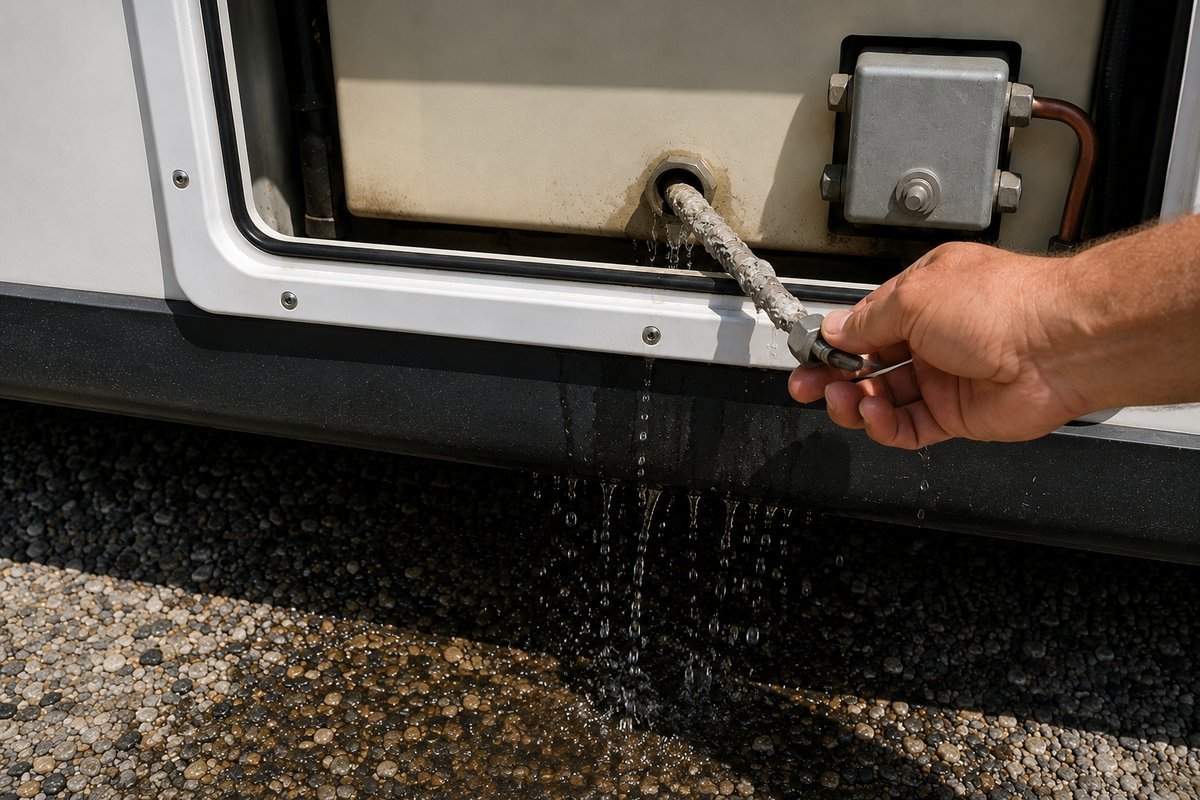
An annual flush is the whole of the maintenance most RV water heaters ever need. Drain the tank, then use a wand to break up what settled at the bottom, because draining alone leaves the sediment where it is. On a Suburban, the drain is the anode rod itself, which is why flushing and checking the rod are the same job done once a year.
What You Need to Do These Jobs Yourself
Four things, matching the jobs above. Nothing here has been used by anyone at Restful RV, so what follows is about fitment, materials and design rather than how it felt in the hand.
Camco RV Water Heater Tank Rinser (40074)
Cheapest job on this listSediment settles across the floor of the tank and insulates the water from the burner flame, which is why a heater that used to run hot starts running lukewarm. Draining alone leaves most of it behind, because the opening sits at one edge and the sediment sits everywhere.
This is a curved wand that goes in through the opening once the anode rod or drain plug is out, connects to a garden hose, and sprays backwards and sideways to lift the sediment and push it out. Do it over gravel or grass, well away from anything you mind getting soaked.
What You'll Love
- Reaches the back and sides of the tank floor, which plain draining doesn't
- Works on steel and aluminum tanks alike
- Needs no tools beyond a garden hose
- Cheap enough that skipping it is a false economy
Worth Considering
- You have to pull the anode rod or drain plug first, so it isn't a five minute job
- The tip is plastic and will crack if you lever it against the opening
- It makes a mess, so plan where the water goes before you start
- Does nothing for a tank that has already corroded through
Suburban Magnesium Anode Rod (233514)
Best protection, shortest lifeAn anode rod corrodes so the tank doesn't. Magnesium is the more reactive of the two common metals, so it gives up material faster, protects harder, and wears out sooner.
This is the Suburban part, 9.25 inches on a 3/4 inch NPT thread, for porcelain lined steel tanks. If your tank is aluminum, which means a Dometic or an Atwood, it left the factory with no anode rod and a plastic drain plug in place of one. Aftermarket rods for those tanks exist, but they aren't the factory design, and this Suburban part won't fit one.
What You'll Love
- Protects a steel tank harder than aluminum does
- OEM part, so thread and length aren't a guess
- Doubles as the drain plug, so you inspect it every time you drain
- Costs a fraction of the tank it's protecting
Worth Considering
- Wears fastest of the two, especially in soft water
- The more likely of the two to leave you with a rotten egg smell
- Wrong part for a Dometic or Atwood aluminum tank
- A rod eaten down to its core protects nothing, so the yearly check is the point
Suburban Aluminum Anode Rod (233516)
For soft water and smelly tanksAluminum is less reactive than magnesium, so it wears more slowly and gives up less. Which one is right depends on your water rather than on which is better.
It's the usual answer to the rotten egg smell, which comes from bacteria feeding on the hydrogen a magnesium rod releases. Switching metals is one of the few fixes for that smell that doesn't involve sanitizing the whole system first.
What You'll Love
- Lasts noticeably longer than magnesium in soft water
- The standard fix for a tank that smells of rotten eggs
- OEM Suburban part, matching thread and length
- Same yearly check, fewer replacements
Worth Considering
- Protects a little less aggressively than magnesium
- Still the wrong part for an aluminum tank, which takes no rod at all
- Won't fix a smell that's coming from the water supply rather than the tank
- The deposits it leaves can be harder to rinse out
RecPro RV Water Heater Bypass Kit
Two valve kit, not threeBypassing the heater keeps six gallons of antifreeze out of the tank every time you winterize. Some trailers left the factory with a bypass fitted and many didn't, and this is what you add when yours didn't.
This is the two valve type, one at the cold inlet and one at the hot outlet, joined by 20 inches of PEX. The valves are PPSU plastic rather than brass and are hand tight plus about a quarter turn, so the wrench stays in the drawer. If your RV already has a factory bypass behind an access panel, you don't need this at all.
What You'll Love
- Saves about six gallons of antifreeze at every winterization
- Comes with the crimp rings and fittings, not just the valves
- Color coded so hot and cold don't get crossed
- PPSU handles heat and treated water better than standard plastic
Worth Considering
- Plastic rather than brass, and overtightening will crack it
- A two valve layout, which isn't the same as the three valve factory arrangement
- You need a PEX crimp tool, which isn't in the kit
- Pointless if your trailer already has a working bypass
How Long Should an RV Water Heater Last?
There's no single reliable number, and any article giving you one is guessing. What decides it is whether the anode rod was maintained on a steel tank, the water chemistry it has lived on, whether it was drained before a freeze, and how often the element ran dry.
A tank that's leaking from the tank itself, as opposed to from a fitting, is finished. There's no repair for a perforated tank and no sealant that belongs anywhere near one.
What Can You Fix Yourself, and What Needs a Technician?
RV water heater troubleshooting splits cleanly in two, and the line is worth knowing before you start.
Reasonable to do yourself: resets, flushing, anode rod replacement on a steel tank, clearing a wasp nest from the burner tube, replacing a pressure relief valve, and checking bypass valves, the same ones you set when you winterize. The sewer hose guide covers the waste side of the plumbing, and a freeze alarm warns you before the pipes freeze.
Get a technician: anything involving the gas valve, the control board, or the propane supply beyond turning it on and off. Also anything where you can smell gas, which isn't a diagnostic exercise.
The line isn't about difficulty. It's that a mistake on the water side makes a mess, and a mistake on the gas side can start a fire. That is the one rule worth carrying into any of the RV water heater problems above.
Frequently Asked Questions
Why does my RV water heater work on gas but not electric?
The high temperature cutoff has almost certainly tripped, or the element has failed from running dry. Check the reset button behind the outside access door first.
Can I run the electric element while the tank is bypassed?
No. The element needs water around it. Running it dry is the most common way an element is destroyed.
Do I need to drain the tank every time I store the RV?
Any time it may freeze, yes. A frozen tank can split, and a split tank can't be repaired.
My water smells like rotten eggs. Is the heater broken?
No. That's usually a reaction between a magnesium anode rod and bacteria in the water. Switching to an aluminum rod, on a tank that takes one, normally settles it.
Quick Answers
Why Is My RV Water Heater Not Working?
Check in this order: both switches are on, propane reaches the RV (light a stove burner), the bypass valves are closed after winterizing, the tank is full of water, and the heater hasn't locked out after failed ignition attempts.
Why Is My RV Water Heater Clicking But Not Lighting?
The igniter is sparking but the board can't confirm a flame. The usual causes, in order, are air in the gas line after a tank swap, a wasp nest in the burner tube, a dirty or misaligned electrode, and least often a failed gas valve.
Why Is My RV Water Heater Only Lukewarm?
Usually the heater is working but something is limiting it: running on electric only, a bypass valve left partly open after winterizing, or sediment insulating the bottom of the tank. A failing thermostat is the least likely cause.
How Do I Reset My RV Water Heater?
There are two resets. For a gas lockout, turn the heater off at the switch, wait a moment and turn it back on. For the electric element, press the red high temperature cutoff button behind the outside access door. If either keeps tripping, find the cause first.
Does My RV Water Heater Need an Anode Rod?
Only if the tank is steel. Suburban steel tanks need one, while Dometic and Atwood aluminum tanks must not have one. A small plastic drain plug means an aluminum tank.
What Is the Most Common Cause of Water Heater Failure?
Sediment. It builds up without obvious signs, reduces capacity and insulates the burner from the water. An annual drain and flush with a rinse wand is the main maintenance most RV water heaters need.