
A lot of RV slide out repair starts with something far cheaper than a new motor. A room that won't move, moves on one side only, or crawls out at half speed is usually pointing at the battery, a breaker, or something in the way, and the manufacturers' own manuals tell you to check those first.
This guide takes those checks in order, using Lippert's published manuals for the common systems. It also covers the jobs that aren't worth tackling in a campground, like a rotted floor or a room that stays crooked in its opening. If you're not sure which system your RV has, our guide to RV slide-out types shows you how to tell in a couple of minutes.
Table of Contents
Why Is My RV Slide Out Not Working?
Start with power. A slide motor is one of the heaviest 12-volt loads on the RV, and Lippert says so directly in its slide out maintenance tips: an electric slide motor "draws considerable current and needs a fully charged battery to operate." A battery that runs the lights and the water pump without complaint can still sag the moment a slide motor asks for current.
After power, the manuals list the same short set of suspects before they get anywhere near replacement parts. Lippert's troubleshooting manual for the electric through-frame slide names "low battery voltage, blown fuse, defective wiring" and an obstruction as the causes of a room that won't move. Work through those before you price a motor. In RV slide-out repair, the motor is last on the list, not first.
Keep one safety rule in mind for everything below. Lippert's manuals tell you to keep hands and other body parts away from the mechanism while the room is moving, and to keep people and pets clear. A slide room is heavy, and the gears don't know the difference between a jammed blanket and a finger.
How Much Battery Voltage Does a Slide Out Need?
More than you'd think. Lippert's in-wall slide, the system most people call Schwintek, is rated to run the room on as little as 8 volts, and its owner manual lists error code 3 as low battery, below 8 volts at the start of a cycle. That's the floor, not the target. Forest River's in-wall troubleshooting sheet says to check the voltage at the controller and charge the battery if it reads below 11 volts.
Hydraulic slides are fussier still. Lippert's hydraulic slide manual says the system "requires full battery current and voltage" and that the battery must be kept at full capacity.
The quickest fix in a campground is often the simplest one. Plug into shore power, which Lippert says will help supply the voltage the motor needs, and try the switch again. If the room works on shore power but not on the battery alone, the battery is the issue, not the slide. Our guide to RV battery testing walks through how to check it properly, and a battery maintainer keeps it topped up in storage so the rooms come in on the first try in spring.
Where Is the Fuse for the Slide Out?
That depends on who built the RV, not who built the slide. Lippert's in-wall manual calls for a 30-amp resettable breaker or blade fuse and notes that the RV manufacturer supplies it, so the location changes from one floor plan to the next.
Look in two places. The first is the 12 volt fuse panel inside the RV, which Forest River's troubleshooting sheet tells you to check for blown fuses. The second is a 30 amp auto-reset circuit breaker on the wire between the battery and the switch, as Lippert's through-frame wiring diagram shows. On many trailers, that puts it near the battery. Your RV's own wiring diagram will say exactly where.
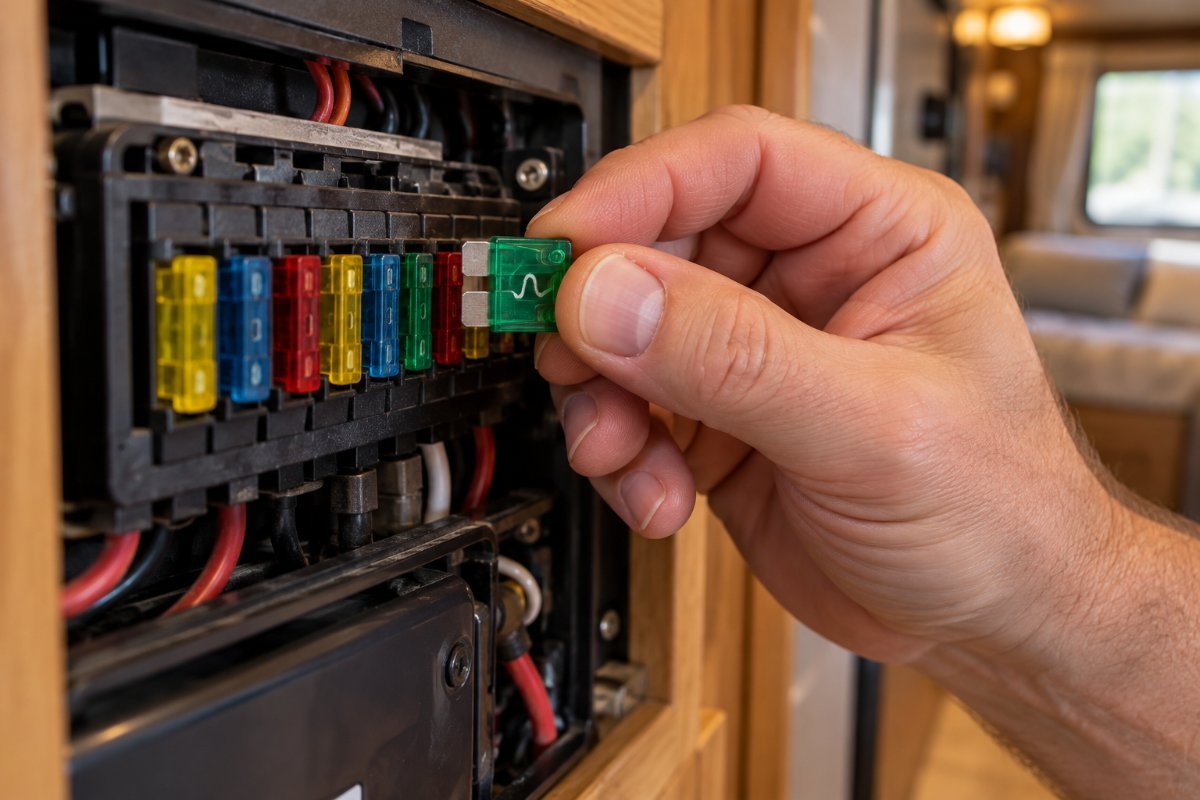
A blown fuse is about the cheapest RV slide-out repair there is, but a resetting breaker can fool you. It trips, cools, and resets itself, so the room might move a few inches, stop, and then work again later. If that happens, a weak battery or a binding room is making the motor pull too hard, and the breaker is doing its job.
Is Something Blocking the Room?
Check before you touch anything electrical. Lippert's in-wall manual tells you to look outside for a tree, a post, or a car, and inside for luggage, furniture, and open cabinets. It sounds obvious. It's also the one RV slide-out repair that costs nothing.
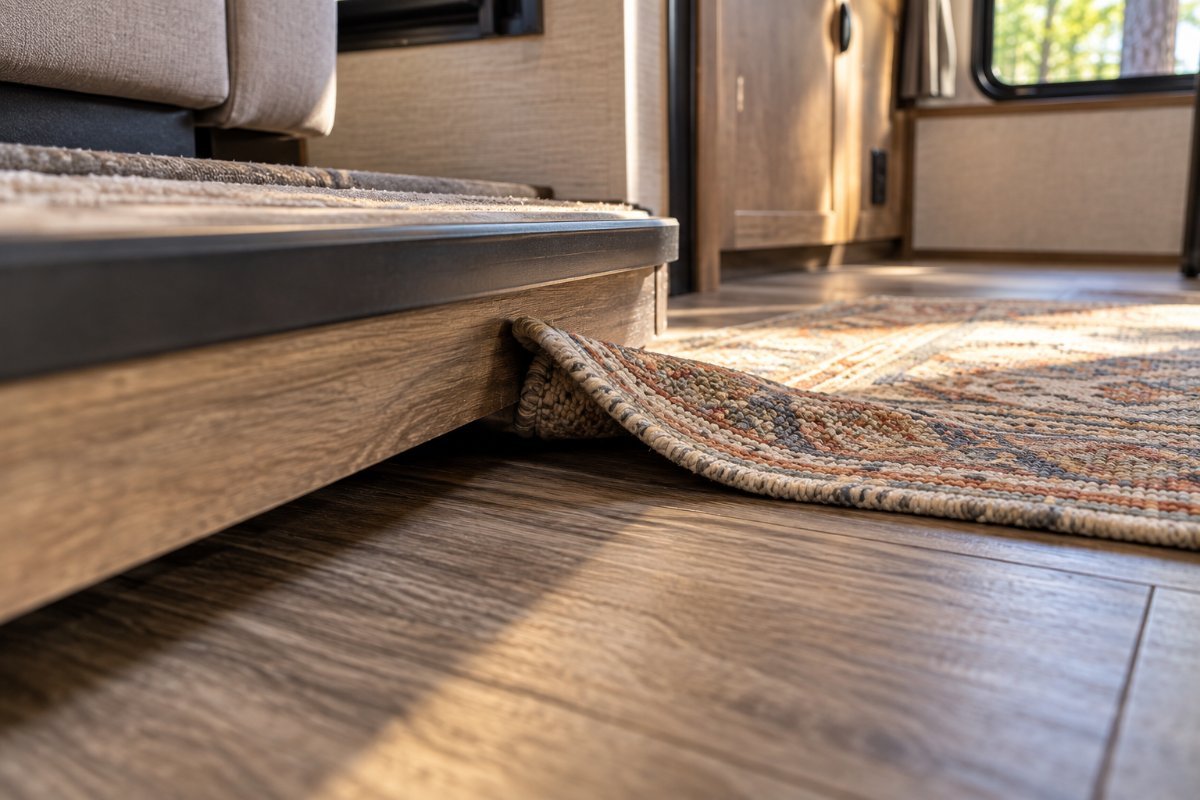
Inside, the usual culprits are a cabinet door that swung open on the road, a rug caught under the leading edge, or a chair pushed back against the slide wall. A wall hugger recliner is designed to sit close to the wall, which is exactly where a slide room needs clear space to move. Outside, walk the full length of the room and look for a picnic table, a hose bib post, or a low branch at roof height.
Some slides also have travel locks or transit bars that hold the room in while you drive. Lippert's Power Gear manual lists removing the transit bars as one of its first checks. If your RV has them, confirm they're off before you go looking for a fault.
How Do You Reset an RV Slide Out?
On an in-wall slide, pressing the switch resets the controller board, according to Lippert's in-wall manual. The same board also tells you what it thinks is wrong. It blinks an error code, and the in-wall owner manual lists each one, from low battery to a motor short circuit. Lippert's in-wall troubleshooting guide says to check the controller label to identify the code, and a red light blinks two to nine times depending on the error. For motor-specific faults, a green light blinks once for motor 1 and twice for motor 2, which tells you which side to look at.
If the room moves but sits crooked, the two motors have drifted out of step, and Lippert publishes a resync routine for it:
- Fully extend the room with the switch and keep holding the switch until both motors shut off on their own.
- Retract the room 1 to 2 inches.
- Repeat those two steps until both motors shut off at the same time. Lippert says two or three rounds are often needed.
It's free, it takes a few minutes, and it's the first thing to try on any Schwintek room that looks out of square. Through-frame and cable slides don't use this routine. Instead, diagnose them by checking power, the switch, and the room's adjustment.
Why Is Only One Side of My Slide Out Moving?
On an in-wall slide, stop right away. Lippert's manual says that if one side moves much slower than the other, or not at all, stop immediately, because a room pushed from only one side can rack in the opening and jam.
Error code 8 points the same way. Forest River's troubleshooting sheet describes it as a wire short between the controller and the motor and says it's usually a wiring problem. Lippert's in-wall troubleshooting guide says to check the connections between the motors and harnesses and to look for pinched or damaged wiring. Check that each motor is plugged firmly into its harness, then look along any wiring you can see for a pinch or a chafe. A connector that worked loose on a rough gravel road is a far better outcome than a dead motor.
The same sheet describes a way to get a stubborn side moving. With a helper, press the switch while the helper pushes the non-moving side in the direction the room is traveling. On larger rooms, the sheet says it may take two or more people pushing. If that side keeps lagging once the room is moving, the motor or its wiring needs attention.
On a through-frame slide, one motor drives the whole room, so one-sided movement usually means the room is binding rather than a motor quitting. Lippert's troubleshooting manual says to check that the room is properly adjusted. On a cable slide, uneven cable tension is the suspect, and our slide out types guide gives the cable slack figure BAL publishes for checking it.
Why Does My Slide Out Move Slowly or Stop Halfway?
Lippert's through-frame troubleshooting manual gives four causes for a slow or stalling room: low battery voltage, a poor ground, extremely low outdoor temperature, or a room in a bind. Voltage is covered above. A poor ground is worth a look if the battery tests fine. The same manual says over 90 percent of electrical problems on the unit come from bad ground connections, and a corroded or loose ground cable starves a motor the same way a weak battery does.
Cold matters more than people expect. If the room is slow on a frosty morning and fine by the afternoon, the weather may be the whole story.
On an in-wall slide, dirt in the gear rack slows the room and wears the teeth. Lippert's manual says to clean the rack with compressed air or a dry brush. Don't reach for grease. Lippert says no lubrication is needed on its in-wall system and that it can hurt long-term reliability, which our slide out types guide covers in detail. Grease on an open gear rack just holds onto grit.
Lippert's own list of warning signs is worth knowing too: jerking or hesitation, slow movement, grinding or clicking noises, gaps in the seals, daylight showing at the corners, and a room that extends unevenly on one side. Any one of those is a reason to check the basics now rather than wait for the room to stop outside.
How Can You Tell If a Slide Out Motor Is Bad?
Check for power at the motor before you blame it. Lippert's through-frame troubleshooting manual has you confirm 12 volts at the motor's incoming leads before replacing anything. If the switch sends power to the motor and the motor does nothing, the motor or its gearbox is the likely problem. If there's no power at the motor, the fault is upstream in the switch, the fuse, or the wiring.
In-wall slides are harder to test at home. Lippert's in-wall troubleshooting guide uses a test harness connected from the controller to the motor, or an ohm test of the harness if no test harness is available. That's dealer equipment for most owners, and it's a reasonable place to hand the RV slide-out repair to a tech. Grinding, a burning smell, or visibly damaged gear teeth are also good reasons to stop and call someone.
How Do You Bring a Slide Out In Without Power?
Each system has its own manual method, and our RV slide-out types guide walks through all of them. In short:
- Electric through-frame: disconnect the battery first, then crank with a 3/4 inch socket and ratchet. Lippert's through-frame manual warns that skipping the disconnect can let electricity backfeed through the motor and cause serious damage.
- Hydraulic through-frame: a hex bit in a cordless drill, fitted to a coupler under a protective label, run clockwise to retract.
- In-wall (Schwintek): Lippert's manual describes an electronic override, entered by pressing the controller's mode button six times and holding it on the seventh for five seconds. Some RV makers, including Grand Design, also describe unplugging both motors to release the motor brakes, then plugging them back in before travel.
- Cable (BAL Accu-Slide): a flexible shaft on the 1/4 inch hex fitting at the end of the motor.
Find your method before you need it, and keep the tool it needs in the RV rather than in the garage at home.
How Do You Fix a Leaking Slide Out?
Most leaks that send owners looking for RV slide-out repair come from the seals, not the room. Keystone's slide-out care tips point out that twigs, leaves, and pine needles can lift the sweep seals and let water in, and that you should check and repair the sealant on the moldings as needed. Sweep the top of the room before you bring it in. A handful of pine needles caught under a seal is a leak waiting for the next storm.
Lippert says its own slide seals need little treatment beyond cleaning with mild soap and water, and that slides from other brands may need a seal treatment. Either way, watch for spots where a seal has rolled, torn, or come loose. A seal that's already split won't be saved by conditioner. It needs replacing.
Water can also come in from above. A slide topper, the small awning that rolls out over the room, keeps debris and standing water off the slide roof. The sealant along the slide's top edge wears the same way as the RV roof sealant on the main roof, so check both on the same day.
Can You Repair a Water-Damaged Slide Out Floor?
Sometimes, but it's the most involved RV slide-out repair on this list, and rarely a weekend job. The slide floor carries the weight of everything in the room, and replacing it often means removing the room from the wall. That calls for the right lifting equipment and more than one person. None of the manufacturer manuals we checked walk an owner through it.
Catching it early is the part you can do. Keystone suggests checking the floor covering under the slide for damage. Soft spots, a floor edge that flexes when you step on it, or staining along the front edge of the room are all signs that water has been getting in for a while. Find the leak first, or the new floor will go the same way.
Prevention is simpler than repair. Lippert suggests keeping the slide closed when you're not using it, to protect the seals and the roof of the room. Bring rooms in dry, and bring them in for storage as part of winterizing your RV.
When Does RV Slide Out Repair Need a Tech?
Plenty of slide-out trouble comes down to a battery charger, a fuse, and a resync. Call a tech when the checks above point to something else. That includes a motor with power that won't turn, error codes for a motor short or excessive current, grinding or damaged gear teeth, a hydraulic line that's weeping fluid, a room that stays crooked after the resync routine, or a soft floor.
If the RV is still under warranty, call the dealer before you open anything up. Most shops bill by the hour and the rate depends on your area, so a clear description of the symptom saves money. Know your slide type, note any error code and which side it points to, and say whether the room moves on shore power. That's ten minutes of work that can save an hour of diagnosis.
Quick Answers
Why isn't my RV slide-out working?
Check low battery voltage first, then a blown fuse or tripped breaker, bad wiring, and something blocking the room. Check those before you suspect the motor. Plugging into shore power is a quick way to rule out a weak battery.
How do you reset a Schwintek slide-out?
Pressing the switch resets the in-wall controller. To resync a crooked room, fully extend it and hold the switch until both motors stop, retract it 1 to 2 inches, and repeat until both motors stop at the same time. Lippert says two or three rounds are often needed.
Where is the fuse for an RV slide out?
Check the 12 volt fuse panel inside the RV first, then look for a 30-amp resetting circuit breaker on the wire between the battery and the switch. The RV manufacturer supplies it, so the exact spot varies by floor plan.
Why is only one side of my slide out moving?
On an in-wall slide, it usually means a motor has lost its connection or its wiring is pinched or broken. Stop right away, check both motor plugs, and look for damaged wiring. On a through-frame slide, the room is more likely binding and needs adjustment.
How do you manually close an RV slide-out?
It depends on the system. For through-frame electric slides, crank in with a 3/4-inch socket after disconnecting the battery. Hydraulic slides use a hex bit in a drill. In-wall slides have an electronic override on the controller, and cable slides use a flexible shaft on the motor.
For more on keeping the inside of your RV comfortable, see our other Interior and Comfort guides.