
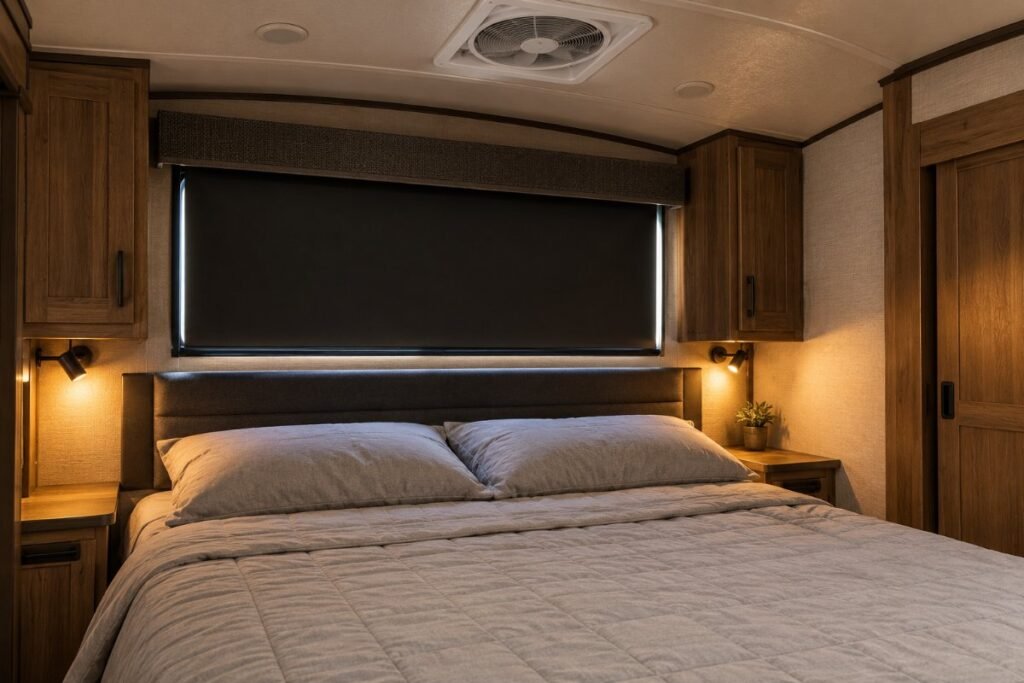
RV interior upgrades cover the parts of a trailer you live with rather than tow. A few decisions come up again and again: where you sleep, how dark you can make it, where you sit when the weather keeps you inside, and how you keep the heat out of it in summer.
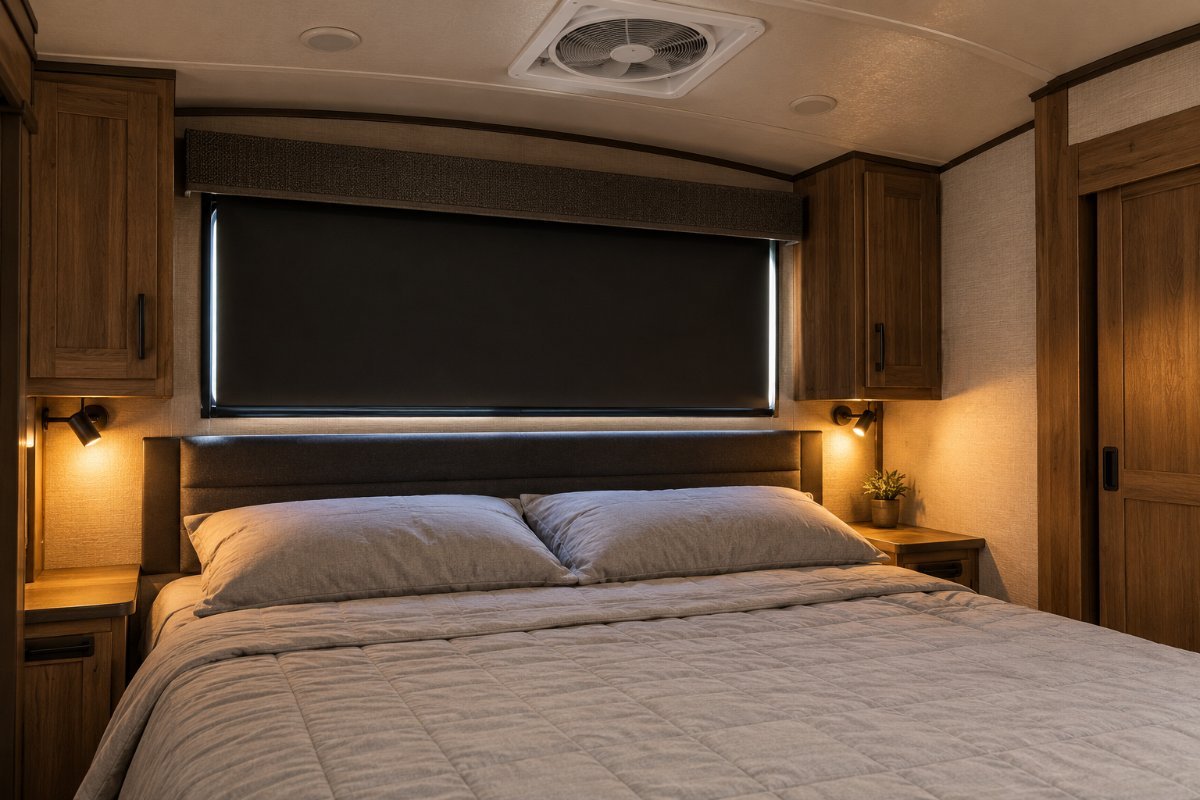
Who this is for. Anybody planning RV interior changes on a travel trailer, especially one where the factory fittings were chosen on cost. Measure before you read the product articles, because in this category the measurement decides the product.
On this page
Sleeping
RV mattresses aren't standard residential sizes, and that single fact causes most of the wasted money in this category. RV mattress replacement covers how to measure yours properly, why an RV queen isn't a queen, and what fits once you know the number.
Light is the other half of sleeping well in a trailer, and factory shades rarely do much. RV blackout curtains and shades covers what blocks light in an RV with shallow window frames, and how the mounting options differ. The Department of Energy's Building America guide to window attachments adds a point about heat: interior shades don't block sunlight until it has already passed through the glass, which is why they do less against summer heat than shade on the outside of the window.
Sitting
Trailer walls make RV interior furniture decisions for you. RV recliners covers why wall hugger is the specification that matters, how much clearance each design needs behind it, and what the published figures leave out.
Staying cool
The rooftop unit is the appliance that decides whether the inside of the trailer is usable in August, and it's the one most owners have never looked at. RV air conditioners covers how the unit works, what the manufacturers publish about sizing and power, why the startup surge matters more than the running draw, and which of the familiar numbers have no manufacturer behind them at all.
If your trailer runs a Coleman Mach unit, or you're replacing one, Coleman RV air conditioners matches BTU to trailer length and compares the low profile and standard height models.
The control end of that system is its own subject. RV thermostats covers why the one on the wall of a trailer isn't the one on the wall at home, what the wires do, and how to tell the thermostat failed rather than the air conditioner.
Whether that rooftop unit needs a cover between seasons is a separate question. RV air conditioner covers covers who needs one, four that fit real units without falling apart in a season, and the one rule that matters more than which one you buy.
Cooled air that never reaches the far end of the trailer is usually a circulation problem, not an air conditioner problem. RV ceiling fans covers the two real 12 volt picks on Amazon, why a household ceiling fan won't fit or wire in safely, and what flush mount installation involves.
The room itself is the other moving part in here. RV slide out types covers the four mechanisms, how to tell in two minutes which one is under your RV, and why three of the four manufacturers say in writing not to lubricate it.
When a room won't move, moves on one side only, or leaks, RV slide out repair walks through the checks in order, from battery voltage and the fuse to Schwintek error codes and the resync routine.
Where to start with RV interior upgrades
Measure before you buy anything. Three numbers cover most of this page. The first is the mattress platform, length and width plus the depth of any storage lid. The second is the depth of the window frames, which decides which blackout mounting will work. The third is the clearance behind any chair you plan to swap. Write them down once and keep the note in the RV.
If heat is the complaint, work from the outside in. Shade the windows first, then get the air moving with a ceiling fan, and only then decide whether the air conditioner itself is the problem. A lot of trailers that feel like they need a bigger unit have a circulation problem instead, and the fix for that costs far less.
If a slide room is part of the living space, check that it moves freely before you fill it with furniture. A recliner or a rug in the wrong spot can stop a room halfway, and the slide out repair guide walks through the rest.
Related
Keeping the inside dry and free of mice over a season sits in storage and winterizing.