
Search for an RV hitch lock, also called a camper hitch lock or an rv trailer hitch lock, and you get two completely different products on the same page. One of them protects your parked trailer. The other one protects a piece of your truck. Plenty of people buy the wrong one, put it on, and think they're covered.
This guide sorts out which is which, what each one stops, and how to measure so the thing fits when it arrives. There's also a recall from 2024 you should check for, because 145,431 of these locks went out with a defect that could let your hitch come apart while you tow.
Table of Contents
The Two Kinds of Hitch Lock
Nearly every complaint about these locks comes down to somebody buying the wrong category. Read this part before you shop.
A receiver lock goes in your truck
Your tow vehicle has a square tube at the back called the receiver. The ball mount slides into that tube and a pin drops through both to hold it. From the factory that pin is held in place by a bent wire clip you can pull out with two fingers. If you tow with a weight distribution hitch, it's the hitch shank that slides into that same tube, and the same pin holds it.
A receiver lock replaces the pin and clip with a pin you need a key to remove. It stops somebody walking off with your ball mount, which happens a lot because most people leave the ball mount in the truck all the time. It also stops somebody pulling the pin and driving away with the whole trailer while you're inside the restaurant.
It does nothing at all for a trailer sitting unhitched in storage.
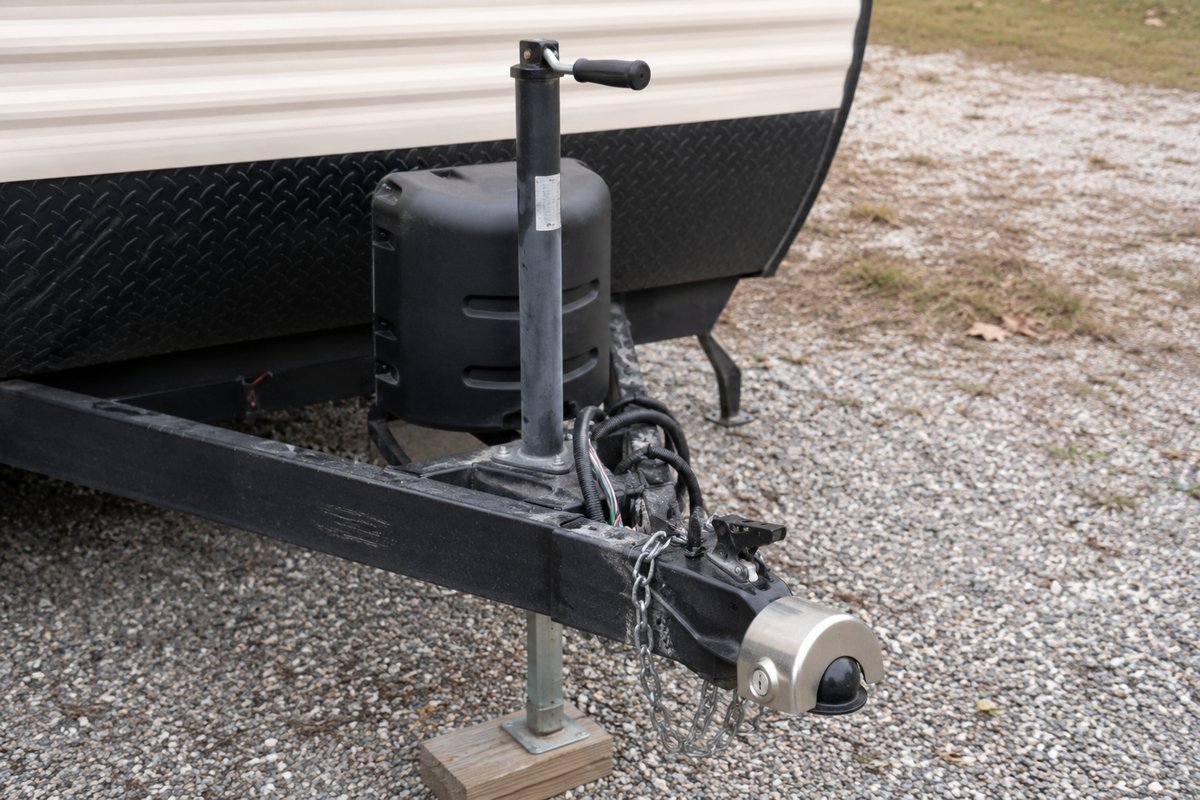
A coupler lock goes on your trailer
The coupler is the socket on the front of your trailer tongue that drops over the ball. A coupler lock fills that socket or clamps around it so nobody can back a truck up, drop their own ball in, and tow your trailer away.
This is the one most people are looking for. We have a separate guide to wheel locks and coupler locks for travel trailers that covers those in depth.
A latch lock is neither
A latch lock is a small U shaped piece that pins the coupler latch shut. It stops the latch being flipped open. On a good many coupler designs a thief can still work a ball into the socket anyway. Latch locks get sold in kits alongside receiver locks and get mistaken for coupler locks constantly. Treat one as a speed bump, not a lock.
If you tow a fifth wheel
None of this applies to you directly. Fifth wheels and gooseneck trailers use kingpin locks, which are a different shape and a different product. This guide is about ball couplers and truck receivers.
Three Receiver Locks Worth Buying
These are the locks that go in your truck. All three publish enough real detail that you can tell before you order whether they will fit, which is more than most of this category manages. Prices move, so check before you buy.
CURT 23518 Receiver Lock
Best documentedCURT publishes the one number that decides whether this fits your truck: usable pin length, 2.850 inches. That is the amount of pin available between the head and the far side once it's seated. If your receiver is buried behind a bumper or has factory plates welded on either side, that number is what tells you the pin won't reach.
Carbon steel with a semi gloss black powder coat, a quarter turn key, a watertight dust cap and two keys. Limited lifetime warranty on the lock itself, one year on the finish and the moving parts.
Read the fitment note before you order. CURT states plainly that it doesn't work with double walled receiver tubes, and owners of some GM half tons report exactly that problem. Measure your receiver depth first.
What You'll Love
- CURT publishes the usable pin length, which almost nobody else does
- Watertight cap keeps the keyway clear through a winter
- Two keys in the box
Worth Considering
- Won't fit double walled receiver tubes, and CURT says so up front
- 2 inch receivers only, so no help on a 1-1/4 inch hitch
- Finish warranty is only a year
Master Lock 2848DAT Receiver and Latch Set
Cheapest way to cover both endsThis is a two piece set that ships keyed alike, so one key does the truck and the trailer. The receiver lock has a swivel head and fits both common pin sizes. The second piece is a stainless latch lock that adjusts from 9/16 of an inch up to 2-3/4 inches, which covers most coupler latches you will meet.
Understand what you're getting on the trailer end. The latch lock pins your coupler latch closed. It isn't a coupler lock and it won't stop a determined thief from working a ball into the socket. What it will stop is the casual grab, and it costs about a third of what a real coupler lock costs.
Master Lock doesn't publish body materials, corrosion testing or warranty terms for this set, so we can't tell you how it holds up in road salt. Treat it as the sensible starting point rather than the last lock you will ever buy.
What You'll Love
- One key opens both pieces, so there's one less key to carry
- Latch lock adjusts across a wide range so fitment is forgiving
- Weather seal and a watertight cap on the receiver piece
Worth Considering
- The latch piece isn't a coupler lock, whatever the packaging suggests
- No published material, corrosion or warranty detail
- Locksmiths have publicly rated Master Lock trailer locks poorly
Trimax SXT3 Stainless Receiver Lock
Best if you tow in road saltThe other two are plated steel. This one is solid stainless the whole way through, which sidesteps the corrosion question rather than answering it with a number. Plated finishes protect until the plating is scratched, and a hitch pin lives its whole life being scratched.
It takes a 5/8 inch pin with a 2-3/4 inch span, which Trimax sizes for Class III and IV receivers, the usual trailer hitch. There's an O-ring around the mechanism and a rubber cap over the keyhole, both aimed at the thing that kills these locks, which is water getting in and freezing.
Trimax also uses a quarter-turn mechanism that it says is designed to prevent false locking, so the lock can't feel shut when it isn't. It publishes strength figures as well: test specifications over 32,000 pounds, and 5,800 pounds of head pull on the lock lugs.
One thing to check before you order. There's no sleeve, so this one won't fit the 1/2 inch pin hole on a Class II hitch. Measure across your own pin holes first, and note that span and usable pin length are two different measurements, so you can't compare this number straight against the CURT.
What You'll Love
- Solid stainless rather than plated, so scratches don't start rust
- Quarter-turn mechanism designed to prevent false locking
- O-ring and rubber keyhole cap, which is what stops a lock seizing
- Published strength figures, including 5,800 pounds of head pull
Worth Considering
- 5/8 inch pins only, with no sleeve for a Class II hitch
- No published corrosion test, only the stainless itself
- Span isn't the same measurement as usable pin length, so check yours
- No help on a double walled receiver, same as the CURT
Check Your Reese Lock Against the 2024 Recall
In late 2024 Horizon Global recalled 145,431 Reese branded receiver locks in the United States, plus another 84,474 in Canada. This is worth five minutes of your time even if your lock has been on the truck for years.
The supplier built the pins in two pieces instead of the one piece design that was specified, and used too little thread adhesive. The cap can work loose. If the cap comes off, the pin can back out of the receiver, and the ball mount can separate from the truck while you're towing. That is a crash, not an inconvenience. Safety chains are what stands between you and the worst version of it, which is a good reminder to cross and use yours.
The affected part numbers are 7057030, 7057230, 7057033, 7054630 and 7057130. Anything built between September 19, 2019 and June 10, 2024 is in the window. In Canada the numbers are 7057030, 7057266, 7054630 and 7057166.
The part number is stamped on the lock. If yours is on the list, the replacement is free. Horizon Global can be reached at 1-800-632-3290, option 2, and dealers were notified in January 2025.
Only one warranty claim was filed and no accidents were reported, which is reassuring. The problem is that most people who own one of these have no idea a recall happened, because nobody registers a hitch pin.
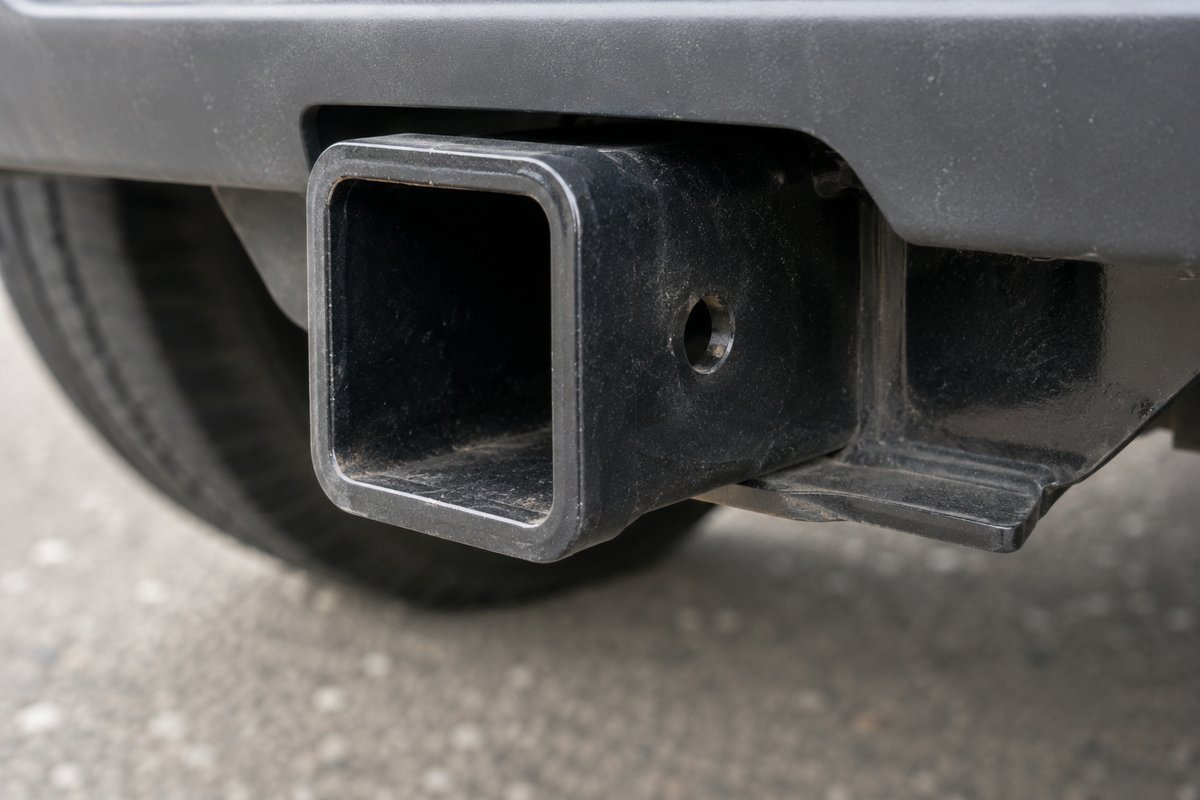
How to Measure So It Fits
For a receiver lock
There's a trap in the pin sizes that catches people. Only two pin diameters exist. A 1-1/4 inch receiver takes a 1/2 inch pin. Every larger receiver, whether 2 inch, 2-1/2 inch, or 3 inch, takes a 5/8 inch pin. So the diameter alone tells you almost nothing.
What changes with the bigger receivers is how much pin you need. A 2-inch receiver needs about 3 inches of usable pin. A 2-1/2 inch receiver needs about 3-3/8 inches. A 3-inch receiver needs nearly 5 inches. Buy a 5/8 inch lock for a 2-1/2 inch receiver without checking length, and the pin won't reach the far hole.
Measure across your receiver from the outside of one pin hole to the outside of the other. That is the number to compare against the usable pin length on the box. Then look at what is around the receiver. Bumpers, factory reinforcement plates, and double-walled tubes all steal length that the receiver size doesn't warn you about.
For anything that goes on the coupler
Measure the coupler, not your ball. Balls get swapped. The coupler is what you're stuck with.
Clean the socket out first and look for a size stamped on it, often underneath near the latch. If there's no stamp, measure the inside of the socket at its widest point with calipers if you have them. The three sizes are 1-7/8, 2, and 2-5/16 inches. The gap between 2 and 2-5/16 is only five sixteenths of an inch, and a tape measure often can't read that difference accurately. Rust and thick paint throw the reading off too.
Then look at the shape of the lip on your coupler, not just the size. Some makers sell four different locks for a 2-5/16 inch coupler, sorted by whether the lip is straight, rounded, square-edged, or flat. Ordering by size alone is the single most common reason one of these comes back in the box it arrived in.
Nobody Is Grading These Locks
This is the part the packaging won't tell you. In the United States, there's no security rating for trailer locks. None. There's no ASTM standard for them, no independent test house that publishes results, and no rating you can look up.
Britain has one. Sold Secure grades caravan and trailer locks Diamond, Gold or Silver, and their approved list runs to brands like Milenco, Bulldog and AL-KO. Not one American brand appears on it.
So when a box says heavy duty, maximum security or theft proof, that is the maker rating its own product. It might be a fine lock. There's simply nothing behind the words. The only claims worth anything are the measurable ones: pin diameter, usable length, material, salt spray hours, warranty term. Those are the specs we put in the boxes above, and the reason two of the three look thin is that the makers didn't publish much.
What a Hitch Lock Does Not Do
Knowing the limits is more useful than more reassurance.
- It won't stop an angle grinder. Nothing in this price range will. A grinder gets through almost any consumer lock quickly, and a thief willing to bring one to a storage lot is going to get your trailer.
- It won't stop a bolt-on coupler being unbolted. Many A-frame couplers are bolted rather than welded. A wrench and a spare coupler defeat a coupler lock entirely. Uncommon, but real.
- It won't stop a flatbed. A trailer can be winched onto a rollback with the coupler locked and the wheels chocked.
- A receiver lock protects nothing on your trailer, and a coupler lock protects nothing on your truck. Those are separate purchases for separate problems.
- A cheap lock left seized shut by rust is a lock you now have to cut off yourself. Put a drop of graphite or dry lubricant in the keyway once a season.
What a lock does is buy time and make your trailer a worse choice than the one parked next to it. That is the whole job, and it's worth doing. Just don't let it stand in for a wheel lock, a good storage lot, or a tracker that tells you where the trailer went.
An RV hitch lock stops the opportunist rather than the determined thief, and the opportunist is most of what happens in a storage lot.
Common Questions
Is a hitch lock the same as a coupler lock?
Not usually. Most products sold as hitch locks are receiver locks that go in your tow vehicle. A coupler lock goes on the trailer tongue. If you want to protect a parked trailer, you want the coupler lock.
Do I need a hitch lock if my trailer is in a gated lot?
A gate keeps out people who don't want to be seen. It doesn't stop somebody who drove in behind another customer. A lock on the tongue costs less than one insurance deductible and is visible from a distance, which is most of its value.
Can I leave a receiver lock on all winter?
Yes, and it will be easier to open in the spring if you use a watertight cap and put dry lubricant in the keyway before you park. Water in the cylinder that freezes and thaws all winter is what seizes these.
Will one key fit both my locks?
Only if you buy them keyed alike as a set, or ask the maker for matching cylinders. Buying two locks separately almost always leaves you with two keys.
What size pin does my truck take?
A 1-1/4 inch receiver takes a 1/2 inch pin. A 2-inch, 2-1/2 inch or 3-inch receiver all take a 5/8 inch pin. What changes is the length of pin you need, so measure across the pin holes rather than guessing from the receiver size.
The Short Version
- Decide first whether you're protecting the trailer or the ball mount. They're different locks.
- For the truck, the CURT 23518 publishes the fitment number that matters, as long as your receiver isn't double-walled.
- For one key covering both ends on a budget, the Master Lock 2848DAT set is the sensible starting point.
- If you tow in road salt, solid stainless beats a plated finish, because plating only protects until it's scratched.
- If you already own a Reese receiver lock bought between 2019 and 2024, check it against recall 24E-110. The replacement is free.
- Measure across the pin holes, not the receiver, and measure the coupler socket, not your ball.
- No American trailer lock carries an independent security rating, so ignore the adjectives and read the specs.
The right RV hitch lock is the one that fits your receiver and coupler without slop, and that you will still bother to fit in the rain.
Related Guides
- Wheel locks and coupler locks for travel trailers
- GPS trackers for travel trailers
- RV storage security, the complete guide
- Entry door locks, the key code problem, and the recall worth checking before you buy.
- Battery locks, including the venting mistake that makes the usual advice dangerous.