
An RV ceiling fan runs on the RV's own 12 volt battery system, which is the detail that separates it from every household ceiling fan sold at a hardware store. It mounts flush against a low RV ceiling, moves the air the air conditioner already cooled, and keeps working whether the RV sits on shore power or is parked off grid with no hookups at all.
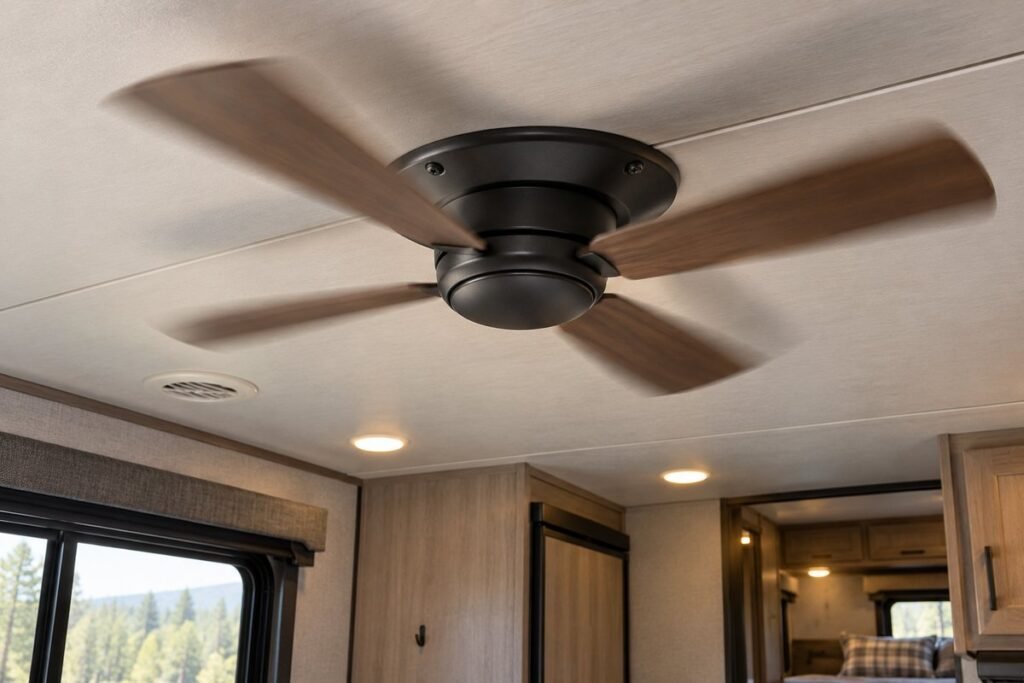
Two brands build the real thing and sell it on Amazon with a track record behind them: RecPro and Camper Comfort. Both are wired for 12 volts, both draw 20 watts, and both are sized to fit the same low ceiling clearance that rules out a household fan. This guide covers both with live listings, how a ceiling fan's job differs from a roof vent fan's, what flush mount installation requires, and why a fan built for a house won't simply bolt into an RV ceiling.
Quick Answer
The RecPro RV Ceiling Fan is the pick to start with: a brushless motor, four speeds, and a flush mount depth of about 4.25 inches that clears most RV ceilings. The Camper Comfort RV Ceiling Fan is the close alternative, with a slimmer 3.5 inch mount depth and a published 30 decibel noise rating, at almost the same price.
Table of Contents
The picks
RecPro RV Ceiling Fan, 36 Inch
Brushless motor and an alloy steel frame
RecPro builds this fan specifically for RV ceilings rather than adapting a household model, and the listing shows it. The frame is alloy steel, the four blades are an engineered wood finish rather than plastic, and the motor is brushless, which tends to run longer between failures than the brushed motor in a cheaper fan.
It mounts flush with no downrod, at a depth of about 4.25 inches, and wires into a switched 12 volt circuit the way a ceiling light does. A rocker switch on the wall controls four speeds and a reversing function. RecPro backs it with a 1 year warranty.
Good
- Brushless motor and an alloy steel frame instead of the plastic most competitors use
- 1 year manufacturer warranty, longer than most fans in this category publish
- Also sold in a 42 inch size for a larger ceiling without changing the mount depth much
Bad
- RecPro doesn't publish a decibel rating, so there's no noise figure to compare against Camper Comfort's
- Rocker switch only, no handheld remote
Camper Comfort RV Ceiling Fan, 36 Inch
Slimmer mount and a published noise rating
Camper Comfort's version trades RecPro's alloy frame and wood-finish blades for a metal body with plastic blades, and a brushed motor instead of brushless. What it publishes that RecPro doesn't is a noise figure: 30 decibels, which sits close to a quiet library reading room.
The mount depth is 3.5 inches, three quarters of an inch slimmer than the RecPro, which can matter in a bunk area or a slide-out ceiling with less clearance to spare. Control is a touch panel rather than a rocker switch, still wired to a 12 volt circuit rather than a battery clip.
Good
- Only one of the two that publishes an actual decibel figure
- Slimmer 3.5 inch mount depth, useful in tighter ceiling spots
- Best Seller in Amazon's RV Ventilation category at the time this was checked
Bad
- Plastic blades and a brushed motor instead of RecPro's alloy frame and brushless motor
- Only sold in the 36 inch size
Quick comparison
| Model | Motor | Mount depth | Noise | Control |
|---|---|---|---|---|
| RecPro | Brushless | About 4.25 in | Not published | Rocker switch |
| Camper Comfort | Brushed | 3.5 in | 30 dB published | Touch panel |
Why this has to be a 12 volt fan, not a household one
A household ceiling fan runs on 120 volt AC power, the same current that comes out of a wall outlet. An RV's onboard electrical system runs 12 volt DC off the house battery, with 120 volt AC only available when the RV is plugged into shore power or running an inverter. Wire a 120 volt fan into a 12 volt circuit and it simply won't turn.
That is the whole reason an RV ceiling fan is a separate product line instead of just a hardware store fan with an RV sticker on the box. Both of the fans above are wired for 12 volts and both draw 20 watts, which works out to a little under 1.7 amps. That is a small enough draw that running one off the battery overnight is a reasonable thing to do, unlike an AC-powered appliance that would need an inverter running the whole time.
Weight matters here too. A household ceiling fan often runs 8 to 15 pounds with a bulkier AC motor and typically hangs from a downrod, which assumes several feet of open ceiling height above it that an RV interior doesn't have. RecPro's fan weighs under 7 pounds and both fans mount flush against the ceiling with no downrod at all.
RV ceiling fan or roof vent fan: they do different jobs
A roof vent fan, the kind sold under the MaxxAir or Fan-Tastic Vent name, sits in the existing roof vent opening and either pulls hot air out of the cabin or pulls outside air in. It exchanges air between inside and outside the RV, which is a ventilation job.
A ceiling fan doesn't touch the roof and doesn't exchange any air with the outside at all. It only moves the air that's already inside the cabin, which means it works alongside the air conditioner rather than instead of it. Running one while the AC is on helps push the cooled air down and around the room instead of letting it settle near the ceiling, and running one without the AC on a mild night just keeps air moving so the cabin feels a few degrees cooler than the thermometer says.
Neither ceiling fan lowers the actual air temperature on its own, which is the whole reason a rooftop air conditioner still has to do the real cooling. For the mechanics of what the air conditioner itself is doing, and when a cooling problem is a sizing problem, see the RV air conditioner guide.
What flush mount installation requires
Both fans here are a flush, or close, mount design. There's no downrod and no gap between the fan body and the ceiling, which is what lets a fan this size fit under a ceiling that's often under 7 feet from the floor.
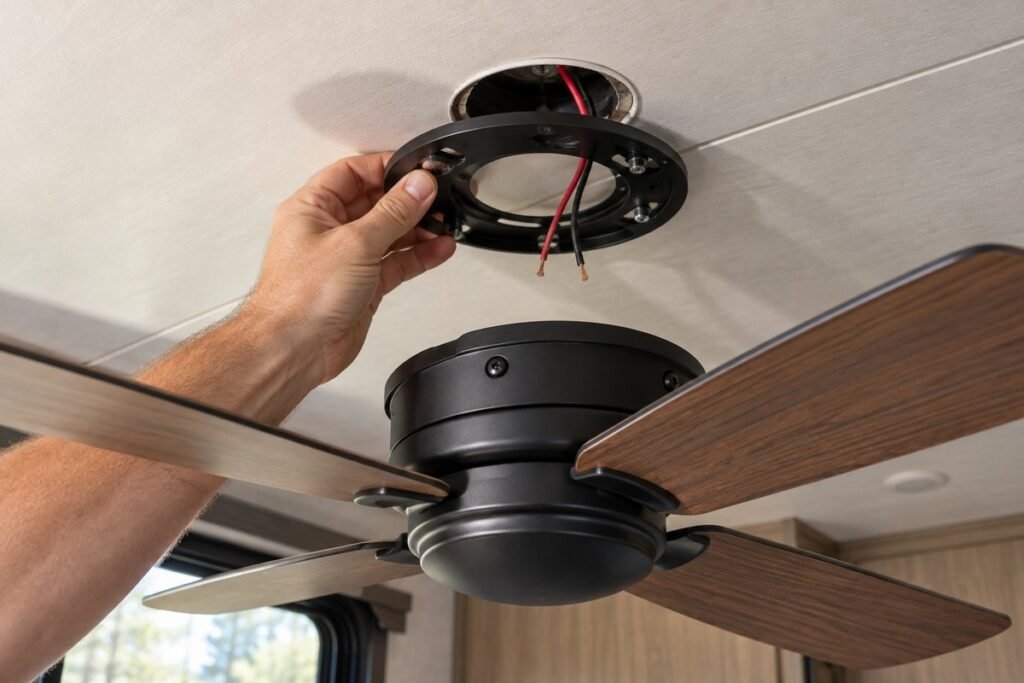
The wiring side is closer to installing a ceiling light than installing a household ceiling fan. It taps into a 12 volt circuit that's already run to the ceiling, usually the same circuit an old dome light used, and is controlled by a wall switch rather than a pull chain. That circuit should be switched off at the breaker or the battery disconnect before any wiring is touched.
Installing an RV ceiling fan isn't the kind of job that sits behind this site's safety boundary the way a rooftop air conditioner does. It's low voltage DC work, not a 120 volt appliance bolted through the roof, so it's a reasonable weekend project for an owner who is comfortable working with 12 volt wiring. Anyone who isn't should still have it done by someone qualified, the same as any other electrical work.
Noise and what it costs to run
Both fans draw the same 20 watts, so the power budget question has one answer no matter which RV ceiling fan is picked. At roughly 1.7 amps on a 12 volt system, a night spent running one on low speed is a minor draw compared to what a rooftop air conditioner pulls at startup, which the AC guide above covers in more detail. Neither fan draws enough to worry a battery bank.

Only Camper Comfort publishes a noise figure, at 30 decibels, which is close to the level of a quiet library. RecPro doesn't list a decibel rating for this fan anywhere in its listing or specifications, so there's no published number to hold it to. That's worth knowing going in rather than assuming both are equally quiet.
Using the reverse setting
Both fans reverse direction from the same wall control. Running them one way pushes air straight down, which is the setting to use in summer for a direct breeze. Running them the other way pulls air up and pushes it out along the ceiling and down the walls, which spreads the warm air that collects near the ceiling on a cold morning before the furnace has caught up.
Neither direction changes the temperature of the cabin. It only moves the air that's already there. That distinction, moving air rather than cooling it, is what every RV ceiling fan on this list does and nothing more.
Quick Answers
Can you put a regular ceiling fan in an RV?
Not as a straight swap. A household ceiling fan runs on 120 volt AC power and is usually too heavy and too deep for a low RV ceiling. An RV needs a fan built for its 12 volt DC circuit, like the RecPro or Camper Comfort fans above, both of which mount flush with no downrod.
What is the best fan for an RV?
It depends on the job. A ceiling fan circulates air that's already inside the cabin and works alongside the air conditioner. A roof vent fan, like a MaxxAir or Fan-Tastic Vent, exhausts hot air and pulls in outside air through the existing roof opening. Neither one replaces the other.
What is a good small ceiling fan for an RV?
RecPro and Camper Comfort both build one sized specifically for this, at 36 inches across, and both mount flush with no downrod, which suits a small RV ceiling better than a household fixture would.
What is the best 12 volt ceiling fan for a motorhome?
The same low mounting clearance that rules out a household fan in a travel trailer applies in a motorhome. Both wire into a 12 volt circuit and mount flush, and either one fits a motorhome ceiling the same way it fits a trailer.
Where to go next
- RV Air Conditioner: The Complete Guide for sizing, generator surge current, and when a cooling problem is a technician's job.
- Coleman RV Air Conditioner for a look at the rooftop units these ceiling fans are meant to work alongside, not replace.