
Trailer wheel chocks and X-chocks get sold on the same shelf, sometimes even in the same photo, and it's easy to assume they do the same job. They don't. One stops the trailer from rolling. The other stops it from rocking once it's already parked. Knowing which one you're holding, and using both correctly, is the difference between a travel trailer that sits still overnight and one that creeps a few inches downhill by morning.
Table of Contents
What's the difference between a wheel chock and an X-chock?
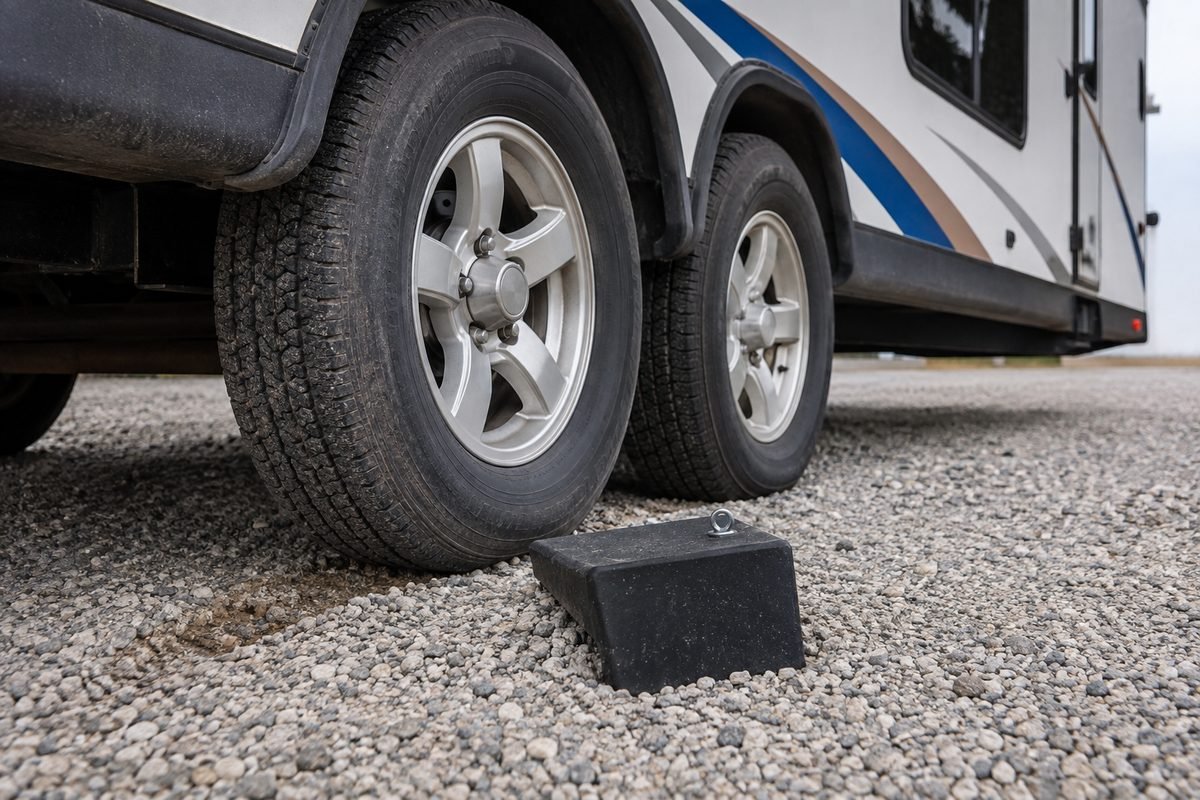
A wedge, or ramp-style, wheel chock is an immobilizer. It sits against the tread of one tire and physically blocks it from rolling forward or backward, the same job a chock does under a parked semi-trailer.
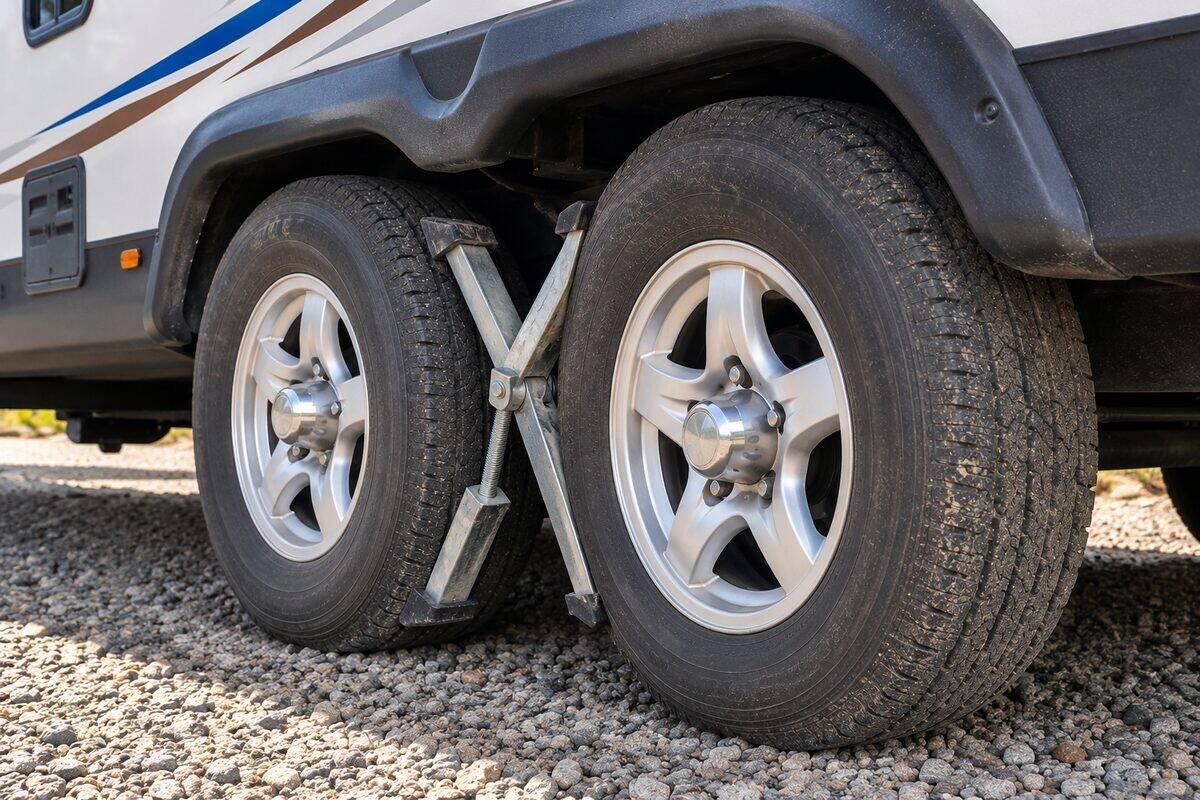
An X-chock is a scissor-style stabilizer that expands between the two tires of a tandem axle and applies opposing pressure to stop side-to-side rock, the movement you feel when someone walks across the floor inside. The difference matters more than the names suggest. A stabilizer works on rock, not roll, so it isn't a substitute for chocking, and the wheels need to be held before it goes on.
| Wedge / ramp chock | X-chock stabilizer | |
|---|---|---|
| Job | Stops the trailer from rolling | Stops tandem-axle tires from rocking side to side |
| Where it goes | Against the tread, front or back of one tire | Wedged between both tires on one side of a tandem axle |
| Replaces the parking brake? | No, used with it | No, manufacturer instructions say not to use it as one |
| Install order | First, before unhitching | After the wheels are already chocked or braked |
| Needed on a single-axle trailer? | Yes | Not applicable, there's no second tire to brace against |
Do you need to chock both sides of an RV?
Yes, if you want the travel trailer restrained against movement in both directions. A single chock only resists the tire rolling one way. Fastway, a towing equipment manufacturer, recommends chocking to resist movement in both possible directions, meaning a chock in front of the tire and another behind it, or a paired system on tandem axles. On a slope, chocking the downhill side matters more than the uphill side, since gravity is doing the pulling, but both is still the safer habit.
Is a parking brake alone enough?
The answer depends on timing. While the truck is still coupled, its brake controller and its parking brake are both doing real work, and the chock manufacturers treat the two as a pair. Fastway's guidance describes chocks as an added physical restraint used together with the parking brake and proper hitching procedure, not instead of it. But that's advice for the few minutes you spend unhitching, not for the week that follows.
Once you drive the truck away its parking brake goes with it, and unless your trailer has the factory cable option that almost none of them do, the chocks are the only thing still holding it. We couldn't find a government or standards-body statement that settles the question with test data, so take the manufacturer advice for what it is. Set the tow vehicle's brake and chock the trailer before you uncouple, then know that after that, the chocks are doing all the work.
Do any travel trailers have a parking brake?
Almost none, and the part that would give you one can't be added later. Three different things get called a parking brake on a trailer, and only one of them is.
Standard electric drum brakes do nothing once the power stops. Dexter describes the action plainly: current runs into an electromagnet inside the assembly, and that movement pushes the shoes outward against the drum. Cut the current and the return springs pull them straight back. Unhitched and unplugged, a normal travel trailer has no braking at all.
A real mechanical parking brake does exist. Dexter's service manual documents a cable operated version in which "Cable force applied to the parking lever creates a torque through the pivot pin and cam assembly," and Lippert sells its own as an electric brake assembly with park.
Nothing electrical is involved, so it holds with no power. There are two catches. Dexter notes the option is "not available on all sizes," and the assembly has to leave the factory with the actuating lever already on it, so you can't add one to brakes that weren't built for it. No holding capacity and no grade rating are published for it anywhere we looked.
The breakaway switch is the one that misleads people, because it does clamp the brakes with the trailer disconnected. That's exactly what it's for. The duration it's built around comes from state law rather than any federal rule, and the RV Industry Association's summary of state trailer brake laws shows why the number is worth knowing.
Alabama, Florida, Montana, Nevada, Oklahoma, South Carolina, South Dakota, Texas, Vermont, Virginia and Washington all require the brakes to stay applied for 15 minutes on trailers above roughly 3,000 pounds. Fifteen minutes is the design target, and the switch meets it by running the magnets at full current off a small battery. Keystone tells owners never to use it for parking, since "removing the pin applies constant power, which can drain the batteries and potentially damage the switch and brake shoe magnets."
Electric over hydraulic, the setup found on heavier fifth wheels and toy haulers where a powered pump makes the brake pressure, is no better. The HydraStar actuator manual states that the actuator and trailer brakes "are not designed to function as a park brake," which follows from a pump that only makes pressure while it has power.
The clearest evidence is what the RV builders leave out. The 2026 Keystone owner manual and the 2024 Jayco towable manual carry no parking brake section at all. Jayco's instruction is simply to "chock the wheels securely to prevent the RV from moving." No federal standard requires a parking brake on a consumer travel trailer in the first place. That gap is the whole reason the chocks carry the load.
How do you chock a travel trailer correctly?
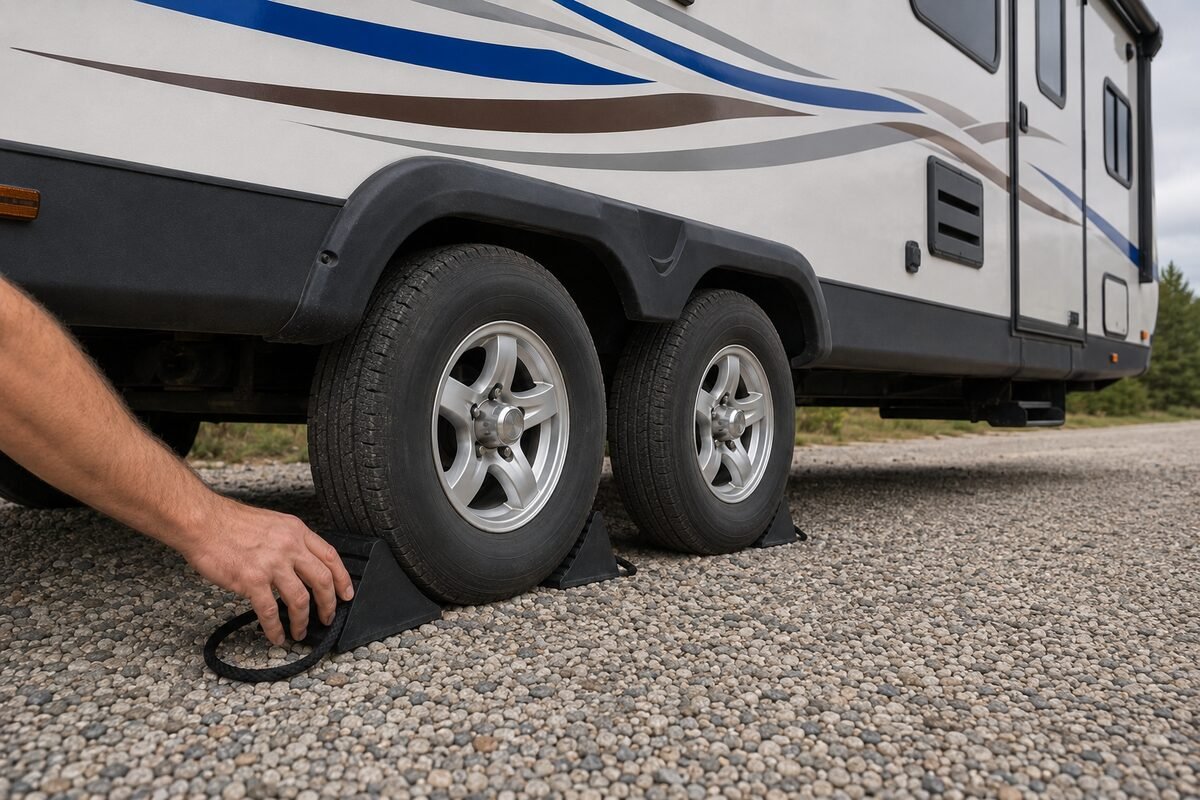
Chocks go on before you unhitch, not after. The sequence that manufacturer instructions describe:
- Park on level ground where possible.
- Set the tow vehicle's parking brake and put its transmission in park.
- Place wedge chocks against the tires, front and back if you want restraint in both directions.
- Only then unhitch the travel trailer from the tow vehicle.
- If you're using an X-chock stabilizer on a tandem axle, install it after the wheels are already chocked or braked, never before, and remove it before towing or before running leveling jacks, since operating jacks with it installed can damage it.
Chocks are only the rolling half of leaving a travel trailer parked. If you're walking away from it for any length of time, a hitch lock covers the theft half. And if the trailer shoved the tow vehicle around under braking on the way in, that is a brake controller problem, not something chocks fix once you're stopped.
What to use instead of wheel chocks?
Nothing does the same job as well. Leveling blocks solve a different problem, getting the trailer level, not stopping it from rolling, and some campers try substituting rocks or scrap lumber, which don't hold shape or grip the way a purpose-built chock does. If what you want to know is whether you can skip chocks and rely on the parking brake instead, see the answer above: manufacturers don't recommend it.
What are wheel chocks made from, and does it matter?
The market splits into rubber, hard plastic, and metal, and it's a genuine trade-off rather than a marketing distinction.
| Material | Strength | Trade-off |
|---|---|---|
| Rubber | Grips pavement and gravel well, stays flexible in most conditions | Heavier to store than plastic |
| Plastic / poly | Light and inexpensive, easy to keep in the tow vehicle | Can crack in a hard freeze or under repeated heavy impact |
| Metal / rubber-coated iron | Most durable, rated for the heaviest loads | Weight and price premium |
One gap worth knowing about: consumer RV-branded chocks generally publish the tire diameter they fit, commonly up to 26 inches, not a numeric weight rating the way heavy-duty industrial chocks do. If your trailer is on the heavy end, check the tire-diameter compatibility on the listing rather than assuming a weight number that isn't published, and while you're under there, it's worth a look at how those tires are aging, since that matters more than the tread.
Is there a safety standard for trailer wheel chocks?
There's one standard written for chocks, and it's probably not doing what you assume. SAE J348 covers, in its own published scope, the basic information required for the design and manufacture of a wheel chock. The full text sits behind a paywall, so most people who cite it haven't read it.
An independent field test report funded through an EPA technical assistance program describes what it leaves out, stating that J348 only tests for strength and breakage resistance and not for traction performance. A chock can meet the only chock standard there is and still slide.
Europe has a stricter one. DIN 76051 covers wheel chocks for vehicles, semi trailers and trailers, and it does test holding. A TUV type approval report for a DIN 76051 chock records testing on an 18 percent slope at an effective wheel load of 6,890 kg. The size code even carries the tire geometry, where the 53 in D53 refers to a 530 mm tire static radius. None of that applies to a chock sold for a travel trailer in the United States.
The federal rules people quote are workplace rules, and they specify nothing about the chock itself. OSHA 1910.178(m)(7) says only that brakes shall be set and wheel blocks shall be in place to prevent movement while loading or unloading. No dimension, no material, no rating, no grade threshold. The MSHA mining rule is the same shape, requiring that equipment parked on a grade be either chocked or turned into a bank, without ever defining a grade. Both are written as outcomes rather than specifications, and neither one reaches your campsite.
OSHA has also been explicit that the plural in chocks is grammar rather than a quantity. A 1991 interpretation letter, written about trucks at a loading dock rather than anything on a campsite, states that one chock should fully satisfy the intent of the regulation if it effectively prevents movement. That's worth knowing before you take any online claim about a legal two chock minimum at face value, because the rule those claims point at is a workplace rule that was never about your trailer.
Of the consumer RV chock brands checked for this article, none claimed compliance with J348 or with any other standard. Industrial suppliers cite OSHA and MSHA section numbers, which is a different thing. Those regulations require that a chock work, and say nothing about how it's built or tested.
Should a chock be a quarter of the tire height?
This is the most repeated number in the category and the hardest to source. It turns up in vendor literature, usually hedged in the same breath, as in one distributor guide that recommends a chock one quarter the height of your tire and then tells you to check with your vehicle owner manual to be sure. Searches of standards bodies and federal sources for the rule returned vendor and blog pages and nothing else.
Real industrial chocks contradict it. ESCO publishes a full spec table, and its 5 ton chock is 6 inches tall for tires up to 27 inches, which works out to 0.22. Its 10 ton chock is 6.25 inches for tires up to 35 inches, or 0.18. The ratio falls as tires get larger, which is the opposite of a fixed fraction.
Part of the confusion looks like two different measurements getting mixed together. The field test report above notes that J348 suggests a length to height ratio of 1.73 for the body of the chock itself, which describes the angle of its ramp face and says nothing at all about tire size. DIN sizes to tire static radius instead. If you want a rule you can act on, use the tire diameter fit the manufacturer publishes, and where none is published, treat that absence as the specification it is.
How much force is a chock holding back?
The force pulling a parked trailer downhill is its weight multiplied by the sine of the slope angle. For the trailers most people tow, that works out smaller than it feels.
| Trailer weight | 3 percent grade | 5 percent grade | 10 percent grade |
|---|---|---|---|
| 6,000 lb | 180 lbf | 300 lbf | 597 lbf |
| 8,000 lb | 240 lbf | 400 lbf | 796 lbf |
An 8,000 pound trailer on a 10 percent grade is leaning about 800 pounds on whatever sits under the tire. Split across four tires on a tandem axle it's closer to 200 pounds each, which isn't a load that crushes a chock.
The more useful number is the grip required. The coefficient of friction a chock needs between itself and the ground is simply the tangent of that angle, which comes to 0.03 on a 3 percent grade, 0.05 on 5 percent and 0.10 on 10 percent. Those are low figures. Rubber on dry asphalt is commonly listed near 0.9 static.
That points to where the real failure comes from. When a chock slides it's almost never because the trailer was too heavy. It's because the surface under the chock stopped being dry asphalt. Wet grass, loose gravel, sand, ice, or a wet paved pad where that same rubber figure drops toward 0.2.
Published friction data for actual chock bodies on gravel or grass didn't turn up anywhere in this research. Nobody can tell you from measurement whether a given plastic chock will hold on a damp grass site, which is worth remembering the next time a product page uses the phrase heavy duty.
What do chock manufacturers publish?
Very little, and the gaps turn out to be more informative than the numbers.
Andersen is the outlier. Its Camper Leveler page publishes both a weight figure, trailers up to 30,000 pounds, and a tire size, up to 32 inches in diameter. Those were the only manufacturer published tire diameter and trailer weight figures found on a manufacturer's own site while researching this article.
The scissor style stabilizers publish a gap rather than a tire size, and this confuses people constantly. The BAL X-Chock fits tire spacing from 1 and 3/8 inches out to 10 inches, with a separate X-Tended Fit model covering 10 to 17 inches. The Fastway ONEstep publishes a wedge tip to wedge tip length instead, 16 to 24 inches on the standard and up to 30 on the XL. Neither of those is a tire diameter. Buy on tire diameter alone, and you can easily end up with the wrong part.
The widely quoted Camco 26 inch tire limit appears on retail listings rather than on Camco's own product page, which publishes physical dimensions and a shipping weight and little else. MaxxHaul was the thinnest of the set. The product pages checked carried no load rating, no tire diameter range and no instruction sheet, for a product whose own name contains the words heavy duty.
Load ratings are close to absent across the category. Fastway, BAL, Camco and MaxxHaul published none on their own sites. Tri-Lynx does publish 40,000 pounds for Lynx Levelers, and that figure gets quoted as though it were a chock rating. It's a static crush rating for a stacked leveling block, and Tri-Lynx sells its chock as a separate product.
What goes wrong when chocks fail?
The accounts that follow come from RV owner forums, not from testing. Nobody measured anything. What makes them worth reading is that the same few failures keep turning up in communities that have nothing to do with each other, which tells you which mistakes are common. It doesn't tell you how any particular chock performs, and it doesn't replace the instructions that came with your own equipment.
The failure that comes up most often is a plastic chock sliding on pavement. One owner, whose trailer moved while he was unhitching, described plastic on asphalt as something that slides and doesn't hold. Another thread describes a trailer that rolled straight over its plastic chock, crushed it flat, bent the front stabilizer jacks over and ended up in the road.
The worst account found came down to sequence rather than hardware. A roughly 10,000 pound bunkhouse on a sloped site, with small plastic chocks already in place, rolled as soon as the coupler cleared the ball, traveled around 80 feet, lost both air conditioners to a tree limb and was a total loss. Chocks were present. They were undersized, and the chains and breakaway cable had already been released.
Chocking one side only shows up repeatedly, including a thread describing a trailer that rolled into the road after a single chock was set before unhooking. That is the exact failure the both sides advice exists to prevent, and it isn't hypothetical.
Two X-chock patterns are worth correcting. Towing away with them installed doesn't appear to bend axles, which is the common fear. Owners instead describe them popping out, in one case flying into a neighboring campsite, which makes them a projectile rather than a repair bill. Over-tightening is the bigger risk. The BAL product page warns against operating the product with a cordless drill or impact driver unless the drill has an adjustable chuck, and owners report indenting the tread by cranking them down. The supplied ratchet wrench is short on purpose.
Are camper levelers the same as chocks?
Retailers list them side by side, and two manufacturers say otherwise in their own words. Choosing between the two is its own subject, covered in the RV leveling blocks guide.
Andersen ships a separate chock with the Camper Leveler and describes its job precisely. The included chock locks the leveler in place. It's there to stop the leveler from moving, not to stop the trailer. The wheel chock and leveler phrasing you see on retail listings is the wording of the retailer, not the Andersen product name.
Tri-Lynx draws the same line. Its FAQ describes the Chock R Dock as a wheel chock that can be used independently to chock your tires, while the Lynx Levelers themselves are described for leveling and stabilizing, under wheels and under jacks, with no chocking claim attached. The Stop N Chock, despite the name, is called a wheel guide.
Curved levelers make this easy to get wrong, because you drive up onto one and from the outside it looks like a chock. It's a ramp your tire is resting partway up. Nothing about that shape stops the tire rolling back down the way it came.
Our picks for trailer wheel chocks
All three below are the highest reviewed trailer wheel chocks and X-chock stabilizers on Amazon at the time of writing, verified directly on the product page rather than a sponsored search placement.
A solid rubber wedge chock with a built-in handle and non-slip traction pads on the base. This is the immobilizer that goes against the tire tread, the job described above, not the stabilizer.
A hard plastic wedge chock from an RV-specific brand, with a rope for pulling it free without bending down. A lighter option than rubber if you're storing several in a bay that's already tight.
The scissor-style stabilizer for tandem axles, the one that stops side-to-side rock rather than rolling. BAL publishes no load rating and no tightening figure for it, and the only warning on its own product page is against driving it with a cordless drill or impact driver. It fits tire spacing from 1 and 3/8 inches to 10 inches, which is a gap measurement and not a tire size.
Quick Answers
What's the difference between a wheel chock and an X-chock?
A wedge, or ramp-style, wheel chock is an immobilizer. It sits against the tread of one tire and physically blocks it from rolling forward or backward. An X-chock is a stabilizer that braces between tandem tires to stop side-to-side rocking, and it doesn't replace a wheel chock.
Do you need to chock both sides of an RV?
Yes, if you want the trailer restrained against movement in both directions. A single chock only resists the tire rolling one way.
How do you chock a travel trailer correctly?
Chocks go on before you unhitch, not after. Park on level ground where possible, set the parking brake, place wedge chocks against the tires front and back, and only then unhitch from the tow vehicle.
Is there a safety standard for trailer wheel chocks?
There's one, SAE J348, and it covers design and manufacture rather than holding power. An independent field test report describes it as testing only for strength and breakage resistance, not for traction. None of the consumer RV chock brands checked for this article claimed compliance with it.
Should a chock be a quarter of the tire height?
No primary source for that rule could be found. Real industrial chocks contradict it, with ESCO publishing a 6 inch chock for tires up to 27 inches and a 6.25 inch chock for tires up to 35 inches. Use the tire diameter fit the manufacturer publishes instead.
Are camper levelers the same as chocks?
No. Andersen ships a separate chock with its Camper Leveler whose job is to lock the leveler in place, and Tri-Lynx sells its chock as a separate product from its levelers.