
Running a CPAP machine away from a wall outlet takes more than a single gadget. It takes the right combination of battery, inverter, and charging method for your trip. This guide pulls together what we found on keeping a CPAP running overnight, in an RV, in a tent, or at home during a power outage. In short, it covers CPAP camping power, and how to run a machine off grid without guesswork. CPAP camping works when you know three numbers: what your machine draws, how long you sleep, and how you will recharge.
Table of Contents
What's in this guide
- The four guides in this series
- What is a watt-hour, and why does it decide everything?
- Which power route is right for you?
- How much power does a CPAP machine use?
- What does a CPAP power setup cost?
- Where to go next
Start here: The 4 guides in this series
- Best Portable Power Stations for CPAP Users. The all-in-one option: a battery, inverter, and charge controller in one box.
- Best Batteries for CPAP Machines While Camping. A deeper look at battery chemistry, capacity, and runtime.
- Best Quiet Inverters for Overnight CPAP Use. If you already have a battery and just need a clean, quiet inverter.
- Best Solar Panels to Recharge a CPAP Battery. For multi-day off-grid trips where you need to recharge, not just carry a bigger battery.
How to pick a starting point
If you're camping for one or two nights, a dedicated CPAP battery backup or a portable power station is usually enough on its own. If you're heading out for a week or more off-grid, pair a higher-capacity battery with a solar panel so you can recharge during the day instead of carrying enough capacity for the whole trip. If you already own a deep-cycle battery and just need to convert DC to AC power quietly, a standalone inverter is the more affordable route.
Which power route is right for you?
There are four ways to keep a CPAP running without a wall outlet, and they sort themselves by how long you'll be away rather than by which one is best.
| Route | Best when | Nights before a recharge | Carrying it | Recharges from |
|---|---|---|---|---|
| Portable power station | You want one box that does everything | One to two | Heaviest of the four | Wall, car, solar |
| Dedicated CPAP battery backup | One or two nights, minimum fuss | One to two | Lightest | Wall, car |
| Deep-cycle battery plus inverter | You already own the battery | Two or more, depending on size | Not moving once it's placed | Wall, alternator, solar |
| Battery plus solar panel | A week or more away from power | Indefinite, weather permitting | Panel folds. Battery doesn't | The sky |
One night in a tent and a week of camping with no hookups are different problems. Buying for the trip you take most often beats buying for the trip you might take once.
What is a watt-hour, and why does it decide everything?
Watt-hours are just fuel in the tank. Your CPAP is the engine. ResMed measured its AirSense 10 at about 7 watts on average with the humidifier off, 22 with the humidifier on, and 34 with the humidifier and heated hose both running. A 300Wh battery against a 35-watt setup, with the humidifier and heated hose on, is about eight hours. The same battery against a machine averaging 10 watts with the humidifier off lasts more than two nights.
That's the whole calculation, and it's worth doing before you look at a single product. Watts are the rate. Watt-hours are the tank. Divide the tank by the rate and you have your night.
Two identical batteries, two different answers
Two people can buy the same battery and get runtimes that differ by half. Pressure setting accounts for some of it, a machine working at 14 cmH2O pulls harder than one at 7. The humidifier accounts for most of the rest. Heating water is expensive in a way that spinning a blower never is.
This is why manufacturer runtime claims almost always carry the phrase "humidifier off" somewhere underneath. They're not being evasive. They just can't publish a number that survives the heater being switched on.
How much power does a CPAP machine use?
Most CPAP machines running at a moderate therapy pressure with the heated humidifier and heated hose turned off average roughly 5 to 15 watts. ResMed's own measurement for the AirSense 10 is 7 watts. Over a typical eight-hour night, that works out to approximately 40 to 120 watt-hours (Wh) of energy. Actual power consumption varies depending on the CPAP model, pressure settings, and whether heated features are enabled.
Turning on the heated humidifier or heated hose can significantly increase power consumption because heating water and air requires much more energy than operating the blower motor alone. Depending on your machine and heat settings, total power use can triple or more. ResMed's figures go from 7 watts to 22 with the humidifier and 34 with the heated hose added. That's why most CPAP battery manufacturers publish their runtime estimates with the humidifier and heated hose turned off.
If you're using a CPAP while camping, RVing, or during a power outage, turning off the heated humidifier and heated hose is usually the best way to maximize battery runtime. If the dry air is uncomfortable, a saline nasal spray can help relieve nasal dryness without using extra battery power.
How much of a battery's rated capacity can you use?
Battery capacity ratings don't always reflect how much usable power you'll have in real-world conditions. Most portable lithium batteries can't deliver 100% of their rated capacity because of normal system losses and built-in battery management. As a general rule, expect about 85% to 95% of the advertised capacity to be available, depending on the battery's design and operating conditions.
The way you power your CPAP also affects runtime. If your CPAP runs through an AC inverter, some energy is lost during the conversion from the battery's DC power to household AC power. Inverter efficiency typically ranges from 85% to 95%, reducing the amount of usable energy. A direct DC connection, when supported by both your CPAP and battery, avoids most of these conversion losses and usually provides the longest runtime.
For example, a 300Wh CPAP battery might provide roughly 240 to 270Wh of usable energy with a direct DC connection. If you're using an inverter, the effective energy available to your CPAP may be closer to 210 to 255Wh, depending on the battery and inverter efficiency.
DC direct or through an inverter?
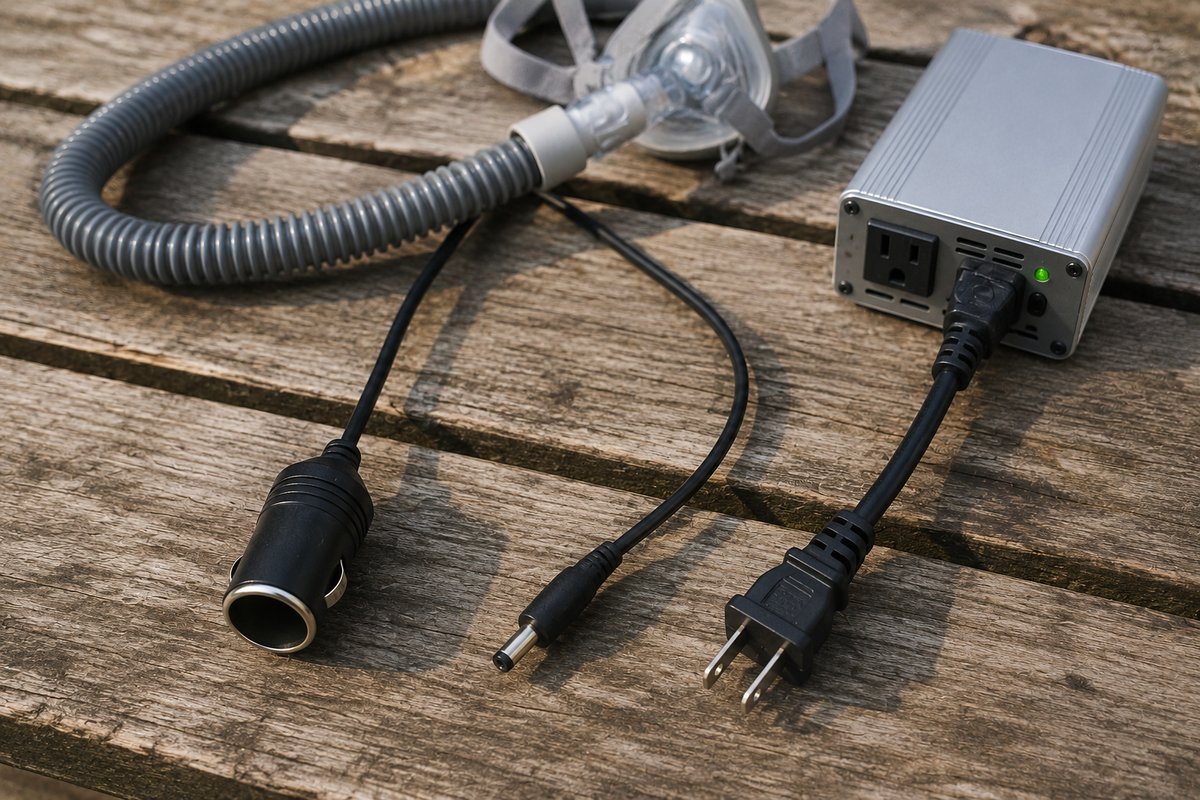
Most CPAP machines run on DC internally. The brick on your power cord converts wall AC to DC before it reaches the machine. That matters off-grid, because if you take a DC battery, invert it up to AC, and then let the power brick convert it back down to DC, you pay a conversion penalty twice for no benefit.
Connecting straight to DC with the right cable for your machine avoids that. It's more efficient, and it's quieter, because a dedicated CPAP battery has no cooling fan while most power stations do. A fan two feet from your pillow is a real consideration when the entire point of the exercise is sleeping well.
The catch is cables. DC connections are machine-specific, and the cable for a ResMed AirSense won't fit a Philips DreamStation. Confirm the exact cable for your model before you order anything, and pack a spare. Our guide to quiet inverters for overnight CPAP use covers the other route in detail, including why a pure sine wave inverter is worth the extra money for medical equipment.
How many nights do you need?
Match the solution to the trip rather than buying for the worst case you can imagine.
- One or two nights. A dedicated CPAP battery in the 95 to 150Wh range does the job and packs small. See CPAP battery backups for camping.
- Three to five nights. A portable power station in the 250 to 300Wh class gives you margin and can charge phones and lights as well. See portable power stations for CPAP users.
- A week or more. Stop trying to carry it all. Pair a mid-size battery with a folding panel and recharge each day. See solar panels to recharge a CPAP battery.
- You already own a house battery. Add a quiet pure sine wave inverter rather than a second battery bank.
How does cold weather change the math?
Lithium batteries lose usable capacity as temperature drops, and most refuse to charge at all below freezing. A battery that comfortably covers a night in July may fall short of the same night in October, and a battery left in an unheated RV overnight can wake up unwilling to take a charge at all.
Two habits fix most of this. Keep the battery inside the sleeping area rather than in a storage bay, and if you're camping in cold conditions, keep it in its case or under a blanket overnight. If your RV spends the winter parked rather than traveling, the same cold that hurts your battery is worth watching for other reasons too, which is where smart temperature sensors and freeze alarms are worth having.
Can you fly with a CPAP battery?
Lithium battery rules are set by watt-hours, and the thresholds are worth memorizing because they shape which battery is sensible to own if you fly at all. The limits come from the FAA, which caps carry-on lithium ion batteries at 100 watt hours and allows two spares between 101 and 160 watt hours only with airline approval.
- Under 100Wh. Allowed in carry-on without asking anyone. This is why so many CPAP travel batteries land at 95 or 99Wh, just under the line.
- 100 to 160Wh. Allowed in carry-on with airline approval, usually limited to two spare batteries. Call ahead.
- Over 160Wh. Not permitted on passenger aircraft. Most portable power stations fall here.
Spare lithium batteries always travel in carry-on, never checked baggage, and CPAP machines themselves don't count against your carry-on allowance as medical equipment. Bring the prescription or the machine's documentation if you want the conversation at security to be short.
How do you use a CPAP while camping?
The same way you use it at home, with one thing added: a decided answer to where the power comes from. The machine doesn't care that it's in a trailer. Everything in this guide exists because that one question has four possible answers and they suit different trips.
The practical differences are smaller than people expect. You need somewhere flat and stable for the machine, distilled water if you run the humidifier, and a plan for the hose that doesn't involve it ending up on the floor.
Is there a special CPAP machine for camping?
Travel machines exist and they're smaller, but for most people the answer is no, and buying one is solving the wrong problem. The obstacle to camping with a CPAP is power, not size, and a smaller machine that still needs a battery hasn't moved you forward.
The exception is anyone carrying gear on their back rather than towing it, where the weight of the machine matters as much as the weight of the battery.
What do people get wrong most often?
- Leaving the humidifier on. The single biggest drain on runtime, and the easiest thing to change.
- Buying on amp-hours instead of watt-hours. Amp-hours mean nothing without a voltage. Multiply them together to compare batteries fairly.
- Using a modified sine wave inverter. Cheap, and hard on the electronics in a medical device. Pure sine wave only.
- Testing for the first time on the trip. Run a full night at home first, every time, with the same cables you plan to pack.
- Forgetting the recharge. A battery is only half a plan on any trip longer than its runtime.
If you are here because of a power cut
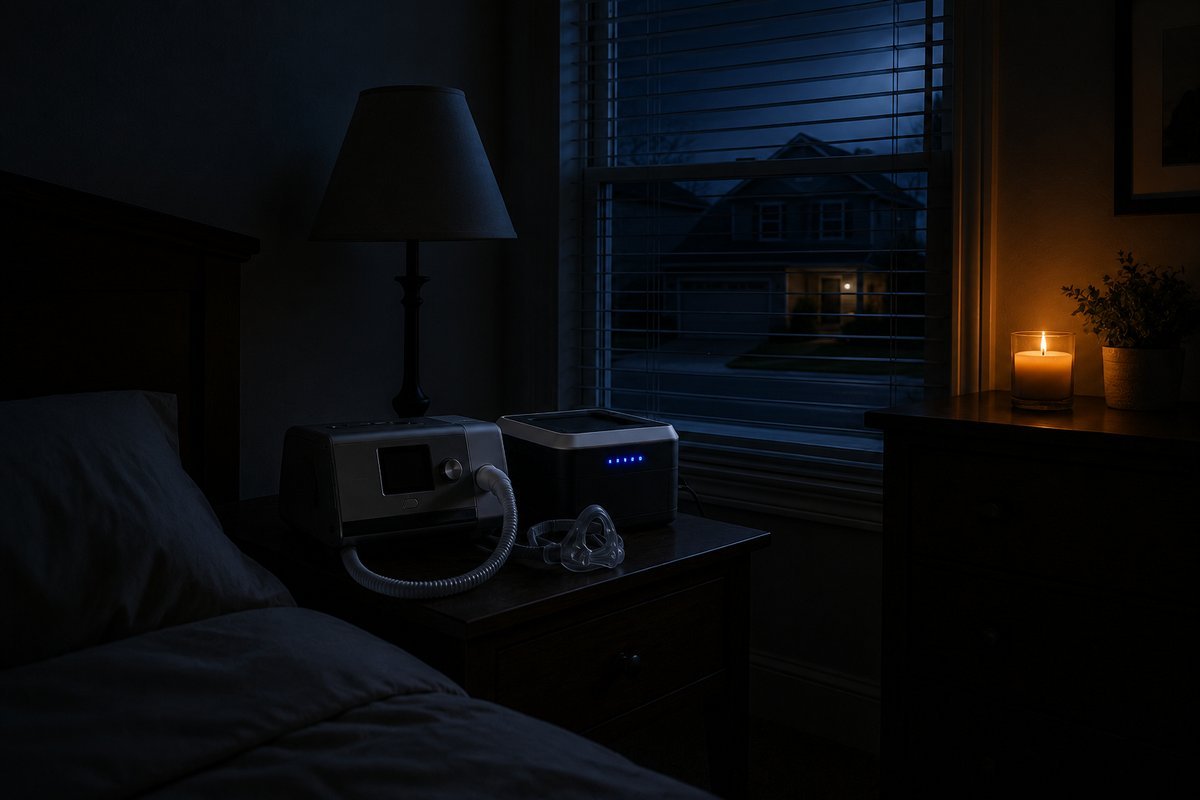
Everything above applies at home too, and the requirements are gentler: you aren't carrying it anywhere, so weight and size no longer matter, and you can simply buy more capacity per pound. A power station in the 300 to 500Wh range covers several nights of CPAP use and keeps phones charged through an outage as well. Keep it charged, and test it twice a year in the same way you would test a smoke alarm.
What does a CPAP power setup cost?
Prices move too often to print, but the shape of the cost doesn't change much, and it's worth knowing before you start comparing listings.
The cheapest route is the one where you already own half of it
If there's already a deep-cycle battery in the trailer, a quiet inverter is the smallest check you'll write. You're buying the conversion, not the storage.
Capacity is what you pay for
Among all-in-one units, cost tracks watt-hours more closely than it tracks brand or features. Doubling your runtime roughly doubles the price, and it more than doubles the weight, which matters more than people expect when the thing has to come out of the truck at night.
Solar is the expensive way to buy the first night and the cheap way to buy the tenth
A panel adds cost without adding a single watt-hour of storage. What it buys is the ability to stop counting nights. For a weekend that's a poor trade. Past four or five days off-grid it becomes the only sensible one.
The costs nobody budgets for
The cable that turns out to be two feet too short. The adapter you need because the panel and the station are different brands. A spare fuse. None of these are large, and you usually discover you need them only once you're at the campsite.
CPAP camping is an electrical problem before it's a comfort problem, and the arithmetic is what decides whether you sleep well or wake up to an alarm. Most CPAP camping problems come from the humidifier, so try a night without it at home first.
Where to go next
If you've read this far you already know which of the four routes fits your trips. The detail, which units are worth buying, what the manuals say, and where the specifications stop being comparable, lives in the four guides below.
Start with portable power stations if you want one box that handles everything. Batteries for camping goes deeper on chemistry and runtime, quiet inverters covers the case where you already own the battery, and solar panels is for trips long enough that recharging matters more than capacity.
One thing worth doing before any of that: check your machine's draw at your own pressure setting, with the humidifier set the way you sleep with it. Every number on this page is a range, and yours sits somewhere specific inside it.
Worked out in advance, CPAP camping is simply camping, which is the point of doing the sums at the kitchen table rather than at a campsite. Keep a note of your machine's DC power requirements with your CPAP camping gear.
Quick Answers
How much of a battery's rated capacity can you use?
Expect about 85 to 95 percent of the rated capacity. Running the CPAP through an inverter loses another 5 to 15 percent in conversion, so a 300Wh battery gives roughly 240 to 270Wh on direct DC and about 210 to 255Wh through an inverter.
DC direct or through an inverter?
Direct DC is usually better. Most CPAPs run on DC internally, so going from battery to inverter to the power brick converts the power twice and wastes energy. A DC cable made for your exact machine avoids that and is usually quieter.
How many nights do you need?
One or two nights: a 95 to 150Wh CPAP battery. Three to five nights: a 250 to 300Wh power station. A week or more: a mid-size battery plus a folding solar panel to recharge each day.
How does cold weather change the math?
Lithium batteries lose usable capacity as temperature drops, and most refuse to charge at all below freezing. A battery that comfortably covers a night in July may fall short of the same night in October, and a battery left in an unheated RV overnight can wake up unwilling to take a charge at all.
Can you fly with a CPAP battery?
Lithium battery rules are set by watt-hours, and the thresholds are worth memorizing because they shape which battery is sensible to own if you fly at all. The limits come from the FAA, which caps carry-on lithium ion batteries at 100 watt hours and allows two spares between 101 and 160 watt hours only with airline approval.
What do people get wrong most often?
Leaving the humidifier on, comparing batteries by amp-hours instead of watt-hours, using a modified sine wave inverter, testing for the first time on the trip, and forgetting a way to recharge.
For more on keeping a CPAP running off-grid, see our other CPAP Power Setups guides.