
RV battery testing takes about two minutes and one cheap tool, and many people do it wrong. Not because the test is hard, but because they read the number off the wrong table and take it at the wrong time.
A resting voltage tells you how full the battery is. A load test tells you whether it can still do any work. Those are different questions, and a battery can pass the first and fail the second. RV battery testing before storage tells you whether the battery is worth maintaining at all.
Quick answer
Disconnect the battery, leave it alone for at least six hours, then read it with a meter. On a flooded lead acid battery Trojan puts 12.73 volts at full and 12.10 volts at half. AGM reads slightly higher. Lithium barely moves at all, so voltage won't tell you much on that chemistry. If it holds a decent voltage and still dies overnight, that is a load problem and needs a load test, not another voltage reading.
Table of Contents
How can you tell if an RV battery is bad?
Four symptoms, in the order they usually show up.
- It reads fine in the morning, and the lights are dim by ten at night. That's capacity, not charge.
- It takes a charge in an hour or two, then drops quickly. A battery that has lost capacity fills faster, not slower, because there's less room left to fill.
- It sits at a low voltage no matter how long the charger runs.
- It reads zero, or close to it, with the charger connected and running.
The first two are common, and neither appears in a single voltage reading. That is why the rest of this article is about two different tests rather than one.
Which battery do you have, and does it need water?
Before any of the numbers below mean anything, find out what is sitting in the box. It takes one look at the top of the battery.
- Anything on the top you can open. That's flooded lead-acid, the wet-cell type. It shows up two ways: six individual round screw caps in a row, or one long raised cover strip running down the length that lifts off horizontally and opens every cell at once. It's the only one of the three that needs water, and the only one a hydrometer works on.
- A flat sealed top with no caps, and the case is heavy for its size. That's AGM or gel. Nothing to open, nothing to add. Trying to pry a vent strip off an AGM battery to top it up will ruin it.
- A flat sealed top, a light case, and often a small display or a Bluetooth logo. That's lithium, LiFePO4. No water, no maintenance, and a voltage curve so flat that the usual state of charge table tells you almost nothing.
If yours is the flooded kind, check the water level every month or two in warm weather, and before you read the voltage. The plates have to stay covered. Top up with distilled water only, to about a quarter inch above the plates, and do it after charging rather than before, because the level rises as the battery charges.
A flooded battery that has been run with the plates exposed has already lost capacity that no charger brings back, so a low reading on a dry battery isn't a charging problem. It's the damage from the months it went unchecked.
Read the table for your battery, not somebody else's
Every chemistry has its own voltage curve, and the numbers people quote in campgrounds usually come from a flooded lead-acid table applied to something else. The gaps are small in volts and large in meaning.
Flooded lead-acid, the deep-cycle batteries most travel trailers leave the factory with. Trojan publishes a 12-volt table:
| State of charge | Resting volts |
|---|---|
| 100 percent | 12.73 |
| 50 percent | 12.10 |
| 0 percent | 11.51 |
AGM reads a little higher at every point. Lifeline publishes above 12.78 volts at full, 12.18 at half, and below 11.58 at empty. Use an AGM table on an AGM battery, and you will read it about five percent low all day.
Lithium is very different, and the table below is the reason this article exists. These are Battle Born's published figures for one of its 100 amp-hour batteries at rest:
| Resting volts | Remaining capacity |
|---|---|
| 13.6 | 100 percent |
| 13.3 | 90 percent |
| 13.2 | 70 percent |
| 13.1 | 40 percent |
| 13.0 | 30 percent |
| 12.9 | 20 percent |
| 12.0 | 9 percent |
| 10.0 | 0 percent |
Look at what happens between 13.2 and 13.1 volts. One tenth of a volt covers thirty percent of the battery. Renogy publishes a table for LiFePO4 that lands in the same place, so this is the chemistry rather than one brand.
Two things follow. A cheap meter that reads to one decimal place is useless on lithium. And a lithium battery sitting at 12.9 volts, which looks nearly flat on a lead-acid table, is at twenty percent and about to shut off rather than nearly full.
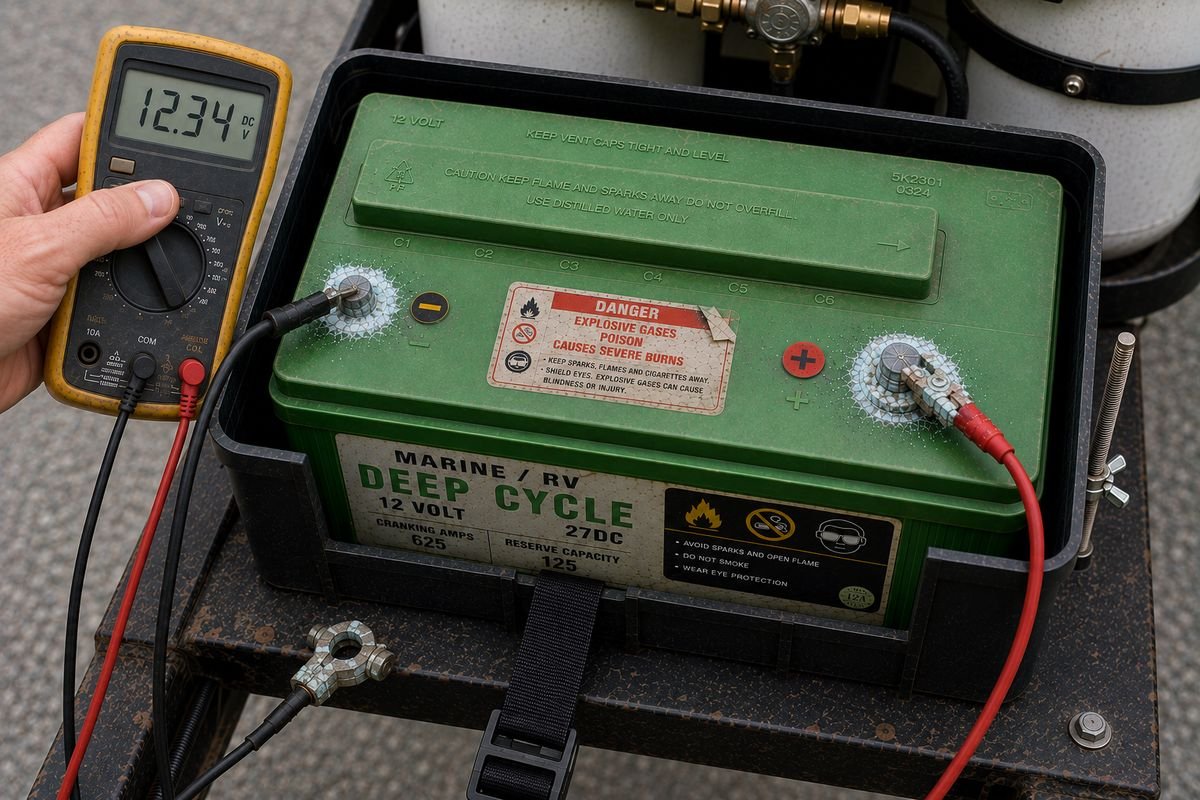
The reading you just took is probably wrong
This is the step most people skip, and it's where most RV battery testing goes wrong. It's the difference between a number that means something and a number that only looks reassuring.
A battery has to rest before it reads true. Trojan is specific about how long: batteries must remain idle, no charging and no discharging, for at least six hours and preferably twenty-four. Lifeline asks for a minimum of four hours with the battery shut off from both its charging source and its load.
Read it ten minutes after the charger switches off, and you're reading surface charge, which reads falsely high. Read it while the fridge control board is awake and you're reading it under load, which sits low.
And your battery is almost never truly at rest while it's connected. The propane leak detector alone is a constant draw. MTI publishes 100 milliamps at 12 volts for its Safe-T-Alert RV series, which is 2.4 amp hours a day out of a battery doing nothing, before the radio memory and the CO alarm. That is why an accurate version of this test starts by disconnecting the negative cable and walking away.
- Turn off the converter or unplug from shore power, and switch the battery disconnect off if you have one.
- Take the negative cable off the battery post. One wrench, one minute.
- Leave it overnight. Six hours is the floor, and a full day is better.
- Touch the meter's red probe to the positive and the black to the negative, set to DC volts, and read it to two decimal places.
- Compare it to the table for your chemistry, not to the one you remember.
The hydrometer test, and which batteries it works on
If your battery has a cover or caps you can lift off, a hydrometer is worth the small cost, though most people don't own one. It draws a sample of acid from a single cell and floats a scale in it. Denser acid means more charge. Trojan publishes 1.277 or greater as full, 1.172 at half charge, and 1.073 at empty, corrected by four points for every ten degrees away from 80°F.
The reason to bother is that it reads each cell individually. Six cells within about fifty points of each other is a healthy battery. If one cell is far below the rest, that cell is dead, and charging won't bring it back, which means a replacement rather than more time on the charger. A voltmeter reads all six together and averages out the bad one.
It only works on flooded batteries you can open. AGM and lithium are sealed, so there's nothing to sample. Wear eye protection and gloves, because the electrolyte is sulfuric acid and the squeeze bulb drips.
Load testing, the other half of RV battery testing
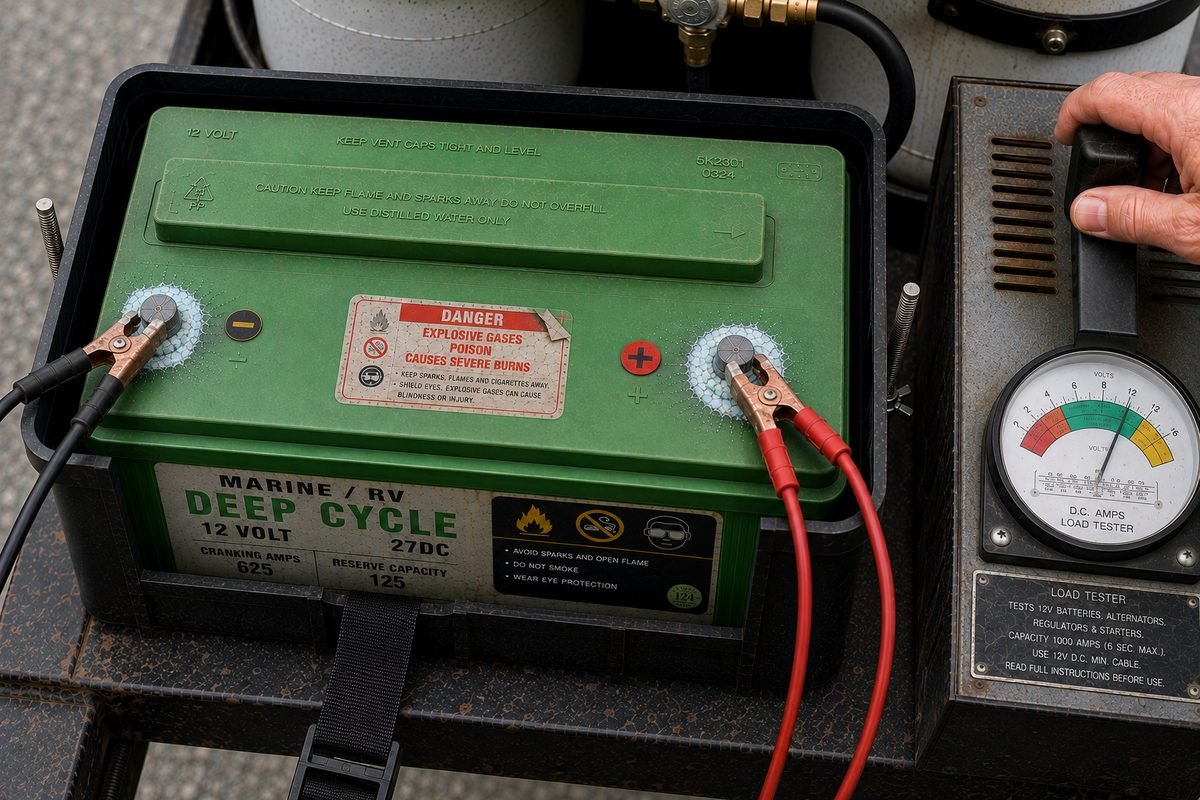
Voltage says how full. A load test says whether the battery can still deliver. A tired deep-cycle battery often reads perfectly fine at rest and collapses the moment it's asked for current.
Lifeline publishes a real capacity procedure in its technical manual: discharge at a constant 25 amps until voltage falls to 10.5 volts, and record the time in minutes. Compare that against the rated capacity, and you have a number that means something.
A handheld load tester is the campground version of that. It applies a fixed load across the battery for about 10 seconds and shows you how the voltage responds. A healthy 12-volt battery should hold up in the mid-11s or better through the test and recover quickly afterward. One that drops toward 10 volts and stays there is finished, whatever it reads at rest the next morning.
One caveat. Most handheld testers on the shelf were designed around cranking batteries, and a deep-cycle battery is built for a long, slow draw rather than a short, heavy one. We couldn't find a manufacturer or standards body that publishes a statement on whether a cranking-style load test is valid for a deep-cycle battery in Trojan's, Lifeline's, or Battery Council International's public documents. Treat the handheld result as a pass-or-fail signal rather than a measurement, and use the Lifeline-style timed discharge if you want a number.
When is it dead?
There's a number for this, and it's lower than most people expect. Lifeline's technical manual says that if the battery delivers less than 50 percent of its rated capacity, it should be replaced.
That threshold is lower than many owners assume. A 100-amp-hour battery that still gives you 55 usable amp-hours is, by its maker's own standard, still in service. The widely repeated figure is 80 percent, and we couldn't find that threshold published by Trojan, Interstate, or Battle Born in their public documents. If somebody quotes you 80 percent, ask where it comes from.
Two failures don't need a test at all. A battery that won't accept a charge after a proper attempt with a good charger. And one that reads close to zero volts with the charger connected and running, which usually means a shorted cell.
Why it died early: the 50 percent rule
Deep cycle doesn't mean bottomless. Trojan recommends discharging only 20 to 50 percent of rated capacity in normal use and treats 80 percent as the outer limit, not a target.
Lifeline arrives at the same place from the other direction, telling you to size the bank at twice what the load needs so the average discharge lands near 50 percent.
The practical version: a single 100-amp-hour battery is a 50-amp-hour battery in daily use. If your overnight draw is 45 amp-hours, you don't have a testing problem. You have a battery that's being asked to end every night at the bottom of its range. That shows up as a battery that tests badly after one season.
Cold weather changes the numbers
Temperature moves the target, and both makers publish a correction.
Trojan gives 0.0028 volts per cell for every degree Fahrenheit away from 77°F on the charging voltage, added when it's colder and subtracted when it's warmer. Lifeline publishes 0.0022 volts per cell per degree, which works out to about 0.013 volts per degree on a 12-volt battery.
Heat is the quieter threat. Lifeline states plainly that battery life decreases by 50 percent for every 18°F (10°C) rise in temperature, which is the argument for where the battery lives rather than how you test it.
We looked for a published figure on how much capacity you lose in cold weather and didn't find one from Trojan, Lifeline, or Battle Born. Battle Born publishes an operating range down to 4°F, but no derating curve.
What to buy
The two that do the actual work. A digital multimeter is the whole test for most people, and it doesn't need to be expensive: the AstroAI digital multimeter reads DC volts to two decimal places, which is the resolution the lithium table above demands, and it will also find the parasitic draw that's flattening your battery. Most people can stop there.
If you're on your second or third battery in a few seasons and yours has caps or a cover you can lift, the EZRED SP101 hydrometer is the one tool that finds a single bad cell, which is the thing a voltmeter averages away.
Worth having if you keep replacing batteries. A load tester answers the question a voltmeter can't: whether the battery still works, rather than how full it is. The Battery Tender 100-amp load tester covers 12 volts at 100 amps and 6 volts at 50 amps, which matters if you run a pair of golf cart batteries. Read the caveat above about cranking-style testers on deep-cycle batteries before you treat its result as final.
Skip. Any tester whose display reads to one decimal place, because it can't resolve a lithium battery at all. Skip the plug in battery monitors that read at the panel while everything is awake, since they can't give you a resting voltage. And skip replacing a battery on a single voltage reading taken ten minutes after the charger shut off, which is the most expensive mistake in this article.
What it comes down to
RV battery testing comes down to two questions asked in the right order. Disconnect it, leave it overnight, read it to two decimal places, and compare it to the table for the chemistry you own. That answers how full.
If it reads well and still dies early, stop measuring voltage and put a load on it. That answers whether it's worth keeping. And if you're asking more than half of a lead acid battery every night, the test isn't going to tell you anything the battery hasn't already told you. Do your RV battery testing with the battery rested, not straight off a charger.
Quick Answers
How can you tell if an RV battery is bad?
It reads fine in the morning and dies by evening, it charges much faster than it used to, it won't come up no matter how long the charger runs, or it reads near zero with the charger running. The first two are capacity problems and won't show up in a single voltage reading.
What voltage means an RV battery is dead?
On a flooded lead acid battery Trojan puts 0 percent charge at 11.51 volts and 50 percent at 12.10 volts. On lithium the numbers are completely different: Battle Born publishes 12.9 volts as 20 percent remaining, so a lithium battery at 12.9 is nearly empty rather than nearly full.
How long should an RV battery rest before testing?
Trojan says at least six hours with no charging and no discharging, and preferably twenty four. Lifeline asks for at least four hours disconnected from both charger and load. A reading taken minutes after the charger shuts off is surface charge and reads high.
Can you test an RV battery while it is still connected?
Not accurately. The propane leak detector alone draws a constant 100 milliamps at 12 volts on the MTI Safe-T-Alert RV series, so a connected battery is never truly at rest. Take the negative cable off and leave it overnight.
Does a voltage test work on a lithium RV battery?
Barely. Battle Born's published table puts 13.2 volts at 70 percent and 13.1 volts at 40 percent, so one tenth of a volt covers thirty percent of the battery. You need a meter that reads two decimal places, and even then voltage is a rough guide on LiFePO4.
At what point should an RV battery be replaced?
Lifeline's technical manual says replace it when it delivers less than 50 percent of rated capacity. The 80 percent threshold that gets quoted widely wasn't found published by Trojan, Interstate or Battle Born.