
A manual RV awning and an electric one do the same job once they're open. The choice between them is a choice about failure modes: a hand crank that never needs power, or a switch that can fail at the worst possible moment, in the rain, with the awning half out.
Table of Contents
What is the actual difference between a manual and an electric RV awning?
Both use the same roller tube and spring-tension arm hardware. A manual awning opens with a hand crank or pull strap, no power needed at all. An electric one runs on a 12 volt motor built into the roller tube, opening and closing at the push of a button or a remote, with no separate inverter required since it runs straight off the RV's own 12V system.
What are the advantages of a manual awning?
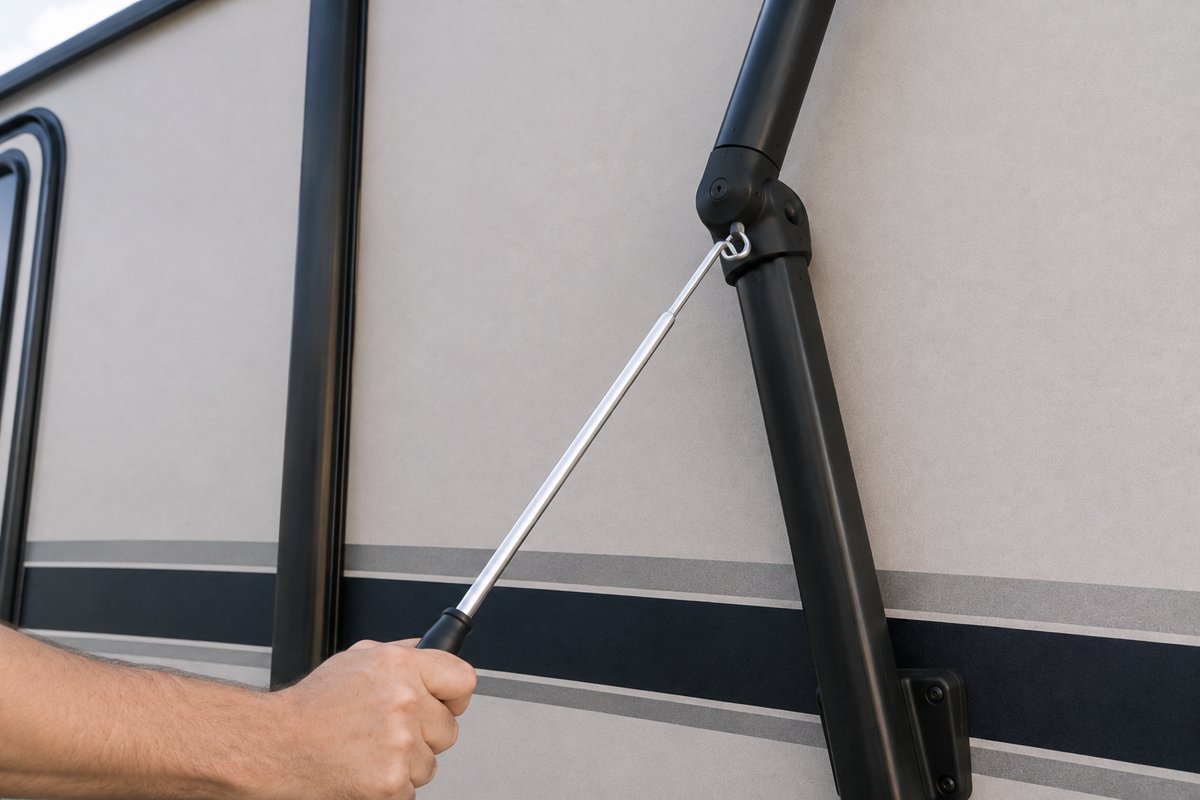
Dometic, which makes both types, is upfront that the case for manual comes down to power independence: it works with no energy supply at all, which matters if the battery is low or the RV has been sitting for weeks. It's also faster to open by hand than most people expect, since there's no motor cycle to wait through. For someone who's stopping for one night and leaving early, that speed adds up over a season of short stays.
What are the advantages of an electric awning?
The appeal is entirely about convenience. One button opens or closes it, and a remote means it can be operated from a distance, which helps on a taller Class A or a fifth wheel where reaching a manual crank means a stepladder. Running off the RV's existing 12V system means there's no separate battery or inverter to add.
Which one is more reliable long term?
This is the gap in the research. Dometic's own comparison focuses entirely on operational convenience and doesn't publish anything comparing failure rates or long-term reliability between manual and electric versions.
What is documented, in Dometic's own 9100 Series operation manual, is what happens when an electric motor does fail: the fabric roller tube stays under spring tension the whole time, so a failed motor doesn't mean a stuck awning, it means a pull-strap manual release procedure done carefully, because the tube will try to close quickly and unexpectedly the moment it's released. A defective motor past that point needs a qualified technician, not a DIY fix.
A manual RV awning has fewer parts that can fail in the first place, simply because there's no motor, gearbox or switch in the chain. That's a mechanical fact, not a manufacturer's claim, and it's the closest thing to a reliability answer either brand publishes.
Can you replace an electric awning with a manual one?
Owners doing exactly this swap report that the arms and roller tube hardware are largely shared across a manufacturer's manual and electric lines, with the motor and its wiring being the main difference. It's a real option if an electric motor has failed and the cost of a manual conversion undercuts a motor replacement, though the exact parts needed depend on the specific awning model and are worth confirming against the manufacturer's part diagrams before ordering anything.
How do you retract an electric awning when the battery is dead?
Every powered awning has a way out, and the three big brands do it three completely different ways. Knowing which one is on your RV is the difference between a ten minute job and a ruined afternoon, and the time to find out isn't while it's raining.
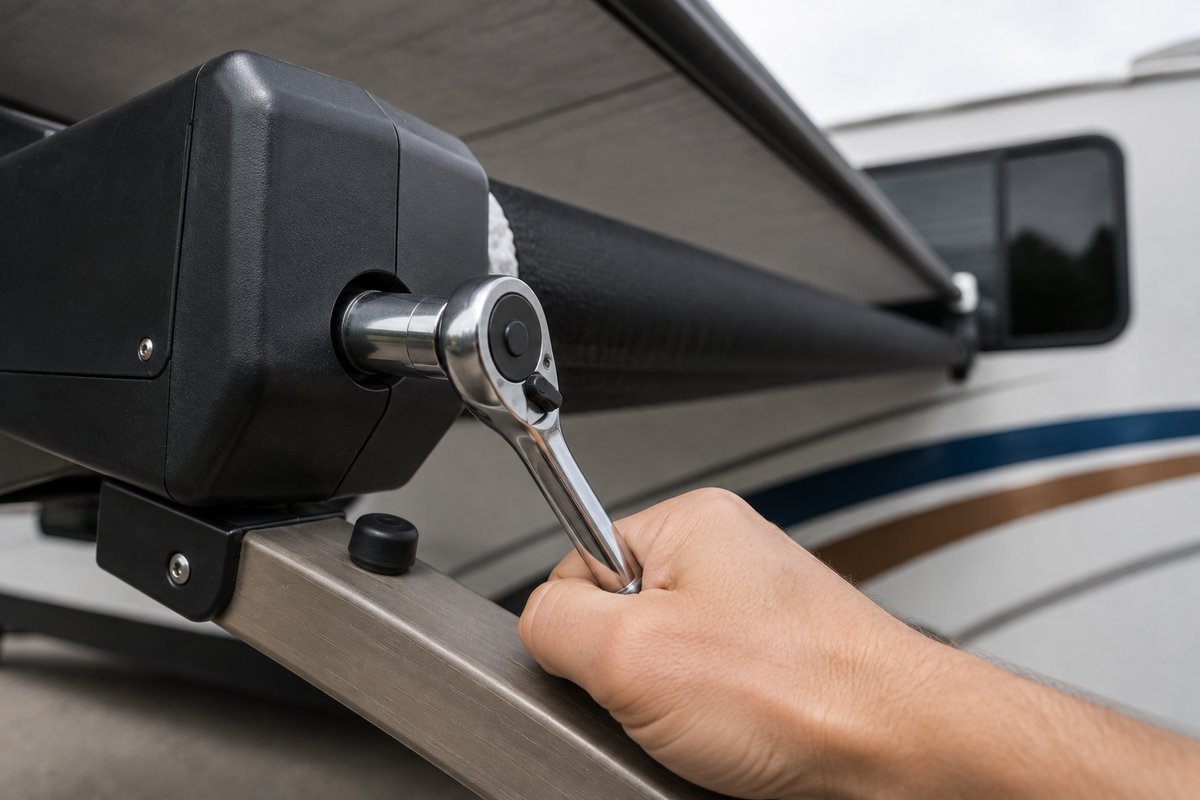
Lippert Solera is the easiest of the three. Pull the rubber grommet off the drive head and there's a nut underneath. The owner manual says to use a 7/16 inch socket and a cordless drill, and spin it counterclockwise to retract. A ratchet works too, it just takes longer.
Carefree has no crank and no nut. There's nothing to turn. The Eclipse manual tells you to attach the supplied jumper wires, the short pair of wires with clips on the ends, to the terminals on the back of the motorized head and connect the other ends to a 12 volt source, which can be another battery or a cordless drill battery. It's firm about the common mistake: "Do not use a 110V power source for the emergency override procedure!" So don't throw out the jumper wires that came with the RV.
Dometic gives you two options and neither is quick. The 9100 manual describes an auxiliary battery method needing 16 gauge wire and a 3 amp inline fuse on the positive lead. The alternative is the pull strap, and that one takes "a 5/32 hex key, and help from at least one other person" plus removing two screws from the top casting. On a WeatherPro, once the pull strap release has been used the manual says the awning has to be serviced before it's used again.
There's one more thing worth knowing, and it's the most important point in this section. A Dometic WeatherPro refuses to move once system voltage drops below about 10 volts, flashing a yellow light instead of running. A low battery doesn't make a powered awning slow. It makes it stop, at the exact moment you want it in.
How windy is too windy for an awning?
This is the most asked question about RV awnings, and none of the manufacturers checked for this article answer it. It matters more if you hang anything on the awning, which is why an RV awning shade comes with its own set of warnings. Nobody publishes a wind speed an extended awning can survive, on either the manual or the electric side.
What does get published is a number for when to put it away, and it comes from the coach builders rather than the awning makers. Keystone tells owners to retract the awning once winds exceed 15 to 20 mph, and says plainly that most awnings aren't built to withstand strong winds or heavy rain. Carefree gives no figure at all, only that the effects of wind and rain are "unpredictable and can cause severe damage." Lippert says to retract completely during high wind, heavy rain, or extended time away from the RV.
The wind sensor on a powered awning isn't the answer people assume, either. Carefree's system doesn't measure wind. It watches the roller tube for movement, on a sensitivity scale of 1 to 5 with a factory default of 3, and the Altitude manual states the limit directly: "no autoretract system is a guarantee against severe or destructive weather."
That cuts both ways on the question this article is about. A wind sensor is only possible on a powered awning. A manual RV awning can't retract itself, ever, so the reliability argument for it comes with a tradeoff: nothing is going to save it while you're at the grocery store.
The last piece is what happens afterward. The Dometic awning warranty excludes "failure or damage caused by storms, rain, water pooling, or any acts of God," and that exclusion reads the same whether a motor is involved or not. Weather damage is yours either way.
Which awning do you already have?
Almost everything below depends on knowing what is on the RV now, and few guides explain how to check.
The identification tag is on the roller tube itself, at the right hand end as you stand facing the side of the camper. That is where the manufacturer name and the model number are. Reading it takes about thirty seconds with the awning rolled out, and it settles which manual applies to you, which override procedure you have, and which parts will fit.
Size is the other number, and it's the one people get wrong. An awning is measured from the center of one arm to the center of the other, not across the fabric. The canopy is cut roughly ten inches shorter than the stated size, so measuring the old fabric gives you a number that matches nothing you can order. Vinyl also shrinks as it ages, which makes a tape measure across an old canopy worse than no measurement at all.
Measure the drop while you're there, from the awning rail straight down. Arm sets come in a few standard lengths, and the vertical space you have is what decides which one fits.
What does converting one to the other involve?
The two directions aren't equally possible, and that is the part most comparisons leave out.
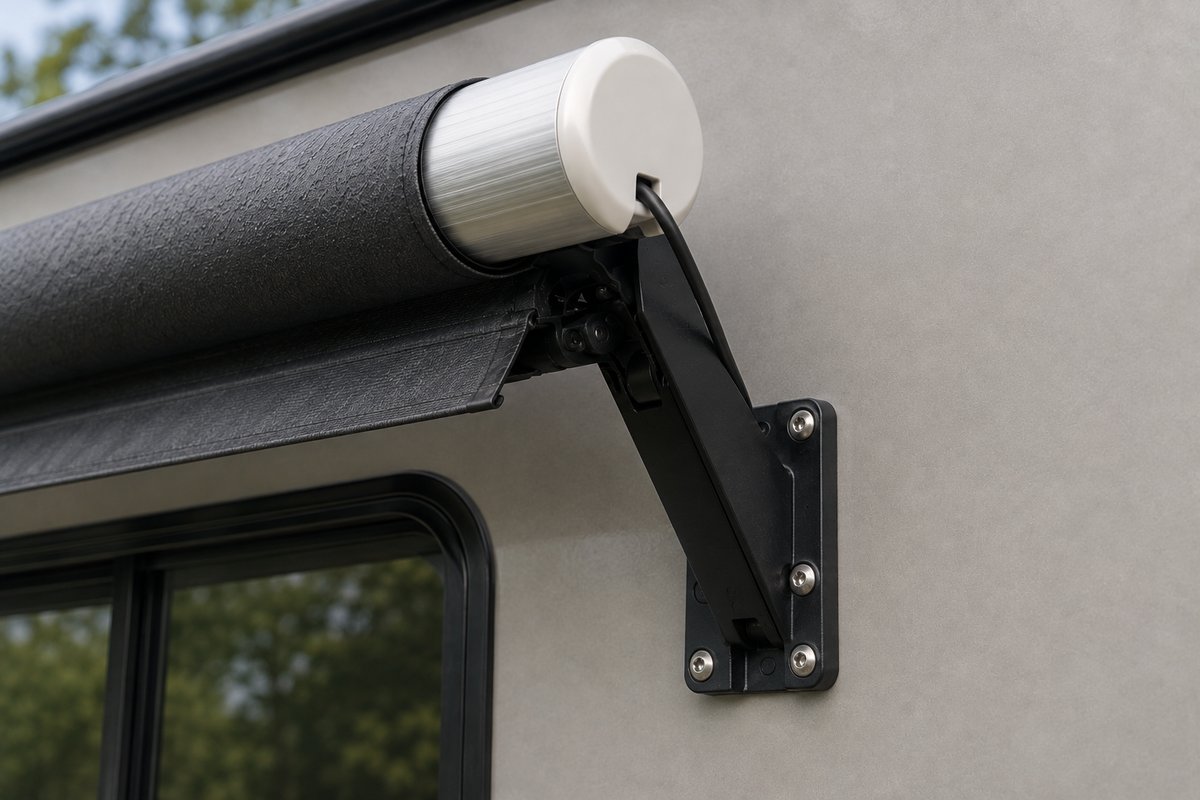
Manual to electric is a real product you can buy. Lippert publishes a manual pull style to power conversion kit that swaps the heads and keeps the existing roller and fabric, shipping a drive head, an idler head, a wire harness and power feed, ten wire covers and a switch assembly.
Carefree sells a motor upgrade kit for its Freedom range on the same principle. The catch is fitment. A head swap kit fits that brand of manual awning and not others, so a manual awning from a different maker usually needs the full arm replacement kit instead of the simple one.
Wiring is the other half of it. An RV that came with a manual awning almost certainly has no 12 volt feed waiting at the awning rail, which is why every kit ships its own harness and a set of covers to run the wire on the outside under trim. Lippert also sells a battery powered version of the conversion specifically so owners can avoid running wire inside the wall, and the existence of that product is the clearest evidence that a pre-wired manual awning isn't the normal case.
Going the other way, electric to manual, there's no kit from any manufacturer we checked. The obstacle isn't the motor. A manual RV awning mounts its lower arm brackets much further down the sidewall than a powered awning does, into an area of wall that usually has no structural backer behind it. That is a wall repair rather than a swap, and it leaves a row of rivet holes to seal where the old brackets were.
Have there been recalls on either type?
Yes, and the pattern is worth knowing before you choose.
Two of them are motor and gearbox faults on powered awnings, and both describe the same alarming outcome. In NHTSA campaign 13V-357, Dometic 9100 power awnings had "a certain electric motor design that is subject to damage," with the consequence that "the awning may unwind unexpectedly either in transit, or while parked."
In recall 22V-863, 4,521 Winnebago Revels were recalled because "there is a potential for the awning gearbox housing to fail, which can result in an unintended awning deployment." Part of that remedy was a firmware update, which is a category of failure a hand crank can't have.
Electric awnings aren't the only ones with recalls. Lippert recalled awning fabric in 2022 over a heat welded seam that could separate and let the canopy come away from the side of the vehicle, and fabric is fabric on both types.
A manual RV awning also has a risk of its own.
The spring inside the roller is under serious tension, and Carefree's own service manual warns that "when removed from the arm, the spring is under extreme tension and will unwind quickly," that "a broken spring can still retain winds under tension," and that closing the roller lock with the end plug detached lets the spring unwind "quickly with significant force." Fewer parts to fail doesn't mean the failures are gentler. It means there's one part you shouldn't take apart yourself.
What it comes down to
Pick a manual RV awning if speed and zero power draw matter more than convenience, especially for short stops or full-time camping without hookups. Pick electric if the RV is tall enough that reaching a crank is a genuine hassle, or if one-button operation matters more than the extra reliability of having fewer moving parts. Neither manufacturer publishes a real answer on which lasts longer, so that part of the decision comes down to how much you value having no motor to fail at all.
Quick Answers
What is the actual difference between a manual and an electric RV awning?
Both use the same roller tube and spring-tension arm hardware. A manual awning opens with a hand crank or pull strap, no power needed at all.
What are the advantages of a manual awning?
Dometic, which makes both types, is upfront that the case for manual comes down to power independence: it works with no energy supply at all, which matters if the battery is low or the RV has been sitting for weeks. It's also faster to open by hand than most people expect, since there's no motor cycle to wait through.
What are the advantages of an electric awning?
The appeal is entirely about convenience. One button opens or closes it, and a remote means it can be operated from a distance, which helps on a taller Class A or a fifth wheel where reaching a manual crank means a stepladder.
Which one is more reliable long term?
This is the gap in the research. Dometic's own comparison focuses entirely on operational convenience and doesn't publish anything comparing failure rates or long-term reliability between manual and electric versions.
Can you replace an electric awning with a manual one?
Owners doing exactly this swap report that the arms and roller tube hardware are largely shared across a manufacturer's manual and electric lines, with the motor and its wiring being the main difference. It's a real option if an electric motor has failed and the cost of a manual conversion undercuts a motor replacement, though the exact parts needed depend on the specific awning model and are worth confirming against the manufacturer's part diagrams before ordering anything.
Related Guides
- How to clean an RV awning, without the mistakes that damage the fabric, whichever type you end up with.
- RV roof sealant, which one your roof needs, and why the rules for a coating aren't the rules for a seam.