
You hitch up, walk to the front of the truck, and the nose is sitting higher than it should. The headlights point too high. That is the problem a weight distribution hitch for a travel trailer is built to solve, and the question everyone asks next is whether they need one.
The short answer is that it depends on two numbers, and neither of them is the one people usually quote.
Table of Contents
Do you need a weight distribution hitch for a travel trailer?
Start with your tow vehicle's own guidance, because that is the only source with authority over your specific truck.
Ford's towing guide sets it by hitch class. For Class III, covering 3,501 to 5,000 pounds, a weight distributing hitch is "not required unless specified for a particular vehicle." Above 5,000 pounds, Class IV, "most applications require a conventional weight-distributing or 5th-wheel hitch."
Ram's guidance is less strict and uses the same number: a weight distributing system is recommended for trailers over 5,000 pounds.
GM's rule is different, because its requirement is narrow and specific rather than general. On heavy duty trucks it mandates a weight distributing hitch only on vehicles fitted with on/off road or mud terrain tires pulling trailers over 10,000 pounds. Different tires, different rule.
Blue Ox, which builds the hitches rather than the trucks, puts the practical line lower: most midsize and half ton trucks will need one at 5,000 pounds or more. It also says to defer to the vehicle manual, which is the right instinct.
So there's no single industry threshold. What there is, roughly, is this: under 3,500 pounds you're unlikely to need one, over 5,000 pounds you probably do, and in between it depends on your truck and how the trailer is loaded.
The number that matters more than trailer weight
Tongue weight is the better test, and here the industry agrees.
Tongue weight should be 10 to 15 percent of gross trailer weight. Equal-i-zer, Fastway, Weigh Safe, Reese and GM all publish that range. Ford and Ram use a flat 10 percent when calculating tow ratings.
Equal-i-zer states the consequence plainly: towing with a tongue weight above 15 percent or below 10 percent of gross trailer weight greatly increases the likelihood of loss of vehicle control. Reese adds the specific failure mode, which is that too little tongue weight tends to produce sway.
One correction worth making, because you will run into it. CURT's own page on choosing a hitch says tongue weight should be 10 to 15 percent of your tow vehicle's gross weight. Every other manufacturer, and CURT's own installation sheets, say trailer weight. Treat the tow vehicle version as an error on that page.
You will also see a rule quoted that you need a weight distribution hitch once the trailer exceeds half the weight of the tow vehicle. We couldn't find that published by Ford, GM, Ram, Equal-i-zer, Fastway, CURT, Blue Ox, Andersen or Weigh Safe. It may be sound advice. It isn't, as far as we can tell, anybody's published specification.
Is a weight distribution hitch required by law?
Mostly no, with one exception that surprises people.
There's no federal standard covering trailer hitches. The Federal Motor Vehicle Safety Standards cover brakes, lighting and occupant protection, and hitches aren't among them. They're governed instead by SAE J684, a voluntary industry standard.
Most state law asks only that the hitch be adequate. California requires a coupling that is "structurally adequate for the weight drawn." Texas requires a connection "strong enough to pull all weight drawn." Neither mentions weight distribution.
Then there is Iowa. Iowa Code section 321.430 requires that every trailer of 3,000 pounds or more gross weight carry an auxiliary means of applying the trailer brakes from the cab, "and shall also be equipped with a weight equalizing hitch with a sway control."
That is a hard requirement for both a weight distribution hitch and sway control, at a threshold most travel trailers clear easily. The statute exempts trailers and semitrailers towed by a truck or truck tractor from the hitch rule, but that exemption doesn't name travel trailers, so a travel trailer behind a pickup still needs the hitch and sway control.
Washington takes a third approach. WAC 204-70-060 doesn't require a weight distribution hitch, but it does require hitches to be tested and labeled by the manufacturer to SAE J684, in the July 2005 revision the rule names, with the maximum gross trailer weight and maximum tongue weight shown, and makes it unlawful to exceed the tongue weight on that label. The manufacturer's sticker becomes legally binding.
We checked California, Texas, Washington, Iowa, Pennsylvania, Illinois and Wisconsin. We didn't check all fifty, so treat Iowa as proof that these rules exist rather than as the only one.
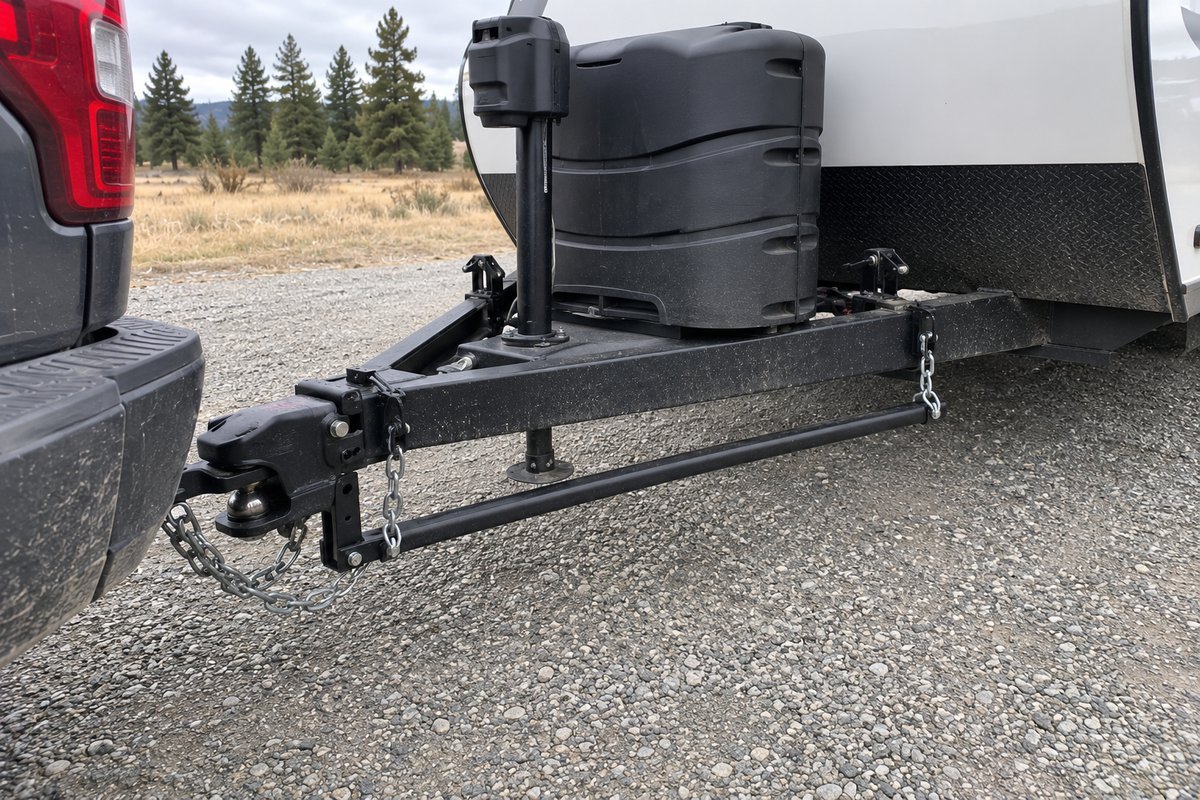
How does a weight distribution hitch work?
It's a lever, not a spring.
When you drop a loaded trailer tongue onto a ball behind the rear axle, that axle becomes a pivot. The tongue pushes the back of the truck down and lifts the front, taking weight off the steering axle. Equal-i-zer describes the fix as transferring tongue weight from the rear axle of the tow vehicle to the front axle and to the trailer axles.
The spring bars do that work. Ram's own description is that the system applies leverage through spring bars, giving a more level ride with improved steering and braking control. Tension the bars and they push down on the trailer frame and up on the ball mount, which rotates load forward onto the front wheels and backward onto the trailer wheels.
What it doesn't do is add capacity. Ford is explicit that the redistributed load still can't push the vehicle past its rear axle rating or its gross vehicle weight rating. A weight distribution hitch moves weight around. It doesn't make weight disappear.
And it doesn't guarantee stability. Fastway and Weigh Safe both publish the same sentence: no hitch setup guarantees that trailer sway will be altogether avoided.
Does a weight distribution hitch stop trailer sway?
Not by itself, and this is the most common misunderstanding in the category.
Weight distribution and sway control are two different jobs. Fastway puts it carefully: weight distribution is one of the many things that reduces sway. It helps, because correct tongue weight and a level RV are both stabilizing. It isn't a sway control device.
Some hitches include one. Equal-i-zer's four point system uses steel on steel friction where the spring arms meet the L brackets and where the sockets meet the head. Blue Ox SwayPro and Husky Center Line use cam and geometry designs. Andersen uses a tapered ball pressed into a friction liner by the trailer's own tongue weight. CURT's TruTrack combines both functions in one product.
Plain round bar and trunnion kits don't include sway control. CURT's installation sheet for those recommends adding a separate friction sway control device to help minimize the effects of sudden maneuvers, wind gusts and buffeting from passing vehicles.
So if your trailer still sways with a weight distribution hitch fitted, the usual causes are tongue weight outside the 10 to 15 percent window, an adjustment that isn't doing what you think it is, or a hitch with no sway control in it at all.
What to do when sway starts
The manufacturers disagree here, which is worth knowing before you need the answer.
Draw-Tite's instruction is to take your foot off the gas and hold the wheel as steady as possible, and explicitly not to brake and not to speed up. Ford's guidance is to activate the trailer brakes by hand using the brake controller, which applies braking to the trailer only and pulls the RV straight.
Both are trying to do the same thing, which is to stop the trailer pushing the tow vehicle. Know which one your equipment's manual tells you to do before you're doing it at 60 miles an hour.
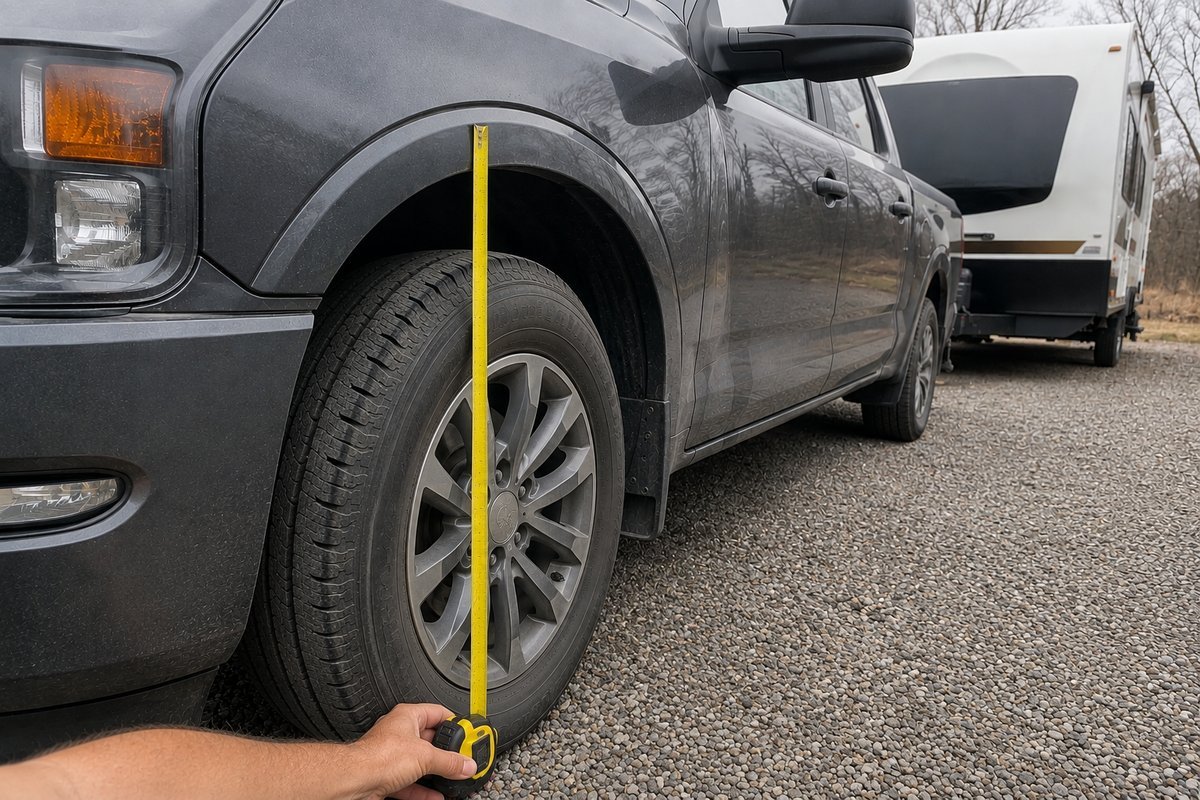
How do you know if it is set up correctly?
There's a real measurement for this.
The method is the same everywhere. Park on level ground. Measure the height of the front wheel opening with the trailer uncoupled. Couple the trailer with no weight distribution applied and measure again. Apply the spring bars and measure a third time.
The first measurement is where the truck sits naturally. The second shows how far the front end lifted. The third shows how much of that you put back.
Where the manuals differ is in how they express the target.
Equal-i-zer's 16K manual and the Fastway e2 manual both publish the formula and both say good adjustment restores 50 to 100 percent of the front end drop. Equal-i-zer warns that going past 100 percent risks loss of traction and control, and jackknifing.
Ford publishes its own version in the owner's manual for its trucks, and asks you to adjust the bars until the front wheel opening comes back about half the way from the coupled height toward the uncoupled one.
Half is the bottom of the range the hitch makers publish, not an argument against it. Follow Ford and you land at the conservative end of what Equal-i-zer accepts. The two are closer than they first appear, and the useful point is that a vehicle maker states one figure while a hitch maker states a range that starts there. We couldn't find a General Motors document publishing a comparable formula. Its current trailering guide describes weight distribution only in general terms.
The safest approach is to follow the manual for the vehicle you're driving, then check that the result is within the hitch maker's acceptable range rather than at the extreme end of it.
CURT approaches it differently and simply asks that after adjustment each measurement be within half an inch of the original, with the spring bars nearly horizontal. Andersen skips percentages and asks for a trailer sitting level front to back, within about an inch.
How do you measure tongue weight?
You can't set any of this correctly without knowing your tongue weight, and guessing isn't close enough.
A tongue weight scale under the jack is the direct method, and the Sherline LM-1000 tongue weight scale is the one most owners end up with. It reads to 1,000 pounds, which covers most travel trailers but not a heavy one loaded to the top of its range, and Sherline makes a 5,000 pound version for those. Load the trailer as you tow it, park level with the coupler at tow height, and lower the jack onto the scale.
A bathroom scale works under 300 pounds with the jack sitting directly on it. Above that, CURT publishes a beam and pipe arrangement that puts a third of the load on the scale, so you multiply the reading by three.
The public truck scale method is the one most people can reach. CURT and Blue Ox both publish it: weigh the tow vehicle with the trailer attached and the trailer wheels off the scale platform, then weigh the tow vehicle alone. The difference is your tongue weight.
One caution. CAT Scale publishes how to position a vehicle on its platforms and states that its scales give axle weights and gross weight, not corner weights. It doesn't publish a tongue weight procedure. The widely repeated "CAT scale method" is a user community construction, so credit the arithmetic to CURT and Blue Ox rather than to CAT.
Blue Ox adds a detail people often miss: the gear you put in the truck counts. Its rule for choosing bars is gear weight plus tongue weight, not tongue weight alone.
What size hitch do you need?
Weight distribution hitches carry two ratings, a maximum gross trailer weight and a maximum tongue weight, and the tongue weight rating is the one that governs. The Equal-i-zer 4-point sway control hitch, part 90-00-1000 shows how that reads in practice, rated for 10,000 pounds of trailer and 1,000 pounds of tongue, and it's the second number you check against what you measured.
Blue Ox states it directly in its SwayPro manual, telling owners to verify that the spring bars are properly rated for their tongue weight, and sets a floor of 200 pounds minimum.
Its published bar ratings run 350, 550, 750, 1,000, 1,500 and 2,000 pounds, and the SwayPro manual says the bars are marked with a dot system on the shank end to identify the rating: no dots for 350 pounds, one dot for 550, two for 750, three for 1,000, four for 1,500 and five for 2,000. Count the dots, then confirm against the part number before you buy.
Bars that are too stiff for the load are a real problem, not just an inefficiency. Blue Ox's own troubleshooting table lists an excessively rough ride and gives two causes for it, chains tensioned too tightly or spring bars too stiff for your tongue weight. No manufacturer publishes a number for how far over is too far, so the rule is to size to the tongue weight you measured.
Your receiver has two ratings, not one
This surprises people who have already bought a hitch.
The same receiver is rated differently depending on whether it's carrying the load or distributing it. CURT's 13333, a Class 3 receiver, is rated 6,000 pounds gross and 600 pounds tongue in weight carrying mode, and 10,000 pounds gross and 1,000 pounds tongue in weight distributing mode. Identical hardware, 67 percent more trailer.
Ford notes that a label on the receiver gives both capacities. Read it before assuming your truck is out of capacity, and read it before assuming it isn't.
When should you not use a weight distribution hitch?
There are real published restrictions, and the biggest one has nothing to do with weight.
Surge brakes. If your trailer has hydraulic surge brakes rather than electric ones, stop and read the actuator's manual first. Andersen prohibits it outright, stating that the forward pressure of the weight distribution leverage will permanently engage the surge brakes. Reese warns that some surge brakes won't work with weight distributing hitches. CURT's friction sway control can't be used with them at all.
Titan, which builds the actuators, calls its Model 10 fully compatible with an equalizing hitch provided three rules are followed: six to eight inches of free chain between the spring bars and the brackets, chains vertical under pulling load, and tongue weight within the actuator's rating.
That last one carries a number worth knowing. Titan states that a weight distribution hitch roughly doubles the load the actuator sees. A 350 pound tongue weight presents as about 700 pounds, which the Model 10 rated at 800 pounds accepts. A 450 pound tongue weight presents as about 900 pounds, which it doesn't.
Rough ground. Equal-i-zer, Fastway and Weigh Safe all say never to tow with the hitch engaged over rough roads, through deep dips and ditches, or while launching a boat. The bars are under tension and the frame isn't designed to absorb that plus a suspension event.
Sharp turns. Weigh Safe says never to tow or back with the arms attached beyond 60 degrees between the vehicle and trailer centerlines. CURT asks for at least five chain links between the lift bracket and the spring bar so the RV can turn.
Air suspension. Equal-i-zer and Fastway both say to disable air bag suspension or auto leveling before setting up. Fastway adds that leaving these systems active reduces the amount of weight distribution by 20 to 25 percent, so a hitch that measured correctly at setup does less than you think on the road.
Two restrictions people repeat that we couldn't find published: there's no manufacturer prohibition on pop-up campers in the Equal-i-zer, Fastway, Andersen, Blue Ox, Husky, CURT or Draw-Tite documentation, and none specific to aluminum bodied trucks. The real constraints on a pop-up are A-frame geometry and low tongue weight, not a rule.
Can you back up with a weight distribution hitch?
Yes, usually, and the belief that you can't comes from mixing up two different pieces of equipment.
An add on friction sway control bar is the one with restrictions. CURT's instructions say that when towing in slippery conditions, wet, icy, gravel or snow covered, the sway control must be removed. Its setup procedure even has you back the trailer into a jackknife position with someone watching, to check clearance.
Chain and spring bar weight distribution carries no general prohibition on reversing. Equal-i-zer and Fastway warn about grade rather than direction: disengage weight distribution before towing or backing where there's a significant transition in grade, which is the campground entrance with a steep apron, or a driveway lip.
The limit that does apply is angle. Weigh Safe says never to tow or back with the spring arms attached beyond 60 degrees. Andersen, whose design uses no chains, markets staying connected while backing as an advantage over spring bar systems.
So the practical rule is that ordinary reversing is fine, sharp jackknife angles aren't, and grade transitions want the bars off.

What maintenance does it need?
More than most people give it, and the specifications are brand specific enough that a general rule is useless.
Chains and U bolts wear. Reese publishes the clearest criterion anyone offers: replace them before they become worn halfway through. Inspect them closely.
Lubrication is required, and the brands don't agree on what to use. Reese calls for several drops of oil at the spring bar and ball mount contact points, and says to wipe out excess oil, dirt and grit whenever the trailer is uncoupled. Blue Ox says to grease both zerks on the bar pivots before every use, and recommends molybdenum grease. Equal-i-zer wants the friction surfaces of the head and sockets kept clean and well lubricated with a multi purpose or bearing grease before each trip. Use the one your hitch's manual names.
Torque figures vary enormously. Reese specifies 300 foot pounds on the ball mount bolts. Blue Ox specifies 257 in one revision of its manual and 250 in another for the same bolts, which is reason enough to work from the manual that came in your box.
Equal-i-zer specifies 180 on the shank of its 4K model but 320 on the 3/4 inch shank bolts of the 6K through 14K, and 60 to 100 on the socket bolts, and asks you to check those before every towing session. Hitch ball nuts are higher again and depend on the nut, not the ball: Equal-i-zer calls for 430 foot pounds, Fastway 420, and Reese 450 on a 1 1/4 inch nut but only 250 on a 1 inch nut. Never carry a number over from one hitch to another.
They can fail. In 2011 Cequent Towing Products recalled 6,336 Reese and Pro Series weight distribution shanks under NHTSA campaign 11E027 for incorrect metallurgy, with the stated consequence that the shank may fracture during installation or use, potentially causing a crash.
That's one recall we can confirm rather than a complete history, because NHTSA's public database can't be searched by component text. It's enough to make the point that this is a structural part carrying a large load, and it deserves the same inspection you give a coupler, or the tires, which age out well before the tread does.
Those numbers are the reason a click type torque wrench belongs in the trailer, not on a shelf in the garage. The TEKTON TRQ52403 torque wrench covers 40 to 300 foot pounds in 2 foot pound steps and clicks in both directions, which takes in every figure above except one: a hitch ball nut at 420 to 450 foot pounds is past what it will reach, and that one is a job for a longer wrench or a shop.
It arrives with a calibration certificate showing it was tested at 40, 180 and 300 foot pounds, which matters, because a wrench that has drifted out of calibration gives you a number you trust and a fastener that's wrong.
Does it change anything about your trailer brakes?
For electric brakes, which is nearly every travel trailer, almost nothing.
The only manufacturer instruction we found is Equal-i-zer's, which says to make sure the trailer brake control is correctly adjusted. That's good practice regardless. The Blue Ox and Reese manuals don't mention brake controllers at all, and no manufacturer we read claims that fitting a weight distribution hitch requires retuning the controller.
Even so, a hitch that transfers weight correctly does change how the RV behaves under braking, and gain is meant to be reset whenever the load or the setup changes. If you're already under the truck adjusting things, it's worth checking. Our guide to trailer brake controller repair covers what to check and in what order.
For surge brakes, the interaction isn't minor, and it's covered above.
What it comes down to
Check your vehicle's manual first, because it's the only source with authority over your truck. Weigh your tongue weight rather than estimating it, and get it into the 10 to 15 percent window before you buy anything. Size the bars to that measured tongue weight, plus whatever you carry in the truck.
Then set it up by measurement, not by eye, and know which target you're following and why. And if you tow through Iowa, know that the hitch and the sway control aren't optional there. The hitch is one piece of a larger setup, covered end to end in the RV towing guide.
Quick Answers
Do you need a weight distribution hitch for a travel trailer?
Check your tow vehicle's manual first. As a rough guide, you're unlikely to need one under 3,500 pounds and probably need one over 5,000 pounds. In between, it depends on the truck and how the trailer is loaded.
Is a weight distribution hitch required by law?
Mostly no. There's no federal hitch standard, and most states only require a hitch that is adequate for the load. Iowa is the exception: a travel trailer of 3,000 pounds or more must have a weight equalizing hitch with sway control.
How does a weight distribution hitch work?
It uses spring bars as levers. Tensioning the bars moves some of the tongue weight off the truck's rear axle and onto its front axle and the trailer axles, which brings the steering axle back down. It doesn't add towing capacity.
Does a weight distribution hitch stop trailer sway?
Not by itself. Weight distribution and sway control are separate jobs. Some hitches include sway control, but plain round bar and trunnion kits don't, and those need a separate sway control device.
How do you know if it is set up correctly?
Measure the front wheel opening height three times: uncoupled, coupled with no weight distribution, and with the spring bars tensioned. Hitch makers say good adjustment restores 50 to 100 percent of the front end drop, and Ford asks for about half. Follow your vehicle manual first.
What size hitch do you need?
Size it to the tongue weight you measured, plus any gear carried in the truck. Weight distribution hitches carry two ratings, a maximum gross trailer weight and a maximum tongue weight, and the tongue weight rating is the one that governs.