
The lock on your entry door is probably not the one you think it is. Whether you call it an RV door lock or a travel trailer door lock, it comes from a mainstream supplier drawing from a pool of about ninety key codes. The manufacturer publishes that range openly, and anyone can buy a cut key for any code in it without proving they own an RV. That is a different problem from the one most articles describe, and it has a different fix.
Table of Contents
The three worth buying
Three, not five. Most of this category publishes nothing at all about what it sells, and a lock with no published specification isn't something this site is going to rank.
Bauer NE Bluetooth
Best documentedBauer is the only maker here that publishes a proper owner's manual, and that manual is unusually clear about the product's limits. It runs on four AA batteries, which aren't in the box. When they get low the lock beeps once and gives you roughly ten more cycles before it will only unlock. If the deadbolt is locked when the batteries die, Bauer states plainly that the deadbolt stays locked, and your mechanical key is what gets you in.
The manual also publishes something most makers would bury. Pull the batteries for ten seconds and the lock resets to the factory code, which is printed in the manual as 3715. That is a documented way past the keypad, and it's the sort of thing you want to know before you rely on it rather than after. The keypad drives the deadbolt only. The paddle stays on the master key.
What You'll Love
- A real owner's manual with numbers in it, which is rare in this category
- Mechanical key override, so a dead battery isn't a lockout
- Retrofits the standard cutout, and comes in both hands
- Owner reports describe it running without trouble
Worth Considering
- Pulling the batteries for ten seconds resets it to the factory code
- Four digit codes only, where some rivals allow more
- Bauer says don't use a power washer on it
- The deadbolt stays locked if the battery dies while it's thrown
RVLock V4.0
Longest codeThe V4 is the keyless lock most people have heard of, and it publishes enough to be judged. It fits the same standard cutout, wants a door between an inch and a quarter and an inch and a half thick, comes in a right hand version as standard with a separate left hand part number, and takes a code of four to eight digits. Two remote fobs come with it. The body is metal rather than plastic, and owners are firm that the metal version is the one to buy.
What it doesn't publish is worth knowing too. There's no battery type, no expected battery life, no waterproof rating and no operating temperature range anywhere on the product page. The warranty is one year and it specifically excludes battery corrosion, which tells you what the maker expects to see come back.
What You'll Love
- Codes up to eight digits, longer than most of the category allows
- Publishes its cutout and door thickness, so you can check before buying
- All metal body, and a left hand version exists
- Two remote fobs included
Worth Considering
- No battery type, life, waterproof rating or temperature range published
- One year warranty, and it excludes battery corrosion
- Replacements may be refurbished, and you pay the shipping
- Owners report the keypad shows wear marks on the digits you use
AP Products 013-570 Entrance Lock
Simplest keyed swapThis is the plain one. A paddle handle and a keyed deadbolt, no keypad, no phone, no batteries to go flat in February. It costs around a third of what the two above cost, and it's sold as a direct replacement for the standard locks, Bauer and FIC included.
Buy it if your lock is worn, sticking, or on the recall list, and you want a working key lock back on the door without learning anything new. Two keys in the box, mounting hardware included, all metal.
It's the only pick here that publishes one clear cutout, 2-3/4 inches by 3-1/4. That single number matters, because the usual experience in this category is two sellers quoting two different sizes for the same part. Measure yours anyway.
What AP Products doesn't publish is the key code series. That matters more here than on most products, because the whole point of this article is that these locks draw from small pools of published codes. You can't tell from the listing which code yours will arrive on, and neither can we.
What You'll Love
- Roughly a third the price of the electronic locks
- No batteries, so nothing to fail in the cold
- Publishes one clear cutout, which is rare here
- Direct replacement for Bauer and FIC standard locks
- All metal rather than plastic
Worth Considering
- The key code series isn't published, so you can't tell what you're getting
- No published door thickness range
- No stated handedness, so check yours against the old lock before fitting
- No published warranty
First, the myth about one key opening every RV
You have probably read that every RV shares a key stamped CH751, and that one key from a hardware store opens any RV in the lot. That's half right, and the half that's wrong is the half that matters.
CH751 is a baggage door code, not an entry door code. It's a generic tubular cam lock, the small round barrel with a flat blade key, and it turns up on storage compartment doors, tool boxes, truck caps, cabinets, and vending machines. Replacement CH751 keys are sold cheaply in packs, openly, and that is a genuine problem for whatever you keep in your storage bays.
It isn't what is on your entry door. Searching for any evidence that CH751 has been used on an RV entry door turned up nothing from a manufacturer or a lock supplier. Plenty of articles say otherwise. None of them cite anything.
The real problem is smaller, and worse
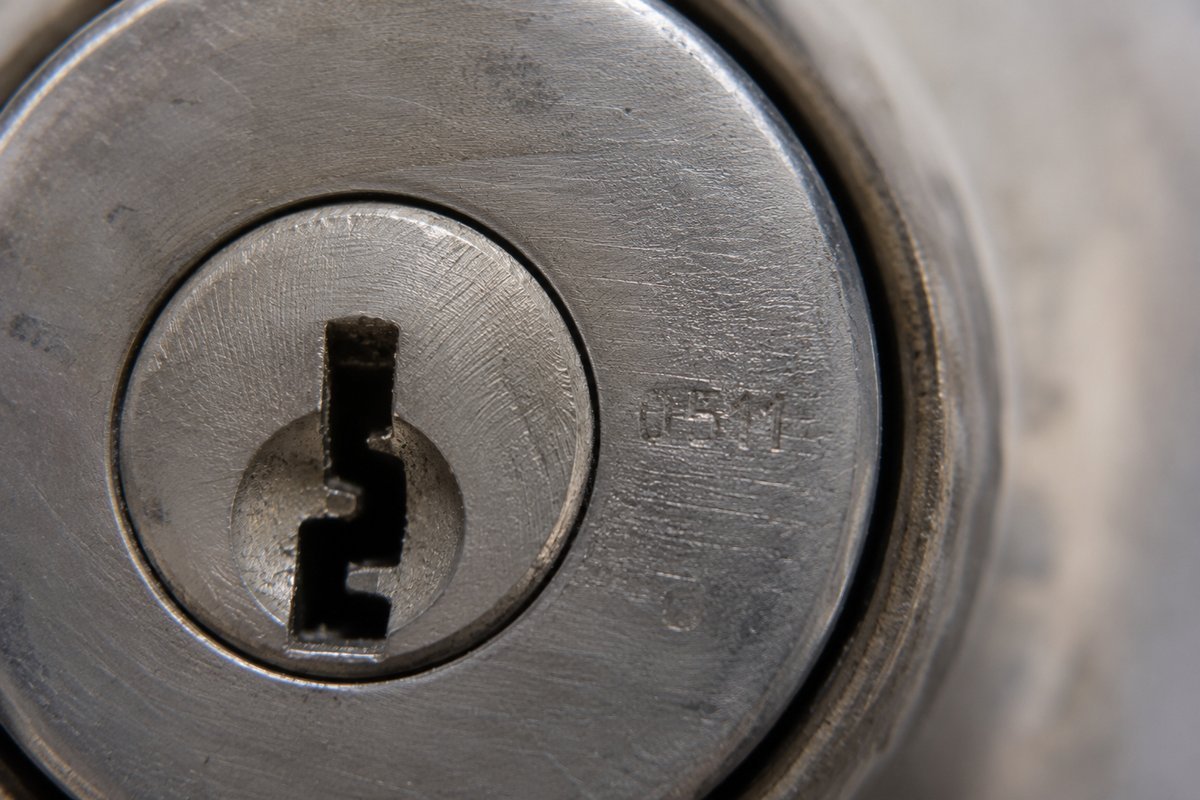
Your entry door key comes from a published range. Bauer states on its own retail page that its locks take Global compatible keys covering codes G301 to G391. Fastec, which supplies a large share of towables, publishes ranges of CF301 to CF351, EF301 to EF351, HF301 to HF351 and a separate 401 to 434 series. Those are roughly ninety codes on one system and about fifty per series on the other.
Now the part that turns a fact into a problem. Precut keys for those codes are sold openly online, listed exactly the way you would expect: pick your code from a dropdown, G301 through G391, and it arrives in the post. No proof of ownership, no dealer account, nothing.
Nobody publishes how many trailers were built per key code, so treat any article claiming a specific number with suspicion. What you can do is the arithmetic yourself. Ninety codes. Millions of registered RVs.
One more detail from Fastec, worth knowing if you assumed your deadbolt was a second line of defense. On a dual cylinder lock, their own FAQ confirms one key runs both the paddle and the deadbolt. There's no separate barrier.
Check your key against a recall before you buy anything
If your trailer was built between 2006 and 2013, look at your key before you spend a cent. Fastec ran a federal recall, NHTSA 13E039, on deadbolt cylinders where the key could be removed in the wrong position and jam the deadbolt. The stated risk wasn't theft. It was that occupants could be unable to unlock the door from inside and would have to leave through an emergency exit.
The recall covered locks made between January 2006 and April 2013 in these key codes:
- HF-304, 307, 308, 309, 311, 313, 315, 316
- HF-320, 322, 323, 328, 331, 335, 336, 339
- HF-342, 343, 347, 349
The remedy was free replacement cylinders with prepaid return shipping. Your key has its code stamped on it. If it starts HF-3 and it's on that list, that is a five-second check worth doing tonight.
What to measure before you order
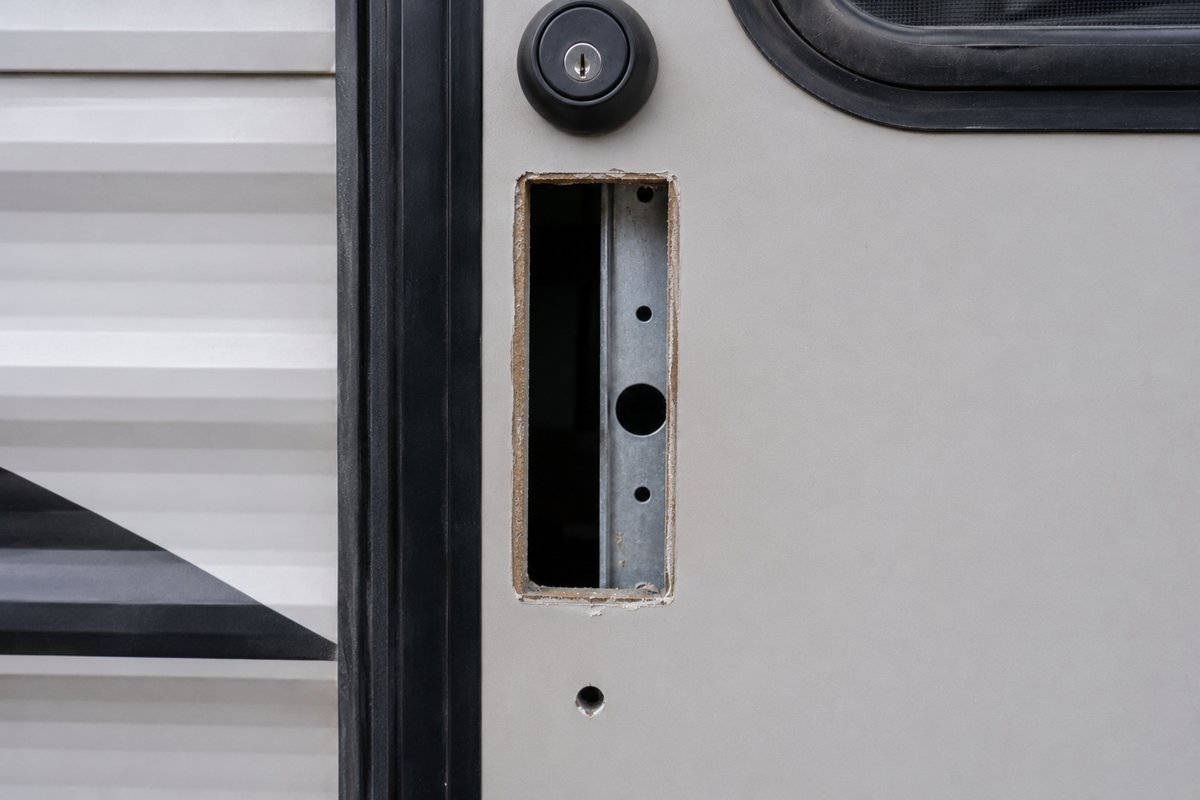
There's no such thing as a lock for a particular brand of trailer. As one parts supplier puts it, you match by measurement, not by model. Three numbers decide it.
The cutout, which is almost always the same
Measure the rectangular hole the lock sits in, not the trim plate over it. The standard is 2 3/4 inches wide by 3 3/4 inches tall, and both Bauer and RVLock publish that same figure. If yours matches, most of the market fits. If it doesn't, you need a specialist lock and the mainstream keyless locks won't fit.
Door thickness
Measure the door slab itself near the lock, ignoring the rubber seal and any trim. Most sit between an inch and a quarter and an inch and a half. RVLock specifies one and a half. Too thin and the lock won't clamp. Too thick and it won't close.
Which hand your door is
Stand outside the trailer and look at the door. Whichever side the hinges are on is the hand. Right hand is the common one, and it's what most listings default to, so a left hand door needs a specific part number rather than the standard one. Getting this wrong is the single most common ordering mistake, and the lock isn't returnable once you have cut into the wiring on a keyless model.
Expect to move the strike plate
Owners who have fitted keyless locks report the same thing over and over. The lock goes into the cutout tight, sometimes tighter than feels right, and then the door won't latch. The fix is almost always the strike plate on the frame rather than the lock itself. Take it off, move it up a little, and elongate the screw holes so you have room to adjust.
Two more from the same reports. Drive the housing screws by hand, because a power tool cracks the case. And tuck the battery ribbon cable well clear of anything that moves, because it sits in a place where it can chafe.
What a new lock does not fix
This is the part most articles leave out.
There's no US standard for RV entry door locks. The RV industry's adopted standards cover fire safety, plumbing, electrical, fuel systems, and construction. None of them addresses door locks or security hardware. The residential grading you may have seen on a house lock, the ANSI Grade 1, 2 and 3 system, applies to builders' hardware and no RV lock maker claims it.
The one standards claim in the category is Bauer describing one of its motorhome locks as approved to FMVSS 206. That is the federal standard for door locks and door retention, and it exists so that doors stay shut in a crash and occupants can get out. It isn't a security rating, and it says nothing about resisting anyone.
We also went looking for what locksmiths and police say specifically about RV entry doors, and about any published test of how much force one will take. There's nothing. No pry resistance figure, no frame pull-out rating, no guidance aimed at this door. That lack of data is itself the finding.
So the supportable claim is a narrow one. Changing the lock closes the hole where somebody already owns a key that works. It does nothing about an aluminum-framed door, and it does nothing about the window beside it. Anyone telling you a keypad hardens your trailer is selling something.
An RV door lock is only ever as strong as the frame it's screwed into, which matters more than the brand on the cylinder.
Quick Answers
Do all RV keys open all RVs?
No, but the pool is small enough to be uncomfortable. Entry doors draw from published ranges of roughly ninety codes on the Bauer and Global system, and around fifty per series on Fastec. Storage compartments are the worst case, because a large share of them use one generic code and the keys are cheap and easy to buy.
Will a keyless lock leave me locked out when the battery dies?
Not on the two here, because both keep a mechanical key. Bauer states it plainly: the key always operates the paddle or the deadbolt. What Bauer also states is that if the deadbolt is thrown when the battery dies, it stays thrown, so the key isn't optional. Keep one somewhere that isn't inside the trailer.
Do the batteries die in the cold?
The owner reports don't support that as much as you would expect. One full timer in a cold climate got just under two years from the first set with several openings a day, then twenty-one months from the next. Treat annual replacement as an inexpensive precaution rather than a necessity.
Is it worth upgrading if the old lock still works?
Only for the shared key problem, which is a real one. If your lock works and the key code doesn't bother you, the money is better spent on a wheel or coupler lock, which stops the trailer leaving rather than stopping someone opening a door.
The short version
- CH751 is your baggage doors, not your entry door. Fix that separately and cheaply.
- Your entry key is one of about ninety published codes, and cut keys for any of them are sold openly.
- 2006 to 2013 trailer? Check your key code against the recall list above before buying anything.
- Measure three things: the 2 3/4 by 3 3/4 cutout, the door thickness, and which side the hinges are on from outside.
- Whatever you fit, expect to move the strike plate.
- A new lock fixes the shared key. It doesn't harden the door.
Changing an RV door lock is a twenty minute job with one screwdriver, and it removes the weakest point in the whole trailer.
Related guides
- Wheel and coupler locks, which stop the trailer being towed away rather than opened.
- GPS trackers, the one thing that still helps after the trailer has gone.
- RV winter storage, what goes wrong while a trailer sits and in what order.
- Hitch locks, the difference between a receiver lock and a coupler lock, and why most people buy the wrong one.
- Battery locks, including the venting mistake that makes the usual advice dangerous.