
An RV roof sealant replacement is the cheapest thing you will ever do to a travel trailer and the one that decides whether the floor is still solid in ten years. The tube costs less than a tank of gas. A soft floor is a five-figure repair, or the end of the trailer.
Here is the first thing that matters, and most articles skip it. Before you buy anything, you need to know what your roof is made of, and the answer isn't in most owner manuals. Keystone publishes the test. It takes a screwdriver and two minutes.
Guess instead of checking and you can buy the wrong sealant without doing anything careless. Some sealants sold for RVs say in their own instructions not to use them on a rubber or TPO roof. Most travel trailers have one or the other.
Table of Contents
What Roof Do You Have?
Four materials turn up on RVs. Two of them are rubbery sheets stretched over the roof deck, and they go by initials: EPDM, which is a rubber, and TPO, which is a plastic. The other two are fiberglass and aluminum. Most travel trailers have one of the first two, and from the ground they look identical. Both are white. Both are a membrane stretched over the roof deck.
Keystone publishes the way to tell. Take the trim ring off a roof vent and look at the membrane where it's stapled inside the framed opening, so you can see both faces of it. In their words, if one side is white or dove colored with a black backing, it's likely EPDM. If it's the same color front and back, it's likely TPO.
There's a second check you can do without touching anything. Alpha Systems, who supply a lot of these membranes, describe TPO as having a textured, orange peel surface, and EPDM as flat and smooth, and as chalking with age. That chalky white residue on your hand after touching an older rubber roof is EPDM doing what it's supposed to do.
Don't simply trust the manual. On owner forums, this goes wrong often enough to be a pattern: one Grand Design owner found the manual named a membrane the trailer didn't have, and a long Jayco thread existed purely to work out whether the roof the maker called Alpha Ply was TPO or EPDM. It's TPO. Go and look at your own roof.
Fiberglass and aluminum are easier. Fiberglass is a hard, smooth, gel-like surface rather than a membrane. Aluminum is metal, and you will know.
Does the Sealant Have to Match the Roof?
It depends on which product you mean. If you're sealing a seam, the roof material barely matters. If you're coating the whole roof, it matters a great deal. Two different jobs, two different products, and mixing them up is what costs people a roof.
The sealant you run along a seam is called lap sealant, and it will stick to nearly anything. Dicor states its self-leveling lap sealant is compatible with EPDM, TPO, and PVC, and that it adheres to aluminum, wood, vinyl, galvanized metal, fiberglass, and concrete. So the tube you use to reseal around a vent isn't the decision people agonize over. It's nearly universal.
Coatings are where the membrane matters. Dicor's EPDM acrylic coating is for rubber and PVC roofing. TPO isn't on that list. Their cleaner and activator says rubber roofing surface only. Their silicone coating covers both membranes but states that TPO primer is required first. Ziollo says the same thing in their own words: primer is critical on TPO.
So a coating bought for the wrong membrane doesn't simply underperform. It fails to bond, and you find out a season later when it starts coming off in sheets.
And one manufacturer restricts you entirely. Alpha Systems states that only Alpha brand sealants can come in contact with Alpha roof membrane. Keystone repeats it. If your roof is theirs, that isn't advice. It's the condition attached to the membrane.
Which Products Will Damage Your Roof?
Three of them, and one is sold with RV on the label.
Petroleum-based cleaners on a rubber roof
Dicor states this plainly: there's no level of petroleum distillates that's recommended. Those are the solvents in products like mineral spirits. Their explanation of why is the useful part. Petroleum distillates soak in, loosen the adhesive holding the membrane down, and the membrane balloons. Alpha Systems says the same, and names acetone specifically as something not to use on their membrane.
That is what makes this an easy mistake. Mineral spirits is the obvious thing to reach for when you're cleaning off old sealant. It's the one thing you shouldn't.
There's a detail worth knowing, because it looks like a contradiction and isn't. Dicor's own lap sealant contains petroleum distillate. Dicor addresses it directly: it's there strictly as part of curing, and it evaporates as the sealant cures. A solvent passing through isn't the same as a solvent left sitting on the membrane.
Silicone, anywhere on the roof
Keystone's instruction is to avoid using any silicone products on the roof material. The reason isn't that silicone fails immediately. It's that nothing sticks to it afterwards. EternaBond states its tape isn't compatible with silicone sealants or lubricants, and Ziollo says its lap sealant and seam tape shouldn't be applied over existing silicone coatings.
So a bead of bathroom silicone isn't a repair. It's a decision that the next person to work on that seam, probably you, has to cut it all out first.
The product with RV in its name
Geocel Pro Flex RV is sold as an RV sealant and appears in roundups as a recommended pick. Geocel's own product page lists what it sticks to as aluminum, glass, coated steel, steel, wood, fiberglass and vinyl, and then states plainly: don't use on extruded polystyrene insulation sheathing, TPO, or EPDM.
Compare that with the first section of this article. The two membranes most travel trailers have are the two the manufacturer tells you not to put it on. It's a perfectly good sealant for a fiberglass or aluminum roof, and the wrong tube for most people reading this.
Is Flex Seal Liquid Good for RV Roofs?
The problem isn't that it fails. It's that nobody, including its own maker, will tell you it's approved for your roof.
Flex Seal publishes an article about repairing RV roof leaks and recommends its tape, its Flex Shot and its liquid. What that article never does is name a single roof membrane. No EPDM, no TPO, no fiberglass, no aluminum. It closes by suggesting you test a small area first.
Now set that beside the others. Dicor names the membranes it works on and the ones it doesn't. Alpha Systems restricts you to their brand outright. Keystone tells you which products to avoid. Every roof manufacturer in this article is specific, and the one product people ask about most is silent.
Add the practical problem, which is the same as silicone: a coating that the next repair can't bond to has to be removed before anything else can be done. For a leak on a Sunday afternoon a hundred miles from anywhere, a roll of tape that stops water is worth having. As the actual repair, you're choosing a product whose maker won't say what it goes on.
Self-Leveling or Non-Sag: Which Do You Need?
Usually both, and this confuses more people than anything except roof material.
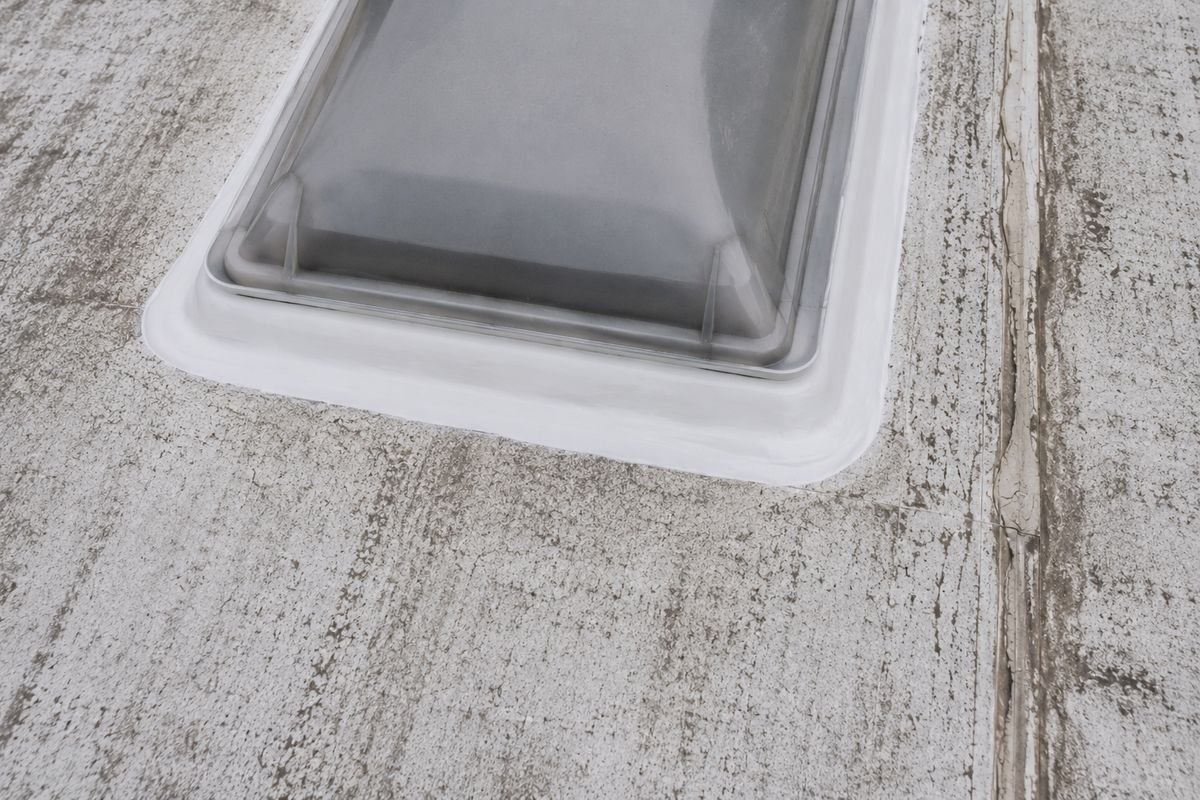
Self-leveling sealant is for horizontal surfaces. You lay a bead around a vent flange and it flows out and settles into an even, sealed edge on its own. That is the tube almost everybody buys, and for the flat part of the roof it's the right one.
Non-sag is the same chemistry that stays where you put it. It's for anything that isn't flat: the curved panel at the front of the trailer, the roof edge, and the strip running down each side that holds the edge of the sheet down. Dicor describes it as the second line of defense along the roof's edges and along the strip that clamps the edge of the sheet down on each side.
Put self-leveling on a vertical surface and it does exactly what its name promises. It runs, thins out at the top of the run, and leaves the highest point, the part most exposed to weather, with the least sealant on it. Nothing looks wrong from the ground. It just fails first at the worst place.
The tubes look nearly identical, come in the same colors and cure the same way. Check which one you have picked up before you climb the ladder.
Are You Sealing a Seam or Recoating the Whole Roof?
These are different jobs, different products and different afternoons, and the search results treat them as one topic.
A seam repair is what most people need. A bead has cracked or pulled away from a vent, a skylight or a screw head. You clean the area, remove what has failed, and lay fresh sealant over it. It's an hour, one or two tubes, and no special conditions.
A full recoat is a different proposition, and the manufacturer's own numbers tell you how much. Dicor's acrylic system wants the roof cleaned with their activator, rinsed with a pressure washer of at least 2,000 psi, then left to dry for 12 to 24 hours. Two coats are required, coverage is a gallon per 125 square feet per coat, and the entire coating process must be completed in one day. That's roughly four gallons for a thirty foot trailer, plus a clear weather window.
A useful rule: coating a roof doesn't fix failed sealant, it hides it. If the beads around your vents have cracked, they need doing first, whatever else you had planned. A coating laid over a failing seam simply puts a lid on the leak you already have.
Which RV Roof Sealants Are Worth Buying?
Three, and the first two are the same product in two forms because that's what the job needs. Every pick here is chosen on what the manufacturer states in writing about where it can go.
Dicor 501LSW Self-Leveling Lap Sealant
The one you will use mostThis is the default bead for every flat seam on the roof, and the reason it's the default is compatibility. Dicor states it works on EPDM, TPO and PVC membranes, and adheres to aluminum, wood, vinyl, galvanized metal, fiberglass and concrete. Whatever your roof turned out to be in the first section, this tube covers it.
The cure schedule is published, which is rarer than it should be: it skins over in about five minutes, is waterproof at four hours, is 80 percent cured at 48 hours and fully cured at 30 days. That four hour figure is the one that matters when weather is coming.
It flows out and levels itself, so a slightly untidy bead ends up looking like it was done properly.
What You'll Love
- Compatible with every common RV roof membrane, so you can't buy the wrong one
- Published cure schedule, including when it's safe in rain
- Levels itself into a clean bead without tooling
- Sold in several colors, so it can match a roof edge as well as a white roof
Worth Considering
- Horizontal surfaces only, and it will run off anything vertical
- Owner forums are divided on how long it lasts, with some reporting cracking within a couple of years
- Cures hard enough that removal later is difficult
- Counterfeit tubes of RV sealants have been reported, so buy from a seller you trust
Dicor 551LSW Non-Sag Lap Sealant
For everything that isn't flatSame chemistry, same compatibility, same cure schedule, one difference: it stays where you put it. Dicor positions it as the second line of defense along the roof's edges and along the strip that clamps the edge of the sheet down on each side.
That covers the curve at the front, the edge where the roof meets the wall, and the sides, which is exactly where a self-leveling bead thins out and fails first without ever looking wrong from the ground.
Most people don't know this tube exists, which is why it's here rather than buried in a paragraph. If you're resealing a roof properly you will use both.
What You'll Love
- Stays put on the curved front panel, the roof edge and the strip down each side
- Works on the same roofs as the self-leveling version, so there's no second question to answer
- Solves a failure most owners never diagnose because it's invisible from the ground
- Matching color range to the self-leveling tubes
Worth Considering
- Wrong choice for a flat seam, where it won't level and needs tooling
- The tube looks almost identical to the self-leveling one, and they get mixed up constantly
- Means buying two products for one job
- Same difficult removal as any cured lap sealant
EternaBond RoofSeal Tape
When the seam has gone past caulkA tape rather than a sealant, for the seam that has opened up beyond what a bead will bridge. Its published bonding list is broad: EPDM, TPO, aluminum, galvanized steel, wood and fiberglass, with a service range of −40°F to 212°F.
Apply it between 40°F and 150°F, onto a surface that's clean and dry. Below 40°F the manufacturer wants their primer used first.
One incompatibility is published and it matters: it won't bond over silicone sealants or lubricants. If somebody has been at that seam with a tube of bathroom silicone, this isn't going to stick.
What You'll Love
- Bridges a gap that a bead of sealant can't
- Published temperature range at both ends, which sealant makers rarely give
- Owners report installations lasting well over a decade
- Goes on in minutes with no cure time before it's watertight
Worth Considering
- An RV repair shop publicly warns that removing it later can damage the membrane underneath
- Reports of it shrinking in the sun over time and opening gaps at the edges
- Won't stick over any previous silicone repair
- Surface preparation is unforgiving, and it doesn't get a second attempt
How Often Should You Reseal an RV Roof?
Every article you will read gives a different number, and none of them cites anybody. You will see every two to four years, once a year, and every ten years, on pages that all sound equally certain.
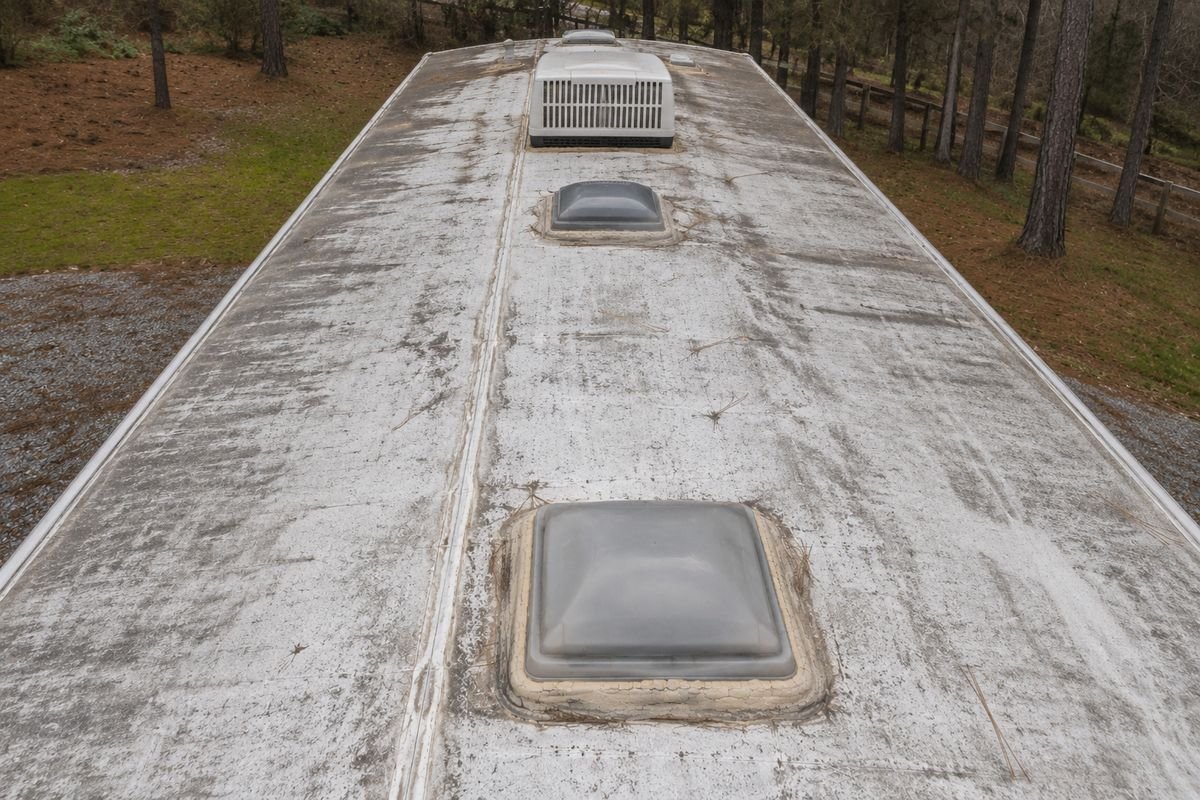
Here is what the manufacturers publish, which is a different thing entirely. Keystone says inspect the roof at least every 90 days, focusing on seams, joints and attachments. Dicor says clean the roof at least four times a year. Alpha Systems says periodic cleaning three to four times a year is the primary maintenance required, with sealant inspection around accessories and fasteners during each clean.
Notice what none of them says. Not one publishes a resealing interval. They publish an inspection interval, because sealant fails at different rates, and how fast depends on sun, temperature swings and whether the trailer sits outside. An RV in Arizona and one in a barn in Oregon aren't on the same schedule and no calendar figure covers both.
So the workable version is quarterly, with a cleaning. You're looking for cracks, gaps, and beads that have pulled away from what they were sealing. Reseal what has failed, when it has failed.
Keystone states the responsibility directly, and it's worth quoting because it explains why they publish that 90 day figure at all: once the RV leaves the factory, they can no longer maintain the sealants, and that falls to the owner.
Can You Reseal an RV Roof Yourself?
A seam repair, yes, and it's one of the few jobs on a trailer that needs no tools worth owning. Clean the area, remove the failed sealant, lay a fresh bead, come down the ladder.
Two cautions, both straight from the manufacturers. Dicor warns that a wet membrane can be extremely slippery and to use extreme caution working on top of the vehicle. Alpha says the same, and adds that you should never stand directly on a skylight.
Whether your roof takes your weight at all is a question for your own manual. It depends on the roof structure underneath the membrane, not the membrane itself, and no general article can answer it for your trailer.
The removal advice that comes up repeatedly from experienced owners is worth passing on: use a plastic tool rather than a blade. Anything sharp enough to cut cured sealant quickly is sharp enough to cut the membrane under it, and that turns a one hour job into a real repair.
Does Skipping It Void Your Warranty?
It can, and the language is more specific than most owners realize.
Jayco's warranty for the 2022 Seneca excludes damage caused by failure to maintain in accordance with the owner's manual or failure to perform routine maintenance, and names sealing in that list. It then excludes delamination caused by water intrusion from lack of required exterior seal maintenance.
Delamination is the expensive failure, where the wall layers separate after water gets in. So the clause isn't a technicality. It's aimed precisely at the outcome this whole job exists to prevent.
Alpha Systems' restriction to their own brand of sealant sits in the same territory. If the membrane carries a warranty and the condition is that only their sealant touches it, a cheaper tube from the RV aisle is a decision about your warranty as well as your roof.
Common Questions
What is the best roof sealant for RVs?
For a seam on any common membrane, Dicor's self-leveling lap sealant, because it's the one product here that's compatible with every roof type an RV is likely to have. The better question is which surface you're sealing, since that decides between self-leveling and non-sag more than brand does.
Can I put new sealant over old sealant?
Over sound, clean, cured sealant of the same type, yes, and that is how most maintenance beads are done. Over cracked or lifting sealant, no. You're sealing the crack in from above and leaving the water path underneath untouched.
How many tubes will I need?
For a maintenance pass around vents, skylights and the refrigerator vent on a typical travel trailer, a few tubes. For a full perimeter and every roof fitting, more. Buy one more than you think and keep the spare, because running out halfway across a roof with an open tube is its own problem.
Does a chalky white residue mean my roof is failing?
No, if it's EPDM. Dicor says the rubber wears away slowly on purpose, and that over a dozen years it may lose about ten percent of its thickness that way. Chalking is the roof working, not the roof dying.
Can I use house caulk or bathroom silicone?
No. Beyond the compatibility problem, silicone is the one material that leaves you worse off than doing nothing, because no sealant or tape will bond over it afterwards. Keystone's instruction is to avoid silicone products on the roof material entirely.
What to Take Away From This
Go and look at your roof before you buy anything. Pull a vent trim ring, look at both sides of the membrane, and settle whether you have EPDM or TPO. That one step is what stops you buying a coating that won't bond or a sealant whose maker says it doesn't belong there.
Then buy the boring answer. Self-leveling for the flat, non-sag for the edges, tape for a seam that has opened up. Keep petroleum cleaners and silicone off the roof entirely, and inspect quarterly rather than trusting a number you read somewhere.
The whole job costs less than a night in a campground. What it prevents doesn't.
Quick Answers
What Roof Do You Have?
Most travel trailers have EPDM rubber or TPO plastic, and both look white from the ground. Take the trim ring off a roof vent: a white top with a black back is likely EPDM, and the same color on both sides is likely TPO. Fiberglass and aluminum are easy to spot.
Does the Sealant Have to Match the Roof?
For seam sealant, barely. Dicor's lap sealant works on EPDM, TPO and PVC and bonds to most other roof materials. For a whole-roof coating it matters a great deal, because a coating made for the wrong membrane won't bond.
Which Products Will Damage Your Roof?
Petroleum-based cleaners such as mineral spirits on a rubber roof, any silicone, and Geocel Pro Flex RV on EPDM or TPO, which its own maker says not to do.
Is Flex Seal Liquid Good for RV Roofs?
Its maker won't say. Flex Seal's own RV roof article never names a roof membrane it's approved for, and like silicone it can leave a surface the next repair won't bond to. Tape is fine as an emergency fix, not as the real repair.
Self-Leveling or Non-Sag: Which Do You Need?
Usually both. Self-leveling sealant is for flat seams and vent flanges. Non-sag is for the curved front panel, roof edges and side strips, where self-leveling sealant would run and thin out.
Are You Sealing a Seam or Recoating the Whole Roof?
Most people need a seam repair: remove the cracked bead around a vent or fitting and lay a fresh one. A full recoat is a separate, all-day job with cleaning, drying time and two coats, and it doesn't fix failed sealant underneath.
Related Guides
- RV covers, damp or wind, because a cover can't fight both.
- Water leak detectors, for the leak that gets past the roof anyway.
- RV storage and security, what goes wrong while a trailer sits, and in what order.
- Manual vs. electric RV awning, which one holds up long term.
- How to clean an RV awning, without the mistakes that damage the fabric.
For more on keeping the roof and exterior in shape, see our other Roof and Exterior guides.