
An RV air conditioner cover isn't something every RV needs, and plenty of RVers never buy one. It earns its cost in two situations: a trailer sitting through a real winter, or a campsite cold enough that the ceiling unit turns into a draft source instead of a cooling one.
This guide covers what a cover does, four that fit real rooftop units without falling apart in a season, and the one rule that matters more than which one you buy: take it off before you run the air conditioner.
Quick answer
No, you don't need one to run the air conditioner or to keep it working. A cover is worth having if the trailer sits through winter, parks under trees, or camps somewhere cold enough that the unit drafts. Never run the air conditioner with the cover on. It blocks the airflow the unit needs to work, and every cover on this page says so.
Table of Contents
The picks
ADCO 3021 RV Air Conditioner Cover
The long-established standardADCO has been sewing RV covers since 1955, and it shows in the one place that matters most for a cover: fit. It ships in eight sizes rather than one, so the cover follows the shape of the shroud instead of a generic box guessed at from a tape measure. Size 21, the one built for Dometic Brisk Air and Duo-Therm units at 13,500 to 15,000 BTU, is the size most travel trailers need.
It's heavy-duty vinyl with a soft jersey backing against the shroud, so nothing rubs paint or plastic raw over a winter of wind. A drawcord cinches the hem shut, the same style used on a stuff sack, rather than a separate strap you have to loop and buckle by hand on a cold morning. An RV air conditioner cover is for storage and wind, not for running the unit.
Good
- Eight sizes means an actual fit, not a box guessed at
- Long-established brand sold by many RV dealers
- Jersey backing keeps the vinyl from wearing on the shroud edges
- Drawcord goes on and off faster than a strap-and-buckle design
Bad
- You have to know your unit's BTU and shroud size before ordering, or you get the wrong one
- Owner reports on durability split: some get three to five years, others say it wears out in one harsh season
- Vinyl, not the heavier acrylic-coated fabric some pricier covers use
Classic Accessories Over Drive RV Air Conditioner Cover
Cheapest of the four, and fits the most brandsClassic Accessories sells this as one shape rather than a range of sizes, and it's cut generously enough to cover Coleman Mach I, II, III and 8, Duo-Therm Briskair and Quick Cool, Carrier Air V, Dometic Brisk II, and Atwood 135 and 150 units. If you aren't sure which brand is on your roof, this is the cover most likely to fit it anyway.
It's a wipe-clean fabric with a soft, non-scratch backing, closed with a single drawcord along the bottom hem. Classic Accessories backs it with a 3-year limited warranty, longer than most of the field.
Good
- One shape fits most common rooftop units, so there's little guessing to do
- The least expensive of the four picks here
- 3-year warranty is the longest of the four
- Soft backing protects the shroud finish, not just the fabric side
Bad
- Single drawcord only, no separate strap for extra wind resistance
- Some owners note the drawcord alone doesn't cinch as tight as a strap-and-buckle system
- One universal shape means a looser fit on unusually small or large units than a sized cover gives
Camco Vinyl Air Conditioner Cover (45392)
The priciest pick, and the highest ratedCamco's cover is built specifically for Dometic Brisk Air and Brisk Air II models, and that narrower fit is exactly why it carries the highest customer rating of the four. A locking draw cord holds the vinyl snug against the shroud rather than just gathered shut, which is the detail that shows up most in owner feedback about wind performance.
Camco prints its own safety note on the listing, not buried in a manual: don't operate the RV or the air conditioner with the cover installed. It's the same rule every cover on this page carries, stated plainly by a manufacturer that sells the accessories inside a lot of RV parts counters.
Good
- Highest customer rating of the four picks here
- Locking draw cord holds tighter in wind than a plain gathered hem
- Purpose-built for Dometic Brisk Air, so the fit is close rather than generous
- Camco backs the brand with decades in RV parts, not just soft goods
Bad
- Most expensive of the four, by a real margin
- Built around one brand family, so it's the wrong pick for a Coleman or Furrion unit
- Some owners report the vinyl cracking or peeling after repeated seasons in strong sun
MQLD RV Air Conditioner Cover
Budget pick, comes in three sizesMQLD is a newer, no-name brand rather than an established RV parts maker, and it's priced like one. It still covers the basics: 600D Oxford fabric with a waterproof coating, offered in three sizes so a mid-size or larger shroud has an option, and a clinch strap in addition to the bottom drawstring for extra hold in wind.
It's the cheapest way to try a cover without committing to a size-specific brand, and the trade-off shows up in the same place cheap covers usually show it: fit and wind resistance in owner reports are more mixed than on the three picks above.
Good
- Least expensive of the four picks here
- Three sizes cover more shroud dimensions than a single universal shape
- Clinch strap adds a second point of hold beyond the drawstring alone
- Ships fulfilled by Amazon with the standard 30-day return window
Bad
- Owner reports on fit are mixed: several say it doesn't cinch as tight as they expected
- Wind resistance complaints show up more often here than on the sized or strap-and-buckle picks
- No established RV-parts track record behind the brand the way ADCO or Camco has
Quick comparison
| Cover | Material | Fit | Best for |
|---|---|---|---|
| ADCO 3021 | Jersey-backed vinyl | 8 sizes by BTU/unit | Getting the size right the first time |
| Classic Accessories Over Drive | Wipe-clean fabric | One shape, most major brands | Lowest price, not sure which brand you have |
| Camco 45392 | Heavy vinyl | Dometic Brisk Air/Brisk Air II | Highest-rated, tightest fit on that unit |
| MQLD | 600D Oxford, PVC coated | 3 sizes | Trying a cover for the least money |
Do you need one?
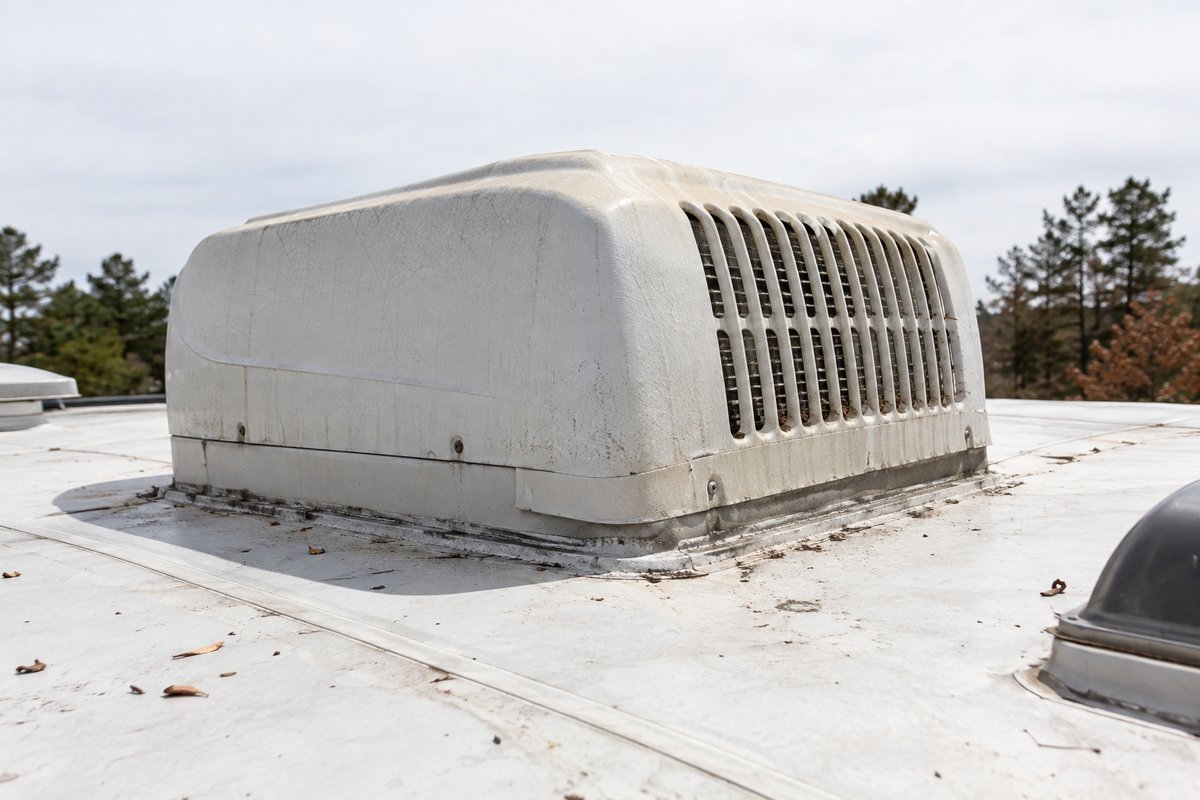
Most of the time, no. The unit is built to live on the roof year-round, rain and sun included. Nothing about a working air conditioner requires a cover the way, say, a battery requires a charger. The case for buying one is narrower than the box marketing suggests, and it comes down to three real situations.
Winter storage. If the trailer sits for months, a cover keeps falling leaves, pine needles, and general roof debris out of the grille and drain outlets, where they can clog things that are hard to reach until spring. It also cuts UV exposure on the shroud plastic during the months the unit is doing nothing to earn that wear.
Cold-weather camping. A rooftop unit isn't sealed tight enough to stop every draft, and in cold weather that shows up as a cold spot right under the ceiling grille. A cover over the unit cuts that draft while you aren't running the AC anyway, which in cold weather is all the time.
Parking under trees. Sap, bird droppings, and dropped debris land on the shroud whether the trailer is in daily use or sitting for a week. A cover is a cheap way to keep that off the plastic and off the fan blades underneath it.
A cover won't make the unit run better, cool faster, or last meaningfully longer if you're using the RV regularly in mild weather. If none of the three situations above apply, save the money.
Putting it on and taking it off without a problem
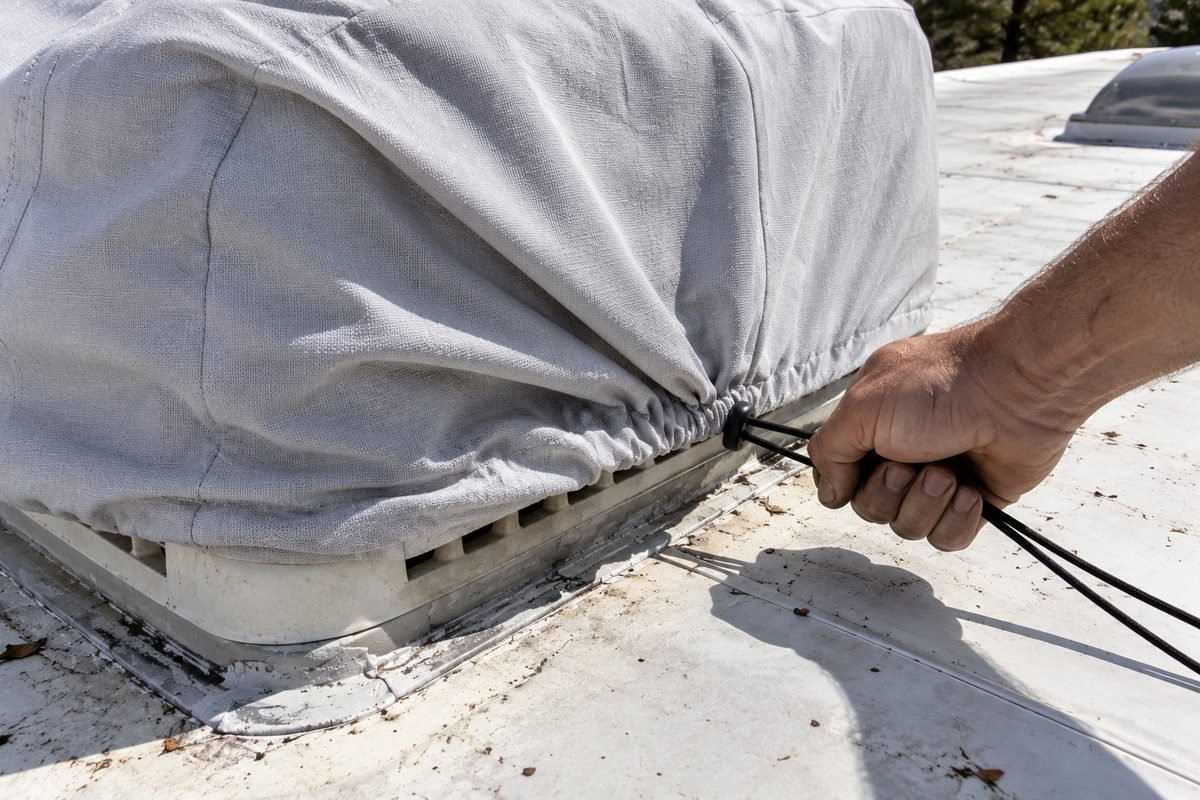
Put the cover on the roof unit itself, not just anywhere near it. Every cover on this page is shaped to fit over the plastic shroud, so line it up square before cinching the drawcord. Otherwise, it bunches on one side and leaves a gap for wind and rain on the other.
Never run the air conditioner with the cover on. Camco prints that warning directly on its listing, and the reason is simple: the cover blocks the outdoor coil from moving air, which is the half of the unit that gets rid of the heat pulled out of the trailer. Run it covered, and the unit works against itself instead of cooling anything.
That means you have to remove the cover before travel days too, not just before you turn the AC on. A cover flapping at highway speed is how you lose one on the interstate.
A trailer's roof isn't a place to stand carelessly. If you aren't comfortable getting up there safely, an extendable pole or having someone hand the cover up from a ladder works just as well as climbing onto the roof itself.
A cover protects the shroud, but the coils underneath still need attention. ENERGY STAR's maintenance checklist points out that dirty coils make an air conditioner run longer and wear out sooner, so take the cover off and check them before the first hot week of the season. Take the RV air conditioner cover off before you run the unit, every time.
Quick Answers
Can you run an RV air conditioner with the cover on?
No. The cover blocks airflow to the outdoor coil, which is the half of the unit that releases the heat pulled from the trailer. Every cover in this guide, including Camco's, prints a warning against running the AC while it's installed.
Are RV air conditioner covers worth the money?
For winter storage, cold-weather camping, or a site under trees, yes. For a trailer used regularly through mild weather, a cover adds little beyond keeping dust off, and that owner can skip it.
What is the best RV air conditioner cover for winter?
A sized cover that matches your unit's BTU and shroud dimensions holds up better through a season of wind and snow than a one-size-fits-all shape. ADCO's range of sizes is built for exactly that.
Do RV air conditioner covers cause condensation problems?
None of the covers here are sealed airtight, and none of the manufacturers publish a moisture warning against seasonal use. The bigger risk with any cover is leaving it on too long into spring and forgetting to pull it before the first warm day you want the AC running.
Where to go next
The cover only matters once the unit underneath it is the right size and working properly.
- RV air conditioners, how they work and what size a trailer needs
- RV thermostats, the control end of the same system
- RV roof sealant, because the unit is bolted through the surface that has to stay watertight around it
- RV covers for winter storage, for protecting the whole trailer rather than just the AC