
If you rely on a CPAP machine to sleep well, dry camping, which means camping with no hookups, can feel like a gamble. A solar powered CPAP battery setup is the only way to stay out indefinitely, and sizing one is where most guides get vague. Your RV's house batteries can run a CPAP for a night or two, but once you're parked off-grid for a week without shore power, that math gets tight fast.
A dedicated solar panel paired with a portable battery pack takes the guesswork out of the equation, letting you top off your CPAP battery every sunny afternoon instead of hunting for an RV park with electric hookups. A solar powered CPAP battery setup is only as reliable as the worst weather day of your trip.
Table of Contents
5 Best Solar Panels to Recharge a CPAP Battery
The default choice, largely because it plugs straight into Jackery's own Explorer stations, which are what a lot of people are already running the CPAP from. No adapter and no guessing at connectors.
It folds into its own case with the kickstand built in, so you can angle it at the sun rather than leaning it against a camp chair. The cells are monocrystalline, rated around 23 percent efficiency, level with everything else here, and it comes in under 8 pounds folded. If your power station is a different brand you will need an adapter, and the case for this one gets weaker.
What You'll Love
- Plugs directly into Jackery Explorer stations
- Kickstand built into the case
- Under 8 pounds folded
- Around 23 percent cell efficiency
Worth Considering
- Fits only its own brand, so other brands need an adapter
- Priced above the budget end of this category
110 watts rated, the highest of the folding panels here, with IP68 on the panel surface. Dew or a passing shower won't end the session, which on most mornings matters more than the extra ten watts.
It pairs with EcoFlow's Delta and River stations, several of which accept more than one panel if you want to halve the charging time. At 8.8 pounds folded it's easy to carry one-handed. The wattage advantage only appears in strong direct sun, so in shade the extra watts don't help.
What You'll Love
- IP68 rated panel surface
- 110W, the highest rating among the folding panels
- 8.8 pounds folded
- Some EcoFlow stations accept multiple panels
Worth Considering
- The connector works best inside the EcoFlow range
- Costs more than the comparable Jackery
120 watts, the most headroom in this group. That helps in hazy or partial sun, and it helps if the same station is charging a phone or a tablet while it tops up the CPAP battery.
The kickstand has several positions rather than one fixed angle, so you can follow the sun through the day, and the case has reinforced corners. Two catches. At 12.6 pounds it's on the heavy side, and if your power station caps solar input below 120 watts you have bought output you can't use. Check that number first.
What You'll Love
- 120W, the highest rating in this group
- Multi-position kickstand
- Reinforced corners on the folding case
Worth Considering
- 12.6 pounds, heavier than the fabric panels
- Wasted capacity if your station's solar input is capped lower
The cheapest here, and the only one with a charge controller built in. That lets it connect to a 12-volt battery directly rather than only to a power station, which matters if you already have a house bank you would rather top up.
It's a rigid suitcase rather than a fabric fold, so it handles gravel and repeated setup better. It also weighs about 17 pounds and takes real space in a basement locker. If you carry the panel any distance from the RV, this is the wrong one.
What You'll Love
- Lowest price here
- Built-in charge controller connects to a 12V battery directly
- Tempered glass panels in an aluminum frame
Worth Considering
- About 17 pounds, the heaviest here
- Bulkier folded than the fabric panels
Reinforced nylon and metal grommets, built for being set up on gravel and propped against rocks for years. That is what the money buys, and it's the most expensive panel here.
It uses Goal Zero's 8mm barrel connector. It's a brand-only plug, but one of the more widely copied ones, so it's less of a problem than it might seem. On paper its efficiency doesn't clearly beat the Jackery or the EcoFlow. At an established campground the toughness is money you didn't need to spend.
What You'll Love
- The most durable housing here
- 8mm barrel connector is widely adapted
- Long track record in outdoor gear
Worth Considering
- The most expensive of the five
- No clear efficiency advantage over the Jackery or EcoFlow on paper
Five panels below, all suited to building a solar powered CPAP battery setup or charging a small power station while you travel. None of them needs an electrician, a roof, or a permanent mount. If you want a permanent roof system instead, see our guide to the best RV solar panel kit.
This guide is based on independent research, not hands-on testing. We compare published manufacturer specifications, cross-check them against verified customer reviews on retail sites and RV forums, and weigh each product on how well each one keeps a CPAP battery topped up off-grid. We haven't physically tested these units ourselves, and where the published specs and real-world owner reports disagree, we say so in the write-up.
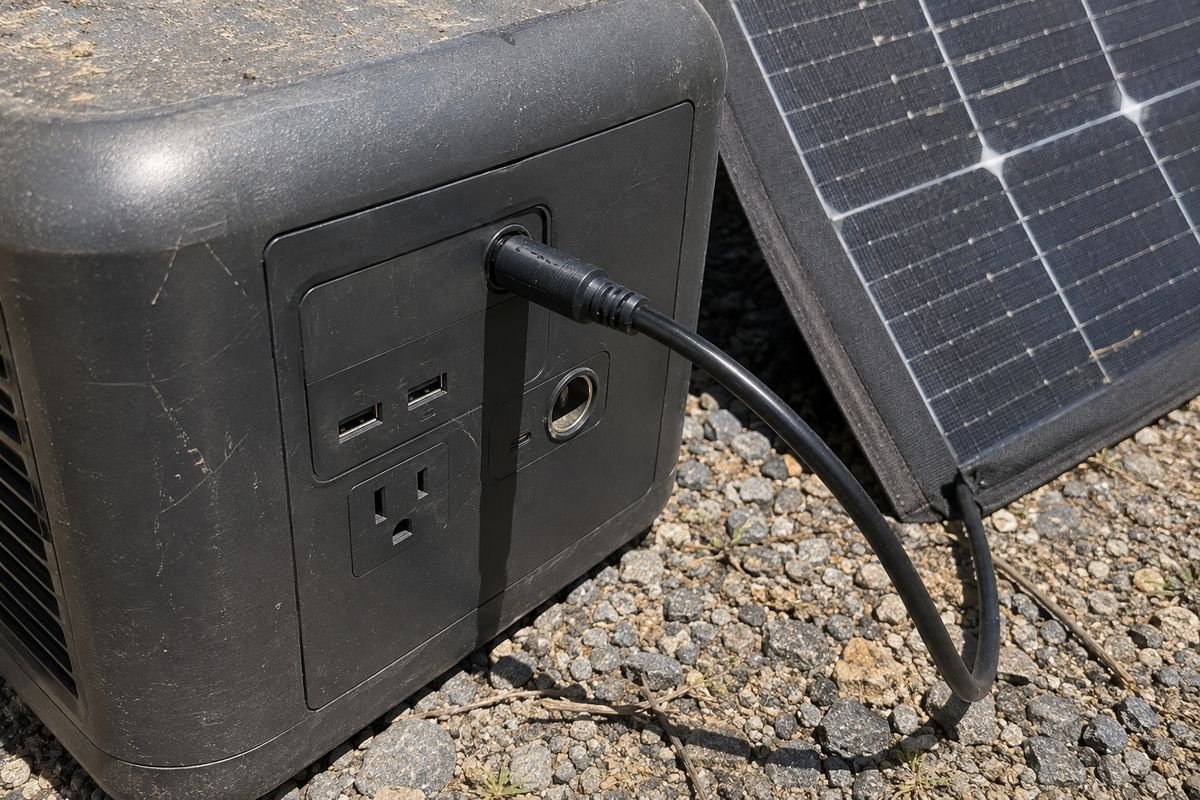
None of these panels require an electrician or a permanent roof installation. Each one connects to a portable power station or battery pack with a simple cable, so you can set it up on your picnic table, prop it against the RV steps, or lay it flat on the dashboard, then bring it inside at night.
Quick Comparison
| Product | Best For | Key Spec |
|---|---|---|
| Jackery SolarSaga 100W | Best Overall | 100W monocrystalline, ~23% efficiency, ~7.9 lb |
| EcoFlow 110W Portable Solar Panel | Best for Fast Charging | 110W monocrystalline, IP68 panel rating, ~8.8 lb |
| Bluetti PV120 | Best High-Output Option | 120W monocrystalline, adjustable kickstand, ~12.6 lb |
| Renogy 100W Solar Suitcase | Best Budget Pick | 100W monocrystalline, built-in charge controller, ~17.4 lb |
| Goal Zero Nomad 100 | Best for Durability | 100W monocrystalline, rugged fabric housing, ~10.2 lb |
Why This Matters
A CPAP machine is a small appliance, but it draws power steadily for six to nine hours every single night, and it can't skip a night just because your batteries ran low. Most CPAP units without a humidifier average about 5 to 15 watts, while a heated humidifier and heated hose push that to around 35 watts. ResMed measured its AirSense 10 at 7 watts alone and 34 with both. Over an eight-hour sleep cycle, that adds up to roughly 40 to 300 watt-hours consumed before you even think about running lights, a phone charger, or the refrigerator.
Campground shore power isn't always available, and RV house batteries are shared among many devices. If you camp without hookups in national forests, BLM land, or state park sites without hookups, your CPAP is competing for battery capacity with your water pump, furnace fan, and interior lighting. A separate solar setup dedicated to your CPAP battery removes that competition entirely, so a cloudy travel day or a dead house battery doesn't turn into a sleepless, unsafe night without breathing therapy.
There's a practical version of this that has nothing to do with reassurance. If the battery is topped up by early afternoon, you stop planning the rest of the day around finding power, and you stop rationing the humidifier to make the reserve stretch.
What to Look For
A panel marked 100 watts doesn't make 100 watts. Four things decide how fast your battery fills, and the number printed on the front is only loosely one of them.
Wattage vs. Real-World Output
That number comes from a laboratory: perfect light, the panel square to the sun, cool cells. Outdoors you lose 20 to 40 percent of it to cloud, angle, dust and heat. So a 100-watt panel gives you 60 to 80 watts on a good clear afternoon. That's still plenty to refill a CPAP battery in a few hours. Plan around the lower figure, though, because the number on the box is what makes people set off at four in the afternoon with a battery that's only half full.
How to Size a Solar Powered CPAP Battery Setup
The arithmetic is simple. Take the battery's watt-hours, divide by the panel's watts, then divide again by about 0.7 for the real world. A 300Wh battery on a 100-watt panel works out to roughly four and a half hours of decent sun. The table below runs that for the battery and panel sizes in this guide, so you can match a panel to what you own rather than guessing and hoping.
| Battery Capacity | Panel Wattage | Realistic Output (~70%) | Sun Hours Needed to Fully Charge |
|---|---|---|---|
| 200 Wh | 100W | ~70W | ~2.9 hours |
| 300 Wh | 100W | ~70W | ~4.3 hours |
| 300 Wh | 120W (Bluetti PV120) | ~84W | ~3.6 hours |
| 500 Wh | 100W | ~70W | ~7.1 hours |
| 500 Wh | 110W (EcoFlow) | ~77W | ~6.5 hours |
Foldable Panel Portability
Every panel here folds, which matters far more in a basement locker than it does in a photograph. Check folded dimensions, the handle, and the weight. Twelve to sixteen pounds with a proper handle is a panel you carry out to a sunny patch and bring back in without thinking about it. Twenty pounds is a panel you set down once and leave until evening. That is the difference between following the sun around the site and taking whatever your parking spot happens to offer.
Connector Compatibility
This is where people often go wrong. Some panels use a plug that only fits their own brand, some use a round barrel plug, and some use MC4, the one connector the whole industry shares. They aren't interchangeable. If you already own a power station, check the panel's cable against your input port, or check that an adapter is in the box. Buying the panel that matches your station's brand is the boring answer and the one that works on the first afternoon. Mixing brands usually means ordering an adapter cable later, after you have already lost a sunny day to it.
Monocrystalline vs. Other Cell Types
All five here use monocrystalline cells, which is simply the current standard because they produce more watts per square foot. Polycrystalline panels are bulkier and heavier for the same rating. In a house that is an academic distinction. In a basement locker where the panel is competing for space with the leveling blocks and the sewer hose, it's the entire argument.
How We Picked These
We didn't physically test each of these panels side by side in a lab or on a shared campsite. Instead, this comparison is based on published manufacturer specifications, verified wattage and efficiency ratings, folded weight and dimensions, connector documentation, and a broad read of owner reviews from RV forums and retail listings. We prioritized panels from established brands with a track record in the portable power space, favored monocrystalline cell technology for its efficiency advantage, and weighed real-world portability alongside rated output, since a panel that's too heavy or awkward to set up regularly won't get used. Prices reflect typical retail ranges at the time of writing and can shift with sales or bundle promotions.
For the basics of how a panel turns light into charge, the Department of Energy's solar primer is a clear, short read. Size the panel for a solar powered CPAP battery around what you use in a night, then add margin for cloud.
Quick Answers
How long does it take to solar charge a CPAP battery?
Most portable CPAP batteries in the 200 to 300 watt-hour range take roughly four to six hours of solid direct sunlight to fully recharge using a 100-watt panel, assuming real-world output in the 60 to 80 watt range. Cloudy days, partial shade, or poor panel angle can stretch that to eight hours or more, which is why many RV travelers set their panel out first thing in the morning rather than waiting until midday.
What is the best portable solar panel for off-grid RV camping with a CPAP machine?
For most people the Jackery SolarSaga 100W is the one to buy, mainly because it's light, sets up in a minute, and plugs into the Explorer stations a lot of CPAP users already own. If your station is a different brand, buy the panel that matches it rather than the panel with the best specification.
Can I run my CPAP machine directly off a solar panel without a battery?
No, running a CPAP directly from a solar panel isn't practical or safe, because sunlight intensity fluctuates throughout the night and disappears entirely after sunset. You need a battery or portable power station in between the panel and the CPAP to store steady, reliable power and deliver a consistent voltage while you sleep.
How many watts of solar do I need to keep a CPAP battery charged every day?
A single 100-watt panel is generally enough to fully recharge a typical CPAP-dedicated battery pack within a day of average sunlight, assuming your CPAP averages roughly 5 to 15 watts without a heated humidifier. If you run a humidifier regularly or want a faster charging buffer for cloudy days, stepping up to a 120-watt panel like the Bluetti PV120 gives you extra margin.
Do I need a separate battery just for my CPAP, or can I use my RV's house batteries?
Many RV owners choose a dedicated portable power station just for their CPAP so it never has to compete with the water pump, furnace fan, or interior lights for available power. This also lets you bring the battery inside at night regardless of where the RV itself is parked, and it protects your therapy from being interrupted if the house battery bank runs low from other appliance use.
Are foldable solar panels durable enough for regular RV travel?
Yes, the monocrystalline foldable panels covered in this guide are built with reinforced fabric or nylon housings designed to be set up and packed away repeatedly across a camping season. Panels like the Goal Zero Nomad 100 go a step further with rugged, outdoor-rated materials for travelers who camp in rougher, more remote conditions.
What happens to my CPAP power if there's no sun for several days?
A fully charged solar powered CPAP battery in the 200 to 300 watt-hour range typically holds enough reserve for two to four nights of use without a humidifier, which gives you a buffer during a stretch of overcast weather. Many travelers also keep a small backup battery or plan a shore-power stop every week or so as extra insurance during extended cloudy periods.
Can these solar panels also charge phones, tablets, or other small devices?
Yes, since these panels charge a portable power station rather than a device directly, that same power station can charge phones, tablets, laptops, and other small electronics through its built-in USB and AC outlets whenever it isn't dedicated to CPAP charging duty. Just keep in mind that sharing the battery across multiple devices will draw down its capacity faster, so it helps to prioritize CPAP charging first each day.
Final Thoughts
None of this needs a powered campsite. Any of these five will keep a dedicated CPAP battery charged through a stretch of dry camping in reasonable sun. The panel to buy is the one that matches the station you already have, and after that the one you're willing to carry.