
RV leveling blocks are the cheapest thing in the storage bay and the one most likely to be used wrong. The question every owner asks first is how many can safely go under a wheel, and the answer isn't what the forums say it is.
This guide covers what the manufacturers of RV leveling blocks publish about stacking, the difference between blocks and a drive-on leveler, why the weight ratings are harder to read than they look, and five sets worth considering.
Quick answer. Only one manufacturer publishes a stacking limit. Tri-Lynx recommends no higher than five levelers when leveling under a wheel, and up to eight when stacking under a jack to stabilize. Andersen, Beech Lane, and Camco publish no limit at all. The familiar rule about never going past three or four blocks comes from nobody.
Table of Contents
How high can you stack RV leveling blocks?
Tri-Lynx is the only one of the four brands here that answers the question in writing, and it gives two answers because there are two jobs.
Its FAQ says that for leveling in a pyramid, it doesn't recommend going higher than five levelers, and that for stabilizing, it doesn't recommend stacking higher than eight. The second number is the taller one because stabilizing means a stack sitting under a jack foot, not a stack being driven onto by a moving trailer.
Two things are worth pointing out. The first is that this is phrased as a recommendation rather than a prohibition. The second is that its own product page gives a slightly different figure to the FAQ, which is why this article counts blocks rather than quoting an inch measurement as though it were settled.
The other three publish nothing. Andersen, Beech Lane and Camco have no stacking guidance on any product page. So the rule you have read a hundred times, that three or four is the maximum, isn't a manufacturer position. It's an unwritten rule passed between owners, and the one company that did commit to a number allows more than that rule does.
With three of the four saying nothing, the height is your call. Two things make a stack safer, and neither of them is a number. Build it as a pyramid, each layer a little narrower than the one under it, so the widest part is on the ground. A column of blocks stacked straight up has nothing bracing it against a sideways push. And keep the top layer wide enough that the whole tire is on it, because a tire sitting on the edge of a stack is what starts the stack moving.
Blocks or a curved leveler?
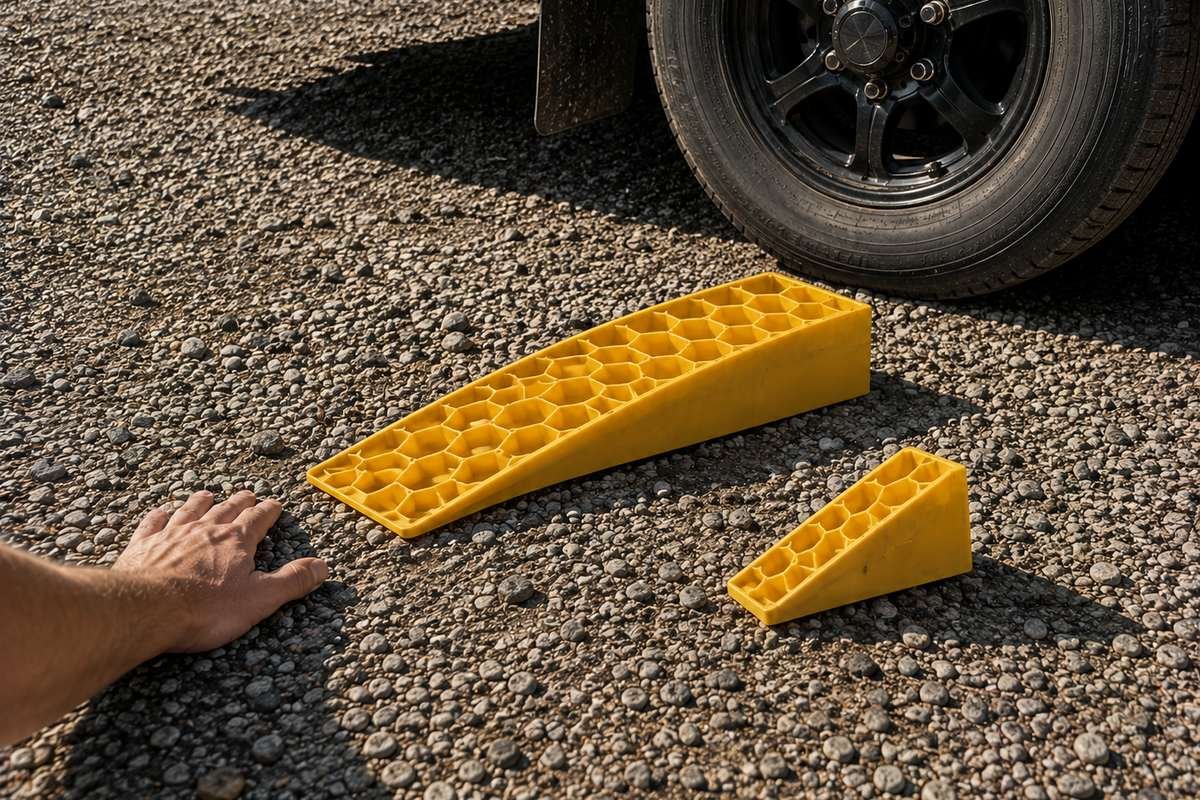
RV leveling blocks and drive-on levelers are two different tools that sell in the same aisle.
Interlocking blocks are the stacking kind. A Lynx Leveler is 8.5 inches square and 1.5 inches thick, and gives one inch of lift per layer once the interlock is taken up. You build the stack first, then drive onto it, which means guessing the height before you know whether it was right.
Curved levelers are the drive-on kind. You put one wedge in front of the tire and drive up it until the bubble level on the trailer reads level, then stop. Andersen publishes a range of half an inch to four inches at any increment, which is the main advantage of the design: you aren't choosing a height in advance. You're stopping when it looks right.
The tradeoff is that blocks go anywhere. Tri-Lynx rates its levelers for use under single and dual wheels, under tandem axles and under jacks, and sells a cap that gives a stack a flat top for that job. A curved leveler does one thing.
There's also a tandem axle problem that only one manufacturer mentions. Beech Lane states plainly that two of its curved levelers can be used on a dual axle trailer, but that up to four inches may need to be cut off the end of one of them. Andersen publishes nothing equivalent, which isn't the same as the problem not existing.
How much of the tire has to be on the block?
Nobody says. Four manufacturers, and not one of them publishes a figure for how much of the tire has to sit on the block, how much overhang is too much, or how wide the stack should be.
That is the odd gap in this whole category. All four publish a weight rating in the tens of thousands of pounds. None of them says anything about the thing that decides whether a stack stays where you put it: how much of the tire is on top of it.
Three things can be said without inventing a specification. The tire should be sitting on the blocks, not perched on the edge of them. The stack should be wide enough that no part of the tread hangs over a side. And if you drive up and the tire ends up on a corner, back off and rebuild rather than leaving it there for the night.
Are leveling blocks the same as wheel chocks?
No, and the manufacturers are clearer about it than the retail listings are. This site covers that argument in full in the trailer wheel chocks guide, so here is the short version and where the products land.
Andersen ships a chock with its Camper Leveler and tells you to place it behind the leveler to hold your position after leveling. The detail matters. The chock is holding the leveler in place, not holding the trailer.
Tri-Lynx draws the same line across two separate products. Its Stop N Chock is described as a wheel guide that can't be used on its own because it interlocks with the levelers. Its Chock R Dock is described as a chock that can be used independently.
Camco needs a closer look, because its product is called the Curved Leveler and Wheel Chock and ships as two pieces: a ramp and a chock. Camco never writes anywhere that the ramp alone will chock a wheel. The name promises more than the product description does, and a reader skimming a listing wouldn't catch the difference.
What do the weight ratings mean?
Less than they appear to. The numbers are large, they're published, and they aren't all measuring the same thing.
Tri-Lynx publishes 40,000 pounds and doesn't say whether that's per block, per stack or per trailer. Beech Lane publishes 35,000 pounds for its polymer leveler. Andersen frames its number as trailers up to 30,000 pounds, which reads as a trailer weight rather than a block rating. Camco publishes 30,000 pounds for the curved leveler and, for its FasTen blocks, no capacity at all.
So three brands publish a figure in three different frames, and the fourth doesn't publish one for its best-selling product. Comparing 40,000 against 35,000 against 30,000 as if they were the same measurement is the mistake the numbers invite.
None of the four publishes what the blocks are made of. Beech Lane says polymer without naming it. The others say strong, durable, heavy-duty honeycomb, and nothing that could be checked.
The specification that's easier to use is the warranty, because it's a promise rather than a description. Andersen and Beech Lane both say lifetime. Tri-Lynx offers ten years with registration. Camco gives twelve months with a receipt.
Five RV leveling blocks worth considering
Every figure below is the manufacturer's own. Where something is missing from a card, it's missing because the manufacturer doesn't publish it.
Tri-Lynx Lynx Levelers, 11 Piece
The only published stacking limitTri-Lynx is the one manufacturer here that will tell you in writing how high to go: five levelers under a wheel, eight under a jack. Nobody else commits to a number, which makes this the set you can follow instructions with.
Each block is 8.5 inches square and 1.5 inches thick, giving an inch of lift per layer once the interlock is taken up. They're rated for use under single and dual wheels, under tandem axles and under jacks, and the pack includes one cap that gives a pyramid a flat top for the jack job. Ten years of warranty, on registration. Tri-Lynx also asks you not to mix them with other brands or with wood, which is worth reading before you build a stack out of whatever is in the bay.
What You'll Love
- The only stacking guidance anybody publishes
- Works under wheels, tandem axles and jacks
- A cap top is included for the jack stack
- Ten pounds for the whole pack, in a bag
Worth Considering
- You build the stack before you know the height you needed
- The 40,000 lb rating isn't explained as per block or per stack
- Tri-Lynx doesn't say what they're made of
- The FAQ and the product page give different inch figures
Andersen Hitches Camper Leveler, 2 Pack
Stop where it looks rightThe drive-on answer to the guessing problem. Andersen publishes half an inch to four inches at any increment, which means you stop when the bubble level reads level rather than building a stack and hoping.
Each leveler ships with a chock, and Andersen is precise about that chock's job: it goes behind the leveler to hold the position after leveling. It isn't the trailer's chock. Tires up to 32 inches in diameter, made in the USA, lifetime warranty on both pieces. The rubber pad that stops it sliding on hard surfaces is sold separately, which is worth knowing before the box arrives.
What You'll Love
- No guessing, you stop at the height you want
- Any increment rather than fixed one inch steps
- Lifetime warranty on the leveler and the chock
- A published tire diameter limit, which is rare here
Worth Considering
- The rubber grip pad is sold separately
- Andersen publishes no material, weight or dimensions
- Nothing published about tandem axle spacing
- Does one job, where blocks go under jacks too
Beech Lane Camper Leveler, 2 Pack
The one that admits the tandem axle problemThe same drive-on idea as the Andersen, from the only manufacturer willing to publish the awkward part: two of these can be used on a dual axle trailer, but up to four inches may need cutting off the end of one of them to fit between the tires.
That is a real answer to a real problem, and no other curved leveler maker says it. Rated to 35,000 pounds in what Beech Lane calls its highest quality polymer, patented, lifetime warranty, and the two pack now includes rubber grip mats to stop it sliding. If the cutting puts you off, Beech Lane sells a stackable version it says fits all dual axles with no cutting.
What You'll Love
- States the tandem axle trimming nobody else mentions
- Grip mats included rather than sold on
- Lifetime warranty, and a stackable version exists
- The highest published capacity of the two curved picks
Worth Considering
- No maximum lift height published anywhere on their site
- Cutting a leveler to fit is a one way decision
- Warranty applies only to Amazon or direct purchases
- Polymer is named as a category rather than a material
Camco FasTen Leveling Blocks, 10 Pack
The cheapest way into interlocking blocksThe familiar yellow blocks, with a T handle for carrying and an interlock that lets them build a pyramid the same way the Lynx ones do.
Camco puts these under wheels, tongue jacks, stabilizer jacks and tandem axles. What it doesn't do is publish very much: no capacity figure, no block dimensions, no material, and no stacking limit on any page. The warranty is twelve months with a receipt, against lifetime from two of the others. Buy these on price and availability rather than on specification, because there isn't much specification to buy on.
What You'll Love
- Cheap, common, and replaceable anywhere
- The T handle makes a stack easy to carry
- Rated by Camco for jacks as well as wheels
- An XL version exists for wider tires
Worth Considering
- Camco publishes no capacity for these at all
- No material and no block dimensions either
- Twelve month warranty against lifetime elsewhere
- No stacking guidance, so you're on your own
Camco Curved Leveler and Wheel Chock
A drive-on leveler at block pricesThe least expensive way to try the drive-on approach, and the pick with the most careful reading required. Camco publishes 30,000 pounds and four inches of lift, though the lift figure appears in a Camco blog post rather than on the product page.
The name is the thing to be careful about. It ships as two pieces, a ramp and a separate chock with rubber grippers, and Camco never writes that the ramp on its own will chock a wheel. Treat it as a leveler that comes with a chock, which is what it is, rather than as a single item doing both jobs.
What You'll Love
- Drive-on leveling for close to the price of blocks
- Four inches of lift, same as the pricier curved ones
- The chock has rubber grippers rather than bare plastic
- Sold singly or as a pair
Worth Considering
- The name suggests one part doing two jobs, and it's two parts
- The lift figure is on a blog post, not the product page
- Twelve month warranty
- No material published, only a honeycomb description
What did not make the list, and why
The Camco Super Tri-Leveler. It sells well and it was going to be the sixth pick here. Camco has no live product page for it. It doesn't appear in the company's own leveling range, and the capacity and lift figures that turn up in search results come from retailer listings rather than from Camco. A product whose specification can't be checked against the manufacturer doesn't get recommended on this site.
The unbranded multi-packs. Page one of any search for these is full of ten and twelve packs from sellers with no manufacturer site behind them. Some are probably fine. None of them publishes a capacity, a material or a warranty that could be verified, which is the whole basis on which the five above were chosen.
What about soft ground and hot asphalt?
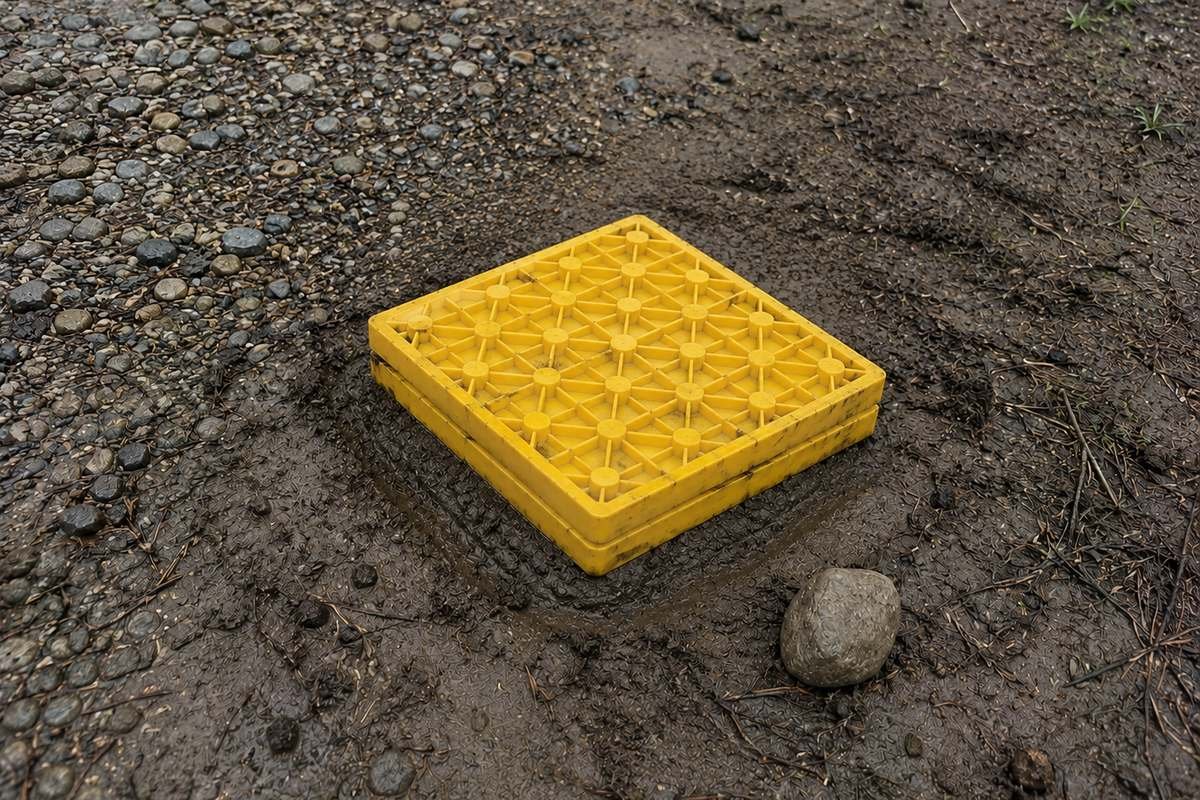
One manufacturer addresses the ground, and none of them addresses the heat.
Tri-Lynx says its levelers should work on all surfaces except muddy ground that's prone to sinking, and asks owners to check for large rocks underneath before setting them down, because the point loading from a rock is what cracks a block. That is the only surface guidance any of the four publishes.
On soft asphalt in high summer, nothing is published by anybody. It's a real thing that happens to jack feet and blocks on hot days, and it's worth spreading the load on a wider pad when the surface is soft, but don't let anyone tell you that's manufacturer guidance. It isn't written down.
Tri-Lynx does publish one more thing worth repeating, which is that it doesn't recommend pairing its levelers with other brands, or with wood and stones, because it can't guarantee how the combination behaves.
Where the work stops
Leveling is one of the few jobs on a trailer with no wiring, no plumbing, and no gas in it. Three things still sit outside it.
Getting under the trailer. Blocks and levelers aren't jack stands, and nothing here supports a trailer you intend to lie beneath.
Automatic leveling systems. Hydraulic and electric levelers are a different subject with their own controllers, pumps, and failure modes. None of this applies to them.
Anything that moved while you were under it. If a stack shifts as the trailer settles, the answer is to pull forward and rebuild rather than to push a block by hand with the weight already on it.
Quick Answers
How high can you stack RV leveling blocks?
Only Tri-Lynx publishes a limit. It recommends no higher than five levelers for leveling under a wheel, and no higher than eight when stacking under a jack to stabilize. Andersen, Beech Lane and Camco publish no stacking guidance at all.
Are RV leveling blocks the same as wheel chocks?
No. Andersen ships a chock with its leveler and says to place it behind the leveler to hold the position after leveling, which is holding the leveler rather than the trailer. Tri-Lynx sells a wheel guide that can't be used on its own and a separate chock that can.
How much of the tire has to sit on the block?
No manufacturer publishes a figure for tire contact or acceptable overhang. What can be said is that the tire should sit on the blocks rather than perch on an edge, and a tire balanced on a corner means backing off and rebuilding.
What do the weight ratings on leveling blocks mean?
They aren't all the same measurement. Tri-Lynx publishes 40,000 pounds without saying per block or per stack, Beech Lane 35,000 pounds, Andersen frames its figure as trailers up to 30,000 pounds, and Camco publishes no capacity for its FasTen blocks.
Can you use leveling blocks on soft ground?
Tri-Lynx says its levelers should work on all surfaces except muddy ground prone to sinking, and asks owners to check for large rocks underneath, since point loading from a rock is what cracks a block. No other manufacturer publishes surface guidance.
Do curved levelers work on a dual axle trailer?
Beech Lane publishes that two of its curved levelers can be used on a dual axle trailer but that up to four inches may need cutting off the end of one. Andersen publishes nothing on tandem axle spacing.
Where to go next
RV leveling blocks are the first thing out of the bay on arrival, and the rest of the setup has its own guides here.
- Trailer wheel chocks, which covers the chock question in full, including what the standard says and how much force a chock is holding back
- Travel trailer tires, since the tire is what sits on the block, and its size decides what will fit
- Weight distribution hitches, for the other half of getting a trailer to sit right
- The RV towing guide, if you're working through setup from the beginning