
Your trailer brakes stopped working, or the controller is flashing something at you, and the obvious conclusion is that the controller has failed. It's the box on the dash, it's the part with the electronics in it, and it's the part you can buy a replacement for this afternoon. Most trailer brake controller repair starts from that assumption, and that is the wrong place to start.
Read what the manufacturers publish and a different picture appears. Dexter, which builds most of the axles under American travel trailers, lists five causes of electric brake failure in its own service manual: poor electrical connections, open circuits, insufficient wire size, broken wires and blown fuses. A faulty controller isn't on the list at all. Tekonsha's Prodigy P3 gives four probable causes for its "No Trailer Connection" message, and a broken controller isn't one of those either.
That isn't proof your controller is fine. Nobody publishes failure rates, and any article claiming a percentage is inventing it. But it does tell you where the people who build this equipment start looking, and it isn't at the controller.
Here is what to check before you replace anything.
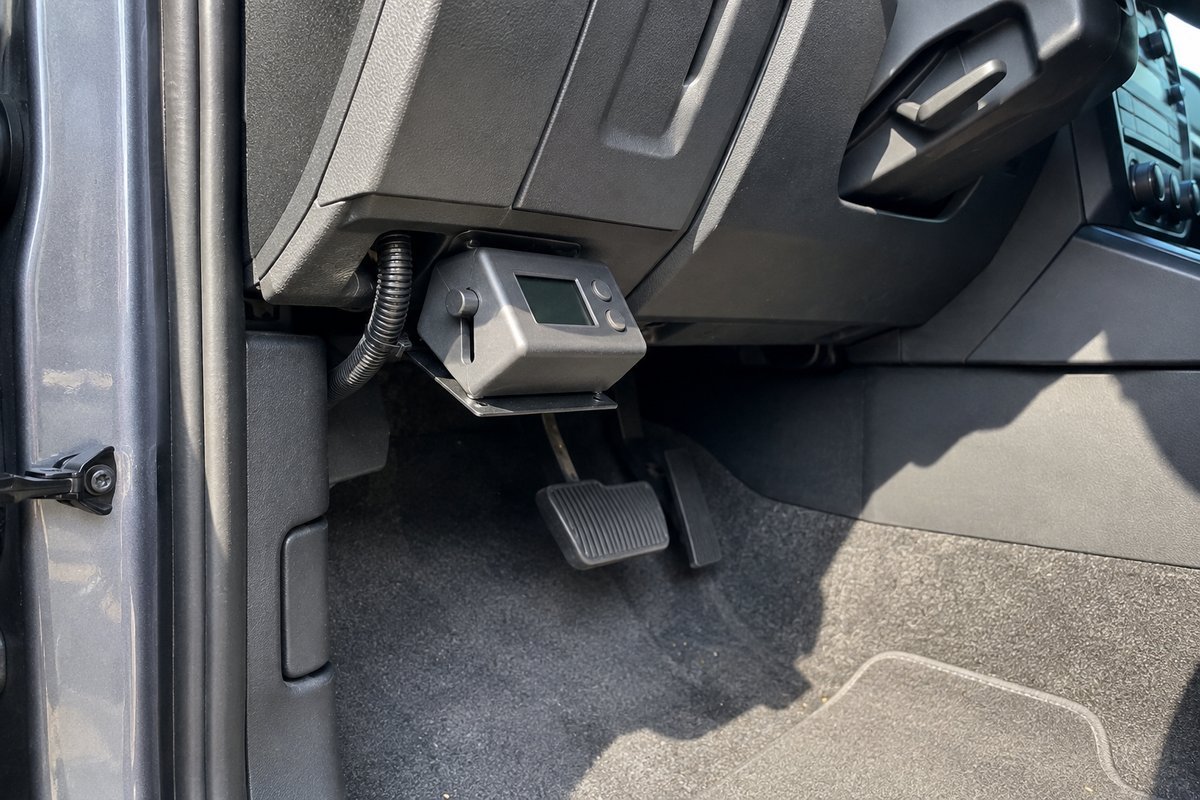
Table of Contents
How do you know if a trailer brake controller is bad?
Mostly, you don't, at least not from the symptom alone. The controller senses electrical load on the brake circuit. It can't tell the difference between a trailer that's unplugged, a trailer that's plugged in with a broken wire, a corroded pin, or a brake magnet that has lost its ground. All four look identical to the controller, and all four produce the same message.
The Tekonsha P3 manual is unusually direct about this. Its "No Trailer Connection!" screen lists exactly four probable causes: the trailer isn't connected, there's an open circuit on the brake line, the connector is disconnected or corroded, or the trailer has lost its brake magnet ground.
Other brands describe the same thing in their own language. REDARC says a Tow-Pro remote head that "breathes" blue is powered but sees no trailer, and points you at dirty or bent plug pins first. CURT's Echo adds a detail worth knowing: on some vehicles the 7-way socket isn't live until tow mode is active, so a controller that looks dead may be sitting on a socket that has no power yet.
The one genuine controller fault in that group is a display that reports an internal error. CURT's TriFlex shows "A.E." for an accelerometer or internal error, and its sheet says plainly to replace the unit.
Why is the controller not recognizing the trailer?
This is the most common complaint, and it's almost always about the connection rather than the box.
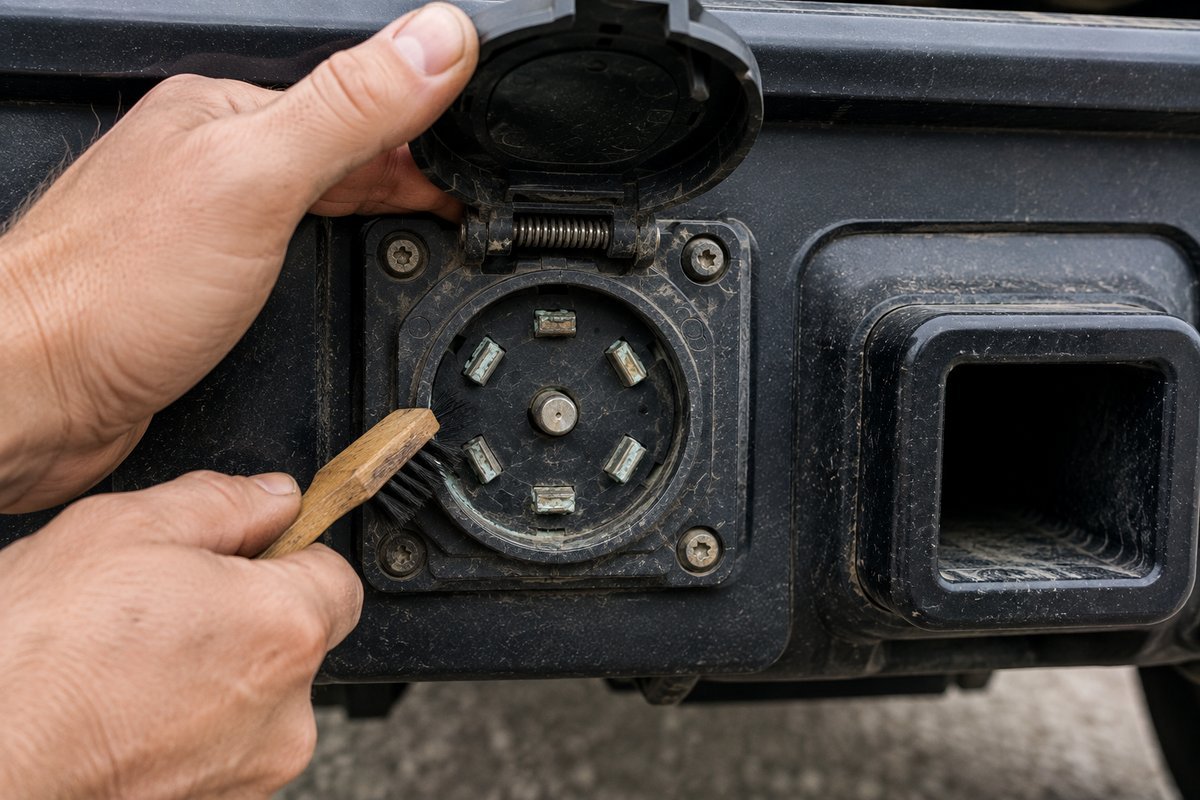
Start with the plug. Look at the pins in the 7-way socket on the truck and the plug on the trailer. REDARC's published check is to clean corroded or dirty pins and gently straighten any that are bent. Hopkins recommends dielectric grease on the terminals as routine prevention, and CURT says the same in its Echo install sheet. When two manufacturers independently tell you to grease the terminals, that tells you how often corrosion is the answer.
Then check that the plug is fully seated. It sounds too simple to be worth saying, but CURT lists a partially seated connector as a specific cause of a disconnect warning.
Then grounds. Hopkins describes the failure that confuses people most: a ground good enough to run some functions but not all, so your trailer lights work and your brakes don't. Dexter goes further and recommends running a common ground from the trailer plug to the magnets rather than grounding each brake separately to the frame. Frame grounds rely on bolted joints that rust, and they fail intermittently, which is the worst way for anything to fail.
One useful fact while you're looking at the plug. The blue wire is the electric brake circuit on both of the wiring conventions CURT publishes for the 7-way RV connector. Along with white for ground, that is the part that stays constant, and CURT notes that other colors vary in function depending on the configuration, which is laid out in full in the brake controller wiring diagram for both color standards.
Blade positions themselves are standardized, and manufacturers do publish pin charts. What confuses people is that two color conventions are in circulation at once, so verify what a wire does at the vehicle socket rather than trusting its color.
If you want to look up the standard yourself, be careful which one you find. SAE J560 comes up constantly in search results and it's the heavy truck connector, the one between a tractor and a semi trailer. It has no electric brake magnet pin at all. The connector on your travel trailer is covered by SAE J2863, which SAE sells rather than publishes free.
Is it the fuse?
Often, and a lot of people go wrong here, because they look for one fuse when there are usually two.
There's a high current feed that powers the brake output, and a separate low current signal circuit. On a current-generation Ford F-150 the trailer brake control module runs on a 30 amp fuse in the engine compartment box. On a 2017 Super Duty there's a 5 amp fuse in the passenger compartment labeled for the aftermarket brake controller and the brake on/off signal. On the F-53 motorhome chassis there's a 30 amp feed in the power distribution box and a separate 10 amp fuse in the cab.
Those are three different ratings inside one manufacturer's own lineup, and Ford moves fuse positions between model years, which is why you shouldn't trust any article, including this one, to tell you your fuse rating. Look it up in the fuse chart in your own owner's manual.
The two circuits do different jobs, and that shapes what you would expect to see. A 30 amp output feed carries the current that works the magnets. A 5 or 10 amp signal fuse carries the brake on/off input. Losing the feed should leave you with no braking output. Losing the signal should leave a controller that looks alive but won't act on the pedal. That is a reasonable reading of the circuits rather than something the manufacturers spell out, so treat it as a place to start rather than a diagnosis.
Location isn't universal either. Ford splits trailer related fuses between the engine compartment box and the passenger compartment panel.
How do you reset a trailer brake controller?
This is the single most asked question about brake controllers, and the answer is frustrating: we couldn't find a factory reset published by any major manufacturer.
What exists is recalibration, it's specific to the model, and the manufacturers don't even agree with themselves. CURT's TriFlex NEXT sheet says to turn the vehicle off and restart it, or disconnect and reconnect the controller. CURT's Spectrum sheet, same brand, says to unplug and re-plug the trailer's electrical connector. REDARC's Tow-Pro Elite recalibrates itself continuously and has no manual reset command. Tekonsha's Prodigy P3 manual publishes no reset procedure of any kind, and neither does Ram's owner information for its integrated unit.
Two pieces of advice you will find repeated online are worth correcting.
Holding the boost button on a Prodigy P3 for five seconds doesn't reset it. In Tekonsha's own words, pressing boost continuously for five seconds with the brake pedal depressed cancels boost and hold for three minutes, which is there to help you back a trailer. It suspends a feature temporarily. It doesn't clear the controller.
Disconnecting the vehicle battery to reset a factory brake controller has no manufacturer source behind it. It's a myth. It may do nothing, and on a modern truck it will certainly reset a lot of things you didn't intend to reset.
If your controller has lost its settings, the thing you need is the setup procedure from your own model's manual, not a reset.
How do you test whether the controller is working?
Here the manufacturers openly disagree, and you need to know which advice applies to your equipment.
REDARC prescribes a 12 volt incandescent test light of 5 to 21 watts, and states that multimeters and LED testers are unsuitable because they don't load the circuit. That point applies whatever you drive. A meter can happily read 12 volts through a corroded joint that collapses the moment real current flows through it. That's exactly how an intermittent brake fault hides from you.
Tekonsha warns the opposite way about its own hardware. The P3 manual notes that some test lights and non-Tekonsha testers can trigger a false "Output Shorted" warning.
There's a catch worth knowing before you buy anything. No test light manufacturer we checked publishes a wattage. We looked at Lisle, Innova, Hopkins and Klein. Innova and Hopkins do say their testers use LEDs, which rules those models out for this job. Lisle sells replacement glass bulbs, which strongly implies a filament, but Lisle never writes incandescent, filament or a wattage anywhere in its product documentation, and neither does Klein. So you can't buy a test light off the shelf and know it meets REDARC's specification.
Worse, the miniature bulbs commonly used in test lights sit in the 158 and 194 family. Working from the current and voltage in the bulb makers' own catalogs, a 158 comes out around 3.4 watts and a 194 around 3.8. Both are below REDARC's five watt floor. An incandescent test light can still fail to load the circuit enough.
If you want to be certain you're meeting the spec, the reliable route is a bulb whose rating you can work out from published figures: a 1141 at about 18 watts, or an 1156 at about 27 watts, in a socket with leads. A spare trailer stop lamp does the same job. Those numbers come from the bulb makers' catalogs, which is more than any test light manufacturer will tell you.
Both are right about their own equipment, which means the useful instruction is to follow the manual for the controller you own rather than a general rule.
If you have a Prodigy P3, you already own the best consumer diagnostic on the market. Its Menu, Help, Trouble Shoot mode displays battery voltage, stoplight switch voltage, average brake voltage and brake current, which is most of what a shop would measure.
How much current should the trailer draw?
This is the number that separates a controller problem from a trailer problem, and Dexter publishes it.
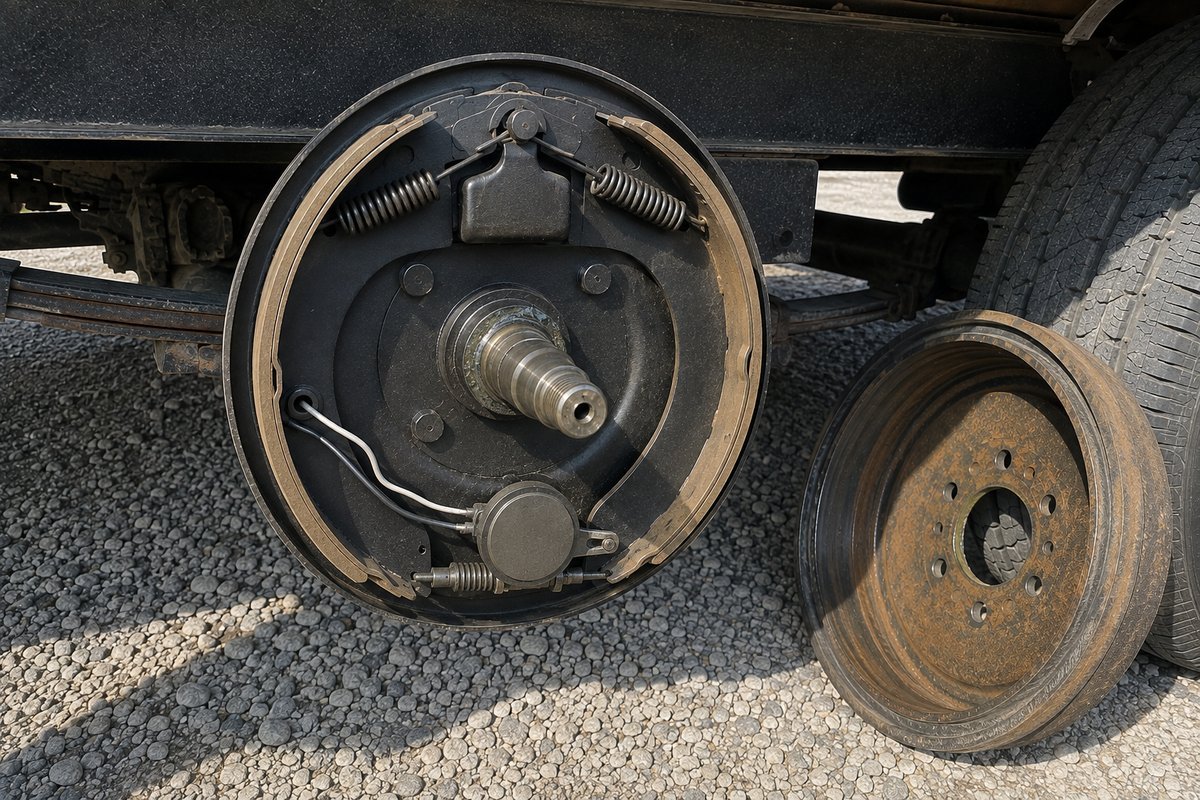
A brake magnet draws about 3.0 amps, or about 2.5 amps on 7 inch brakes. So two brakes should pull around 6 amps, four brakes around 12 amps, and six brakes around 18 amps. Voltage at the magnets should climb gradually to about 12 volts as the controller is applied, not jump.
If your controller reports that it's commanding close to 12 volts but the current is far below those figures, the fault is downstream of the controller. That's magnets or wiring, not the box on your dash.
Dexter's service manual also publishes a magnet resistance figure alongside the amperage, 3.2 or 3.9 ohms depending on brake size. Resistance on its own is the weaker test, though. A magnet can read close to specification on a meter and still fail to pull the current it should once the circuit is under load, which is why the amperage figures above are the ones worth measuring.
What does the gain setting do?
Gain sets how much power the controller sends to the trailer brakes, and there's a full walk through of setting the gain on a proportional brake controller if yours has never been set properly. It isn't a repair, but a wrong gain setting produces symptoms that get mistaken for a fault often enough that it belongs in this article.
GM's owner manual states it as a safety warning rather than a tip: trailer brakes that are over-gained or under-gained may not stop the vehicle and the trailer as intended. The target GM gives is just below the point of trailer wheel lock-up, which it says you identify by wheel squeal or tire smoke.
The detail most people miss is in the same document. GM notes that trailer wheel lock-up may not happen at all when you're towing a heavily loaded trailer. So "I turned the gain to maximum and nothing locked up" is documented normal behavior, not evidence that your controller is broken.
Tekonsha adds two more non-faults. Cold brakes are less responsive than warm ones, so a controller set on cold brakes will feel weak. Worn trailer brakes may need more boost to do the same work.
REDARC provides the useful counterweight: it sends unpredictable trailer braking to the trailer's own drum brakes rather than to gain, saying the cause is commonly traced to the brake hubs. Not every grabby trailer is an adjustment problem.
Is there a correct gain number?
No, and this is worth saying clearly, because you will be offered one constantly.
No manufacturer we checked publishes a recommended gain setting. What the manuals publish are starting points for a road test, and even those disagree: Tekonsha's Prodigy P3 starts at 6.0, Draw-Tite's Activator starts with the output control in its lowest position, and REDARC has no numeric scale at all. Quoting any of those as "the right gain" misrepresents every one of those manuals.
The published test speeds are more consistent, with one split. Tekonsha and CURT both specify about 25 miles per hour on dry level pavement. GM and Ram both specify 20 to 25 miles per hour.
There's a second difference that matters more than the speed. CURT tells you to test using the vehicle brake pedal. Tekonsha, GM and Ram all tell you to use the manual override lever. Follow the wrong one for your controller and you will get a different result.
Every manufacturer agrees on one thing: gain has to be reset when the load, the trailer, the road surface or the weather changes. It isn't a set once and forget setting.
Three things worth owning before you replace the controller
None of these is a brake controller. They're the tools that tell you whether you need one, and the two consumables that stop the fault coming back.
UNI-T UT210E Clamp Meter
Measures the currentThe one measurement that tells you whether the fault is in the controller or out at the trailer is current draw at the magnets, and an ordinary multimeter can't take it without breaking into the circuit. A clamp meter reads it around the outside of the wire.
The two things that matter here are that it reads DC and that it has a low range. Most cheap clamp meters do neither, and a meter that only reads AC is useless on a brake circuit.
What You'll Love
- Reads DC current, which most budget clamp meters can't
- 2 A and 20 A ranges resolve one magnet from four
- About 0.09 A of error at 3 A, so 2.5 A and 3.0 A are distinguishable
- Standalone meter, not a probe that needs a second instrument
Worth Considering
- Hall-effect sensors drift, so it needs zeroing before each reading
- 100 A top range is more than a brake circuit will ever need
- No true one-hand operation on a tight jaw
- Manual ranging takes a moment to learn
Permatex 22058 Dielectric Tune-Up Grease, 3 oz
What two makers recommendBoth Hopkins and CURT tell you in writing to put dielectric grease on trailer connector terminals. It keeps water and road salt off the contacts, which is where most of these faults start.
Permatex lists trailer electrical connectors by name among its applications, and its own directions say to coat both parts. That answers the usual worry about greasing a contact: the maker intends it to go on the metal.
What You'll Love
- Manufacturer names trailer connectors as an intended use
- Wide temperature range covers anything you will tow in
- Won't attack the rubber seal or the plastic housing
- 3 oz is years of use on one RV
Worth Considering
- Permatex publishes no dielectric strength figure
- Messy to apply in the cold
- The 0.33 oz version (81150) is too small to be worth buying
- Does nothing for corrosion already present, clean first
WD-40 Specialist Contact Cleaner, 11 oz
Clean before you greaseGrease over corrosion traps the corrosion. If the contacts are green, they need cleaning first, and a contact cleaner flushes the recesses a brush can't reach.
This one dries quickly and leaves no residue, so you can grease straight after. It's safe on metal and on most plastics, though WD-40 asks you to test a plastic part first.
What You'll Love
- Reaches into the contact recesses where a brush won't go
- Dries fast enough to grease the same afternoon
- No residue left to attract fresh road dirt
- Useful well beyond the trailer plug
Worth Considering
- WD-40 asks you to test plastics before spraying
- Aerosol is wasteful for one small connector
- Won't remove heavy corrosion on its own
- Needs doing outdoors
When is it the controller, and when is it the trailer?
A rough division, based on what the manuals above describe.
Suspect the connection when the controller reports no trailer, when the fault is intermittent, when trailer lights work but brakes don't, or when the symptom changes if you wiggle the plug.
Suspect the trailer when the controller commands voltage but current is low, when braking is uneven side to side, or when brakes grab or judder rather than fading.
Suspect the controller when the display reports an internal error, when it fails with a known good trailer that brakes correctly behind another vehicle, or when the manufacturer's own diagnostic mode shows no output at all.
Anything involving brake wiring, magnets or drums is shop work. Trailer brakes are the system that stops several thousand pounds behind you, and guessing isn't safe.
Does the law require a brake controller?
Not by name, anywhere. This surprises people.
There's no federal standard requiring service brakes on a light electric-braked travel trailer. FMVSS 121 applies to trucks, buses and trailers with air brake systems. FMVSS 135 applies to cars, multipurpose vehicles, trucks and buses rated at 7,716 pounds or less, and never names trailers. The Federal Motor Carrier rules apply to commercial operation, although some states adopt that text.
What states require is that the trailer has adequate working brakes above a weight threshold, and that the combination stops within a set distance. None of the statutes below uses the words "brake controller." The controller isn't mandated. It's simply how you comply, because electric brakes can't work without one.
The thresholds vary enormously, and so does the weight they're measured against:
| State | Brakes required at | Measured as |
|---|---|---|
| New York | 1,000 lb | unladen |
| California | 1,500 lb, trailer coaches and camp trailers | gross |
| Florida | 3,000 lb | gross |
| Arizona | 3,000 lb | gross |
| Washington | 3,000 lb | gross |
| Texas | 4,500 lb | gross |
New York is the outlier twice over. It's the only one of these measured on unladen weight, and its statute adds a second test: trailers built on or after 1 January 1971 also need brakes above 3,000 pounds gross.
Texas has a further wrinkle. Between 4,500 and 15,000 pounds a trailer can go without brakes only if it's towed at no more than 30 miles per hour, which isn't a realistic way to use a travel trailer.
Florida and Washington are worth reading carefully, because the exemption has a condition attached. A trailer under 3,000 pounds is exempt only if the weight on its wheels stays under 40 percent of the tow vehicle's gross weight. A light trailer behind a light tow vehicle can therefore still need brakes.
The Texas threshold is four and a half times New York's, which is why no single national number works. Check your own state, and be aware that no source we could find resolves cleanly which state's rule applies while you're traveling through.
Surge brakes, which work on the trailer's own inertia, need no controller and no electrical connection. Texas permits them expressly for trailers up to 15,000 pounds and the federal rules allow them. Most other states are simply silent rather than prohibiting them.
Breakaway systems are the other half of the picture. If the trailer separates, its brakes must apply automatically and hold. The 15 minute figure is published in federal rule and in Florida, Washington, Texas and California law, though Florida's version applies to trailers built after 1 January 1972 and Washington's to those built after 1 January 1964. It isn't universal either: Arizona requires automatic application on breakaway but publishes no duration, and New York's brake statute contains no breakaway requirement at all.
California's rule is confusing. Section 26304(a) states the 15 minute rule, but it's written for "power brakes," meaning air, vacuum or boosted hydraulic systems. Ordinary electric drum brakes on a travel trailer don't obviously fall under that wording, so the requirement is stated clearly but doesn't map cleanly onto the equipment most travel trailers use.
What trailer brake controller repair usually comes down to
Check the plug and the pins. Check both fuses, not one. Confirm whether the socket is even live. Compare the current the trailer draws against about 3 amps per magnet. Check the gain before you decide the controller has failed, and warm the brakes before you judge it.
Then, if the controller still fails against a trailer you know is good, replace the controller.
Quick Answers
How do you know if a trailer brake controller is bad?
Usually not from the symptom alone. A controller can't tell an unplugged trailer from a broken wire, a corroded pin or a lost magnet ground, so check the connection and wiring first. The one clear controller fault is a display that reports an internal error.
Why is the controller not recognizing the trailer?
It's almost always the connection. Clean and straighten the pins in the 7-way plug, make sure the plug is fully seated, check the trailer's ground, and confirm the truck's socket is live. Some trucks only power the socket in tow mode.
Is it the fuse?
Often. There are usually two fuses to check: a high current feed, often 30 amps, that powers the brake output, and a smaller signal fuse for the brake on/off input. Ratings and locations vary by model and year, so use the fuse chart in your owner's manual.
How do you reset a trailer brake controller?
We couldn't find a factory reset published by any major manufacturer. What exists is model-specific recalibration, such as restarting the vehicle or unplugging and reconnecting the trailer. Disconnecting the truck battery has no manufacturer backing.
How do you test whether the controller is working?
Follow your controller's manual, because the makers disagree. REDARC calls for a 12 volt incandescent test light of 5 to 21 watts, since multimeters and LED testers don't load the circuit. Tekonsha warns that some test lights can trigger a false Output Shorted warning on its P3.
How much current should the trailer draw?
Dexter publishes about 3 amps per brake magnet, or about 2.5 amps on 7 inch brakes, so around 12 amps for a four-brake tandem axle trailer. If the controller is sending close to 12 volts but the current is far below that, the fault is in the magnets or wiring.