
An RV water pressure regulator is a brass fitting that screws onto the campground spigot and costs less than dinner out. It's the cheapest insurance on your trailer, and almost everything written about it gets the main question backward.
Everywhere you look, you're told the cheap ones slow the water down so much you can't take a decent shower, and that the answer is to spend five times as much on an adjustable one with a gauge.
Winnebago tested them. They hooked each one to the same spigot and timed how long it took to fill a five gallon jug. The inexpensive brass regulator moved about twenty percent more water than the adjustable one that cost five times as much.
Here is what the numbers say, what you're protecting, and how to pick one.
Table of Contents
What You Are Protecting
Ask why you need a regulator, and most articles say it protects your water lines. That is the wrong answer, and it makes the whole thing sound optional.
The water lines in a modern trailer are PEX, and PEX is rated to around 160 psi at room temperature. No campground is going to hurt it. If PEX were the weak point, you could skip the regulator entirely.
The weak points are everything joining the PEX together. The crimp rings, the plastic compression fittings, the little flexible supply lines under the sink and behind the toilet. RV technician Dave Solberg puts plastic compression fittings at around 60 psi when they're installed properly, and points out that on a new trailer the crimps aren't always done properly in the first place.
He has also seen water lines held on with ordinary screwdriver tightened hose clamps come apart at well under 40 psi.
So the regulator isn't protecting the pipe. It's protecting the cheap connection behind a wall panel that you won't find until the floor is soaked.
And the pressure is real. Winnebago measured 115 psi at a test spigot. Mortons on the Move measured 120. That's double what your fittings are rated for, sitting there all night while you sleep.
How Much Pressure Is Safe
Here is where we disagree with most of the internet. You will read 40 to 60 psi everywhere, stated as fact, with no source attached.
The rules that govern how RVs are plumbed live in NFPA 1192, and that document is behind a paywall. We don't have a copy, so we aren't going to tell you it says a number. Anybody quoting you a specific figure from NFPA 1192 without owning a copy is guessing.
What we can tell you is what the manufacturers themselves print, which is better evidence anyway.
- Winnebago says a regulator should hold pressure to 50 psi maximum.
- Valterra prints on its own product page that settings above 60 psi aren't recommended, and to check your RV manual.
- Camco presets its regulators to 40 to 50 psi and leaves it there.
Three manufacturers, no coordination, and they land in the same place. Set yours around 45 to 50 and stop thinking about it. If your trailer came with a manual that gives a number, that number wins.
The Flow Rate Myth
Better flow is the reason most people pay extra for an adjustable regulator, and it doesn't hold up.
The story goes that a cheap non-adjustable regulator strangles your water, so you need an adjustable one to get a decent shower. Winnebago tested it properly. They ran an unregulated spigot at 115 psi as a baseline, which gave 17.2 gallons a minute, then timed a five gallon fill through each regulator.
The results, in gallons per minute:
- Valterra stainless high flow, not adjustable: 10.4
- Camco 40055 brass, not adjustable: 9.2
- Valterra brass, not adjustable: 9.1
- Watts LF263A, adjustable with a gauge, roughly five times the price: 7.7, the worst of the group
The expensive adjustable one came last. Winnebago also found its built-in gauge was inaccurate and that it was awkward to adjust.
Why the expensive one flowed the least
So we looked up Watts' own paperwork, and it explains the whole thing.
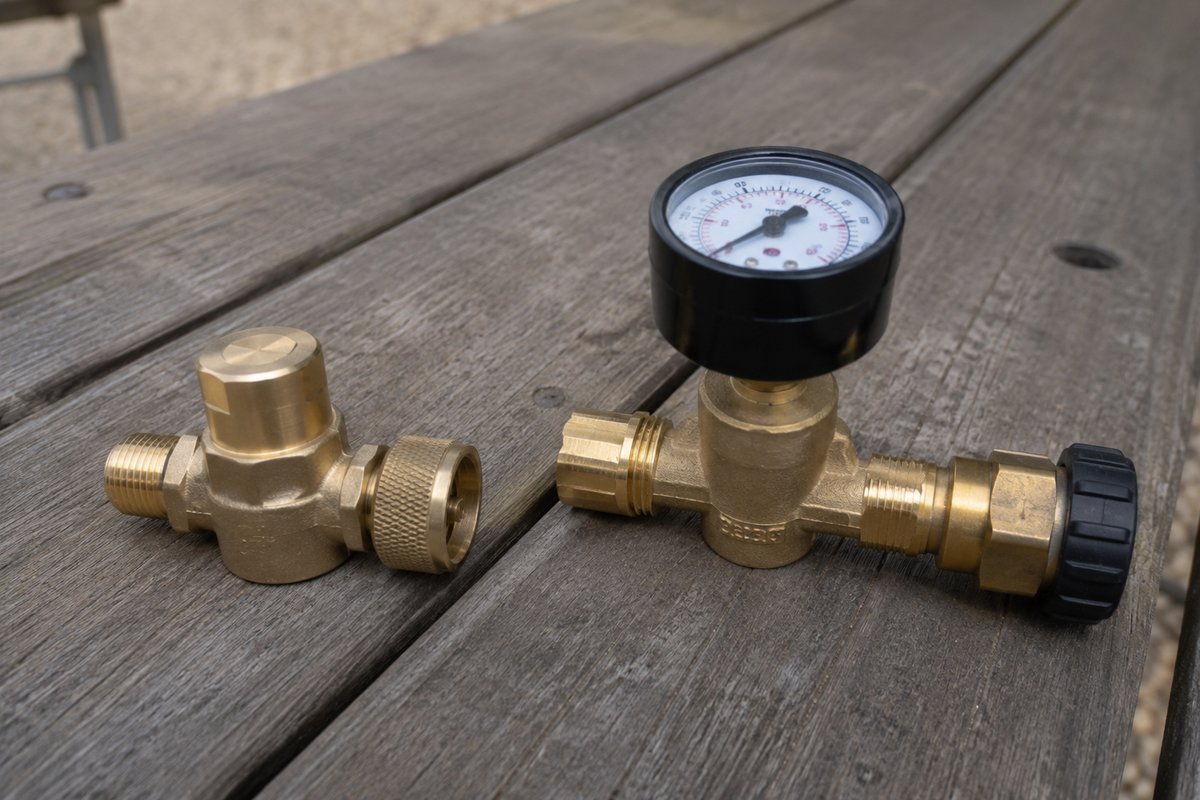
The Watts isn't an RV part at all. Watts sells it for beverage machines, ice makers, paint spraying, humidifiers and drinking fountains. It's only built with half inch openings or smaller, and Watts' own figures say it will carry no more than 7 gallons a minute.
Your hose and your trailer's inlet are three quarter inch. The RV sellers take that smaller valve and screw hose fittings onto each end so it will connect up. The narrow part in the middle stays narrow. It was never built to carry as much water as a campground hookup can push through it.
And none of it matters much anyway
An RV showerhead uses about 2 gallons a minute. Every regulator in that test delivered between 7.7 and 10.4. You aren't going to notice the difference in the shower, because the showerhead is the restriction, not the regulator.
So when somebody does lose water pressure after fitting a regulator, the regulator design is usually not the cause. See the next section.
When the Flow Does Drop
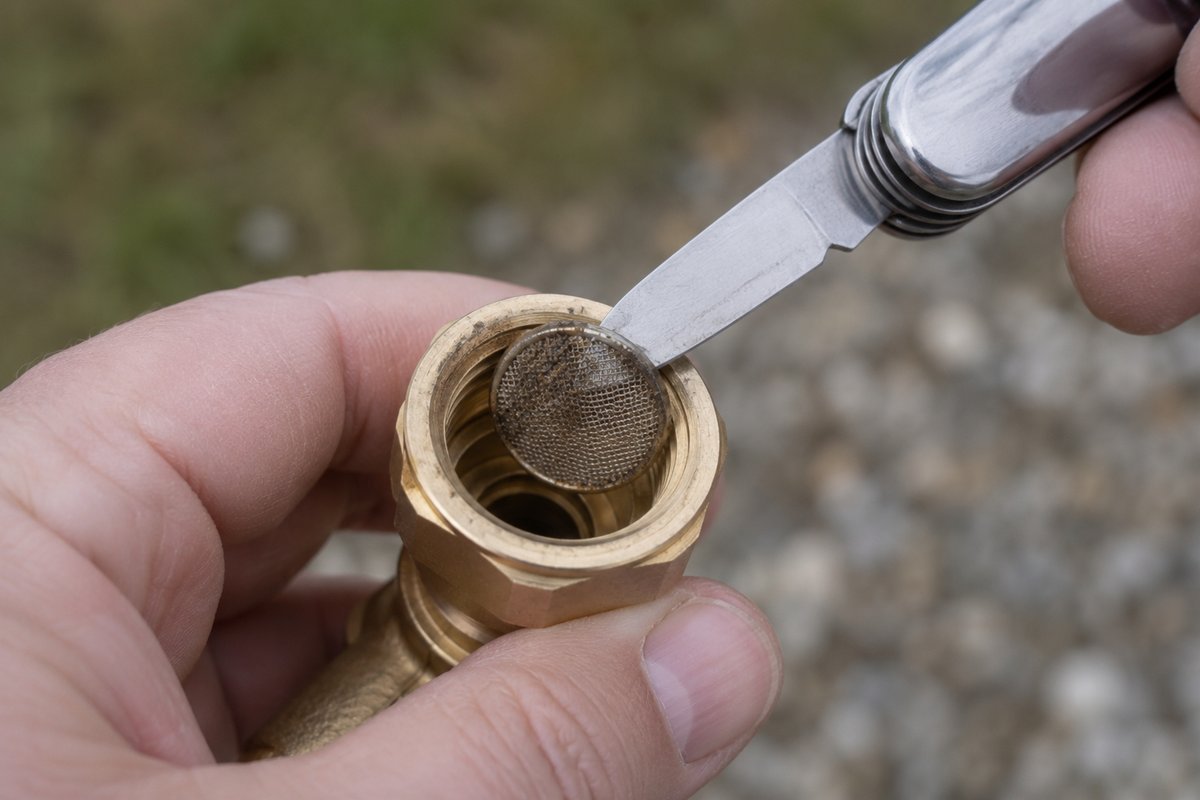
Most regulators have a small screened washer in the inlet. Renator and Valterra both ship one. It catches grit before it reaches the diaphragm inside.
That screen clogs. Campground water carries sand, rust flakes and bits of the last person's hose washer, and a screen the size of a dime fills up quickly. When somebody says a regulator killed their shower, this is nearly always what happened.
The fix takes two minutes and no tools beyond a pair of pliers. Unscrew the regulator, look into the inlet end, and pick the screen out with a fingernail or the corner of a knife. Rinse it, look at it against the light, and put it back the same way round. Do it at the start of the season and any time the pressure drops off.
If the screen is clean and the flow is still poor, then you have a regulator that's failing rather than one that's blocked.
Three Regulators Worth Buying
Prices move, so check before you order. All three are currently available.
Camco 40055 Brass Regulator
Best for most peopleNot adjustable, no gauge, preset to 40 to 50 psi, and the least expensive option here. This is the one Winnebago measured at 9.2 gallons a minute, which beat the adjustable regulator costing five times as much.
It's the only one of the three that states an actual third party certification for lead. The listing says CSA certified to NSF/ANSI 372, which is the standard behind the federal lead free rule. The two more expensive regulators below make a lead claim but don't publish a certification.
Three quarter inch female thread on the inlet and male on the outlet, so it goes straight onto a spigot. Lead free brass, one year warranty. Camco doesn't publish a flow rate or a maximum inlet pressure for this model, which is worth knowing, though no manufacturer in this category publishes flow rate at all.
What You'll Love
- Beat the premium adjustable regulator on measured flow
- The only one here with a stated third party lead certification
- Nothing to adjust means nothing to drift out of adjustment
- Cheap enough to keep a spare in the truck
Worth Considering
- No gauge, so a failure gives you no warning
- No published flow rate or maximum inlet pressure
- Fixed pressure, so no help if your manual asks for something different
Valterra A01-1114VP Stainless
Highest measured flowStainless rather than brass, preset to 50 to 55 psi, and the highest measured flow in the Winnebago test at 10.4 gallons a minute. That's roughly 14 percent above the brass regulators.
Stainless is the sensible choice if the regulator is going to live outside on a spigot in all weather, which is exactly where it should live. Three quarter inch hose thread, one year warranty.
Understand that the extra flow is unlikely to change your life. A showerhead uses about 2 gallons a minute. Buy this one for the stainless body and the slightly higher preset, not because you expect a better shower.
What You'll Love
- Highest measured flow of any regulator tested
- Stainless handles living outdoors better than brass
- Preset sits at the top of the sensible range
Worth Considering
- No gauge, so a failure is silent
- Roughly twice the price of the Camco for a difference you won't feel
- No published lead certification
Renator M11-0660R Adjustable
If you want a gaugeAdjustable, with an oil filled gauge on the front. It arrives preset at 45 psi and can be turned up as far as 160, which you shouldn't do.
The real argument for a gauge isn't fine tuning. It's that the most common way a regulator fails is to fail open, quietly passing full pressure through while looking exactly the same from the outside. Without a gauge you have no way of knowing. That is a better reason to pay extra for a gauge than anything about flow.
The oil filled gauge is the right kind, because the oil damps the needle so it doesn't hammer itself to death when a pump cycles. Lead free brass, three quarter inch hose thread, one year warranty, screened inlet washer. Renator states less than 0.13 percent lead but doesn't publish a certification, and says test paperwork is available by email on request.
What You'll Love
- A gauge is the only way to spot a regulator that has failed open
- Oil filled gauge survives pressure spikes better than a dry one
- Set it to whatever your trailer manual asks for
- Screened inlet washer included
Worth Considering
- Adjustable regulators have more parts to drift or fail
- Lead claim is self reported with no published certification
- Adjusts up to 160 psi, which is far past anything you should use
The Lead Question, and a Surprise
This is drinking water going through a brass fitting, so lead is a fair thing to ask about.
There's a real federal rule. The Reduction of Lead in Drinking Water Act took effect in 2014 and amended the Safe Drinking Water Act. Lead free means a weighted average of no more than 0.25 percent lead across the surfaces that touch the water. NSF/ANSI 372 is the standard used to certify that a part meets it.
Here is the surprise. The inexpensive Camco is the one an outside body checked. Its listing says CSA certified it to that standard.
The pricier Renator gives you its own number instead. It says the brass is under 0.13 percent lead, which is well inside the limit, but nobody outside the company is named as having checked it, and Renator will only send you the test paperwork if you email and ask for it. The Valterra simply says lead free, with no standard and no certifier mentioned anywhere.
Say this carefully, because it matters. A missing certification isn't evidence of lead. It's evidence of a claim nobody else has checked. All of these are sold as lead free and probably are. But if a documented certification is what you want, the cheapest one is the one that has it, which is the reverse of how this usually goes.
Where to Put It
On the spigot, before the hose. Not at the trailer.
The reason is the hose. If the regulator is at the trailer end, the hose spends all day holding whatever the campground is putting out. One owner on the Forest River forum described coming back to a hose that had swollen, in his words, to the size of a summer sausage. Hoses left pressurized in the sun do burst, and a burst hose at a full hookup runs until somebody notices.
There's a counter argument that mounting at the trailer avoids losing pressure down the length of the hose. Somebody did the arithmetic on that: a 25 foot, five eighths inch hose flowing 2 gallons a minute loses about a quarter of one psi. It's a real effect and it's far too small to care about.
So put the regulator on the spigot, then the hose, then the trailer. The one exception worth knowing is if you're on a well or a system that already runs under 50 psi, where you want every bit of flow you can get.
Regulator or Filter First
Regulator first, then filter, then the hose to the trailer.
The reason is that filter housings are plastic, and on that whole run they're the part least able to take pressure. Putting the regulator ahead of the filter protects the housing along with everything downstream of it. Turn it around and you have a plastic canister sitting at full campground pressure.
The one time to reverse it is low supply pressure, where the filter first costs you less flow. On a normal hookup, regulator first, every time.
How These Fail
The important one first.
It fails open
A regulator that quits usually quits by passing everything straight through. It looks identical from the outside, it feels the same in your hand, and the first sign is often a wet floor. This is the whole argument for a gauge. A regulator with no gauge that has failed open is indistinguishable from one that's working.
The pressure drifts
Fixed regulators wander a little as they age. Adjustable ones have more moving parts, and more parts means more ways to drift. If you have a gauge, glance at it now and then rather than assuming the number you set last spring is still the number.
The inlet screen clogs
Covered above. By far the most common, and the easiest to fix.
Grit reaches the diaphragm
If the screen has been missing or damaged, sediment gets to the rubber diaphragm inside and the regulator starts restricting flow for real. At that point it's a replacement, not a repair. With an inexpensive brass regulator, that isn't a hardship.
Two gaps. We could find no manufacturer failure data, no warranty claim rates, and no published testing on how long these last. And we found no recall, from CPSC or any manufacturer, for any RV water pressure regulator.
Do Not Use a Garden Regulator
Irrigation regulators look similar, cost about the same and are sold in the same aisle. They don't work for this.
Winnebago tested one, a Dig unit marked 25 psi. Fed with 115 psi it passed 82 psi straight through. Winnebago called it nearly worthless, and that's fair. These are designed to regulate at the steady high flow a sprinkler line draws, and an RV draws small amounts intermittently. At the flows you use, it barely regulates at all.
Buy one sold for RV or marine use.
Common Questions
Do I need an RV water pressure regulator?
Yes, and it's the cheapest protection you can buy for a trailer. Campground spigots have been measured at 115 and 120 psi. The plastic fittings inside your walls start letting go around 60, and some fail well below 40.
What psi should I set it to?
Around 45 to 50. Winnebago says hold it to 50 maximum, Valterra says don't go above 60, Camco presets to 40 to 50. If your trailer manual gives a figure, use that instead.
Will a regulator ruin my water pressure?
No. In the only published test we could find, every regulator delivered between 7.7 and 10.4 gallons a minute, and a showerhead uses about 2. If your flow drops after fitting one, check the inlet screen for grit.
Is an adjustable regulator better than a fixed one?
Not for flow, and not for price. The value of an adjustable one is the gauge, which is the only way to notice that the regulator has failed open. If you buy a fixed one, buy a good one and replace it every few seasons.
Should it go on the spigot or on the trailer?
The spigot. That way the hose is protected too, and a hose left at full pressure in the sun is a real way to come back to a flooded site.
Do I need a filter as well?
That is a separate job. A regulator controls pressure and a filter controls what is in the water. If you use both, the regulator goes first so the plastic filter housing isn't sitting at full pressure.
Can I leave it on all winter?
Take it off and bring it inside with the hose. Water trapped in the body freezes and can crack it, and it costs nothing to unscrew.
The Short Version
- The regulator is protecting your fittings and supply lines, not the PEX. PEX handles 160 psi. The plastic fittings start going at 60.
- Set it around 45 to 50 psi, or whatever your trailer manual says.
- The cheap non adjustable brass one outflowed the expensive adjustable one in the only real test published. Ignore the flow rate argument.
- Buy an adjustable one for the gauge, not the adjustment. Regulators fail open and silently, and the gauge is how you find out.
- Never buy an irrigation regulator. One tested at 25 psi passed 82.
- Fit it on the spigot, before the hose, and put the filter after it.
- If flow drops, pull the inlet screen and rinse it before you blame the regulator.
- Take it off and bring it indoors before the first freeze.
Related Guides
- Water leak detectors for travel trailers
- Freeze alarms for a winterized RV
- RV storage security, the complete guide
- RV water filters, the filter goes behind the regulator, and its housing is the pressure weak point.