
An RV water filter is one of the first things people buy for a new trailer, and one of the least understood things they end up owning. The blue cylinder on the end of the hose does have a job. It's usually not the job the person who bought it thinks they're paying for.
Here is the finding this article is built around. Search NSF's public database of certified drinking water treatment units for the brands that dominate this category and you won't find them. Not Camco. Not Clearsource, Hydro Life or Beech Lane. The database doesn't even have a product category for an RV hose filter. Its categories are plumbed-in, point-of-use, faucet mount, pour through, refrigerator and shower. The entire RV inline category sits outside the listing.
That isn't the same as saying these filters are uncertified, and this article is careful about the difference further down. What it does mean is that the certification most buyers assume sits behind the words on the box isn't where they would go looking for it.
Table of Contents
Do You Need an RV Water Filter?
Two different jobs get run together under one word, and separating them settles most of the argument.
The first job is protecting the trailer. Grit and rust off a campground's own pipes end up in your faucet cartridges, your toilet valve and your water pump. A coarse filter catches that, and for that job a cheap one is enough.
The second job is protecting the person drinking the water. That is a much higher bar, and it's the one the packaging tends to imply without quite claiming.
It helps to know what a campground is in regulatory terms. The EPA classifies a campground water supply as a transient non-community water system, and names campgrounds specifically in the definition. Those systems face lighter ongoing monitoring than the city system at your house. The arsenic standard, for instance, applies to community systems and to non-transient systems serving the same people for much of the year, not to transient ones.
The other half of it has nothing to do with the source. A campground can be fed by perfectly good municipal water and still hand you something with grit in it, because the variable is the park's own distribution lines, the spigot, and the hose that has been coiled in a wet compartment since April.
What Does an RV Water Filter Remove?
Three things are doing the work inside these filters, and they aren't interchangeable.
Carbon handles chemistry. Chlorine, taste, odor, and the solvent-type compounds that occasionally show up in water. It comes in two forms and the difference matters more than anything else in this article. Loose granules, sold as granular activated carbon, let water find paths between them. A carbon block is compressed into a solid shell, so water has to pass through the material rather than around it, which is why only a block can accurately carry a pore size rating.
Sediment media is mechanical. It's a strainer. In the two-stage systems it's spun polypropylene, and its real purpose is protecting the expensive carbon block behind it from clogging up with silt.
KDF is a copper and zinc alloy used for chlorine and some heavy metals. Camco also markets it as stopping bacteria growing inside the filter while it sits in storage. Read that claim carefully, because it's about the inside of the filter and not about your water. It's easy to read as the opposite.
Sediment also shortens a water heater's life. If your filter clogs quickly, your water heater is probably collecting sediment too, and the RV water heater repair guide covers how to flush it.
Is Any RV Water Filter NSF Certified?
The answer is more specific than either yes or no.
NSF/ANSI 42 covers what NSF calls aesthetic impurities. Chlorine, taste, odor. NSF/ANSI 53 covers contaminants with a health effect. Those are two separate categories in the listing database, which means a filter certified only to 42 carries no health claim of any kind. Not lead, not cysts, not bacteria.
The important nuance is that 53 isn't one thing either. A product is certified to 53 for a named contaminant. Hydro Life publishes the clearest wording in the category: its filter is tested and certified by TEI Analytical Laboratories against NSF/ANSI 42 for chlorine, taste and odor, and against NSF/ANSI 53 for lead. That is a real, specific, checkable claim. It's also lead only. Nothing in it says anything about giardia.
Waterdrop publishes NSF/ANSI 42 and NSF/ANSI 372 for its RV filter. The 372 part is worth understanding because it gets quoted as though it were a filtration standard and it isn't. It certifies that the wetted parts of the product are lead free, meaning a weighted average of not more than a quarter of one percent. It says nothing at all about what the filter takes out of the water.
Culligan's RV-800 page says "IAPMO R & T Tested and Certified" without naming a standard number, and lists what it reduces as bad taste, odor, chlorine and sediment. That reads like an aesthetic-scope claim.
Camco's own product page for the TastePURE filter, the single best selling item in this category, publishes no micron rating, no media specification, no flow rate, no gallon capacity and no filtration certification. What it does publish is a low lead certification for the plastic and brass. Retailers add the words "NSF Certified" to the listing title with no standard number attached.
What certified means, and why it is worth checking
NSF describes certification as testing plus unannounced plant inspections plus regular retesting, with de-certification and recall available if a product stops meeting the standard. Wording like "tested to NSF standards" or "meets NSF standards" carries none of that. There's no listing, no plant audit and nobody to withdraw it.
So the check that settles it is simple. Take the model number and search the certifier's own database. It takes a minute.
One caution, stated plainly because it cuts against the argument above. NSF isn't the only accredited body. The EPA names eight organizations that can certify to these standards, including the Water Quality Association, IAPMO, UL, CSA and Intertek. The WQA and IAPMO directories couldn't be searched while researching this article, because both are built in a way that blocked automated access. So the accurate statement is this: none of these brands appear in NSF's database, and we couldn't rule out a listing with one of the other bodies. Absent from NSF isn't the same as uncertified, and anyone telling you otherwise has skipped the same step we couldn't complete.
Even so, at least one inline filter is currently sold with NSF/ANSI 42 and 53 certification stated in the product title itself, and that model doesn't appear in NSF's database. That may mean it's listed elsewhere. It may mean something else. The point is that it's checkable, and almost nobody checks.
Does an RV Water Filter Remove Bacteria or Giardia?
Almost certainly not, if what you own is the standard hose filter.
The CDC is specific about the threshold. To physically strain out cryptosporidium and giardia you want a pore size of one micron or less, and the word absolute has to be in there. An absolute rating means every pore is at or below the stated size. A nominal rating is an average, and the CDC notes that nominal one micron filters let something like twenty to thirty percent of cryptosporidium through.
Now compare that to what is on the end of most hoses. Camco doesn't publish a micron rating on its own page at all. Retail spec sheets for the same family say twenty micron, and one retailer says one hundred. Culligan's RV-800 doesn't publish a rating. Neither does Waterdrop's RV filter. The Hydro Life user manual runs to several pages of specifications and never states one.
Twenty micron nominal, if that is what it is, is roughly twenty to forty times too coarse to be a barrier to a cyst. It isn't a close call.
Viruses are a further step again, small enough that even a very fine pore size doesn't stop them. Removing those means either ultraviolet treatment or certification to NSF Protocol P231, which sets the bar at 99.9999 percent of bacteria, 99.99 percent of viruses and 99.9 percent of live cysts. No RV filter found for this article publishes a P231 listing.
Clearsource's top system includes a stage the company says has certified capability against bacteria, cysts and viruses using technology it describes as NASA developed. No certifying body is named on that page, no standard number, no log reduction figures and no pore size. It may well work. As published, there's nothing there a buyer can verify.
Inline or Canister: Which One Do You Need?
Set the marketing aside and compare what the two types publish, because the gap isn't where people expect.
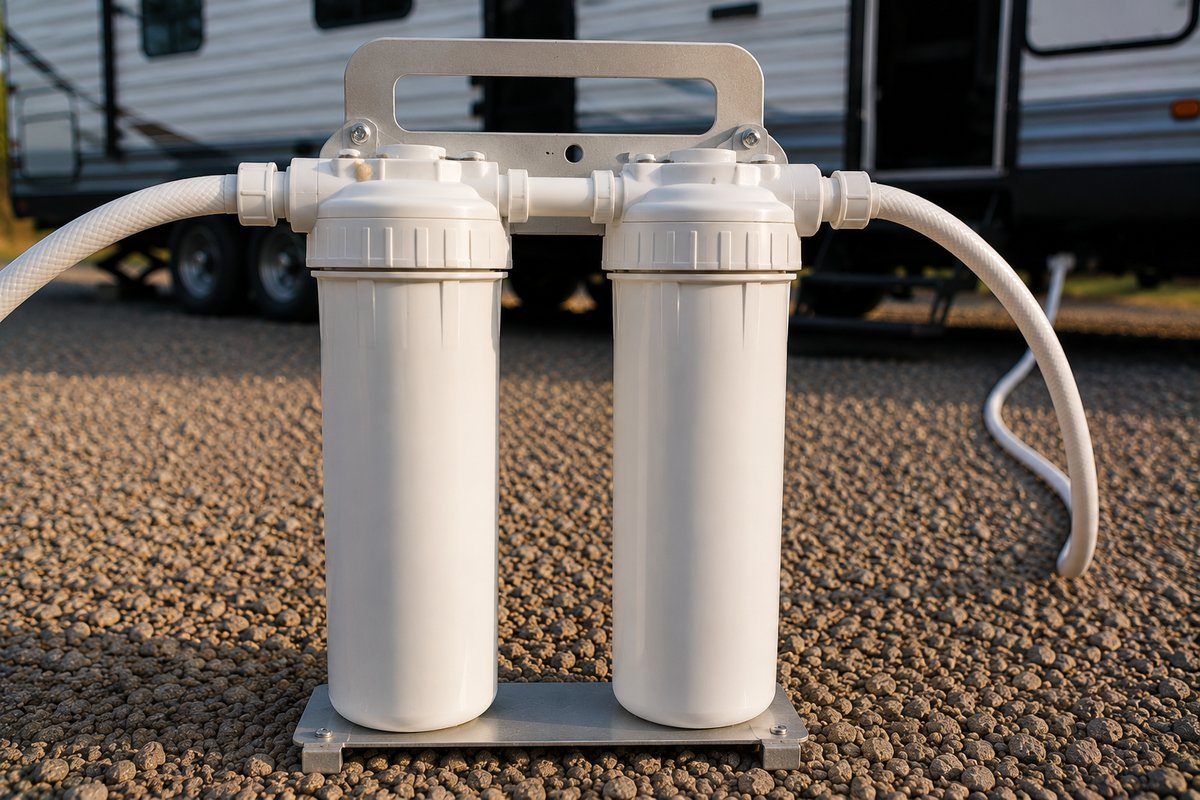
What the canister buys you is a real pore size, and a small one. Every two-stage system in this category publishes the same shape: a five micron sediment stage in front, then a half micron carbon block behind it, with the premium systems going finer still. That is a number you can hold against the CDC threshold. The inline filters mostly don't give you one to hold.
It also buys you flow. Hydro Life's manual rates its inline filter at one gallon per minute at sixty psi. Culligan's RV-800 says one gallon per minute. The canister systems publish four and a half to six and a half. If you have ever wondered why the shower went weak the day you fitted a filter, that is the number to look at.
And it buys you separation of jobs. Sediment gets strained out in front, chemistry gets handled behind, and the expensive cartridge isn't being asked to do both.
What the canister doesn't buy you is certification. This is the strange part of the category. The premium canister systems publish no NSF certification at all, while the cheap inline filter publishes a named laboratory and two named standards. You can spend ten times as much and end up with less documentation, not more.
Which RV Water Filters Are Worth Buying?
Three picks, chosen on what the manufacturer is willing to put in writing rather than on what the box says.
Hydro Life HL-200 Inline Filter
Best documentedThe user manual is the reason this one leads. It states one gallon per minute at sixty psi, and it gives capacity by contaminant rather than as a single number: ten thousand gallons for chlorine, and fifteen hundred for lead.
That second figure is the useful one, and no competitor publishes anything like it. It tells you the filter stops doing its hardest job long before it stops doing its easiest, which is exactly the thing a taste test can't tell you.
It's also the only filter here whose certification names both a laboratory and the standards it was tested against. Just be clear about the scope: the health standard applies to lead, not to anything living.
A note on buying it. On Amazon the complete HL-200 kit is down to a single used unit as we write this. If you already own the housing, the Hydro Life 52412 replacement cartridge is in stock, and Camco says it fits most 10 inch housings.
What You'll Love
- Publishes real numbers where the whole category publishes marketing
- Capacity stated per contaminant, which is the more useful way to do it
- Certification names the testing laboratory and both standards
- Manual is explicit about the limits: cold water only, protect from freezing, no antifreeze through it
Worth Considering
- One gallon per minute is slow, and you will notice it in the shower
- The company's own store page claims 2.5 gpm, which contradicts its own manual
- No micron rating stated anywhere, including in the full manual
- The health certification covers lead only, so this isn't a cyst barrier
Beech Lane External Dual Filter
Best value canisterTwo stages, and both of them come with a number: five micron spun polypropylene in front, half micron carbon block behind. That half micron figure is what puts it under the CDC's one micron threshold on paper, which almost nothing else at this price does.
The fittings are lead free brass and the warranty is a lifetime one, which is unusual enough in this category to be worth saying.
What you're giving up is documentation. There's no model number, no published flow rate, no capacity and no stated cartridge life on the manufacturer's page. You're buying the specification of the cartridges rather than the specification of the system.
What You'll Love
- Both stages carry a published micron rating, which the inline filters don't
- Half a micron clears the CDC threshold for cysts on paper
- Lead free brass fittings rather than plastic
- Costs a fraction of the premium canister systems for the same published pore size
Worth Considering
- Doesn't say whether the 0.5 micron rating is nominal or absolute, and the difference matters
- No flow rate, capacity or cartridge life stated by the manufacturer
- Bulkier than an inline filter, and it needs mounting or a flat spot at the spigot
- Two cartridges to replace instead of one filter to throw away
Clearsource Premier Mini
The only absolute ratingOne word on this product page does more work than every other claim in the category: absolute. Clearsource states that its 0.2 micron filter carries an absolute rating, meaning every pore is at the rated size or better. That's precisely the distinction the CDC draws between a filter that reliably strains out cryptosporidium and one that mostly does.
Flow is published at four and a half gallons per minute, so unlike the inline filters this isn't going to be the reason your shower disappoints you. It's also light for a canister system.
It's expensive, and it still publishes no third party certification, no cartridge capacity and no stated life. You're paying for a specification, and the specification is a good one, but nobody outside the company has signed it off.
What You'll Love
- Publishes an absolute rating, which is the number that matters
- 0.2 micron sits well below the CDC's one micron threshold
- Flow is high enough that you won't notice the filter is fitted
- Light and compact for a two stage system
Worth Considering
- Many times the price of an inline filter
- No third party certification published
- No cartridge capacity or replacement interval published
- Even at this pore size, viruses aren't addressed
Should the Filter Go Before or After the Pressure Regulator?
After. The regulator goes on the spigot, the filter goes behind it, and then the hose runs to the trailer.
The reason is simple and physical. A filter housing is plastic, and it's the weakest pressure-bearing thing in the chain. Put it in front of the regulator and it's taking whatever the campground decides to deliver that day, which can be well over a hundred psi. Owner forums are full of people describing housings that split, and the ones who moved the filter behind the regulator report the problem going away.
This argument runs for pages on every RV forum, which is a sign that nobody selling these things has bothered to settle it. It's the same reasoning covered in more depth in the guide to RV water pressure regulators, where the point is that the regulator is protecting your fittings rather than your pipe.
Why Did My Water Pressure Drop After Fitting a Filter?
Because the filter is doing what it was always going to do, and the published numbers say so.
One gallon per minute is the rated flow on two of the common inline filters. A shower and a faucet running together will ask for more than that. Nothing has gone wrong, you have simply put a restriction in the line and then asked it to do more than it's rated for.
It compounds, too. If your regulator is set low and you then add a filter, the two restrictions stack. People chase the campground for low pressure when the fix is at their own spigot.
And if flow falls off over a season rather than on day one, the filter is loading up with sediment. That is the filter telling you it's finished, which is more useful information than most of them give you.
How Often Should You Change an RV Water Filter?
By gallons and by conditions, not by the calendar. Which is inconvenient, because gallons is the one thing nobody measures.
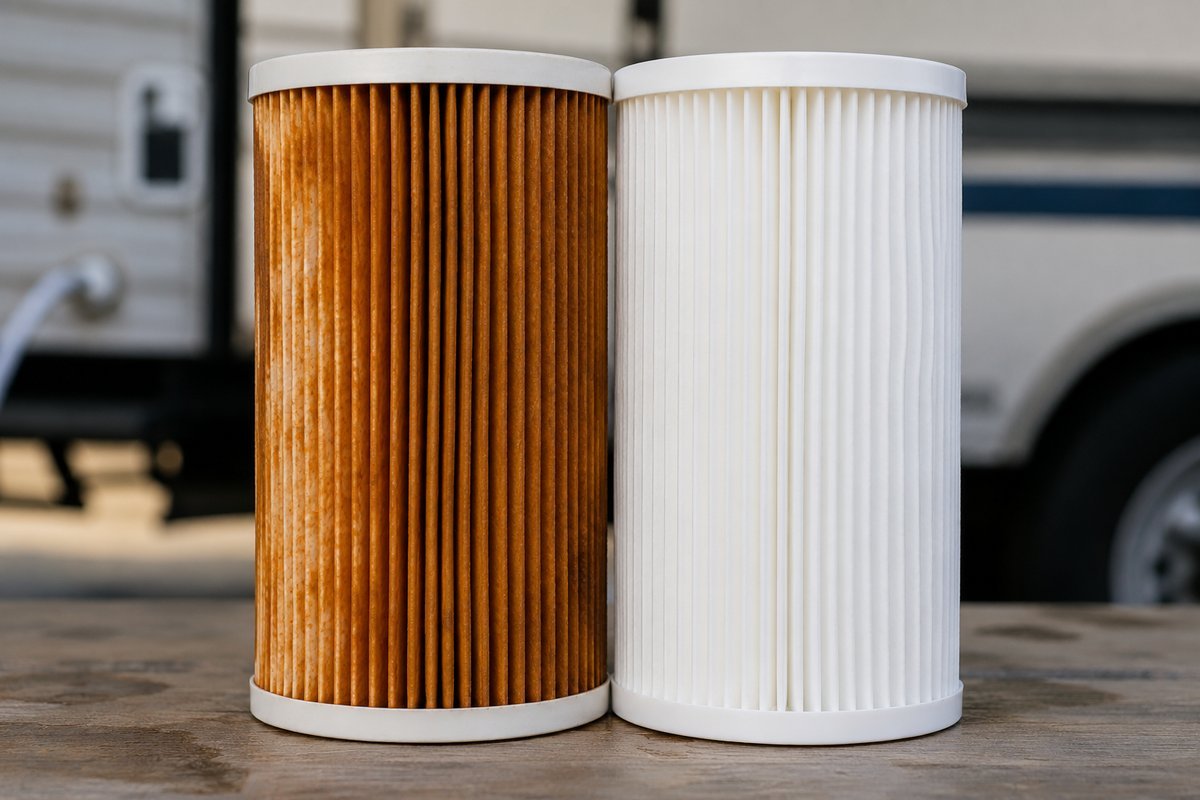
Look at what the manufacturers are willing to state. Culligan says two thousand gallons or three months. Camco publishes no gallon figure whatsoever for the TastePURE and says it lasts the season, without saying what a season is. Hydro Life declines to give a time interval at all and tells you to replace it when the taste or odor comes back or when flow drops noticeably.
Hydro Life's approach is the most accurate. Actual life is set by three things: how much sediment is coming at it, how much chlorine it has to strip out, and total volume through it. A filter on a fifth wheel parked full time on hard water is finished long before the same filter on a trailer that goes out four weekends a year.
The trap in the "one season" advice is that taste comes back last. Carbon exhausts for lead long before it exhausts for chlorine, which is what makes that fifteen hundred gallon figure worth knowing. If you're relying on taste to tell you when to change it, you're using the least sensitive test available.
Can You Clean and Reuse an RV Water Filter?
A carbon filter, no. A ceramic one, yes.
This confuses people because rinsing a filter visibly works. Sediment washes out and flow improves, so it looks like it has been restored. What has happened is you cleared the strainer and did nothing at all to the carbon, which doesn't clog so much as fill up. Once its surface has taken on all the chlorine it can hold, no amount of water going the other way puts that back.
Ceramic elements are different, and they're meant to be brushed off and reused. That isn't what is inside a standard RV hose filter.
How Do You Store a Filter Between Trips?
Worth saying plainly: no manufacturer in this category publishes storage instructions. Every method you will read about, drying it out, bagging it, keeping it in the refrigerator, is user practice rather than anything the maker has tested or endorsed.
Two things do come from the manufacturers. Hydro Life says to run the water for several minutes to flush the system if the RV or the filter hasn't been used recently. And Camco says the KDF media prevents bacteria growing inside the filter while it's stored, which is the only claim any of them makes about the problem at all.
What isn't in dispute is freezing. Hydro Life states it directly: protect the filter from freezing, and never run antifreeze through it. A filter left on the hose through a hard freeze is a filter to throw away.
Can You Drink Campground Water?
Usually yes, and the filter isn't what makes that true.
A campground on a regulated public supply is delivering water that has to meet federal standards. The looser monitoring that applies to transient systems is a reason to pay attention, not a reason to assume the worst. Meanwhile the standard hose filter is improving taste and catching grit, and on the published specifications it isn't a barrier to anything living.
So the fair position is that a filter isn't a substitute for knowing whether the water is safe. If you have real reason to doubt a supply, the equipment that addresses it is a one micron absolute rating at minimum for cysts, and ultraviolet treatment or a P231 certified purifier if bacteria and viruses are the worry. If you don't have that reason, an inline filter is doing a modest, useful job and there's nothing wrong with that.
Is It Better to Filter Everything?
Not necessarily, and this is the one place where the whole-RV filtration pitch is worth questioning.
Chlorine is doing something useful in your fresh tank. It's the reason bacteria don't grow in the tank between trips. Strip it out at the hose, before the water reaches the tank, and you have removed the thing that was keeping the tank clean while gaining very little, because the water is going to sit in there for weeks anyway.
The alternative approach is to filter coarsely at the hose to protect the plumbing, and filter properly at the faucet you drink from. Whether that's worth reorganizing your setup over depends on how you camp, and it isn't a settled question. It's just one that the people selling whole-RV systems tend not to raise.
Common Questions
Does an RV water filter remove chlorine?
Yes, and this is the one thing the whole category does well. Carbon is good at chlorine, the certifications that do exist cover chlorine, and the capacity figures for chlorine are the largest numbers any of these products publish. If your complaint is that the water tastes like a swimming pool, a cheap inline filter will fix it.
Do I need a filter if the campground says the water is safe?
Not for safety, if you believe them. You might still want one for the trailer's sake. Grit off an old distribution line is what chews up faucet cartridges and toilet valves, and that happens on perfectly safe water.
Is a smaller micron rating always better?
No, and it's a real trade. A finer filter strains out more and clogs faster, and it costs you flow while it does it. Half a micron on a two stage system with a sediment filter in front is a sensible arrangement. Half a micron on its own would spend its life blocked.
Does a low TDS reading mean the filter is working?
No. Those meters measure dissolved solids, mostly minerals, and a carbon filter isn't designed to remove them. A perfectly good filter will barely move the number. It's a common way to conclude a filter has failed when it hasn't, and an equally common way to conclude water is clean when the meter can't see the thing you're worried about.
Are two filters better than one?
Only if they're doing different jobs. Sediment in front of carbon is two filters doing two jobs, and that is what a canister system is. Two identical filters in a row is mostly two restrictions in a row.
Is a water filter the same as a water softener?
No. A softener deals with hardness, the calcium and magnesium that leave scale on the fixtures. A filter deals with particles and chemistry. If your problem is white crust on the faucet, a filter isn't the answer.
Do RV water filters work?
For what they're built to do, yes. Chlorine, taste, odor and grit are exactly where the certifications that do exist sit, and where the capacity figures are largest. A cheap inline filter will fix water that tastes like a swimming pool, and it will keep grit out of your faucet cartridges.
For what the packaging implies, no. No RV hose filter appears in NSF's certified products database, and a twenty micron element is twenty to forty times too coarse to be a barrier to a cyst. The filter works. It just isn't doing the job most buyers think they're paying for.
How many gallons is an RV water filter good for?
It depends which contaminant you're asking about, and only one manufacturer says so. Hydro Life publishes ten thousand gallons for chlorine and fifteen hundred for lead, from the same filter. Culligan's RV-800 says two thousand gallons or three months. Camco publishes no gallon figure at all for the TastePURE and says only that it lasts the season.
The lead number is the one worth remembering. A filter that has stopped removing lead can still be removing chlorine perfectly well, which means it still tastes fine. Taste is the last thing to go, so it's the least useful test of whether a filter is finished.
What to Take Away From This
If the goal is better tasting water and a bit of protection for the trailer's plumbing, buy the cheap inline filter and stop thinking about it. That is a real job and it does it.
If the goal is a barrier against what is living in the water, the standard hose filter isn't it, and no amount of packaging changes that. What you need is a published pore size of one micron or less, with the word absolute attached, and that means a canister system.
And whichever way you go, take one minute to search the model number in the certifier's own database before you believe the box. It's the single most useful thing in this article, and it costs nothing.
Quick Answers
Do You Need an RV Water Filter?
It depends on the job. A cheap coarse filter protects the RV's faucets, toilet valve and pump from grit, and that is worth having. Protecting the person drinking the water is a much higher bar that most hose filters don't meet.
What Does an RV Water Filter Remove?
Mostly chlorine, taste, odor and grit. Carbon handles chlorine and taste, sediment media strains out grit, and KDF media targets chlorine and some heavy metals. Most hose filters aren't a barrier to bacteria or cysts.
Is Any RV Water Filter NSF Certified?
None of the major RV hose filter brands appear in NSF's public database. Hydro Life states certification by TEI Analytical Laboratories to NSF/ANSI 42 for chlorine, taste and odor, and NSF/ANSI 53 for lead. Search the model number in the certifier's database before trusting the box.
Does an RV Water Filter Remove Bacteria or Giardia?
Almost certainly not, if what you own is the standard hose filter. The CDC says a pore size of one micron absolute or less is needed to strain out cysts like giardia, and most hose filters are rated around 20 micron nominal or publish no rating at all.
Inline or Canister: Which One Do You Need?
A canister system gives you a published small pore size, often 0.5 micron, and much higher flow, around 4.5 gallons per minute. An inline filter is cheaper but flows about 1 gallon per minute and usually publishes no micron rating.
Which RV Water Filters Are Worth Buying?
The Hydro Life HL-200 for the best documentation, the Beech Lane dual canister for value with a 0.5 micron carbon stage, and the Clearsource Premier Mini for the only 0.2 micron absolute rating in the category.
Related Guides
- RV water pressure regulators, which go in front of the filter, and why the cheap one won a bench test.
- Water leak detectors, for the failure the plumbing gives you no warning about.
- RV storage and security, what goes wrong while a trailer sits, and in what order.
For more on RV water systems and plumbing, see our other Water and Plumbing guides.