
The RV sewer hose is the cheapest part of the trailer that can ruin a weekend. It costs less than a tank of fuel, lives in a tube on the bumper, and gets thought about exactly twice: the day it's bought and the day it splits.
Most of what goes wrong is decided before it's ever used. The wrong length means an awkward stretch across the pad. The wrong fittings mean a connection that lets go under load. A hose put away wet means a smell in the storage bay that never quite leaves. So the best RV sewer hose isn't the cheapest one on the shelf, it's the one whose length, fittings and wall match the way the RV is parked. The best RV sewer hose is long enough to reach without stretching and tough enough to survive being dragged across gravel.
Table of Contents
Are All RV Sewer Hoses the Same?
No. There's no single best RV sewer hose, because the hose that suits a pull through site isn't the hose that suits a back in site with the inlet on the far side. The differences between hoses show up in the same three places every time.
The wall. Cheap hoses are thin vinyl over a wire coil. Better ones use heavier vinyl, more layers, and a stiffer coil that holds its shape when the hose is full. A full 20 foot run carries a surprising amount of weight, and a thin wall hose sags between supports and traps waste in the dips.
The end fittings. Some hoses arrive with fittings bonded on. Others are bare hose with clamp-on ends you fit yourself. Bonded ends fail less often, because a clamp is where most leaks start.
Crush resistance. The hose lives in a bumper tube or a bay and gets stood on, driven over and squashed under leveling blocks. A hose that takes a permanent kink has a low spot in it for the rest of its life, and a low spot holds waste.
What doesn't vary is the size, and that is the next thing everybody asks.
What Size Is a Standard RV Sewer Hose?
Three inches. Travel trailer waste outlets and the hoses that connect to them are built around a 3 inch bayonet fitting, the type with lugs you push on and twist a quarter turn to lock. Adapters, elbows and extensions across the aftermarket are built to that same standard, which is why a hose from one maker joins a fitting from another.
The confusion is at the other end. The ground inlet at a campsite or dump station is usually 4 inches, and often it's an open pipe with a threaded or lipped rim. That is what the tapered rubber donut or the stepped threaded adapter in a kit is for. One end of your hose is a fixed standard and the other end is whatever the campground built.
Worth knowing before buying, because a hose sold on its own may include neither adapter. A kit usually includes both.
What Goes Wrong With a Sewer Hose?
Almost never the middle of the hose. The failures cluster at the two ends and at whatever the hose was resting on.
- The fitting works loose because it was seated but not twisted fully home, and pressure from a full black tank finishes the job.
- The clamp band cuts the vinyl on a clamp-on end that has been overtightened, which starts as a weep and ends as a split.
- A stone under the run wears a hole through the underside over a few trips, in a spot nobody inspects.
- The coil takes a set after being stored compressed, so the hose no longer stretches to its full length and every fold becomes a trap.
- The bumper cap disappears on the highway and the hose follows it a few miles later.
None of that is unusual, and all of it is visible in sixty seconds if you look at the hose in daylight before you connect it rather than after.
How Long Should My RV Sewer Hose Be?
Twenty feet in total for most travel trailers, carried as two ten foot sections rather than one long one.
Sites aren't built to a standard. The inlet can be a few feet from your outlet or most of the way to the back of the pad, and it can be on the wrong side entirely. Ten feet covers a good site and strands you on a bad one. Thirty feet covers everything and leaves you draining, rinsing and coiling thirty feet of hose every time you move.
Two sections means you use one when one will do, join them when the site demands it, and a split in one doesn't take the whole setup out of service.
Longer isn't automatically better. Waste moves by gravity alone, so every extra foot is more distance across a shallow slope. A twenty foot run with real fall in it empties better than a thirty foot run laid flat.
How Do You Connect a Sewer Hose to an RV?
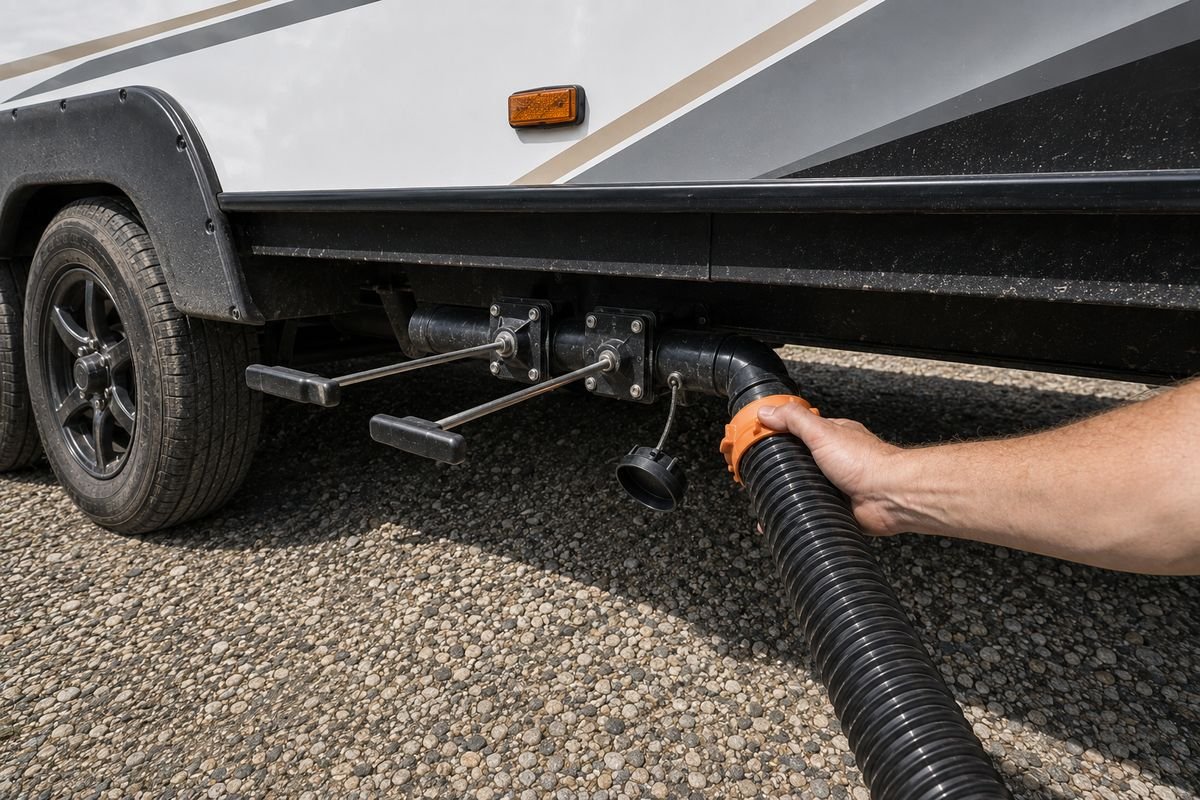
The order matters more than the technique.
- Connect the ground end first. If something is going to come apart, better it's the end that isn't attached to a full tank.
- Push the bayonet on and twist a quarter turn until the lugs seat. It shouldn't turn back without you lifting it.
- Support the run so it falls continuously toward the inlet. A hose that dips and rises leaves waste standing in the low point.
- Open the black valve first. Not the gray.
- Close the black valve, then open the gray and let it run through the same hose.
Gloves aren't optional, and the manufacturers say so plainly. THOR Industries recommends latex or rubber gloves for the whole job.
Do You Dump Black or Gray Water First?
Black first, every time. This comes from the manufacturer, not just campground habit: THOR's guidance is that you always dump the black tank first, so the solid waste is out before the gray water follows.
The gray tank is doing a second job. Shower and sink water is comparatively clean, and running it through afterwards flushes out what the black tank left in the hose. Dump gray first and you throw that away, then finish by leaving black tank residue in the hose until next time.
The same logic is why the black valve stays shut while you're parked on full hookup. Left open, the liquid drains away continuously and the solids stay behind and dry into a mound that rinsing won't move. Jayco's towable manual says to connect the sewer hose to the campsite hookup when you have one, but connected isn't the same as open.
Where Can You Legally Empty the Tanks?
At a permitted facility, and nowhere else. Dump stations are regulated waste infrastructure rather than plumbing: state guidance treats an RV park dump station as a permitted structure, and North Carolina's guidance for RV parks requires the permit to come from the Division of Waste Management, with an engineered design where the discharge goes into certain systems.
In practice that means a campground hookup, a dump station, or a facility that advertises itself as one. It doesn't mean a storm drain, a field, or a cleanout you found at the side of a building. Gray water isn't a lesser case in most jurisdictions, whatever you may be told at a campsite.
Rules vary by state and by county, so the specific question of what you may do at your own house is one for your local authority, not for a forum thread.
What Is the Best Way to Store an RV Sewer Hose?
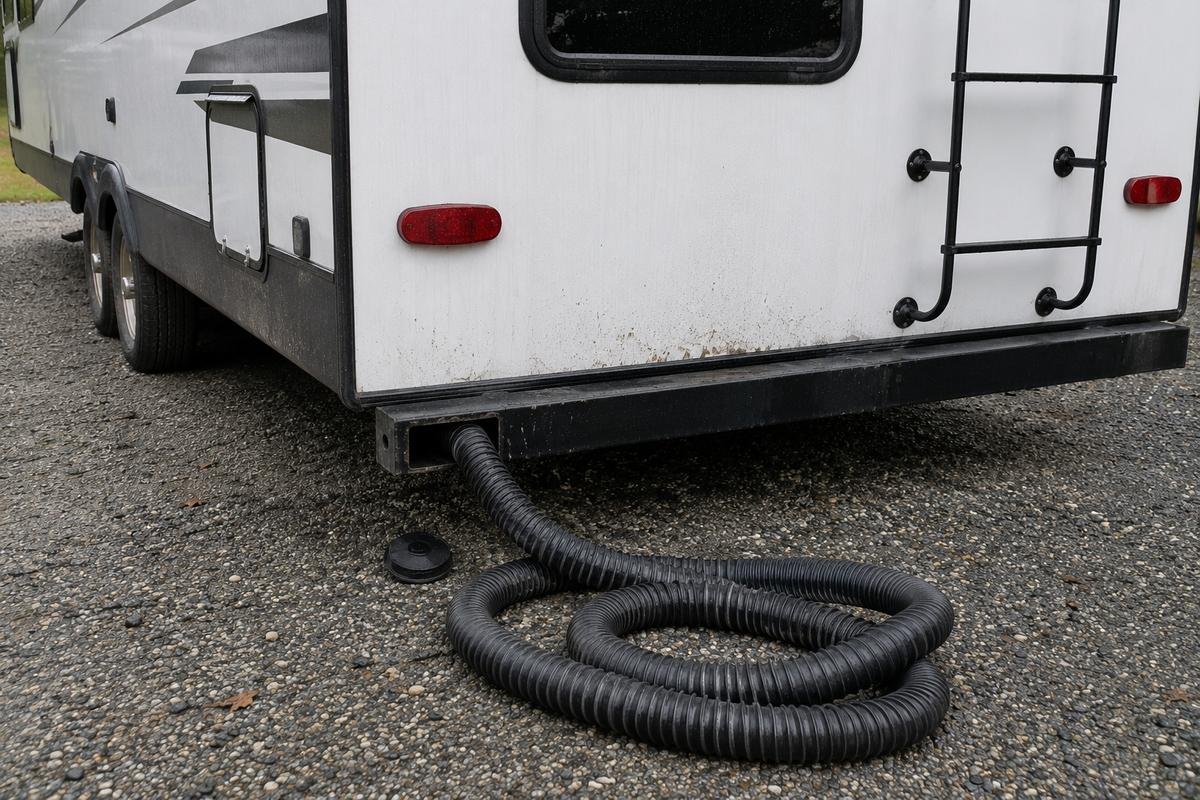
Dry, and not inside the trailer.
The standard is the square bumper tube on the back of most travel trailers, with caps on both ends. It works, with two caveats: the tube collects road water and grit, and the caps go missing, at which point the hose starts making its own way onto the highway.
Whatever it goes into, the sequence is the same. Rinse it, drain it completely by walking it end over end, and let it dry before it's put away. A hose stored wet is where the smell in a storage bay comes from.
A carrier that mounts to the frame or bumper is the upgrade, and it is worth it mostly because it is easier to use. Anything that makes the rinsing step less unpleasant is a step you will take.
How Often Should You Replace Your RV Sewer Hose?
There's no service interval, because handling kills a hose rather than hours of use. Replace it when any of these is true, and not on a calendar.
- A pinhole anywhere. Hold it up to daylight with both ends open. Pinholes don't stay pinholes.
- A permanent kink that won't open out when stretched.
- A fitting that turns freely after you have locked it. The lugs are worn and it will let go under load.
- Wire coil visible through the vinyl at any point.
- You have already repaired it once. Tape on a sewer hose only delays the failure to a worse moment.
Carrying a spare is the cheap version of this advice, and in a two section setup the spare is also doing a job.
Best RV Sewer Hose Picks, and What You Can Skip
Six things, in the order they matter. Nobody at Restful RV has dumped a tank with these, so each card is about fittings, lengths and materials rather than how they felt on a wet night. The last two do the same job in different conditions, and you almost certainly want one of them rather than both.
| Camco RhinoFLEX 20 ft kit | Thetford Titan 20 ft kit | Camco RhinoFLEX 10 ft extension | |
|---|---|---|---|
| Length | 20 ft, two 10 ft sections | 20 ft, two 10 ft sections | 10 ft, single section |
| Wall | Polyolefin over steel wire | TPE | Polyolefin over steel wire |
| RV fitting | 3 in bayonet | Universal bayonet | Lug and bayonet |
| Dump end | Clear elbow with adapter | Five in one, handled | Mates with the kit |
| If driven over | Steel helix can deform | Rebounds to shape | Steel helix can deform |
| Storage | Fits a 4 in bumper | Not stated | Collapses |
| Best for | Most RVs, most pads | Hoses that live on the ground | Reaching 30 ft, or a spare |
Camco RhinoFLEX 20 Ft Sewer Hose Kit
Two ten foot sections, not one twentyTwenty feet carried as two ten foot sections is what this article argues for, and this kit is that arrangement in one box rather than a single long hose you have to drain and coil every time you move.
The wall is polyolefin reinforced with steel wire, the fittings are bonded on rather than clamped, and the clear elbow comes with a removable adapter that fits a 3 inch slip inlet or a 3, 3.5 or 4 inch threaded one, which covers what campgrounds put in the ground. It collapses down to store in a standard 4 inch bumper tube.
What You'll Love
- Two sections, so you use ten feet when ten will do
- The clear elbow is included, not sold separately
- The adapter covers slip and threaded ground inlets
- Collapses short enough for a standard bumper tube
Worth Considering
- Swivel fittings make the ends bulky in the bumper
- The clear elbow stains and needs rinsing to stay useful
- Twenty feet still strands you on the worst sites
- Nothing in the kit supports the hose, that is a separate buy
Thetford Titan 20 Ft Premium RV Sewer Hose Kit
The one built to survive a tireThe RhinoFLEX above is polyolefin wrapped around a steel wire helix. The Titan is TPE, a rubbery thermoplastic, and it behaves differently the moment something heavy lands on it. Thetford states the hose is uncrushable and bounces back into shape even after a car has run over it. That matters, because getting driven over at a dump station is how a large share of sewer hoses die.
The layout is the same as the Camco kit. Twenty feet in two ten foot sections, a universal bayonet mount at the RV, and a five in one adapter with a handle at the dump station end. Thetford also states puncture resistance, abrasion resistance and extreme temperature resistance. It costs roughly half again what the RhinoFLEX kit does, so the question is simply how often this hose is going to end up on the ground where somebody can drive over it.
What You'll Love
- TPE wall rebounds after being crushed, which is how most hoses die
- Two ten foot sections, so it runs at 10 or 20 feet as needed
- Five in one adapter has a handle, which makes it easier to seat
- Puncture, abrasion and extreme temperature resistance all stated
Worth Considering
- Costs roughly half again what the RhinoFLEX kit does
- TPE is heavier in the hand than polyolefin
- Fewer owner reviews behind it than the Camco kits
- Storage tube fit isn't stated, so measure the bumper before ordering
Camco RhinoFLEX 10 Ft Sewer Hose Extension
The spare that also does a jobTen more feet takes the setup to thirty, which covers the site where the inlet is at the far end of the pad or on the wrong side.
It's the same hose family as the kit, so the lug and bayonet ends mate without an adapter. Kept in the bumper it's also a spare: if a section splits at a bad moment, you're still dumping tonight rather than driving home.
What You'll Love
- Joins the kit without an adapter or a clamp
- Turns a bad site into a normal one
- Doubles as the spare section
- Collapses short for the bumper tube
Worth Considering
- Only worth it on awkward sites
- Every joint is one more place to leak
- A longer run means less fall, so support it properly
- Takes bumper space you may not have
Beech Lane 20 Ft Sewer Hose Support
Match the support to the hoseA support holds the hose in a continuous downhill run so the tank empties instead of mostly emptying. The length is the part people get wrong: a ten foot support under a twenty foot hose leaves half the run lying on the ground. Our RV sewer hose support guide compares five supports and explains how much slope a hose needs.
This one is twenty feet, which matches the kit above, and the version here adds clip-on feet that spread the load on soft ground. It nests into itself for storage rather than folding into a long awkward stack.
What You'll Love
- Length matches a 20 ft hose run
- Clip-on feet steady it on grass and gravel
- Nests down small instead of folding long
- Holds a steady fall on flat ground and long runs
Worth Considering
- One more bulky item to find space for
- Feet still sink into soft wet ground
- Unnecessary on a level site with the inlet close by
- Plastic, so it doesn't enjoy being stood on in the cold
Camco Rhino 25 Ft Clean-Out Hose
A different color, on purposeThe article gives one rule about rinsing that isn't negotiable: the hose you use to rinse the sewer hose and flush the tanks is never the hose you drink from, and it's never stored beside it.
This one is bright orange, 5/8 inch, with standard threaded ends, and the color is the point. It's the reason nobody in the family reaches for the wrong one in the dark, and it costs a fraction of what a mistake costs.
What You'll Love
- The color does the safety work, not your memory
- Long enough to reach from a site spigot to the hose
- Standard threads, so it takes a rinse cap or wand
- Cheap enough to replace the moment it looks tired
Worth Considering
- One more hose to coil and stow
- Not drinking water safe, and must never be swapped in as one
- Store it apart from the fresh hose or the rule means nothing
- Heavier PVC is stiff in cold weather
Camco 4 x 3 Sewer Hose Seal
The cheapest fix for an open pipePlenty of campsite inlets are an open pipe in the ground with no usable thread. Dropping a hose into one is how the smell gets out and how the hose works its way loose.
This is the tapered rubber donut that turns that open pipe into a sealed connection. It slips onto the hose end and wedges into a 4 inch inlet. It weighs nothing and takes no space, which is the argument for carrying one even if your last few sites didn't need it.
What You'll Love
- Turns an open pipe into a sealed connection
- Weighs nothing and stores flat
- Works where threads are missing entirely
- Keeps the hose from creeping out of the inlet
Worth Considering
- Not needed where the kit adapter threads in properly
- Rubber perishes eventually and wants checking
- A badly shaped or oversized inlet will still defeat it
- One more small thing to lose in the bumper tube
Camco Flexible 3-in-1 Sewer Hose Adapter
For inlets with damaged threadsThe kit above comes with a 4-in-1 adapter that threads into a good inlet. The trouble starts at older parks, where the threads in the ground are cracked, cross-threaded or long gone.
This is the flexible version: it connects to 3, 3.5 or 4 inch inlets and seals against a damaged thread rather than needing a clean one, with a handle so it can be pulled back out without lying on the ground to do it.
What You'll Love
- Works on the inlets that defeat a rigid adapter
- Covers three inlet sizes in one part
- The handle means you aren't kneeling in the wet to remove it
- Flexes rather than cracking under a sideways pull
Worth Considering
- Redundant if your sites have sound threaded inlets
- Overlaps with the seal above, you don't need both
- Flexible plastic is easier to leave behind at a site
- Bulkier in storage than a rubber donut
What Else Do You Need Besides the Hose?
Three things turn a hose into a setup that copes with a bad site.
A clear elbow. A 45 degree elbow with a clear section shows you when the tank has finished draining and when the rinse finally runs clean. The kit above includes one, so most readers already have it. If your hose came without one, it's the first thing to add, because everything else is guesswork without it.
A support, matched to the length of the run. Sites are rarely flat in the direction you need them to be, and a supported hose drains where an unsupported one holds a puddle. A short support under a long hose leaves half the run on the ground, which is the mistake worth avoiding.
Gloves and a dedicated rinse hose. The rinse hose must be a different color from the fresh water hose and must never be stored with it. That rule exists because the failure is invisible and the consequence isn't.
A seal for the ground inlet. Threaded adapters only work where there's a sound thread to grip. At older parks the inlet is often a plain open pipe, or a thread that has been cross-threaded by twenty seasons of other people. A tapered rubber donut or a flexible adapter seals into it and keeps both the smell and the hose where they belong. Campgrounds increasingly expect the connection to be sealed rather than a hose dropped into a hole.
A regulator belongs on the fresh side of the same setup, covered in our guide to the RV water pressure regulator, and what the fresh hose should and shouldn't filter is covered in the RV water filter guide.
Is a Macerator Worth It Instead?
A macerator pump grinds the waste and pushes it through a garden-hose-sized line, which lets you run much further and uphill. It solves a real problem, and it introduces a new one: it's an electrical pump with an impeller in the worst possible place, and when it fails it fails while the tank is full. What's usually feeding that failure is undissolved paper, not the pump itself. See which rolls break down fast enough for a macerator before blaming the hardware.
For a travel trailer that parks at sites with a normal ground inlet, a gravity hose is simpler, cheaper and has nothing to go wrong that a light and a spare can't solve. The macerator makes sense when the geometry is against you, not as a default. Even the best RV sewer hose fails early if it goes back into the bumper unrinsed.
Frequently Asked Questions
Can you connect two RV sewer hoses together?
Yes, and it's the normal way to make up twenty feet. The bayonet fittings join hose to hose as well as hose to trailer. Lock the joint the way you lock the trailer end, and support it so it doesn't sag.
Can you shorten an RV sewer hose?
Physically yes, using clamp-on fittings. In practice a shortened hose with a clamped end becomes the most likely leak in the setup, and a ten foot section costs little enough that cutting one down rarely makes sense.
Do you need a sewer hose support?
On a level site with the inlet close by, no. On a flat site, or where the inlet is twenty feet away, the support is the difference between a tank that empties and a tank that mostly empties. If the inlet sits higher than your outlet, no support will help, because waste cannot drain uphill.
Can I dump my black tank into a house sewer cleanout?
Sometimes, and it depends on local rules and on the cleanout being the right kind. Ask your local authority rather than a forum, because the answer varies by jurisdiction and the penalty for getting it wrong isn't small.
How do you rinse the hose without making a mess?
Leave the hose connected at the ground end after the gray tank has run through, and use the dedicated rinse hose at the trailer end with the tank valves closed. Rinsing a disconnected hose on the grass is how a site gets contaminated and how the job gets skipped next time.
Quick Answers
Are All RV Sewer Hoses the Same?
No. They differ in wall thickness, in whether the end fittings are bonded on or clamped, and in how well they resist being crushed. Heavier walls and bonded fittings fail less often.
What Size Is a Standard RV Sewer Hose?
Three inches. Travel trailer waste outlets and the hoses that connect to them are built around a 3 inch bayonet fitting, the type with lugs you push on and twist a quarter turn to lock.
What Goes Wrong With a Sewer Hose?
Almost never the middle of the hose. Most failures are at the two ends, such as a fitting that wasn't twisted fully home or a clamp that cut the vinyl, or on the underside where a stone wore through.
How Long Should My RV Sewer Hose Be?
Twenty feet in total for most travel trailers, carried as two ten foot sections rather than one long one.
How Do You Connect a Sewer Hose to an RV?
Connect the ground end first, then push the bayonet onto the RV outlet and twist a quarter turn to lock it. Support the hose so it falls continuously toward the inlet. Open the black valve first, then close it and open the gray. Wear gloves.
Do You Dump Black or Gray Water First?
Black first, every time. THOR's guidance is to always dump the black tank first, so the gray water that follows flushes the hose.