
An RV surge protector is the cheapest insurance on the trailer, and the name undersells it. Lightning is the thing people picture, and it's the least likely fault to reach you. What destroys air conditioners is a campground pedestal that has been rewired by four different people over twenty years, or a park sagging to 104 volts on the hottest afternoon of the year.
The other thing worth knowing before you spend anything: the cheap units and the expensive ones do two different jobs, and the difference isn't quality. One absorbs spikes. The other watches the power and disconnects you from it.
Table of Contents
Do You Need a Surge Protector on an RV?
If you plug into campground power, yes, and the reason isn't the weather.
A pedestal is an outdoor electrical outlet that lives in the rain, gets hit by trailer tongues, and is worked on by whoever the park could get. The failures that follow are unglamorous: a ground wire that came loose, a neutral that was never landed properly, hot and neutral reversed on one leg. None of that announces itself, and none of it trips a breaker. Your trailer simply plugs into it.
Then there's voltage. A park running at capacity in August can sag well below the range appliances are built for, and low voltage is what kills an air conditioner compressor. It draws more current to do the same work, gets hot, and eventually stops. A surge does its damage in microseconds. A brownout does its damage over a summer.
The case against is real but narrow: if you camp without hookups and only ever run off your own battery and generator, you're protecting against a smaller set of faults, and a basic unit is enough.
What Low Voltage Does to an Air Conditioner
This gets its own section because it's the failure an RV surge protector is most often bought too late to prevent.
A motor is trying to do a fixed amount of work. Drop the voltage and it draws more current to get there, and current is what makes heat. A compressor running on 104 volts on a 100 degree afternoon is hot, working hard, and getting no help from the air moving over it. It may survive that day. It rarely survives a summer of them.
This is also why the damage is invisible until it's total. Nothing trips, nothing smells, nothing sounds wrong, and then one day the RV air conditioner hums and doesn't start. Replacing a rooftop unit costs many times what the protector would have.
It's also why the restart delay matters. A compressor that stops on a sag and is handed power back two seconds later is being asked to start against pressure it can't overcome, and that is its own way of dying.
How Does an RV Surge Protector Work?
The protection itself is a set of components called metal oxide varistors, and they work by sacrificing themselves.
In normal use they do nothing. When the voltage spikes above a threshold, they become conductive and shunt the excess energy to ground instead of letting it into your trailer. Every spike they absorb wears them down a little. This is why a surge protector has a lifespan measured in events rather than years, and why a unit that has taken a serious hit needs replacing even if it still passes power.
That is the whole of what a basic surge protector does. It doesn't watch the voltage, it doesn't check the wiring, and it will happily pass 104 volts through to your air conditioner all afternoon.
What Is the Difference Between a Surge Protector and an EMS?
This is the question worth getting right, because the price gap is large and the capability gap is larger.
A surge protector absorbs spikes. An EMS, an electrical management system, monitors the supply and disconnects the trailer when something is wrong. Southwire draws the same line across its own range: the basic units identify faulty conditions, while the full protection model automatically shuts off the power when a problem is detected rather than only reporting it.
The specifics are worth seeing in numbers. Southwire's 50 amp full protection unit cuts power below 102 volts and above 132 volts, detects open ground and open neutral, and waits 128 seconds before restoring power. That delay isn't a quirk. It exists so an air conditioner compressor is never restarted into a pressure it can't start against.
- Buy the surge protector if you mostly camp without hookups, or you already have voltage monitoring built into the trailer.
- Buy the EMS if you stay in campgrounds, and especially if you run air conditioning in hot weather where sagging voltage is normal.
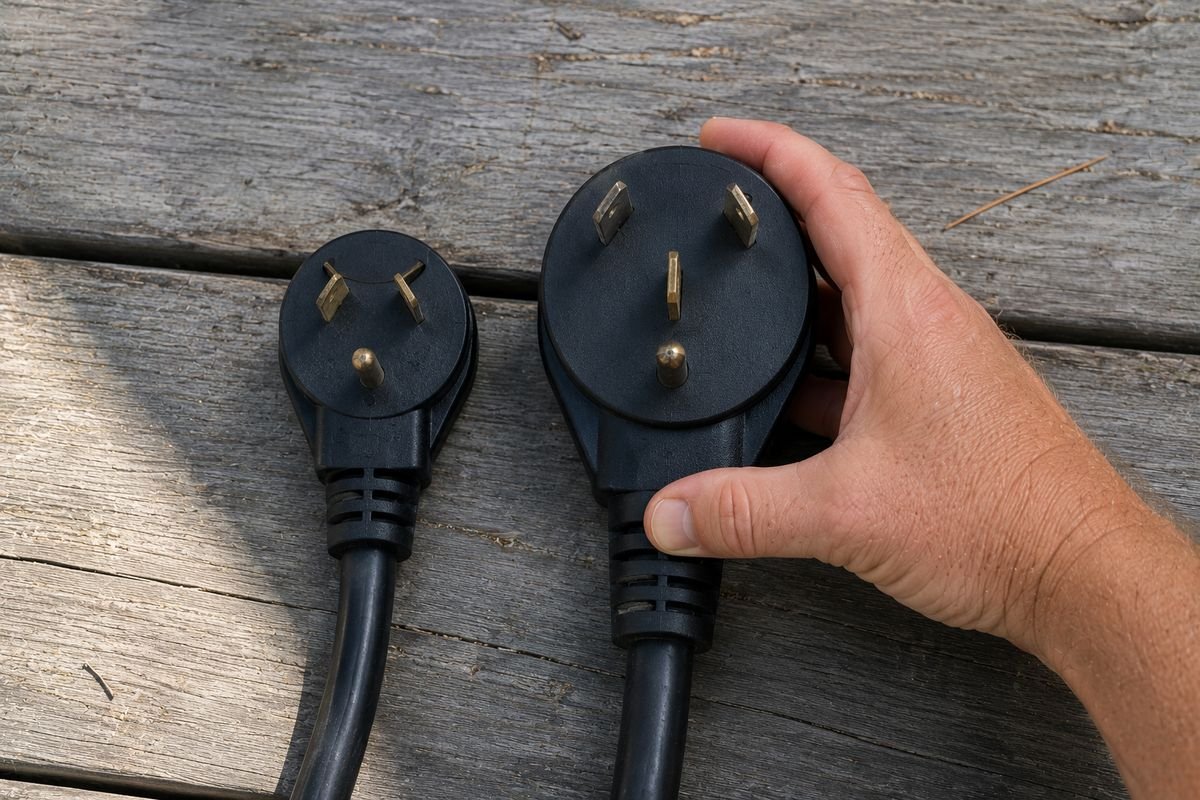
Do I Need a 30 Amp or a 50 Amp Unit?
This one is decided by your trailer rather than by preference, so check the shore power cord before you shop.
30 amp service uses a three prong plug and gives you a single 120 volt leg, about 3,600 watts in total. That is why the air conditioner and the microwave together trip the pedestal.
50 amp service uses a four prong plug and gives you two 120 volt legs, 120/240 volts, about 12,000 watts. It isn't slightly more than 30 amp. It's more than three times as much.
The protection has to match the cord, and the products are different, so the buying advice lives in two separate guides rather than here: the 30 amp surge protector guide and the 50 amp surge protector guide. Everything on this page applies to both.
How Many Joules Do You Need?
Joules measure how much energy the protector can absorb over its life before its components are used up. More is better, but the number is less useful than it looks.
As a benchmark for an RV surge protector, Southwire rates its SurgeGuard line at up to 4,200 joules across the basic, surge plus and full protection ranges, which is to say the joule rating isn't what separates their cheapest unit from their most capable one. Everything that separates them is monitoring and disconnection.
So treat joules as a floor rather than a ranking. Anything from around 1,500 joules upward is sensible for a travel trailer, and beyond that you're better off spending the money on an EMS than on a bigger number. A unit that disconnects at 1,790 joules protects far more than one that only absorbs at 4,200.
What Does Open Ground or Reverse Polarity Mean?
These are the pedestal faults a decent unit will refuse to connect to, and each one is worth understanding because the consequences are different.
- Open ground. The ground wire isn't connected. Everything works normally until something faults, at which point the metal parts of your trailer can become live with nothing to carry the fault away.
- Reverse polarity. Hot and neutral are swapped. Appliances run, but parts of them that should be at neutral are live, including switches that appear to be off.
- Open neutral. The worst of the three on 50 amp service, because the two legs are no longer balanced against a neutral and 120 volt circuits can see far more than 120 volts. This is the fault that destroys everything plugged in at once.
A unit that only reports these leaves the decision to you. A unit that disconnects makes it for you, which is the argument for the EMS in one line.
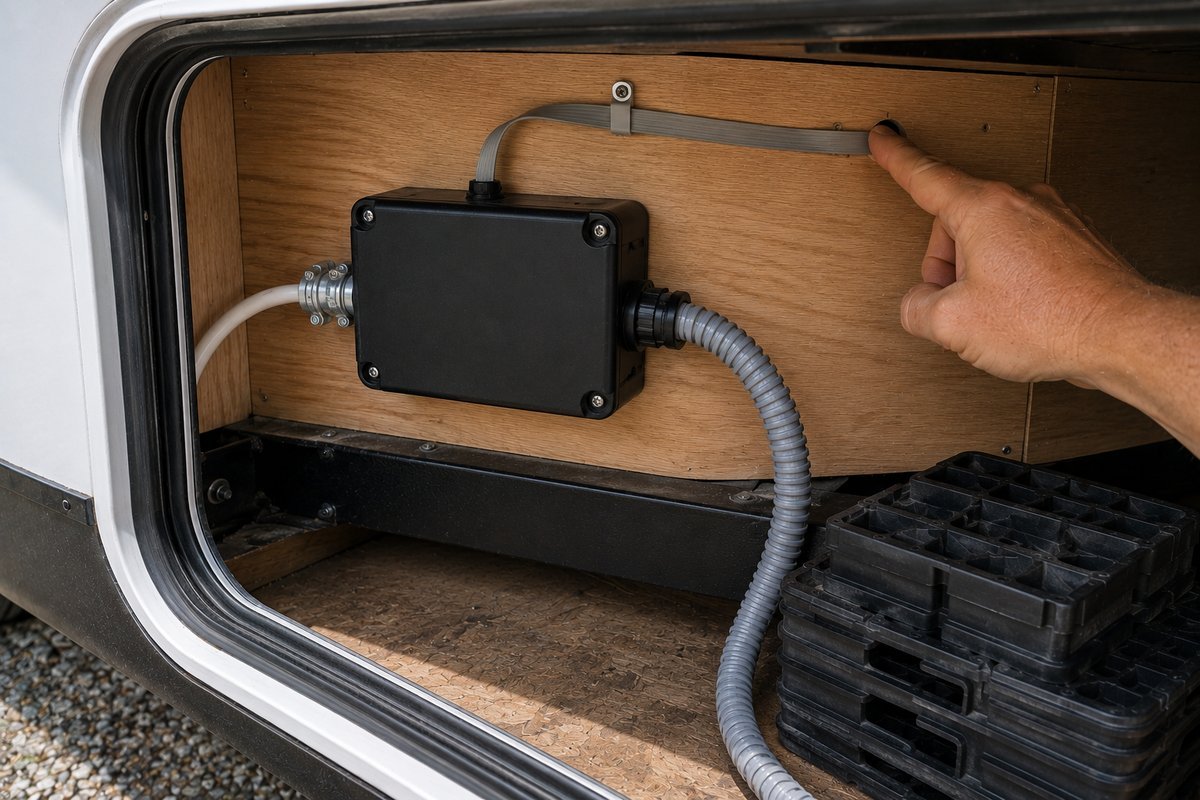
Should It Be Portable or Hardwired?
Portable plugs in at the pedestal and can be moved between trailers. Hardwired is fitted inside, usually near the transfer switch, and never touches the weather.
- Portable is easier to fit, easy to take to a new RV, and easy to steal. Anything left at a pedestal overnight in a busy park needs a lock through it.
- Hardwired can't be stolen or rained on, and it protects the trailer whether you remembered to plug it in or not. The tradeoff is installation and the fact that you can't test a suspect pedestal with it before connecting.
- The compromise most owners land on is a hardwired unit with a remote display inside, plus a cheap plug-in tester kept in the storage bay for checking a pedestal before backing in.
How Do You Install an RV Surge Protector?
A portable unit needs no installation. Plug it into the pedestal, plug your shore cord into it, wait for it to finish testing, and lock it to something.
A hardwired unit goes between the shore power inlet and the distribution panel, usually near the transfer switch, and the job is straightforward for anyone comfortable working on a disconnected 120 or 240 volt circuit: shore power unplugged, battery disconnected, existing feed cut and landed on the unit's terminals, remote display run to somewhere you will look at it.
If any part of that sentence is unfamiliar, this is a job for an RV technician. It's an hour of labor and it isn't the place to learn.
- Mount it where it stays dry and where the heat it makes can escape.
- Don't bury the display. A monitor you can't see is a monitor you won't read.
- Leave the pedestal tester in the bay anyway. Hardwired protection is downstream, so it can't tell you about a pedestal before you commit to it.
How Do You Maintain One?
Almost nothing, which is why they get forgotten.
- Look at the indicator every time you connect. That is the entire maintenance schedule for a basic unit.
- Keep the contacts dry and clean. A portable unit lives outdoors and its receptacle collects grit.
- Check the plug and receptacle for discoloration. Heat marks mean a loose connection somewhere, and that gets worse rather than better.
- Store it inside, not at the pedestal. Sun and rain age the case faster than use ages the electronics.
How Do You Know If Your Surge Protector Is Bad?
Because they wear out silently, this matters.
- The protected or status light is out while power is passing through. That is the classic sign that the protection components are spent and the unit is now an extension cord.
- It passes power but no longer reports anything, on a model with a display that used to show voltage.
- It has taken a known hit. If the park lost power in a storm and yours has worked since, check the indicators rather than assuming.
- The plug or receptacle is discolored or deformed. Heat damage at the connection is a fault in its own right, and it doesn't improve.
On an EMS, most faults appear as an error code rather than silence, which is one more argument for the more capable unit.
What Else Belongs in the Bay?
Two small things finish the setup.
A pedestal tester. A three light plug-in tester costs very little and tells you whether the outlet is wired correctly before your cord goes anywhere near it. On a hardwired setup it's the only way to check a pedestal first.
A lock. If the protector lives at the pedestal, it needs securing. The same logic covers the rest of what sits outside overnight, which is dealt with in our guide to RV storage and security. Water side protection is separate and covered in the RV water pressure regulator guide.
Frequently Asked Questions
Does a surge protector help with low voltage?
A basic one doesn't. It absorbs spikes and passes everything else through, including 104 volts on a hot afternoon. Only an EMS watches the voltage and disconnects.
Can I use one with a generator?
Yes, and it's worth doing, because an unsteady generator output is exactly the sort of supply these units exist to watch. Expect a delay before power passes, because the unit runs its restart delay on generator start just as it does on shore power.
Do I need the emergency power off feature?
Only if you want the ability to cut shore power from inside. It's convenience rather than protection, and plenty of good units don't have it.
Do I need a surge protector at a house outlet?
Plugging into a household 15 or 20 amp outlet through an adapter puts far less load on the trailer, but the same 120 volt wiring faults apply and older houses have plenty of them. The unit costs nothing to use, so use it.
Can I leave it plugged in all season?
Yes, and that is the normal way to use one. Long term seasonal setups are exactly where an EMS earns back its price, because nobody is standing there watching the pedestal in July.
Will it stop my breaker tripping?
No. A tripping pedestal breaker usually means you're asking 30 amp service for more than 3,600 watts. That is a load problem, and the protector isn't involved.
Quick Answers
Do You Need a Surge Protector on an RV?
If you plug into campground power, yes. The real risks are miswired pedestals and low voltage in a full park, not lightning, and none of those trip a breaker. If you only run off your own battery and generator, a basic unit is enough.
How Does an RV Surge Protector Work?
It uses parts called metal oxide varistors. When voltage spikes, they send the extra energy to ground instead of letting it into the trailer, and each spike wears them down a little. A basic unit doesn't watch voltage or check wiring.
What Is the Difference Between a Surge Protector and an EMS?
A surge protector absorbs spikes. An EMS, or electrical management system, also watches the supply and disconnects the trailer for low or high voltage, open ground, open neutral and reverse polarity, then waits before restoring power so the air conditioner compressor isn't damaged.
Do I Need a 30 Amp or a 50 Amp Unit?
Match it to your shore power cord. A three prong plug is 30 amp service, with one 120 volt leg and about 3,600 watts. A four prong plug is 50 amp service, with two 120 volt legs and about 12,000 watts.
How Many Joules Do You Need?
Treat joules as a minimum, not a ranking. Around 1,500 joules or more is sensible for a travel trailer. Beyond that, spend the money on an EMS that disconnects rather than on a bigger joule number.
What Does Open Ground or Reverse Polarity Mean?
Open ground means the ground wire isn't connected, so a fault has no safe path. Reverse polarity means hot and neutral are swapped, so switches that look off can still be live. A good unit refuses to connect to either.