
If your shore power cord ends in a three prong plug, you need a 30 amp RV surge protector, and the choice is narrower than the shelf suggests. This page is about which one to buy for 30 amp service. How the protection works, and what an EMS adds over a plain surge protector, is covered in the main surge protector guide. A 30 amp RV surge protector is only useful if it's plugged in before anything else is.
Table of Contents
What 30 Amp Service Gives You
One 120 volt leg, 30 amps, about 3,600 watts in total. That is the whole budget, and everything in the trailer draws from it.
An air conditioner takes a large share of that on start-up, which is why the microwave and the air conditioner together trip the pedestal breaker and why an electric heater in spring can do the same. The published locked rotor figures behind that are worth seeing, and they're in our guide to the RV air conditioner. It also explains why voltage sag hurts a 30 amp RV sooner: there's no second leg to spread the load across.
The plug is a TT-30, three prongs, and it isn't a household dryer plug despite looking related. That matters when someone offers you an adapter at a house.
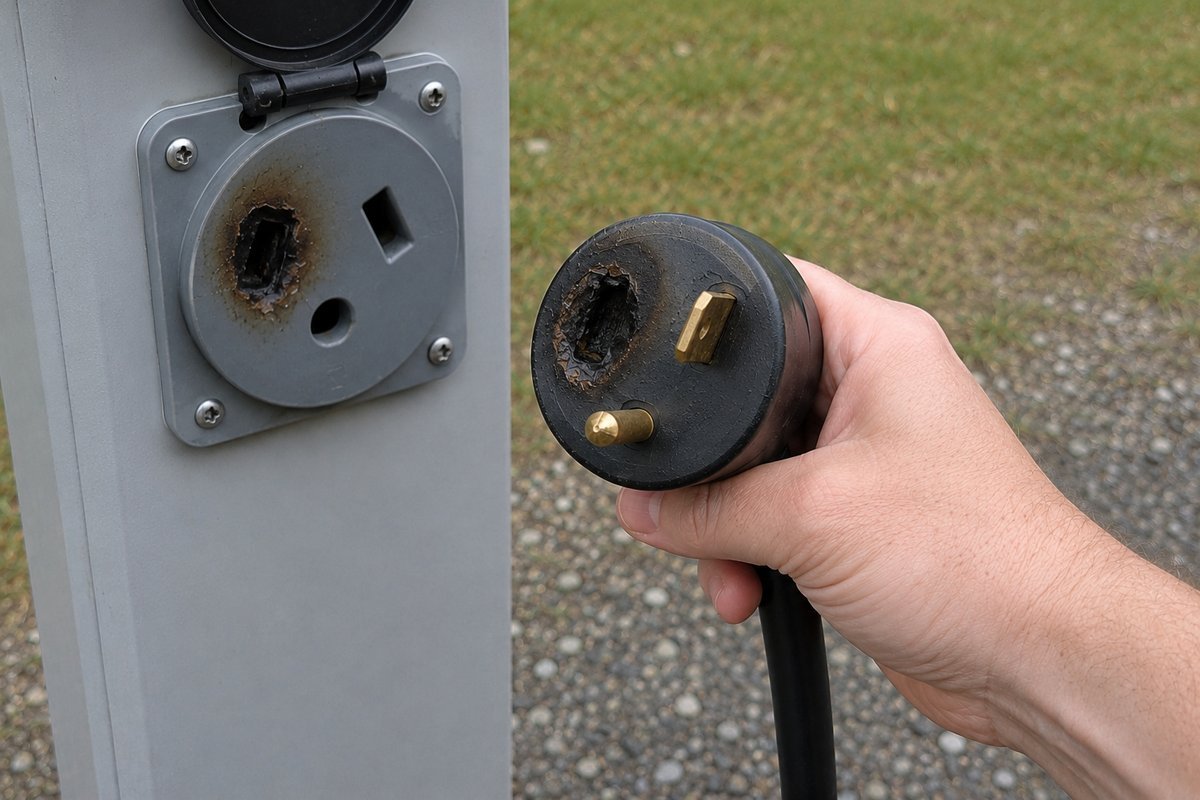
What Goes Wrong at a 30 Amp Pedestal
The 30 amp receptacle takes more abuse than the 50 amp one, because it's the one every rental trailer and every weekend camper plugs into.
- Worn contacts. A TT-30 receptacle that has taken thousands of insertions grips loosely, and a loose connection makes heat rather than a spark.
- Heat damage at the plug. Browned or melted plastic on either the cord end or the receptacle. It never improves and it's a fire risk, not a cosmetic one.
- Open ground. The ground wire is disconnected somewhere. Everything works until something faults, and then the trailer's metal parts have no safe path for that fault.
- Reverse polarity. Hot and neutral swapped. Appliances run and switches that look off are still live.
- Voltage sag. The most common of all in a full park in summer, and the one a basic surge protector won't save you from.
What to Look For in a 30 Amp Unit
- Does it disconnect, or only report? The single most important line on the box. A basic unit absorbs spikes and passes everything else through. An EMS cuts power on low voltage, high voltage, open ground and open neutral.
- Low voltage cutoff. Look for a stated threshold around 102 to 104 volts. Without it, nothing protects the air conditioner compressor from a park that sags in August.
- Restart delay. Anywhere from about 30 seconds to over two minutes, and longer is safer, because the compressor is never handed power back into pressure it can't start against.
- A display you can read at the pedestal, or a remote display if the unit is hardwired.
- Weather sealing and a lock point, because a portable unit lives outdoors and is worth stealing.
Portable or Hardwired on a 30 Amp Trailer?
Portable plugs in at the pedestal and moves between trailers. Hardwired fits inside near the transfer switch, can't be stolen or rained on, and protects whether you remembered it or not.
On a smaller 30 amp trailer the hardwired argument is a little stronger than usual, because storage space is short and a portable unit is one more object to carry, lock and dry off. The compromise most owners reach is a hardwired unit with a remote display, plus a cheap plug-in tester in the bay for checking a pedestal before backing in.
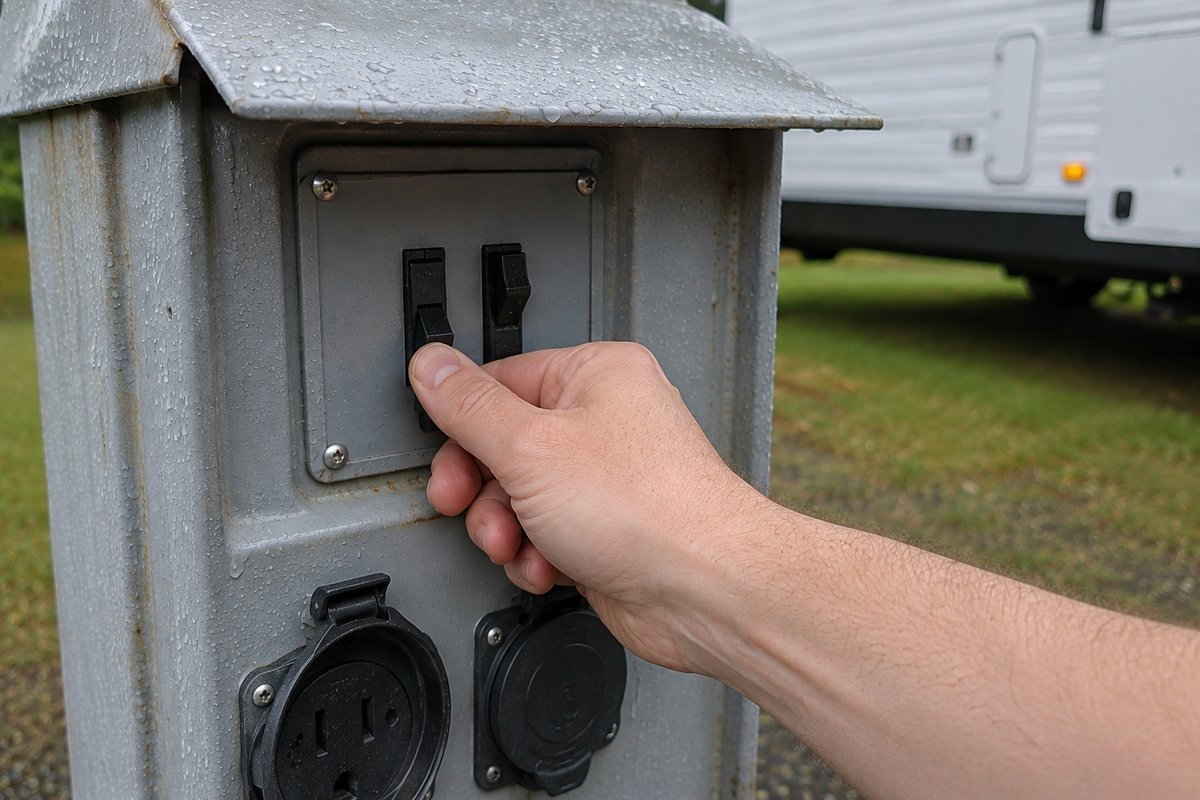
The Order to Plug In
Doing this in sequence costs nothing and avoids the two ways people damage a connection.
- Switch the pedestal breaker off first. Plugging into a live outlet is what pits the contacts.
- Test the outlet with a plug in pedestal tester, or let the protector run its own check.
- Fit the protector, then the shore cord, pushing each fully home.
- Switch the breaker on and wait. An EMS will hold the power for its delay period before passing it through. That pause is the unit doing its job, not a fault.
- Lock it if it stays out overnight.
Does It Work With a Generator?
Yes, and on a 30 amp trailer that's often where it pays off, because a small generator under load is exactly the kind of unsteady supply these units watch for.
Expect a delay before power passes when the generator starts, and another short delay when you switch back to shore power. Southwire's units run the same restart delay on generator start as they do on shore power. Nothing is wrong during that pause.
Can You Use a 50 Amp Protector on a 30 Amp Trailer?
With adapters it can be made to work, and it's usually a poor idea.
A 50 amp unit expects two hot legs. From a 30 amp pedestal it sees one leg missing, which some units report as a fault and refuse to pass. You have also added two more connections to the part of the system most likely to overheat, and made the assembly heavy enough to hang off the pedestal outlet rather than sit on the ground.
If the trailer is 30 amp, buy a 30 amp unit. It costs less anyway. The reverse case, a 30 amp unit on a 50 amp trailer, isn't an option at all: you would be running a 50 amp service through a device rated for 30.
Which 30 Amp Surge Protector to Buy
Progressive Industries EMS-PT30X
The one that disconnectsThis is the unit the criteria above describe. It doesn't just absorb spikes. It watches the pedestal continuously and opens the circuit when the power goes out of range.
Low voltage cuts at 104 volts once the sag has held for six seconds. High voltage is stepped, tripping between 132 and 140 volts after three seconds and faster the higher it climbs. It also catches reverse polarity, open ground, open neutral, an accidental 240 volt feed and a frequency wandering outside 51 to 69 hertz. Restart is held for 136 seconds so the compressor is never restarted into pressure.
What You'll Love
- Cuts the power at 104 volts instead of passing it through
- A 136 second restart delay, which is the protective end of the range
- Catches the accidental 240 volt feed that destroys everything at once
- Built in bracket takes a cable lock at the pedestal
Worth Considering
- 1,790 joules reads small beside no name units claiming five figures
- Lives outdoors on the pedestal and is worth stealing
- The display is out at the post, not where you're sitting
- Costs several times what a surge only unit does
Progressive Industries EMS-HW30C
Fitted once, and it covers the generatorThe same protection as the portable, wired into the trailer instead of hanging off the pedestal. Progressive specifies it between the shore power inlet and the transfer box.
That position is the point. Wired before the transfer switch, it protects against generator output as well as shore power, which nothing sitting out at the pedestal can do. The remote display goes wherever you will look at it, and the restart delay is selectable at 15 seconds or 136.
What You'll Love
- Protects generator power as well as shore power
- Nothing to carry, unplug or steal
- Remote display can be mounted where you will read it
- Restart delay is selectable rather than fixed
Worth Considering
- Needs a wiring job on a properly disconnected circuit
- Moving it to another trailer isn't a five minute task
- No display at the pedestal, so faults are read inside
- Same 1,790 joules as the portable for a similar outlay
Southwire Surge Guard 44261
It tells you. It doesn't disconnect.The budget option, and it sits on the line this article has already drawn: this absorbs spikes and lights an indicator, then passes everything else through.
Its lights name the three faults worth knowing about at a pedestal, open ground, open neutral and reversed polarity, and Southwire stands behind it with a limited lifetime warranty. What it won't do is notice a park sagging to 104 volts on an August afternoon, because it has nothing to notice it with.
What You'll Love
- A real manufacturer with a published range behind it
- Indicator lights name the three pedestal wiring faults
- Limited lifetime warranty
- A fraction of what an EMS costs
Worth Considering
- Passes low voltage straight through to the air conditioner
- No restart delay, so nothing shields the compressor
- Lights only, with no voltage reading to check
- Southwire documents the 44260. This is a retail SKU variant
Nilight 30 Amp RV Circuit Tester
Goes in before your cord doesNot a protector. A plug you push into the pedestal, read, and pull out again before the trailer is connected to anything.
It's a male TT-30P with no outlet on the back, which is exactly right for the job: it can't be left in line and forgotten. Its indicators cover eight conditions including open neutral, the one that does the expensive damage, and it's ETL listed with a two year warranty.
What You'll Love
- Reads the pedestal before the trailer is connected to it
- Flags open neutral, the fault that does the damage
- Costs less than a tank of fuel
- ETL listed with a two year warranty
Worth Considering
- No protection at all, it only reports
- Male plug only, so it can't stay in line
- Tells you nothing once the cord is connected
- One more small thing to lose in the bay
Specifications above are taken from each manufacturer's own documentation rather than the retail listing.
What Else Belongs in the Bay
A plug in pedestal tester, which tells you whether the pedestal is wired correctly before your cord goes near it, and a lock if the protector stays outside overnight. The rest of what sits outside is covered in our guide to RV storage and security, and the water side of the same hookup is in the RV water pressure regulator guide.
A 30 amp RV surge protector pays off on the days nothing dramatic happens, when the park voltage quietly sags and the air conditioner keeps running anyway.
Plug-in protection has limits worth knowing. The Electrical Safety Foundation International notes that no surge protection device can handle a direct lightning strike, so unplugging from the pedestal when a storm is close is still the safest move. Check the 30 amp RV surge protector's display at every new pedestal before you connect the RV.
Frequently Asked Questions
Does a 30 amp RV need a surge protector?
If you plug into campground power, yes. The faults that matter are miswired pedestals and sagging voltage, not lightning, and a 30 amp RV meets both as often as a big fifth wheel does.
Will it stop the pedestal breaker tripping?
No. A tripping 30 amp breaker means you're asking for more than 3,600 watts. That is a load problem and the protector plays no part in it.
Can I use it plugged into a house outlet?
Yes, through the usual adapter. The load is far smaller, but household wiring faults are just as common, especially in older houses and detached garages.
Is a 30 amp EMS worth it on a small trailer?
If it has an air conditioner, yes, because the compressor is the expensive thing low voltage destroys. If it doesn't, a basic surge protector covers the realistic risks.
Can I leave it connected all season?
Yes, and seasonal sites are where it pays for itself, since nobody is standing at the pedestal in July watching the voltage.
How do I know when it has worn out?
The protection indicator goes out while power still passes through. At that point it's an extension cord. Details and the other failure signs are in our guide to how RV surge protectors work.
For a trailer on a TT-30 cord, a 30 amp RV surge protector is the cheapest protection available for the most expensive appliance on the roof.
Quick Answers
Portable or Hardwired on a 30 Amp Trailer?
Portable plugs in at the pedestal and moves between trailers. Hardwired fits inside near the transfer switch, can't be stolen or rained on, and protects whether you remembered it or not.
Does It Work With a Generator?
Yes, and on a 30 amp trailer that's often where it pays off, because a small generator under load is exactly the kind of unsteady supply these units watch for.
Can You Use a 50 Amp Protector on a 30 Amp Trailer?
It can be made to work with adapters, but it's usually a poor idea. A 50 amp unit may see the missing second leg as a fault and refuse to pass power, and the adapters add more connections that can overheat. Buy a 30 amp unit for a 30 amp trailer.