
Everything that connects the trailer to the truck, and everything that slows the pair of them down. This is the part of the RV where the published numbers matter most, and where the most confident advice online is the least sourced.
Who this is for. Somebody towing a travel trailer behind a pickup or an SUV. A motorhome towing a car and a fifth wheel are different arrangements, and the weight math does not transfer cleanly to either. If you are setting up for the first time, read down this page in order. If something has already gone wrong, jump to the last section.
Start here
Tires, hitch, chocks and brakes are usually treated as four separate subjects, and they are not. Underinflated tires change how the trailer pulls, which changes how much the hitch has to correct, which changes how the brake gain should be set. The RV towing guide explains how the whole system fits together and is the right place to begin before buying anything.
Choosing the hardware
The hitch. A weight distribution hitch does two jobs that get confused with each other. It moves load back onto the front axle of the tow vehicle, and on most designs it adds some resistance to sway. Those are separate things, and no hitch stops sway on its own. Whether you need one is answered by your tow vehicle's own manual and by your measured tongue weight, not by trailer length. Weight distribution hitch for a travel trailer covers the tongue weight window, how to tell when one is set up correctly, and the one state that puts the requirement in statute.
The tires. Trailer tires usually age out before they wear out, so tread depth is the wrong thing to judge them by. Travel trailer tires covers how to read the date code on a sidewall, what the load range promises, and what the manufacturers publish instead of a replacement age.
Covering the tires. Sun ages tires while the trailer sits between trips. RV tire covers explains whether covers work, how to measure for the right size, and which five are worth buying.
The controller. Trailer brakes are electric on nearly every travel trailer, and the controller in the cab decides how hard they work. Proportional brake controller covers what proportional means, how to tell which kind is already under your dash, and the manufacturer procedure for setting the gain.
Setting it up
Wiring the controller in. Brake controller wiring harness covers which harness your truck needs and how to tell from what the factory already wired in, plus the four wires every controller uses and the two 7-way color standards. Worth reading before you order a part, because the plug is not there on every model year.
Watching the tires. A trailer tire can fail without anything reaching you in the cab, which is the argument for monitoring rather than a walk around at the last fuel stop. TPMS setup for a travel trailer covers sensor placement, alert thresholds and whether a repeater is needed.
Every time you tow
Tongue weight. Ten to fifteen percent of gross trailer weight is the window published by the manufacturers we checked, and it decides hitch sizing, sway behavior and whether the RV is safe before any hardware is chosen. It is measured, not estimated from trailer length.
Chocking. A trailer that is uncoupled, or parked on any kind of grade, is held by whatever you put against its tires. Trailer wheel chocks covers which type holds, and the standard that turns out not to test holding power at all.
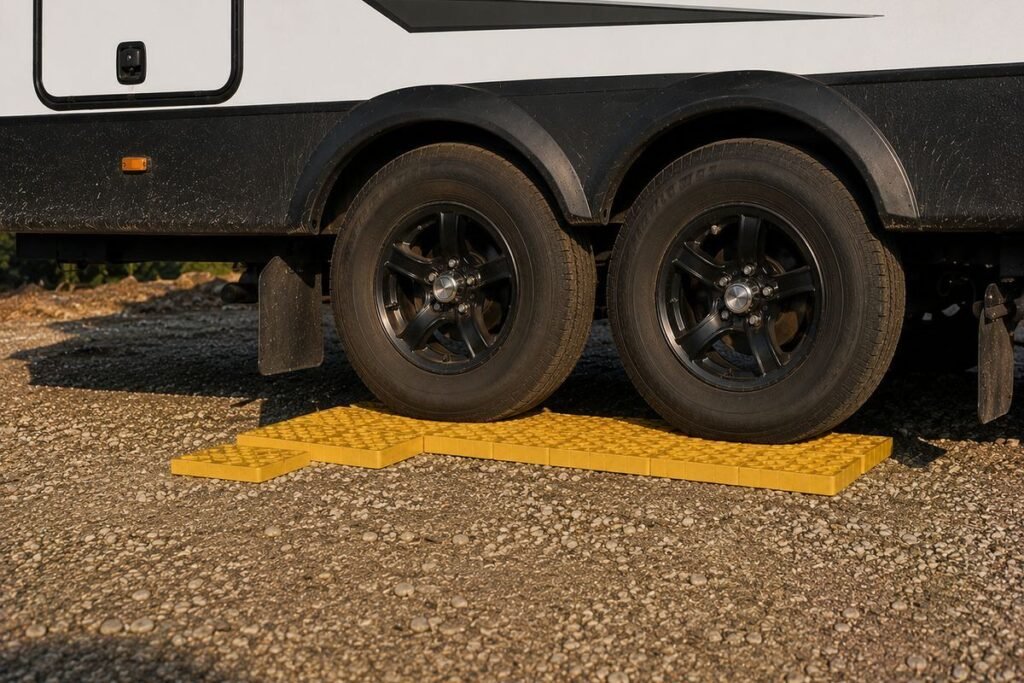
Leveling. Once it is parked and chocked, it still has to sit level. RV leveling blocks covers how high you can safely stack them, which is a question only one manufacturer answers in writing.
Seeing behind it. Once the trailer is hitched, the truck's own camera only shows the coupler. RV backup camera covers wired versus wireless, four picks, and why a camera on a pre-wired trailer stays dark until the truck's headlights are on.
When something stops working
When trailer brakes stop behaving, the fault is usually in a connection rather than in the box on the dash, and the order you check things in matters. Trailer brake controller repair walks the checks in the order a shop would run them, and says plainly where manufacturers publish nothing.
Brakes that do nothing at all point at the wiring. Brakes that grab or lag point at the controller type and its gain. A trailer that wanders points back at the tires and the hitch.