
Travel trailer tires fail in a way car tires don't. They age out before they wear out, and the part that goes is the part you can't see. A tire with most of its tread left can be five years past the point where anyone should trust it, and nothing on the outside says so.
That is the whole problem with travel trailer tires, and it's why tread depth is the wrong test. What follows is what the manufacturers, the regulator and the federal rules publish, including the places where they flatly disagree with each other.
Table of Contents
How long do travel trailer tires last?
There's no agreed answer, and the disagreement is more useful than a number would be.
Michelin says ten years. Its guidance is to replace tires ten years from the date of manufacture "regardless of remaining tread depth or apparent condition," with a professional inspection every year after the first five. It applies the same ten year rule to spares. Bridgestone and Firestone share one maintenance manual, and it gives the same pair of figures: inspection once the tire has five years of service behind it, and replacement of anything "more than 10 years old" regardless of condition or tread.
Airstream says five. In a bulletin filed with the federal regulator it states plainly that "if a tire is five years old then it should be replaced." Its support pages keep the same five year point but add a step, asking for inspection by a tire expert and replacement "even if it has no apparent tread wear." Same interval, different emphasis, and the bulletin is the more direct of the two.
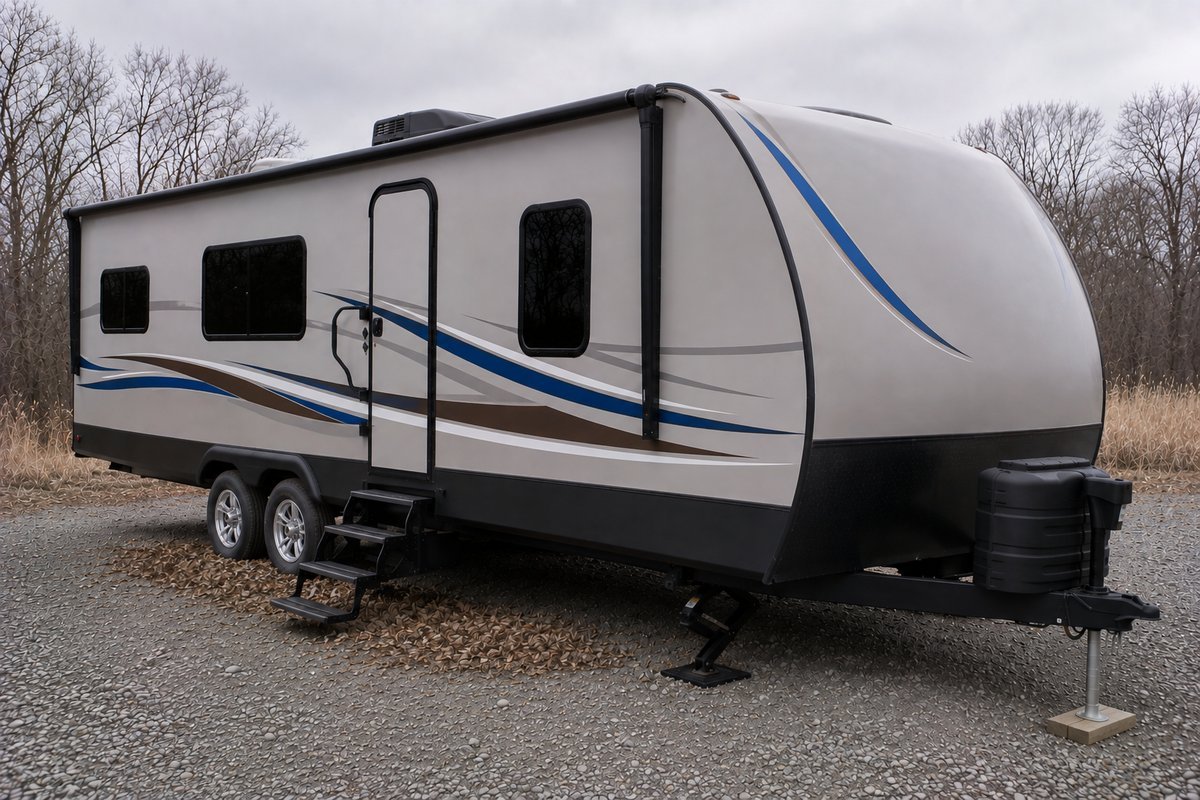
And the companies that specialize in trailer tires publish no age at all.
Carlisle, one of the most widely fitted trailer tire brands in the country, will tell you exactly why tread is meaningless and then decline to give you a year. Its own words: "Remaining tread is not an indicator of tire life as the irregular duty cycle requires that they sit in extended storage under static load conditions often for long periods without tire movement or maintenance, causing the tire carcass (internal structure) to break down, a condition undetected by visual inspection."
The carcass is the part of the tire you never see. Under the rubber sit layers of fabric cord, usually polyester, and the steel belts. That structure is what holds the air and carries the weight of the trailer, and the rubber is just the skin over it.
The company selling the tires is telling you the failure happens inside the carcass, that storage causes it, and that looking at the tire won't reveal it. Tread wears from the outside, where you can watch it. The carcass goes from the inside, where you can't. Then Carlisle stops short of saying when.
Maxxis publishes a six year warranty from the date of manufacture, with free replacement inside the first 25 percent of treadwear or twelve months, whichever comes first, and prorated cover after that. It's a warranty window and not a service life. Goodyear names a warranty by product line but its warranty documents wouldn't load for us, and it publishes no replacement age. Jayco and Grand Design owner manuals contain no tire age guidance at all.
So in summary, published guidance runs from five years to ten, the shortest number comes from an RV maker rather than a tire maker, and the people who build trailer tires won't commit to one. What everybody does agree on is that age matters more than mileage and that tread depth won't tell you.
How do you tell when trailer tires need replacing?
Start with the date, because it's the only hard fact on the sidewall.
How do you read the date code?
Every tire sold in the United States carries a Tire Identification Number molded into the sidewall. Federal rule 49 CFR 574.5 sets out how it's built: three symbols for the plant, six for the manufacturer code, and a final group of "four numerical symbols" for the date.
Those last four digits are the ones that matter. The first two are the week and the last two are the year, counted from "the first full calendar week in each year." The regulation gives its own example: "0109 means the tire was manufactured in the first full calendar week of 2009."
A tire stamped 2419 was built in the twenty fourth week of 2019. That is the date the clock starts, not the date you bought it.
Why can you never find it?
Because on a trailer it's often facing the axle.
The federal standard for these tires, FMVSS 119, relaxes the marking rule for them, though not for them alone: "Markings may appear on only one sidewall and the entire sidewall area may be used in the case of motorcycle tires and recreational, boat, baggage, and special trailer tires." Trailer tires are lumped in with boat and baggage tires, and the effect is that everything the rule requires can live on a single side.
A car tire is held to a fuller marking rule on both sidewalls, though even there only the outboard side carries the complete identification number. On a trailer tire there's no rule saying which side gets used, and plenty of builders face the marked side inward.
If you can't find a date code on the outside of the tire, it's on the inside. You aren't missing it.
What else is worth looking at?
Cracking where the tread meets the sidewall, and cracking in the grooves. Bulges anywhere. Flat spots from sitting. Any of those on a tire that's also old settles the question. None of them appearing on an old tire settles nothing, which is the point Carlisle is making.
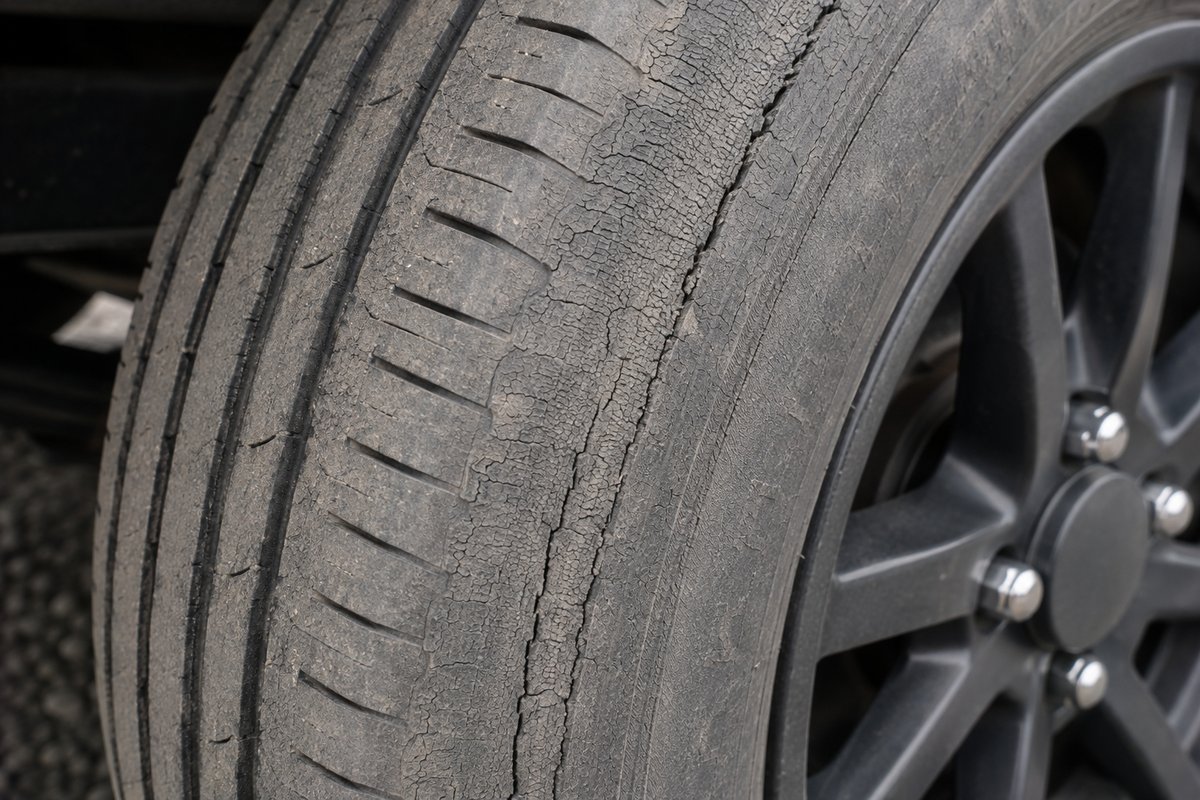
Check the spare on the same schedule. The federal regulator singles it out: "Spare tires on all vehicles are prone to aging because they seldom get replaced." A spare that has never turned a mile is exactly as old as the day it was built.
What does the federal government require?
Nothing about age. There's no federal tire expiration date, and this is worth being clear about because plenty of writing implies otherwise.
What the National Highway Traffic Safety Administration publishes on its consumer page is a report of what other people recommend: "Some vehicle and tire manufacturers recommend replacing tires that are six to 10 years old, regardless of treadwear." That is the agency describing the industry, not setting a rule.
Its research went further. The Tire Aging Test Development Project measured what happens to rubber over time and found hardness and cross link density going up while tensile strength, elongation and flex properties went down, all of it consistent with thermo oxidative aging.
In durability testing the agency reported that "the laboratory roadwheel test results for used tires often exhibited a trend of decreasing time-to-failure with increasing mileage and/or age." Its report to Congress is more cautious still: "about half of the six models of used tires exhibited a trend of decreasing time-to-failure in the roadwheel test with increasing service life when compared to new versions of the same tires."
Note the careful wording. About half of the models, and a trend rather than a rule. The agency has measured the chemistry of aging directly and found a pattern in how aged tires fail on the test rig, but it stops well short of a clean relationship, and it has never set a maximum service age.
It does single out vehicles like travel trailers. Infrequently driven, low annual mileage, parked in sunlight, stored badly, warm climates. A travel trailer ticks most of those in a normal year. Sunlight is the easiest of them to block while it sits, which is what RV tire covers are for.
What is the difference between ST and LT tires?
ST stands for Special Trailer, and the difference isn't simply that one is better.
Federal rule FMVSS 110, which covers vehicles rated at 10,000 pounds or less, says trailers "may be equipped with ST tires, FI tires, or tires with a rim diameter code of 12 or below." Heavier trailers fall under FMVSS 120 instead, so check your own weight rating before applying any of this. Either way it's permission, not a requirement, and it's worth reading carefully before anybody tells you the law demands one or the other.
The structural difference is the one most guides skip. Special trailer tires are certified under FMVSS 119, written in 1971. Most of the radial tires on the truck pulling the trailer are certified under FMVSS 139, which came out of the TREAD Act and phased in through 2007, and which adds tests 119 doesn't have, including a low inflation performance test and an aged tire endurance test. The tires on the back half of your RV are held to an older standard than the tires on the front half.
Carlisle argues against fitting passenger or light truck tires to a trailer, and its reasoning is about sway rather than strength: "Passenger or truck tires, with their more flexible sidewalls, can result in trailer sway problems. The stiffer, heavy duty sidewalls of ST tires are designed to control and reduce sway problems."
That is a tire maker defending its own category, and it's also a coherent argument. A trailer has no steering and no driver input to correct with. Sidewall stiffness is doing work there that it doesn't do on a car.
How fast can you tow on trailer tires?
The sixty five mile an hour figure that gets repeated everywhere was never a federal rule, and on current tires it's out of date.
Carlstar publishes the convention: "If the tire is not marked with a speed symbol, the default speed rating for trailer tires is 62 mph." It also puts the familiar numbers in the past tense: "In the past, most trailer tires were rated at 62 or 65 mph.
Today, some of our tires are rated at 87 mph (N), some at 75 mph (L), some at 65 mph (J: ST tires) and some at 62 mph." Goodyear said at the Endurance launch in 2017 that the whole line carried an N speed symbol, which is 87 miles an hour, and every size we checked still does. Maxxis publishes N across the M8008 Plus range as well.
Then Carlstar says two things worth quoting. First, on what a rating means: "speed ratings are test speeds and not recommended driving speeds. The ratings apply only to the tire itself, and not a particular vehicle." Second, on what to do: "We recommend driving no more than 60 mph when towing a trailer."
A tire manufacturer telling you to tow slower than its own tires are rated for is the most useful sentence in this whole subject. Note who is speaking, though: Carlstar is Carlisle, and the same company supplies the tread quote, the inflation advice and this speed advice. It's the most forthcoming voice on this page, not three independent ones.
What load range do you need?
Load range is a letter, usually C, D or E, and it isn't a fixed weight. It's size specific and it only means anything paired with a pressure.
The federal standard for trailer tires requires the letter to be molded on, alongside a line reading "Max load ____kg (____lb) at ____kPa (____psi) cold." It never defines what the letters mean. That definition lives in industry tables rather than in the rules.
What you can rely on is the pairing. In the same size, a higher letter means a higher maximum pressure and therefore a higher load. Maxxis publishes the M8008 Plus in load ranges C through E with maximum pressures from 50 to 80 psi and maximum loads from 1,360 to 3,420 pounds depending on size.
Airstream gives a worked example on the most common travel trailer size: "A Goodyear Endurance ST225/75R15 tire inflated to 80 PSI (MAX.) has a load capacity of 2830 lbs." Goodyear publishes the same figure for that tire, at load index 117.
The number that has to clear is your axle rating divided between the tires on that axle, with the trailer loaded the way you tow it. Not the empty weight on the brochure.
What pressure should trailer tires run?
Here the sources disagree, and you should know that before somebody tells you the answer is obvious.
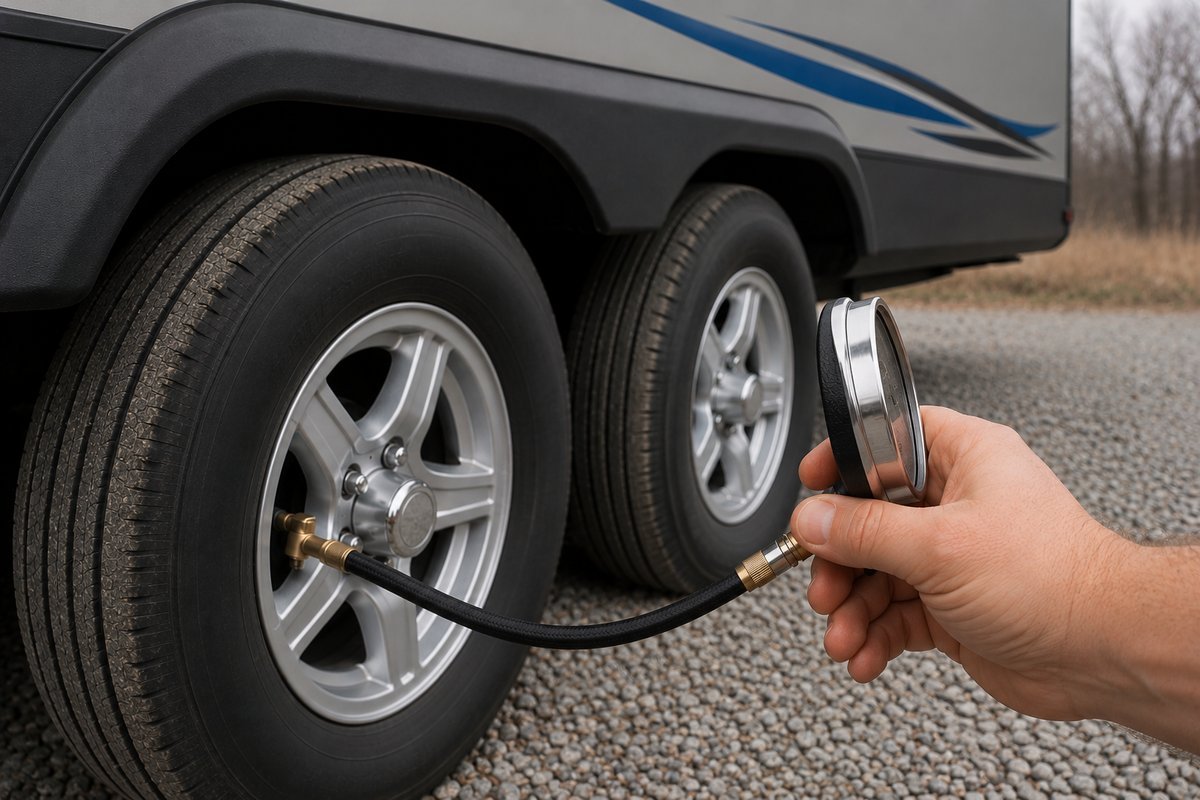
Carlisle says run the sidewall maximum: "Maintain air pressure at the maximum PSI recommended on the tire sidewall." It also names the failure mode, and it's the one that ends trips: "Under inflation is the number one cause of trailer tire failure."
Bridgestone says the sidewall number isn't a recommendation at all: the figure there "only indicates the greatest pressure permitted for that tire," and running at it "could make them wear faster or compromise your traction or braking abilities." It points owners to the placard on the vehicle instead.
Goodyear once published load and inflation tables telling owners to inflate to the tire carrying the heaviest load on the axle. That guidance lived on its RV tire site, which no longer exists, and its current consumer pages simply point to the vehicle placard. Worth knowing if somebody quotes the old tables at you: they're no longer published.
The federal rule sits behind Bridgestone here. On trailers rated at 10,000 pounds or less, FMVSS 110 makes the placard the vehicle manufacturer's statement of recommended cold inflation. Above that rating the equivalent requirement is in FMVSS 120. On a trailer the placard figure and the sidewall maximum often land in the same place, because trailer builders tend to specify a tire at close to its rated capacity. That isn't a rule and no manufacturer states it, so treat the placard as the authority and Carlisle's position as Carlisle's.
Two practical numbers from Bridgestone that are easy to forget. A tire loses "approximately 1 pound per square inch (PSI) of tire pressure every month" on average, and "for every 10 degrees F change in ambient temperature, tire pressure will change by approximately 1 PSI." That second one runs both ways, but the cold direction is the one that causes problems. A trailer that came out of storage in March at the pressure you left it in November isn't at that pressure any more.
Check them cold, before towing, every time. Travel trailer tires punish this more than car tires do, because nobody drives them daily and notices. If you would rather know while moving than find out afterwards, our guide to setting up TPMS on a travel trailer covers what the sensors weigh and where the repeater goes.
Why do campers keep having blowouts?
Put the sourced facts next to each other and the pattern isn't mysterious.
- The tires are certified to an older standard than the ones on the tow vehicle.
- They spend most of their life stationary under load, which Carlisle says breaks down the carcass invisibly.
- They lose pressure sitting, roughly a psi a month, and more as it gets cold.
- Under inflation is what Carlisle names as the number one cause of failure.
- The one test most owners run, looking at the tread, is the test the manufacturer says doesn't work.
- The date code that would tell you the real answer is often molded on the hidden sidewall.
Travel trailer tires aren't fragile. They're used in a way that defeats the checks people know how to run.
The five picks
Five lines, all shown in ST225/75R15 so the numbers sit side by side. That size is an example, not a recommendation. Match the size, load range and pressure on your own placard and sidewall, because the right tire for one trailer is the wrong tire for the next one.
Every figure below comes from the manufacturer rather than the retailer, and that distinction matters here: Amazon's own spec table gives the Maxxis a load capacity of two pounds. The more important thing they have in common is what none of them publishes. Not one of these five states a replacement age.
What they publish instead are warranty windows. Maxxis six years from the date of manufacture, Carlisle two years from the date of purchase, and those are coverage limits, not advice about when a tire stops being safe. Two of the five publish no warranty terms that can be reached at all. That gap is the argument of this whole article, and no maker on this page closes it.
Goodyear Endurance
Built in the USAGoodyear calls the Endurance "the only radial special trailer tire built in the United States," and it's the only maker on this page that says where its tires are made at all. The whole line carries the N speed rating, which Goodyear publishes line-wide rather than size by size, and ties directly to highway speeds.
For this size Goodyear publishes load range E, load index 117, 2,830 pounds at 80 psi and an N rating good for 87 mph, the same figure Airstream quotes and the one used earlier on this page. The warranty is the gap. Goodyear names one by product line, but every warranty document we tried returned an error, so we can't tell you what it covers or how long it runs. If a warranty you can read matters more to you than where the tire was built, that sends you to the Maxxis.
What You'll Love
- Only radial ST tire built in the United States
- N speed rating published across the entire line
- Steel belted, with Goodyear's Durawall sidewall technology
- The load figure is corroborated by an Airstream filing, not just a retailer
Worth Considering
- Warranty is named by product line but the documents won't load
- Publishes load index 117 only, with no dual figure
- Publishes no replacement age, same as every maker here
- Usually the most expensive way to buy this size
Carlisle Radial Trail HD
Read the load rangeThis is the tire behind the sway argument quoted earlier. Carlisle is the maker telling you that stiff ST sidewalls exist to control sway, and it puts more trailer tires on the road than anyone else in this set.
The trap is in this exact listing. It's the load range D version: 65 psi, 2,540 pounds, 113M. If your placard calls for a load range E, this is 290 pounds per tire short of what came off, and the size on the sidewall is identical either way, so nothing about the number warns you. Carlisle also disagrees with itself on speed.
Its website gives 81 mph for this size and its own 2025 catalog gives 87, and those aren't two roundings of one figure, they're two different speed symbols, M and N. Carlisle does publish a load range E version of this tire at 2,830 pounds and 80 psi, so if your placard says E, ask for that one rather than this listing.
What You'll Love
- The most widely fitted ST tire in this set
- High tensile belt package Carlisle says resists punctures
- Warranty terms are published plainly and easy to read
- A very large body of buyer feedback behind it
Worth Considering
- This listing is load range D, not E, check your placard first
- Carlisle's website and catalog give different speed symbols for it
- Publishes no load index, in any size
- Two years from purchase is the shortest warranty here
Maxxis M8008 Plus
Best documentedOf the three established names here, Maxxis is the only one that publishes load index, speed symbol, load range, maximum load and maximum pressure in one table you can read. Goodyear scatters it and Carlisle publishes no load index at all. In load range E this size is 2,830 pounds at 80 psi, 117/112N, and the N rating applies to every size rather than some of them.
Its warranty is the longest and the most specific here: six years from the date of manufacture, free replacement inside the first 25 percent of treadwear or twelve months, prorated after that. Note what that isn't. Six years of coverage isn't an instruction to replace at six years, and Maxxis publishes a replacement age no more than anyone else does. The listing also carries 16 ratings, which is very little to stand on if buyer feedback is how you decide.
What You'll Love
- Every spec that matters, published in one place
- N speed rating in every size, not just some of them
- Six years from date of manufacture, the longest warranty here
- Dual cord body casing and a sidewall built for high load cycles
Worth Considering
- Only 16 ratings on this listing
- Warranty is prorated after the first 25 percent of treadwear
- Doesn't state where the tire is made
- The six year window is a coverage limit, not a service life
Transeagle ST Radial
For a heavier axleLoad range F: 3,195 pounds per tire at 95 psi, all steel in both sidewall and tread. This is the slot for a trailer whose axle rating won't divide into what a load range E can carry, and it's the only above-E option in this size from a brand that publishes a full spec table.
The speed rating here works the opposite way you might expect. This F rated tire is 121/117M, which is 81 mph, while the lighter E rated tires on this page carry N, 87 mph. More load capacity doesn't buy more speed, and the heavier tire is the slower rated one.
Transeagle also publishes no warranty a buyer can read: the Limited Warranty link on its own site lands on a login page asking for an email and a code, and the warranty PDF retailers host for it belongs to a different company. If an E already clears your axle rating, there's no reason to carry the extra weight.
What You'll Love
- The highest load capacity here by a clear margin
- All steel construction in both sidewall and tread
- The only above-E choice in this size with published specs
- A complete manufacturer size table covering every size
Worth Considering
- Its own warranty page is locked behind a dealer login
- M is a slower rating than the E tires on this page carry
- Heavy enough that owners report needing truck tire mounting
- No country of manufacture published
Transeagle ST II
Like for like EPart number TSL10N: load range E, 117/112N, 2,830 pounds at 80 psi, 28.31 inches overall diameter and 7.8/32 of tread. Polyester casing, steel belts, and a full nylon overlay that Transeagle applies across every size in the line.
It's worth seeing what that load figure does. At load range E this tire, the Goodyear, the Maxxis and Carlisle's E version all carry exactly 2,830 pounds at exactly 80 psi, as they must, because that pairing comes from the industry load and inflation table for this size rather than from any one maker's engineering.
At this load range capacity isn't the variable at all. What separates them is what each maker will put in writing, and on that measure this one gives you a complete size table and no warranty whatsoever, because the link doesn't work. If a written warranty is part of what you think you're buying, take the Maxxis instead.
What You'll Love
- A complete manufacturer size table, every figure published
- Full nylon overlay applied across all sizes
- N rating, faster than the F rated Transeagle above it
- Carries the same 2,830 pounds as every other E on this page
Worth Considering
- Warranty is locked behind a dealer login
- Only 42 ratings behind it
- No country of manufacture published
- Nothing in its specs separates it from the other E tires here
One pattern is worth naming before you go looking. Search this size for anything above load range E and almost everything that comes back is a private label with no technical documentation behind it, no published spec table, no warranty you can read, sometimes no stated load index.
Carlisle and Maxxis publish nothing above load range E in ST225/75R15, and we couldn't find an above-E Endurance either. The owner who needs more than an E is pushed out of the documented brands entirely, which is worth knowing before you assume the choice is yours to make.
The other thing to watch for is the listing that borrows a name. Search for the Goodyear Endurance in this size and one of the first results is a two pack sold by eCustomRim whose title begins with the word Fits. It isn't a Goodyear. Read the brand line, not the title.
What it comes down to
Find the date code, on the inboard sidewall if it isn't on the outboard one, and write the year on something you will still have next season. Set your own replacement age with the published range in front of you, knowing it runs from five years to ten and that no trailer tire maker will pick for you.
Check pressure cold before every trip, against the placard. Load the trailer the way you tow it and make sure the axle rating divides into tires that can carry it. And tow at sixty, because the company that makes the tires says so.
None of that is expensive. All of it is more reliable than looking at the tread. Tires are the part of the towing system that touches the road first, and the RV towing guide covers how they connect to the hitch and brakes.
Quick Answers
How long do travel trailer tires last?
No one agrees on a number. Michelin and Bridgestone say to replace them at 10 years regardless of tread, Airstream says 5 years, and trailer tire makers like Carlisle publish no age at all. Every source agrees that age matters more than mileage.
How do you tell when trailer tires need replacing?
Start with the four-digit date code on the sidewall. The first two digits are the week and the last two are the year. Then look for cracking, bulges and flat spots. Tread depth won't tell you, because trailer tires usually fail from age inside the casing.
What does the federal government require?
Nothing about age. There's no federal tire expiration date. NHTSA reports that some vehicle and tire makers recommend replacing tires at six to 10 years, but that describes industry advice and isn't a rule.
What is the difference between ST and LT tires?
ST stands for Special Trailer. ST tires have stiffer sidewalls, which Carlisle says help control sway, but they're certified to FMVSS 119, an older standard than the FMVSS 139 that most passenger radials meet. Federal rules allow ST tires on trailers but don't require them.
How fast can you tow on trailer tires?
Check the speed symbol on the sidewall. Many current ST tires are rated N, which is 87 mph, and an unmarked trailer tire defaults to 62 mph. Carlstar, the company behind Carlisle tires, still recommends towing no faster than 60 mph.
What load range do you need?
Load range is a letter, usually C, D or E, and it only means something paired with a pressure. In the common ST225/75R15 size, load range E carries 2,830 pounds at 80 psi. Your loaded axle weight, divided between the tires on that axle, has to fit under that figure.
For more on towing setup and tire care, see our other Towing and Tires guides.