
An RV awning shade is the mesh panel that hangs from the front edge of your patio awning and turns a strip of hot ground into somewhere you can sit. The awning alone stops the sun overhead, which is fine at noon and useless at five in the afternoon when the light comes in flat under the edge.
The picks are below. After that is the part almost nobody covers, which is what your awning's own manufacturer says about hanging things off it.
Quick answer
A front shade slides into the spare channel on the awning roller tube and stakes to the ground, and blocks somewhere around 85 to 87 percent of the light by the makers' own numbers. A side shade closes the end the sun comes around in the afternoon. Take either one down before you retract the awning or before wind arrives, because a screen turns the awning into a sail.
Table of Contents
Our picks for an RV awning shade
Tentproinc RV Awning Mesh Sun Shade Screen
Best all aroundThe one to buy if you want the front of the awning covered and nothing else complicated. It's a single mesh panel with a poly cord sewn into the top edge, and that cord slides into the spare groove on the awning roller the same way the awning fabric itself does. No zipper, no second piece to store, nothing left permanently attached to the RV.
Sizing runs off the awning, not the RV. The 8 by 15 foot 3 inch panel is the one for a 16 foot awning, which is the sign that these are meant to sit a few inches short of the arms rather than run wall to wall. Stakes and bungee balls come in the box, and they're what hold the bottom edge down.
Good: Simplest attachment in the category, and nothing stays on the awning when it comes off.
Bad: The maker claims it reduces wind, which is the opposite of what an awning manufacturer will tell you.
ShadePro Vista Shade Zipper Sun Screen
Best if you take it up and down oftenTwo pieces instead of one. A narrow insert lives in the awning roller permanently, and the shade body zips onto it with a marine grade zipper. That means the fiddly part happens once, and every setup after that is a zip rather than threading eight feet of cord into a groove in the wind.
ShadePro publishes 85 percent for the mesh on its own site, which is within a point or two of everything else here and not a reason to choose it. The zipper is the reason to choose it.
Good: One time install, then it goes up and comes down in seconds.
Bad: The insert stays in the roller when the shade is off, so you're committing the groove to it.
Tentproinc RV Awning Side Sun Shade Screen
For the end the sun comes aroundA front shade does nothing about the afternoon sun arriving from the side, which on most sites is the problem. This is a 9 by 7 foot panel for the open end, hung with hooks and bungees off the awning arm and staked at the bottom.
It's the cheapest fix for the hour that drives people inside, and it's the one people buy second after discovering the front panel didn't solve it.
Good: Solves the low afternoon sun the front panel can't reach.
Bad: More attachment points to fuss with, and it catches wind on the arm rather than on the roller.
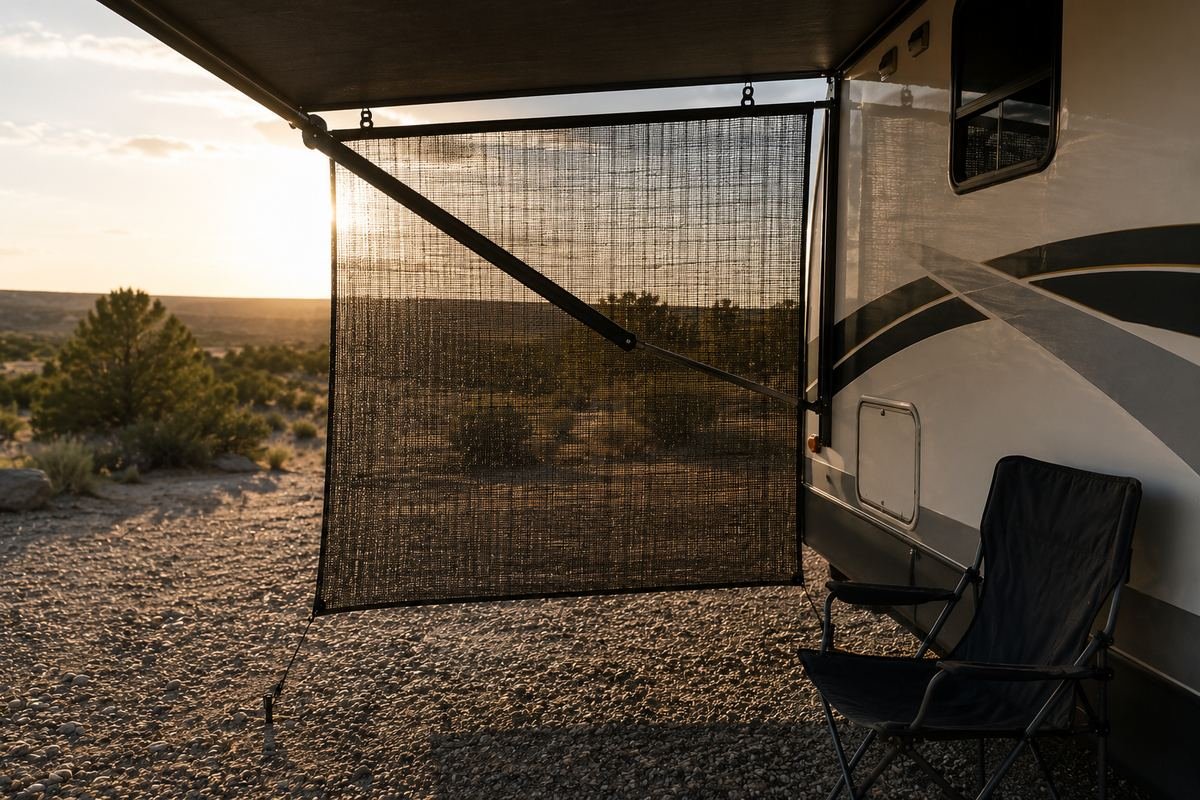
Your awning maker may tell you not to fit one at all
This is the thing to read before you spend anything, and no page selling these mentions it.
Dometic's own owner's manual for the WeatherPro awning says, in the safety section: don't attach or hang any objects from the awning or tie the awning down. Every shade in this article attaches to the awning and stakes to the ground, which is both of those things at once.
Carefree and Lippert don't say it that directly, but neither one says anything else either. Carefree's Paramount manual tells you not to leave the awning out unattended or when wind or rain is expected, and warns that the effects of wind on an awning are unpredictable. Lippert's Solera manual says to retract fully in high wind or heavy rain. None of the three publishes a single word about accessories, compatible or otherwise.
So here is where that leaves you. A mesh screen adds surface area to a structure the manufacturer already treats as fragile in wind, and at least one manufacturer forbids hanging anything on it at all. That doesn't make these products useless, and thousands of people run them without incident.
What it means in practice is two things. Take the shade down whenever you leave the site, and take it down before weather arrives rather than after it starts. And if the wind does damage the awning while the screen is on it, expect to pay for the repair yourself, because Dometic states plainly that damage caused by wind and rain isn't covered by warranty. If it does happen, our RV awning repair guide covers which tears you can patch yourself.
If your awning has a wind sensor, know what it's set to. Dometic ships the WeatherPro with an 18 mile an hour preset, adjustable between 12 and 24, and it retracts the awning on its own. A shade zip-tied on at both ends when that happens is how a screen gets destroyed and a roller gets bent.
What the mesh numbers mean
Three products, three percentages, and they aren't measuring the same thing.
- Tentproinc says it blocks about 86 percent of UV, and in the next line says about 86 percent of the sun's light. Those are different properties, and it would be a coincidence for both to be 86 percent.
- ShadePro says its open weave cuts about 85 percent of sunlight on its own site, and 87 percent on some of its retail listings, which is a light figure and not a UV one either way.
- EZ Shade says 85 percent UV block.
For anything solid you have to go past the shade makers to the people who weave the cloth. Phifer publishes real specifications for SunTex 80 and 90: an openness factor of about 25 percent and about 75 percent UV blockage for the 80, and about 10 percent openness with about 90 percent UV blockage for the 90. Twitchell publishes that Textilene 80 and 90 block up to 80 and 90 percent of the sun's rays.
Two things follow from that. Openness and blocking work against each other, so the tighter the weave the less you see out and the less air moves through. And a shade advertising a number in the mid eighties is somewhere between those two standard cloths, which is the range where you keep a view and still get real shade. Nobody in this category publishes which cloth they use.
How does an RV awning shade attach?
Every shade sold for the front of an awning assumes the same thing: that your roller tube has a second, empty groove running along it beside the one holding the awning fabric. That is the standard fitting, and it's why the makers all describe the same two minute job.
- Extend the awning most of the way, but not all the way. You want the roller reachable.
- Find the empty groove in the roller tube. On most RVs it faces down and slightly out when the awning is extended.
- Feed the shade's poly cord into the open end of that groove and slide the panel along until it's centered. With two people, this takes a minute rather than ten.
- Extend the awning the rest of the way, which pulls the shade down with it.
- Stake the bottom edge out and tension the bungees so the panel is taut and not flapping. A loose screen wears at the seams and makes noise all night.
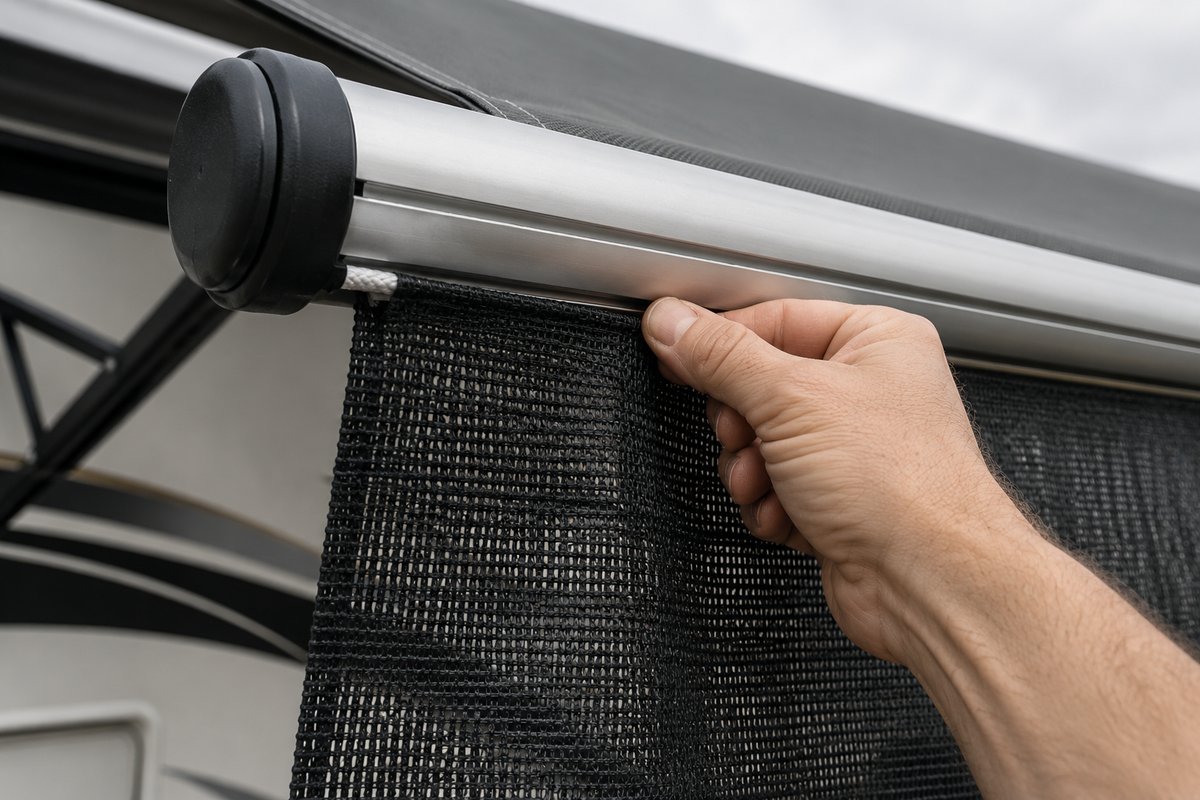
If your roller has no spare groove, none of these manufacturers publish a method for fitting a shade. We checked Tentproinc, ShadePro, EZ Shade and Camco, and all four assume the channel exists. Camco's kit is the closest thing to an answer, because it hangs and stakes rather than threading into anything.
Can you roll the awning up with the shade still on it?
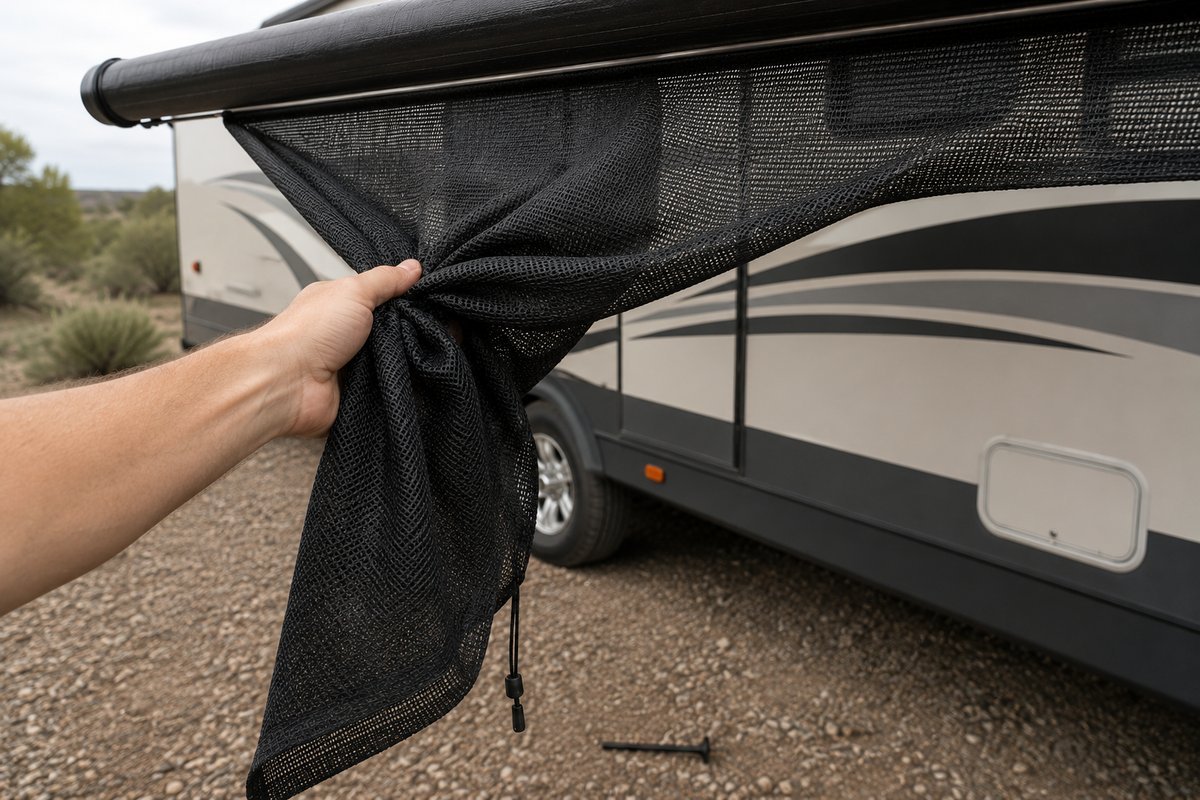
Camco is the only maker in this set that answers directly, saying its shade can retract like a curtain while still installed in the awning channel. Everybody else designs around taking it off: ShadePro's whole selling point is a zipper, and EZ Shade fits a heavy zipper for the same reason.
Treat that as the answer. Unzip or unthread the shade before the awning comes in. Rolling a mesh panel and its cord into the roller tube along with the awning fabric puts a lump in a wrap that's supposed to be flat, and the awning manufacturers say nothing about it because they never planned for it.
What size do you need?
Measure the awning, not the trailer, and expect the shade to be shorter than you think.
Tentproinc's own ordering guide gives the rule: a 16 foot awning takes a 15 foot 3 inch shade. That nine inch difference is the arms. Measure from the center of one awning arm to the center of the other, or measure the awning fabric itself, and buy to that.
Drop height is the second number, and it's sold in whole feet, commonly 6 through 9. The right one depends on how high your awning sits and whether you want the panel to reach the ground or stop short of it. Nobody publishes a recommended ground clearance, which is a gap, so the practical answer is to measure from the awning track to the ground at your usual extension and subtract a few inches so the bottom edge isn't dragging in the dirt.
What it does not do
It doesn't cool the air. Every maker in this set claims lower temperature under the awning and not one of them publishes a figure, in degrees or otherwise. Shade feels cooler because you're out of direct sun, which is real and worth having, and it isn't air conditioning.
It doesn't stop wind, whatever the packaging says. Tentproinc's listing claims the screen reduces wind and breaks the force of a cross wind. Set that against Dometic telling you not to hang anything from the awning at all, and decide which of the two has more to lose by being wrong.
It doesn't give you privacy at night. Mesh works one way: people on the darker side can see out to the brighter side. During the day you see out and passers by don't see in. After dark, with your lights on, that reverses completely.
What it comes down to
If the sun comes at you from the front, a single mesh panel in the roller groove fixes it for the price of a tank of gas, and the Tentproinc is the simplest of them. If you set up and pack down constantly, pay a little more for the zipper. If the problem is the late afternoon, the panel you need is the side one.
Then take it down when you leave the site, because the manufacturer of your awning would rather you had never hung anything on it in the first place.
Quick Answers
How does an RV awning shade attach?
Most slide a poly cord sewn into the top edge into the spare groove on the awning roller tube, then stake the bottom edge to the ground with bungees. ShadePro's version leaves a permanent insert in the groove and zips the shade body onto it.
How much sun does an RV awning shade block?
Makers claim 85 to 87 percent, though they mix up UV blocking and light blocking in their own copy. The fabric weavers publish firmer numbers: Phifer's SunTex 90 is about 10 percent openness and roughly 90 percent UV blockage.
Can you retract the awning with the shade attached?
Camco says its shade can retract while still in the channel. Every other maker designs it to come off first, which is why zippers exist on these. Take it off before the awning comes in.
What size RV awning shade do I need?
Buy to the awning, not the trailer, and expect it to be shorter than the awning. Tentproinc's guide puts a 15 foot 3 inch shade on a 16 foot awning, the difference being the arms.
Is it safe to hang a shade on an RV awning?
Dometic's owner's manual says not to attach or hang any objects from the awning. Carefree and Lippert publish nothing about accessories at all. Take the shade down when wind is expected, and know that wind damage isn't covered by the awning warranty.
Does an awning shade give privacy at night?
No. Mesh lets people on the darker side see out, so it gives privacy during the day and reverses after dark once your lights are on.