
A brake controller wiring harness is a plug-in adapter that connects a trailer brake controller to your truck's existing wiring, so you don't have to cut into anything. Underneath it, the wiring is always the same four wires: black for battery power, white for ground, red for the brake light signal, and blue for the output that applies the trailer brakes. It's one piece of the larger system covered in the RV towing guide.
Which harness you need depends on the truck, not on the controller you like the look of. Buy before you check, and you can end up with a part that fits the truck and not the controller, or with a harness for a truck that already had a brake controller built into the dash. Get the four wires right and almost any controller will work. Get one wrong, and the likely result is trailer brakes that do nothing, or a truck electrical fault that's expensive to chase, which is the territory covered in diagnosing a brake controller that has stopped working.
Quick answer
A brake controller has four wires: black to the battery via a 30-amp circuit breaker, white to ground at the negative battery terminal, red spliced into the brake light circuit, and blue running to the trailer's brake wire at the 7-way connector. Power and ground go straight to the battery, never to the existing wiring, because the brake controller can draw more current than a light circuit is rated for.
Table of Contents
The four wires, one at a time
A brake controller wiring diagram looks the same whatever you're installing, whether that is a basic time-delay unit or a proportional controller that reads the truck's own braking. The colors below are CURT's, and they match what you will see on most harnesses sold in the US.
Black: battery power
The black wire is the controller's power feed and must go straight to the battery, not to an accessory circuit or a fuse box tap. CURT's own installation instructions are direct about why: "connect the black wire to the 'AUX' side of the 30-amp circuit breaker", with that breaker wired from the black wire to the battery on 10-gauge wire.
A brake controller can draw real current, especially a proportional one working four trailer brakes on a hill. A wire sized for a dome light or a radio isn't sized for that.
White: ground
The white wire is ground, and CURT's instructions call for it to land on "the negative battery terminal using a ring terminal," not on a body bolt or an existing ground point. A shared or corroded ground is one of the most common causes of intermittent brake controller operation, because the controller interprets it as a fault even when the actual connection is only marginal.
Red: the brake light signal
The red wire tells the controller when the brake pedal is pressed, and it splices into the truck's stop lamp switch wire. Miss this connection and the controller has no idea the brakes are being applied. CURT states it directly: "The brake light connection (red wire) is still required to activate the Assure™ brake controller." Nothing about that requirement changes across brands. A controller with power, ground, and a trailer connection but no brake signal won't apply the trailer brakes when the pedal is pressed.
Blue: brake output to the trailer
The blue wire is the one that does the actual work. It carries the controller's output down to the 7-way connector and out to the trailer's brake magnets. CURT's instructions: "Run a 10-gauge blue wire from the tow vehicle's trailer plug 'brake' terminal to the brake controller." Blue is the brake wire in both color standards used in 7-way connectors today, as covered below.
Why not just splice into whatever wire is closest? CURT's installation sheet answers that directly: "The brake controller's positive (with 30-amp circuit breaker) and ground wires must be connected directly to the tow vehicle's battery using 10-gauge minimum stranded wire. Connecting to existing wiring or an alternate ground may damage vehicle circuits, lead to failure of the brake controller module, loss of trailer brakes or vehicle fire."
The 7-way connector has two different color standards
A lot of online wiring diagrams get confusing here: there are two different color conventions for the 7-way RV blade connector, and they only agree on two of the seven wires.
| Function | Traditional | SAE J2863 |
|---|---|---|
| Electric brakes | Blue | Blue |
| Ground | White | White |
| Taillights | Green | Brown |
| Left turn/brake | Red | Yellow |
| Right turn/brake | Brown | Green |
| +12 volt | Black | Orange |
| Reverse lights | Yellow | Gray |
Blue is the brake wire, and white is ground on both standards, which is why those two rarely cause confusion. Everything else swaps. Work from the wrong chart on the other five, and the most likely result is crossed turn signals or taillights that don't match the truck side. That isn't a brake problem, but it's worth checking which standard your vehicle and trailer use before assuming. Taillight and marker wiring matters for one more reason on a trailer pre-wired for a backup camera, because the camera usually runs off that same circuit. The RV backup camera guide explains why that leaves it dark until the truck's lights are on.
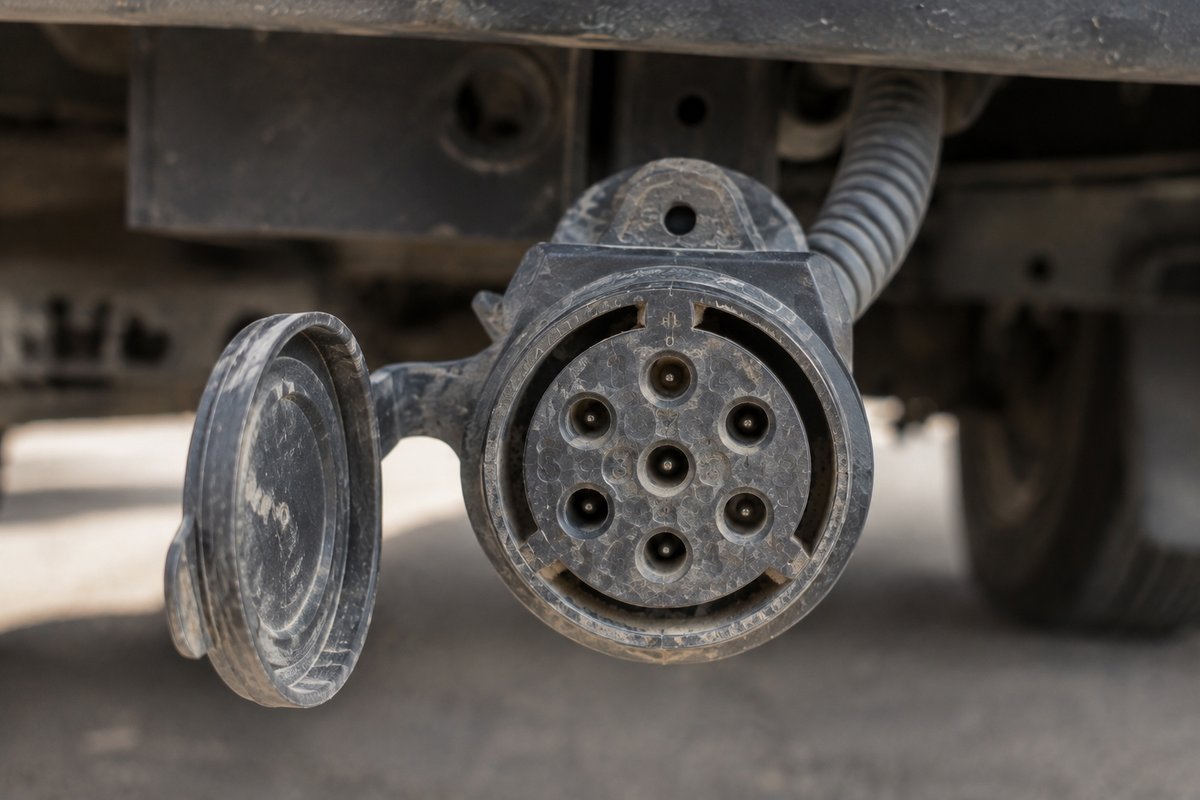
A 7-way socket does not mean a brake controller is installed
Many first-time trailer owners miss this. The truck has a 7-way plug. The blue pin is right there, so it seems reasonable to assume the brake controller wiring is already done. It usually isn't.
The 7-way socket wired to carry a brake signal is a capability, not an installation. The blue pin exists so that a signal can reach the trailer. Nothing puts a signal on that pin unless a brake controller is wired into the truck's cab and connected to it. A truck can be towing-package equipped, with the 7-way socket and the wiring run to a connector under the dash, and still have no controller mounted at all.
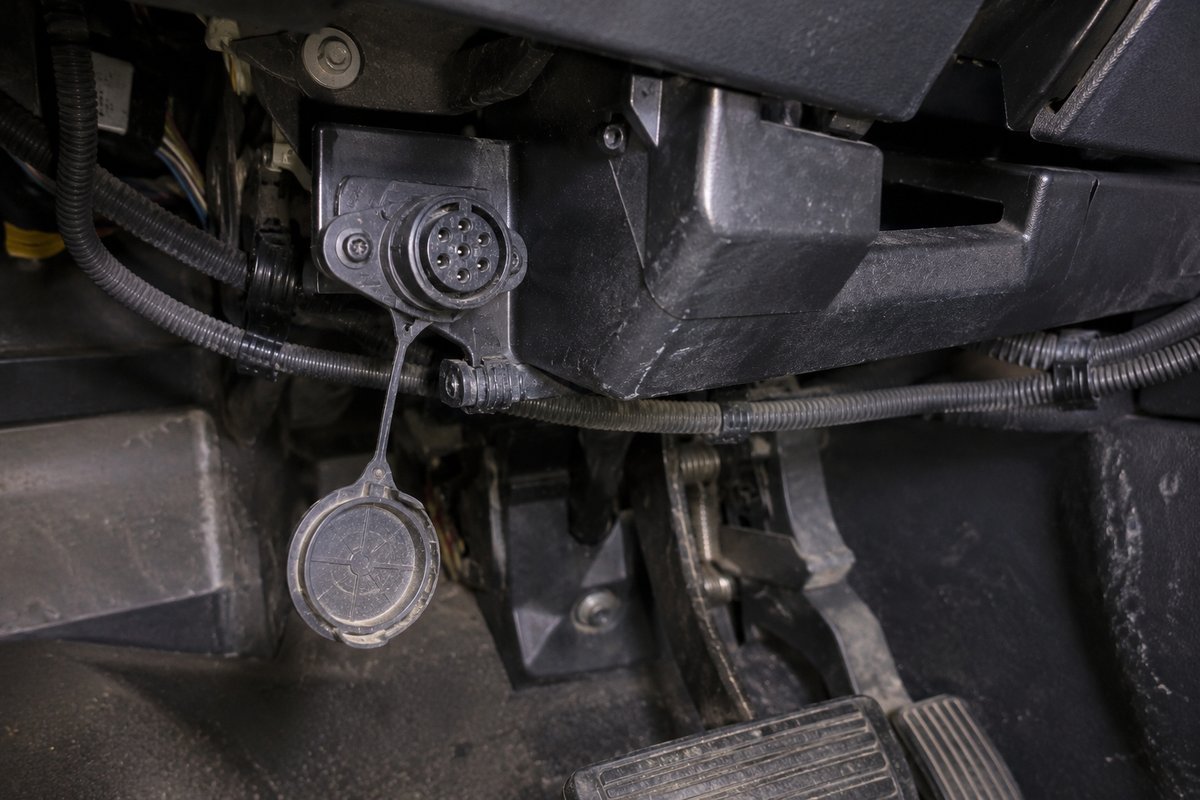
The way to tell: with the truck off and the trailer unplugged, look under the dash near the steering column for a capped plug that isn't connected to anything. If pressing the brake pedal does nothing to a test light on the blue trailer wire, there's no controller feeding it yet.
How do you know which wiring harness to buy?
Trucks sold with a factory tow package usually have the brake controller wiring already run to a connector inside the cab, with the wiring waiting under a cap. It saves the work of running the black, white, and red wires from scratch, which is most of the job.
There are only three answers, and you can usually get to yours in the driveway in about five minutes without spending anything. The truck already has a brake controller built into the dash, so you don't need anything. It has the wiring and a capped connector but no controller, which is exactly what a plug-in harness is made for. Or it has neither, and the power has to be run from the battery.
If the truck came with a factory brake controller option, even if it wasn't ordered, the plug is very likely there. If there's no factory tow package at all, there may be nothing to find, and a universal harness that draws directly from the battery, as CURT's instructions describe above, is the way in.
On a GM truck, the answer is printed on a label
GM is the one manufacturer that lets you settle this without opening anything. Every GM truck carries a label listing its RPO codes, which are the option codes it was built with, and it lives in the glovebox or near the spare tire. Two of them matter here. Z82 is the trailering package. JL1 is the integrated trailer brake.
If JL1 is on the label, the truck already has a brake controller in the dash, and you can stop reading. GM says so itself, in the upfitter bulletin covering aftermarket installs: "This information does not apply to trucks equipped with an integrated trailer brake control module (JL1)."
If Z82 is there and JL1 isn't, the truck has the wiring and no controller. That is the case a harness is for. GM puts the connection point at "the X611 Junction Block located under the I/P to the left of the steering column," where I/P means the instrument panel, and sells its own harness for it as part number 23184088.
What is waiting there isn't always a plug, though, and this is the part that surprises people. GM's own bulletin describes the provision as a harness carrying "a label ... that calls out the wire colors and each wire's function," which is a hint worth taking seriously. In some years, what is under the dash is labeled "wire," not a socket you can plug into.
The install guides etrailer publishes for the 2007 to 2013 full-size trucks describe exactly that: a bundle of wires taped together with white tape, sitting to the left of the brake pedal, joined to a controller with butt connectors rather than a plug. Their guide for the 1999 to 2006 trucks describes the opposite: a junction box under the dash where the adapter plugs into a numbered slot. The plug came back on the trucks built after that window.
So the accurate GM answer is that a plug-in harness is the right part on either side of that middle stretch and the wrong part inside it. Look before you order, rather than buying on the year alone.
If neither code is on the label, there's probably nothing waiting under the dash to plug into.
It's worth knowing what Z82 buys on its own, because it's less than most people assume. Chevrolet's own trailering guide describes it as providing "a trailer hitch platform and a 7-pin sealed connector at the rear bumper." A hitch and a socket. Nothing in that sentence is about brake controller wiring, and that is why a truck can have the 7-way on the bumper and still have nothing in the dash.
On everything else, you go and look
No other manufacturer publishes a code you can read off a sticker, so the check is physical. The connector is usually capped and hanging loose rather than built into anything, which is why people walk past it on the first try.
| Truck | Where the connector sits | What the maker calls it |
| Chevy Silverado, GMC Sierra | Under the dash, to the left of the steering column | X611 junction block |
| Ford F-150, Super Duty | Behind the center-left dash trim panel, then the storage bin lifts out | Trailer control harness electrical connector |
| Ram 1500, 2500, 3500 | Gray four-way connector on the right, where the knee panel attaches. A gray two-way connector sits at the top of the gas pedal | Not named |
| Nissan Titan, Armada, Frontier | Nissan confirms the truck is pre-wired but doesn't publish where | Not named |
| Toyota Tundra, Tacoma | Toyota publishes no location we could reach | Not named |
One thing that will save a Ford owner an hour: the location isn't in the owner's manual. We checked the 2025 F-150 manual, the 2025 Super Duty manual, and an older Super Duty owner's guide, and none of them mention the aftermarket connector. They cover the factory integrated controller and stop there. The location above comes from Ford's accessory installation instructions, which is a different document.
The Ram locations come from Ram's body builder documentation for the 2014 and 2015 trucks. The dash has changed since, and we couldn't find the same document for the current generation, so treat that one as a starting point rather than a certainty.
Toyota and Nissan are harder to pin down. Nissan states in its towing guide that "Armada, Frontier, Pathfinder, Titan, and NV vehicles are pre-wired to accommodate most popular electric trailer brake controllers," which indicates the wiring exists without specifying where it comes out. Toyota publishes nothing we could reach. On both, the harness maker's fit guide ends up doing the job the truck maker should have done.
The harness fits the truck, but does it fit the controller?
A vehicle-specific harness solves the truck side of the wiring: it matches the factory plug, carries the right wires, and usually needs nothing more than a socket to click into. What it doesn't automatically solve is the controller side, and that is where people get caught after already doing the truck-side work.
A brake controller wiring harness has two ends, and the truck end is only half the problem. The plug on the controller end isn't shared across brands, and the clearest evidence is that manufacturers sell adapters to work around it. CURT sells one adapter, part 51520, described as designed to let competitor harnesses run a CURT controller, and a single part covers Tekonsha, Reese, Draw-Tite, and Pro Series. Those four are all the same parent company. REDARC has to sell three separate adapters, one each for CURT, Tekonsha, and Hopkins.
Read those two facts side by side, and the pattern is plain. One plug shape per corporate family, and no plug shared between families. Nothing forces them to agree, either. The SAE standard for the seven-position trailer connector covers the socket on the bumper, not the plug under the dash, and none of the standards RVIA has adopted covers it.
Before buying a harness, check that it's rated for the specific controller going in, not only the truck. If a harness and controller don't share a plug pattern, the fix is usually a short adaptor rather than rewiring, but it's a part to buy on top of the harness rather than something included with it.
What if the truck has nothing to plug into?
If there's no factory connector, the harness stops being a plug and becomes a wiring job. Power and ground for the controller come straight off the battery rather than from a tap in the fuse box, and that run needs its own protection.
This is one of the few places where the manufacturers openly disagree, and it's worth seeing before you buy a kit. CURT's install sheets call for a 30-amp circuit breaker and a minimum of 10-gauge stranded wire back to the battery. Hopkins' universal kit ships with a 20-amp fuse and 12-gauge wire. Same job, two manufacturers, different numbers, and neither one explains the gap.
We aren't going to tell you which is right, because neither publishes the reasoning behind its figure. What is fair to say is that the heavier of the two costs slightly more, and that a controller pulling hard on a loaded trailer down a grade is the wrong moment to discover the supply was marginal. Whichever kit you buy, follow the numbers in its own instructions rather than mixing the two.
This is also the point where plenty of people stop and pay somebody, and that is a reasonable choice. Running a new power line means getting through the firewall and working at the battery terminal. If that isn't work you have done before, an hour of shop time is money well spent, and the job is common enough that any trailer shop has done it many times.
Do you need a brake controller?
Whether trailer brakes, and by extension a brake controller, are legally required depends on the trailer's weight and on the state, not on federal commercial trucking rules. The federal regulations that govern semi-trailers and commercial carriers specifically exempt non-commercial personal towing, so they aren't the right source to check.
State requirements vary more than most people expect. The RV Industry Association's state-by-state summary puts the threshold as low as 1,000 pounds GVWR in North Carolina and as high as 4,500 pounds in Texas, with most states somewhere in the 1,500 to 3,000 pound range.
| State | Trailer brakes required above |
|---|---|
| North Carolina | 1,000 lb GVWR |
| Nevada | 1,499 lb GVWR |
| California | 1,499 lb GVWR |
| Mississippi | 2,000 lb GVWR |
| Ohio | 2,000 lb empty weight |
| Alabama, Connecticut, Michigan | 2,999 to 3,000 lb GVWR |
| Rhode Island | 3,999 lb GVWR |
| Illinois, Louisiana | tiered, 3,000 and 5,000 lb |
| Texas | 4,500 lb GVWR |
In practice, this rarely changes anything for a travel trailer owner. Nearly every travel trailer on the road today, empty or loaded, meets all of these thresholds, which means it needs brakes and a controller regardless of which state it's registered in or towed in. The real value of checking is confirming that a smaller utility or cargo trailer, which might be light enough to skip brakes in one state, still needs them the moment it crosses into a stricter one.
What to buy
What you buy follows entirely from which of the three cases your truck is in, so run that check before you order anything. Getting this wrong is how people end up with a harness that fits the truck and not the controller, or a controller they never needed.
The two that do the actual work. If the truck has a factory connector, you want a harness that plugs into it. CURT's Quick Plug range covers most common truck makes, and Tekonsha, Reese, and Hopkins publish their own equivalents. The Reese 8506911 is the long-standing generic version of this, with a factory connector on one end and a brake control plug on the other, and it has the review history to back it up.
If the truck has nothing to plug into, none of these is what you need. That job requires a universal wiring kit that supplies its own circuit breaker and heavy-gauge wire back to the battery, and the numbers to follow are the ones printed in the kit's instructions.
Worth having if your parts come from different families. An adapter between a harness and a controller of different brands is a real part rather than an upsell, and it's far cheaper than replacing either end. The CURT 51520 is the clearest example, because one part connects Tekonsha, Reese, Draw-Tite, or Pro Series harnesses to a CURT quick-plug controller. Read its own exception before you order, though: CURT states it does not work with their Echo controllers. Tekonsha's 7894 pigtail kit does a similar job from the other direction and lists the exact controllers it fits, including the Prodigy P3 and P2 and the Primus IQ, but stock on it runs thin.
Skip. Anything whose listing title has to name somebody else's part number to explain what it is. Search any real brake controller part number, and most of the first page comes back as replacements for it, usually with better star ratings than the genuine part, because a cheap product that has been selling a long time collects reviews faster than a good one. Buy from the manufacturer's own storefront, and the problem goes away.
What it comes down to
Choosing a brake controller wiring harness comes down to one question asked in the right order: what did the factory already put in the truck? On a GM truck, the label in the glovebox answers it. On the others, it's five minutes under the dash with a flashlight. Answer that first, and the right part is easy to choose.
The brake controller wiring diagram underneath all of it is four wires, and three of them rarely cause trouble. Black and white go to the battery on adequately sized wire, red taps the brake light circuit, and blue does the actual work. A 7-way socket with a blue pin proves the truck can carry a signal. It takes an actual controller, wired to both the truck and the trailer, to put one there.
Quick Answers
How do you know which wiring harness to buy?
Start with the truck rather than the catalog, because there are only three answers. The truck already has a brake controller built into the dash, so you don't need anything. It has the wiring and a capped connector but no controller, which is what a plug-in harness is made for. Or it has neither, and power has to be run from the battery.
Do you need a brake controller if the truck has a 7-pin plug?
Yes. A 7-way socket wired to carry a brake signal is a capability, not an installation. The blue pin proves the truck can carry the signal, and it takes an actual controller, wired to both the truck and the trailer, to put one there.
Do you need a brake controller?
That depends on the trailer's weight and on state law, not on federal commercial trucking rules, which specifically exempt non-commercial personal towing. State thresholds run from 1,000 lb GVWR in North Carolina to 4,500 lb in Texas, and nearly every travel trailer clears all of them, so a controller is almost always required.
How can you tell if a GM truck already has a brake controller?
Read the RPO code label, which lists the options the truck was built with. It's in the glovebox or near the spare tire. JL1 is the integrated trailer brake, so if it's on the label, the truck already has a controller and doesn't need a harness. Z82 without JL1 means the wiring is there and the controller isn't, which is what a harness is for.
Does a brake controller wiring harness fit both the controller and the truck?
Not automatically, and the plug on the controller end isn't shared between brands. CURT sells a single adapter, part 51520, that covers Tekonsha, Reese, Draw-Tite, and Pro Series, all of which are part of one parent company, while REDARC has to sell three separate adapters for CURT, Tekonsha, and Hopkins. Check that the harness is rated for the specific controller going in, not only the truck.
What wire and breaker does a universal brake controller install need?
The manufacturers disagree, which is worth knowing before you buy a kit. CURT's install sheets call for a 30-amp circuit breaker and a minimum of 10-gauge stranded wire back to the battery, while Hopkins' universal kit ships with a 20-amp fuse and 12-gauge wire. Neither publishes its reasoning, so follow the numbers in the instructions for whichever kit you're working from rather than mixing the two.