
An RV air conditioner is the appliance that decides whether an August afternoon inside the trailer is bearable, and it's also the one most likely to trip a breaker on the way there. Almost everything written about choosing one is a chart with a BTU number next to a trailer length. That chart is the part of the advice with no manufacturer standing behind it.
This guide covers what the roof unit does, what the installation manuals say about power, airflow, and sizing, and where the familiar numbers run out. The individual pieces have their own guides, linked at the end.
Quick answer. Most travel trailers leave the factory with a single 13,500-BTU rooftop unit, and 15,000 BTU is the usual upgrade. Running draw is around 12 to 13 amps, and that isn't the number that causes trouble. The trouble is the fraction of a second at startup, when a fixed-speed compressor pulls 52 to 70 amps. That figure is why the unit runs happily on a campground pedestal and stalls a small generator, and it matters more than anything else on the spec sheet.
Table of Contents
How does an RV air conditioner work?
It doesn't make cold. It moves heat out of the trailer and vents it to the outside air, which is why the whole appliance sits on the roof rather than in a cabinet. Dometic describes it as a refrigerant that removes heat from the space and releases it outside, and the same circuit pulls moisture out of the cabin air as it passes.
The box on the roof holds both halves of that job. One coil sits in the air coming up from the cabin and removes heat from it. The other sits in the outdoor air and dissipates that heat, which is why the top of the unit is mostly fan and grille. Cooled air goes back down through the ceiling, and the water that condenses on the indoor coil drips off the roof. That puddle beside the trailer on a humid afternoon is the air conditioner working, not leaking.
The part on the ceiling is sold separately
The chassis on the roof isn't the whole appliance. The interior half is a distinct component, either an air distribution box with adjustable louvers and its own controls, or a plain return grille wired to a wall thermostat. Dometic sells its 15,000 BTU units on that basis, with the distribution box or control kit called out as required for installation. It's worth knowing before you price a replacement, because ordering the rooftop unit alone doesn't get you a working air conditioner.
Ducted or non-ducted: what's the difference?
Non-ducted means the cooled air drops straight out of the box in the ceiling, in one place. Ducted means it leaves the unit through channels built into the roof and comes out at registers spaced along the length of the trailer. Most rooftop units are sold to do either, with the ceiling half deciding which one you end up with.
The ducted version carries real requirements. Dometic's installation manual for the Blizzard NXT calls for a duct cross-section of at least 21 square inches, total duct length between 15 and 40 feet, four to eight registers, and R-7 insulation on the ducting. Those are the numbers the coach builder worked to. They're also why a duct system laid out around a 13,500-BTU unit doesn't automatically suit a larger unit dropped into the same hole.
What size RV air conditioner do you need?
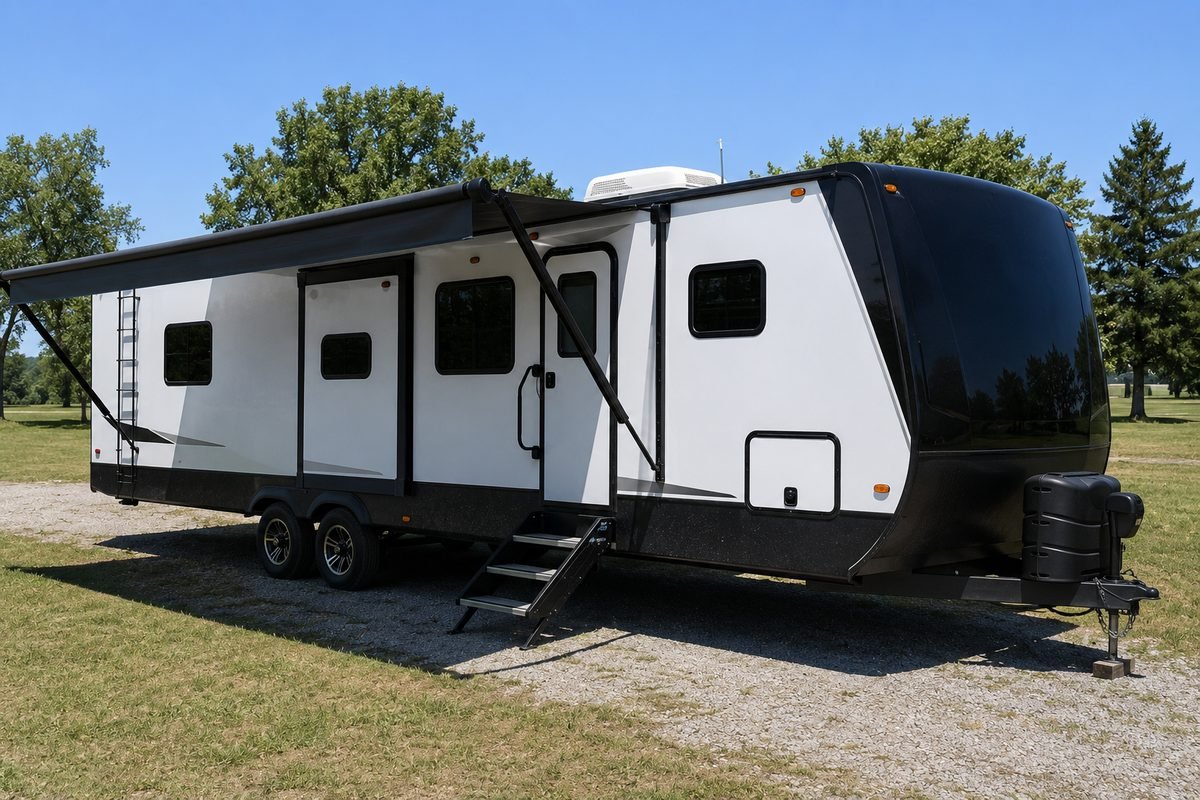
Rooftop units are sold at 11,000, 13,500, 15,000, 16,000, and 18,000 BTU. The 13,500 is what most travel trailers came with. The 16,000 and 18,000 units are recent arrivals, coming from newer names in the category rather than from the two companies that have been building these for decades, whose published lineups stop at 15,000.
What manufacturers publish about sizing
This is the part worth slowing down for. The chart everyone repeats, the one putting 13,500 BTU against trailers up to about 30 feet and 15,000 against anything longer, doesn't come from a manufacturer.
None of the installation manuals or support documents we checked include a BTU-per-foot or BTU-per-square-foot table. That list includes Dometic's manuals for the Brisk II, the Blizzard NXT, and the Penguin II. It also includes Coleman-Mach's 45000 and 48000 series manuals and service literature, and the published documentation for Advent Air and GE. What the Blizzard NXT manual says instead is that cooling capacity depends on the RV's heat gain. That is accurate, but it doesn't help much when you're trying to pick a size.
The closest thing to a length figure any of them publishes sits on marketing pages rather than in manuals. Fogatti puts its 16,000 BTU unit at RVs up to roughly 36 feet long and about 600 square feet, and says in the same sentence that results depend on insulation, sun exposure, and climate. Dometic's category page allows that larger RVs may need more than one unit. Neither is an engineering table.
So accurate sizing advice is simpler than the chart. Heat gain depends on how much roof and wall area the sun hits, how well the trailer is insulated, how many windows it has, and how many are shaded. A 26-foot trailer parked broadside to full sun in Arizona is a harder job than a 34-foot one under trees in Michigan, and no chart organized by length knows the difference.
What you can act on is simpler. If the unit you have keeps up everywhere except the worst two weeks of the year, size isn't your problem. If it never catches up anywhere, more BTU is one answer, and shade, a second roof vent fan, and reflective window covers are the cheaper ones to try first.
Why the startup surge matters more than the running draw
A 15,000-BTU unit draws about 13 amps. That is the number on the spec sheet, and the one people plan around, and it isn't the number that causes trouble.
The trouble is locked-rotor amps, which are the current the compressor draws at the instant it starts, before the motor is turning. Dometic publishes the figure model by model in its installation manuals: 58 to 60 amps on the Blizzard NXT, 63 amps on a Brisk Air 13,500, and 70 amps on a 15,000 BTU high-performance unit. Truma publishes the clearest version of the same thing for its Aventa: roughly 12 amps running, with a startup draw near 70 amps lasting 150 milliseconds.
Seventy amps for a sixth of a second is nothing to a campground pedestal, which is why the unit behaves perfectly on shore power. It's too much for a 2,000-watt inverter generator, which can supply somewhere around 16 amps and will simply stall trying.
That's also why the generator sizes manufacturers publish look large. Dometic specifies 3.5 kW for a single unit and 5.0 kW for two, and repeats it across the Brisk II, Blizzard NXT, and Penguin II manuals. Its older and smaller units list 2.5 kW and 4.0 kW. None of the Coleman-Mach documents we checked specify a generator size.
One more number from the same manuals decides what else you can run. Each rooftop unit is specified to be on its own 20-amp circuit with 12-gauge wire in both Dometic's and Coleman-Mach's installation instructions. On a 30-amp trailer, that's two-thirds of everything you have going to one appliance. The pedestal end of that is its own subject, and it's worth having a surge protector between the post and the trailer before you find out how good the campground wiring is. The 30 amp version is the one most travel trailers need.
What a soft start device changes
A soft start device sits between the power supply and the compressor, gradually bringing it up instead of all at once. Micro-Air, which makes the EasyStart, describes it as controlling the power going to the motor windings on each AC cycle, and puts the reduction in peak current at 50 to 70 percent. Its own product pages advertise up to 75 percent. Where a manufacturer's support documentation and its marketing disagree, plan around the support documentation.
The practical claim is that a 16,000 BTU compressor rated at 50 to 60 amps locked-rotor can be brought under 20 amps at start, which puts a 2,000-watt inverter generator back in play. Micro-Air adds an important caveat to its generator sizing notes. The minimum generator size assumes no other significant loads are running when the compressor tries to start. The microwave and the water heater element are exactly the sort of thing it means.
How cold should an RV air conditioner get?
There's a number that circulates as a test of whether your unit is healthy. It should cool to somewhere around 20 degrees below the outside temperature, people say, and if it doesn't, the unit is failing. That is a misreading of a real specification.
Coleman-Mach publishes the actual figure in two separate documents, and it's measured somewhere else entirely. Air leaving the unit runs 15 to 20 degrees cooler than the air entering it. Entering, not outside. The worked example in its 45000 series instructions makes it unmistakable: 80-degree return air produces 60 to 65-degree supply air.
That changes what the measurement tells you, and it turns a vague complaint into something you can check in five minutes. Hold a thermometer at the ceiling register, then at the return grille. A 15- to 20-degree split means the unit is doing its job, whatever the weather is doing. If the trailer is still sitting at 88 degrees with a healthy split, the unit is working but can't keep up with the heat. That is a heat-gain problem, and a larger unit is only one way to fix it.
Two limits are published and worth knowing. GE tells owners not to run in cooling mode when it's below 60 degrees outside, because the indoor coil can freeze. And none of the manuals we checked publish a maximum outdoor temperature or any altitude derating at all. Dometic's thermostat range of roughly 65 to 90 degrees is a setpoint range, not a limit on the weather, and it shouldn't be read as one.
What are the alternatives to a rooftop unit?
A rooftop air conditioner is the only option on this list that will hold a sealed trailer at a set temperature in real heat. Everything else does a narrower job, and some of them do a useful narrower job.
| Option | What it does | The catch |
|---|---|---|
| Rooftop, fixed-speed compressor | 11,000 to 15,000 BTU on 120-volt shore power | 52 to 70 amps at startup, so it needs shore power or a 3.5 kW generator |
| Rooftop, variable speed compressor | Same job with a compressor that ramps up instead of slamming on | New to the category, and the low startup claims sit on marketing pages rather than in published locked rotor tables |
| 12 volt rooftop unit | Runs off the battery bank with no generator and no pedestal | Dometic's RTX 2000 manual calls for a battery of 180 Ah or greater and lists draw up to 58 amps. Velit product page and manual state no minimum battery capacity |
| Portable unit | Cools one part of the trailer with no roof work | A single hose unit exhausts air it took from the room, which pulls outside air in behind it |
| Roof vent fan | A MaxxFan Deluxe is rated at over 900 CFM on a 2 amp service | Moves air, removes no heat. A different job, not a smaller version of the same one |
| Evaporative cooler | TurboKool claims 20 to 30 degrees of cooling on 4.6 amps at 12 volts | Its own pages advise against high average humidity, giving the limit as 70 percent in one place and 75 in another, and it needs a window or vent open |
The portable unit deserves a note, because the physics is against it inside a trailer, and the reason is documented, not just repeated by owners. The Department of Energy's test procedure rule sets it out plainly: pushing condenser air outside creates negative pressure inside, which draws unconditioned air back in through every gap, and the department concluded that net cooling is well below what the older industry method suggested. The published cooling capacity for a portable unit sold here is a seasonally adjusted figure, which is why it reads so much smaller than the number people remember.
What maintenance does an RV air conditioner need?
Less than most appliances on the trailer, and the filter is most of it.
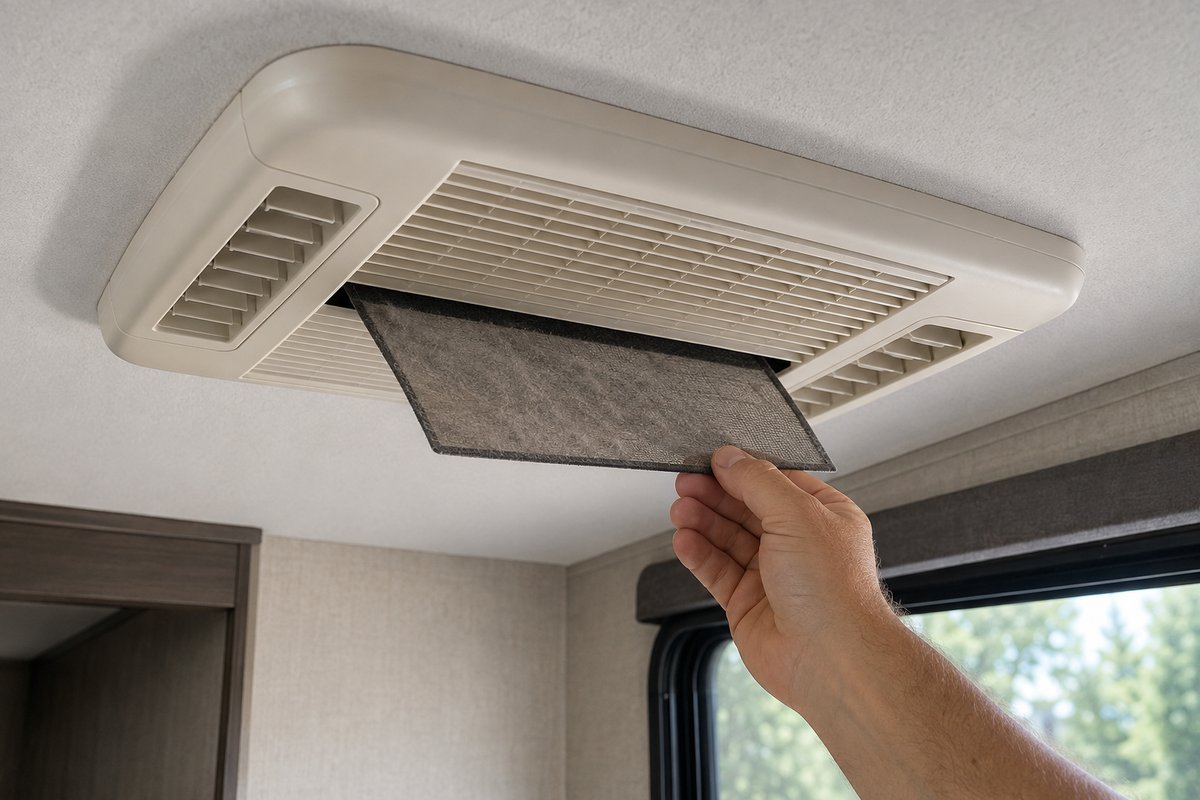
Dometic's Brisk II Evolution manual says to remove the return air filter and wash it in warm soapy water at least every two weeks of operation, then dry it and put it back. Coleman-Mach says at least every two weeks in use. Furrion says every four weeks, with an indicator light at 250 hours and replacement at twelve months. There's no single monthly rule. The three brands don't agree, and the interval to follow is the one in the manual for your own unit.
What happens when it's skipped is stated flatly. Dometic's instruction is never to run the unit without the filter in place, because dirt reaches the indoor coil and reduces performance over time. Coleman-Mach warns that running without a filter for extended periods leads to coil icing and damage to operating components. Neither is a warranty technicality. A plugged coil is the most common reason a unit that used to cool no longer does.
Two jobs people expect on the list aren't there. Dometic says its blower motor is lubricated at the factory and needs no service. Condenser coil cleaning appears exactly once across the documents we read, on Coleman-Mach's support pages, as a yearly job with a warning against pressure washers. Dometic and Furrion publish no owner procedure for it, and Furrion prohibits high-pressure cleaning of the unit outright. Treat that one as a job to have done, not a job to schedule.
One detail from Dometic's Penguin II High Capacity instructions is worth knowing before you close a register to force more air toward the bedroom. A unit running in cooling mode requires at least two distribution vents to be open. Close too many and the coil can freeze, which is the opposite of what you were trying to do.
Why is my RV air conditioner not cooling?
The manufacturers' own troubleshooting tables are shorter and simpler than what you will find on a forum, and they point at a handful of things. Work them in this order.
Airflow first. A dirty filter, closed registers, or a suitcase parked in front of the return grille all show up as poor cooling, and all three take a minute to rule out. This is the single most common cause and the only one on the list that costs nothing.
Frost on the coil. Dometic says frost on a small part of the coil isn't unusual, and tells owners to check the filter, raise the thermostat setting, and run the fan on its own until the coil clears. Coleman-Mach lists the causes as a thermostat set too cold on a cool night and clogged filters restricting airflow, and its own remedy is to run the fan on high until the coil clears.
A breaker that keeps tripping. Coleman-Mach's manual first points to abnormal starting or running current and second to the breaker itself. An extension cord too short for the distance is on its list, too, which is common at campsites where the post is farther away than the cord can safely reach.
Nothing happens at all. Check that the pedestal has power before anything else, then the trailer's own breaker, then the thermostat.
If none of those apply, the manufacturers stop providing instructions and tell the owner to call a service center. That isn't caution for its own sake, and the next section is why.
Where the work stops, and a technician starts
A rooftop air conditioner sits right where the two jobs this site won't walk anyone through overlap. It's a 120-volt appliance bolted through a hole in the roof.
The manufacturers say so themselves, and they're clear about it. Dometic's manuals state the unit must be serviced by a qualified service technician. Coleman-Mach says in capital letters that people who aren't qualified shall not install or service the equipment, and notes that some states require a license to do it. Furrion routes a damaged fan, damaged seals, and low voltage to an authorized service agent.
Two specifics sit behind that. The capacitor inside the electrical box retains a charge after the power is off, and it can hurt someone who opens the shroud without knowing it. And the four bolts clamping the unit down are what compress the roof gasket that keeps water out of your ceiling.
Dometic specifies 40 to 50 inch-pounds on those bolts, and Furrion specifies 40 on the Chill Cube, both with the gasket squeezed to about half an inch. Both publish that as an installation step rather than as owner maintenance. Coleman-Mach is the only one of the three that asks an owner to look at them at all, and it asks whether they're still tight, not for a torque wrench reading.
The line those manuals draw is a good one to copy exactly. What you can reach through the return grille, plus a look at the condensate drains, is yours. Everything on the far side of the shroud is a service call, and the roof itself is a separate thing to stay on top of, because a leak around an air conditioner is rarely the air conditioner's fault.
What do people get wrong most often?
- Buying BTU off a length chart. Nobody who builds these publishes one. Heat gain, not feet, is what the unit is fighting.
- Judging the unit against the outdoor temperature. The published split is between return air and supply air. Measured that way, many units accused of failing turn out to be fine.
- Closing every register but one. Two distribution vents open is the published minimum in cooling mode. Below that, the coil can ice over.
- Expecting a 2,000-watt generator to start a fixed-speed unit. It won't without a soft-start device, and waiting and retrying won't change that.
- Treating a heat pump as a furnace. Coleman-Mach states its heat pump doesn't operate below freezing. Dometic says the electric heat strip option is for taking the chill off a cool morning and won't heat the RV in cold weather.
- Waiting for a replacement date that no one has announced. See below.
That last one is worth its own paragraph. The figure that circulates is 10 to 15 years, and none of the manufacturer documents we checked specify an expected service life. What they will commit to is a 2-year warranty across Dometic, Coleman-Mach, and GE. Dometic's own manuals don't even agree on that, with one installation manual citing two years and another citing one, which is a decent argument for reading the paperwork that came with your specific unit instead of a number from a forum.
Quick Answers
How does an RV air conditioner work?
It moves heat out of the trailer rather than making cold, which is why the whole appliance sits on the roof. One coil removes heat from the air rising from the cabin. The other releases it into the outdoor air, and the water that condenses on the indoor coil drips off the roof.
What size RV air conditioner do you need?
None of the manufacturer manuals we checked include a BTU-per-foot sizing table, so the familiar length chart has no maker behind it. What the unit fights is heat gain, which depends on sun exposure, insulation, and shading rather than on trailer length.
How cold should an RV air conditioner get?
Coleman-Mach publishes a 15- to 20-degree split between the air entering the unit and the air leaving it, measured at the return grille and the ceiling register. That isn't a figure measured against the outdoor temperature, which is how it usually gets repeated.
What are the alternatives to a rooftop unit?
Twelve-volt rooftop units, portable units, roof vent fans, and evaporative coolers all exist and each does a narrower job. A roof vent fan moves air without removing heat, and an evaporative cooler isn't recommended where average humidity tops 75 percent.
What maintenance does an RV air conditioner need?
Mostly the filter. Dometic and Coleman-Mach both specify cleaning it at least every two weeks of operation, while Furrion says every four weeks with replacement at twelve months. Running without a filter lets dirt reach the coil and permanently degrades performance.
Why is my RV air conditioner not cooling?
Check airflow first: the filter, the registers, and anything blocking the return grille. Frost on the coil, a breaker tripping due to abnormal current, and an undersized extension cord are other causes the manufacturers list before they hand the job to a service center.
Where to go next
The rooftop unit is one key to staying comfortable in a trailer, and most of the others have their own guides here.
- Coleman RV air conditioners, matched to trailer length by BTU, with low profile and standard height compared
- RV thermostats, the control end of this system, and why a home thermostat won't do the job
- RV ceiling fans, for the cooled air that already made it into the trailer but hasn't reached the far end yet
- RV surge protectors, which are what stand between a campground pedestal and everything electrical you own, including this one
- 30-amp surge protectors and 50-amp surge protectors, if you already know which service your trailer has
- RV awning shade and screens, which is the cheapest way to cut the heat load the air conditioner has to fight
- RV roof sealant, because the air conditioner is bolted through the surface that has to stay watertight around it
- RV air conditioner covers, worth it for winter storage or a shaded site, optional otherwise
For more on keeping the inside of your RV comfortable, see our other Interior and Comfort guides.