
An RV thermostat looks like the one on the wall at home, and underneath it's a different device. It runs on a different voltage, and on most current trailers, it doesn't switch anything at all. That is why the smart thermostat in a box in your garage isn't going on the wall of your trailer.
This guide covers what makes the RV version different, what the wires do, how to tell yours has failed rather than the air conditioner, and what to buy when it has.
Quick answer. A home thermostat is built around a 24-volt AC control circuit. An RV thermostat runs on 12-volt DC from the coach, and on Dometic and Furrion systems, it communicates with the air conditioner over a data line rather than closing contacts. There's nothing for a Nest to wire to. Replacements have to match the equipment's brand, not just the shape of the hole in the wall.
Table of Contents
Is an RV thermostat different from a regular thermostat?
Yes, in two ways, and the second matters more than the first.
The voltage, which is the part people know
Home heating and cooling operate their controls at 24 volts AC. Honeywell publishes that figure for its low-voltage thermostats and for 120- or 240-volt line-voltage models. Either way, the thermostat is built around a transformer sitting in the furnace or air handler.
An RV works from the coach battery instead. Coleman-Mach specifies a 12-volt DC control circuit fed from the converter or the battery, drawing no more than 2 amps. A home thermostat needs 24 volts, and it needs them alternating rather than direct. A trailer supplies neither. The transformer that would have made that 24 volts is part of the furnace back at the house, and there's nothing in the coach doing the same job.
The bigger problem: on most trailers, it is not a switch
A home thermostat is a set of switches. It closes a contact, and the furnace runs. That is the whole idea, and it's why swapping one at home is a job anybody can do.
Current RV systems don't work that way. A Dometic single-zone thermostat connects with three wires: 12V+, COMM, and ground. COMM is a data line to a control box. Furrion uses the same idea with a pair of communication wires marked A and B alongside its 12-volt supply, and Micro-Air documents the same interface for the display it replaces.
So the thermostat is talking to the air conditioner, not switching it. There's no heat wire to close and no cool wire to close. Even with the voltage solved, a smart thermostat can't communicate on that data line and has no terminal to connect to.
So can you put a Nest in an RV?
No, and it's worth being precise about why, because the reason usually given online is only half of it.
The half everybody gives is the voltage. That one is real, and on its own it would only mean the Nest needs a different power supply. The half that settles it is the second section above: on a Dometic or Furrion system, the thermostat sends signals over a data line and isn't a switch, so there's no heat contact and no cool contact anywhere for a residential thermostat to close. Solve the voltage, and it still has nothing to connect to.
Two notes go with that. First, no manufacturer document checked for this article contains a sentence forbidding it. Dometic, Coleman-Mach, Micro-Air, and the rest simply publish what their equipment requires, and a residential thermostat doesn't meet those requirements. The case is built from their specifications rather than from a warning label.
Second, 12 volts isn't universal. Coleman-Mach's service manual for its 6633 series package units calls for a 24-volt AC thermostat, and Micro-Air labels its Coleman replacement as 12-volt DC only and not for 24-volt models. If you have a package or basement unit rather than a rooftop one, check before assuming. It changes which replacement you need. It doesn't change the answer about the Nest, because a 24-volt RV unit still lacks the common-wire or transformer arrangement that a smart thermostat expects, and its outputs are sized for RV relays.
What do the wires do?
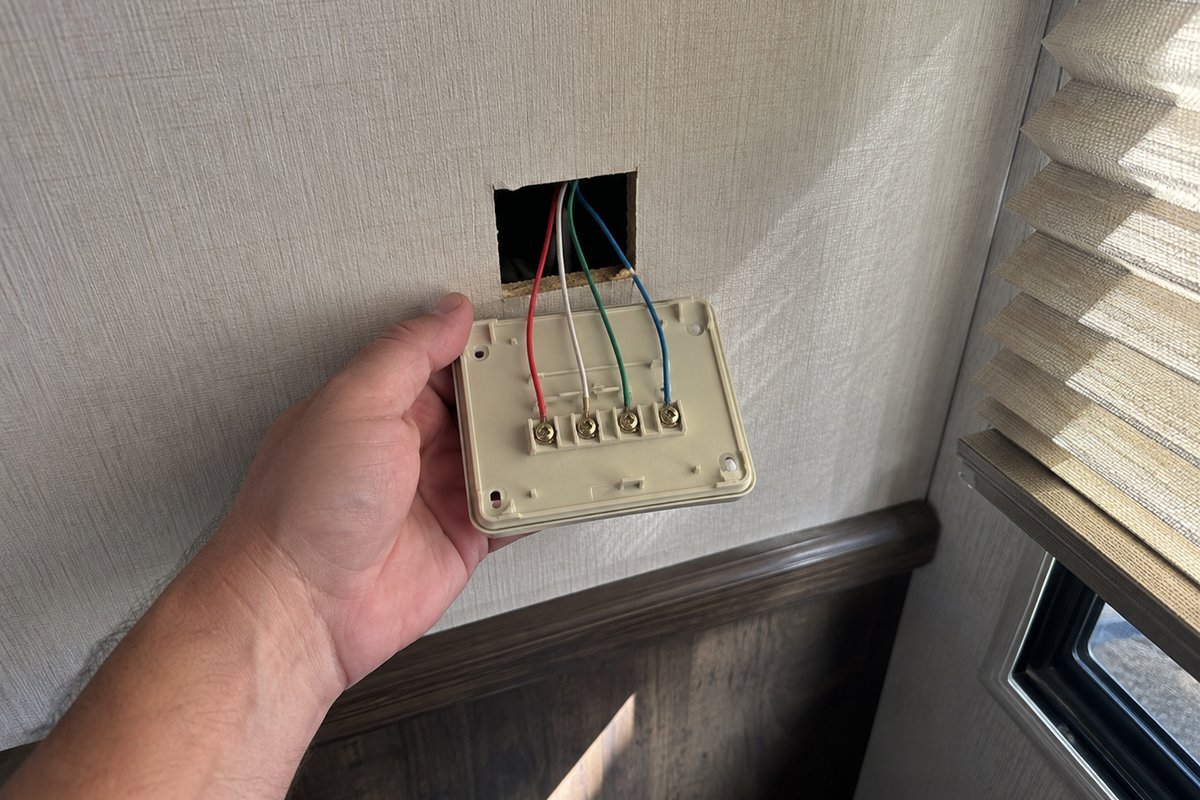
On a conventional RV thermostat, the kind that switches rather than communicates, Coleman-Mach labels the terminals R for the 12-volt input, B for ground, Y for the compressor, GH and GL for fan high and fan low, W for gas heat, and WHP for electric heat.
Those letters can mislead you. R, W, and Y are the same letters used on a home thermostat, and they mean something different here. Seeing familiar markings is what convinces people the parts are interchangeable, and they aren't.
The wiring itself is modest. Coleman-Mach calls for a minimum of 18-gauge, the negative routed directly from the converter or battery rather than picked up at a convenient chassis point, and a 2-amp fuse with the thermostat.
Single zone or multi zone?
A zone is one air conditioner and the area it serves. Most travel trailers have one rooftop unit, which makes them single zone by construction.
Dometic's Comfort Control Center 2 handles up to four zones, and its own wording is the useful part: it runs the appliances your vehicle manufacturer designed to heat or cool specific areas. The coach builder decided this when the trailer was built.
Which means a multi-zone thermostat won't give you multi-zone cooling. If there's one unit on the roof, there's one zone, and a more capable controller doesn't change that.
Analog or digital?
Analog is the slider and the mechanical switch. It does the same job through the same 12-volt logic, controlling the air conditioner's 115-volt circuits via 12-volt relays, and Coleman-Mach limits it to a furnace control circuit not exceeding 1 amp, compared with 2 amps for its digital units.
Digital adds three useful things. Error codes, which the section after next is about, and the most useful of the three. Automatic changeover between heating and cooling. And on some units, control from a phone.
One warning applies to both, and especially to analog. Coleman-Mach calls the thermostat a sensitive instrument and advises against mounting it in locations with unusual heating conditions, such as direct sunlight or heat-producing appliances. A thermostat on a sunlit wall reads the sun rather than the room, and runs the air conditioner accordingly.
Will any RV thermostat work with your air conditioner?
No, and this is how money gets wasted. RV thermostats are matched to the brand of the equipment they control.
Micro-Air states it in an installation manual rather than in marketing, which is the version worth trusting: its EasyTouch RV 351 is only for use in Dometic single-zone capacitive touch or single-zone LCD systems. Elsewhere, the company states plainly that not all RV thermostats are universally compatible and that a replacement must match the system type.
Compare the two terminal sets, and the reason is obvious. Dometic communicates over 12V+, COMM, and ground. Coleman-Mach switches through R, B, Y, GH, GL, W, and WHP. There's no correspondence between them, so there's nothing to match up wire by wire. No manufacturer document states the prohibition in those words, but the two published wiring tables leave no room for it to work.
Aftermarket isn't the same as universal. Micro-Air builds a different model for each host system: a 351 for Dometic, a 352 for Coleman-Mach, a 353 for Furrion. Buying the right brand doesn't help if you buy the wrong model within it, so match the display you already have before ordering. If your roof unit is a Coleman-Mach, our Coleman RV air conditioner guide covers the three main models.
How do you tell the thermostat failed and not the air conditioner?
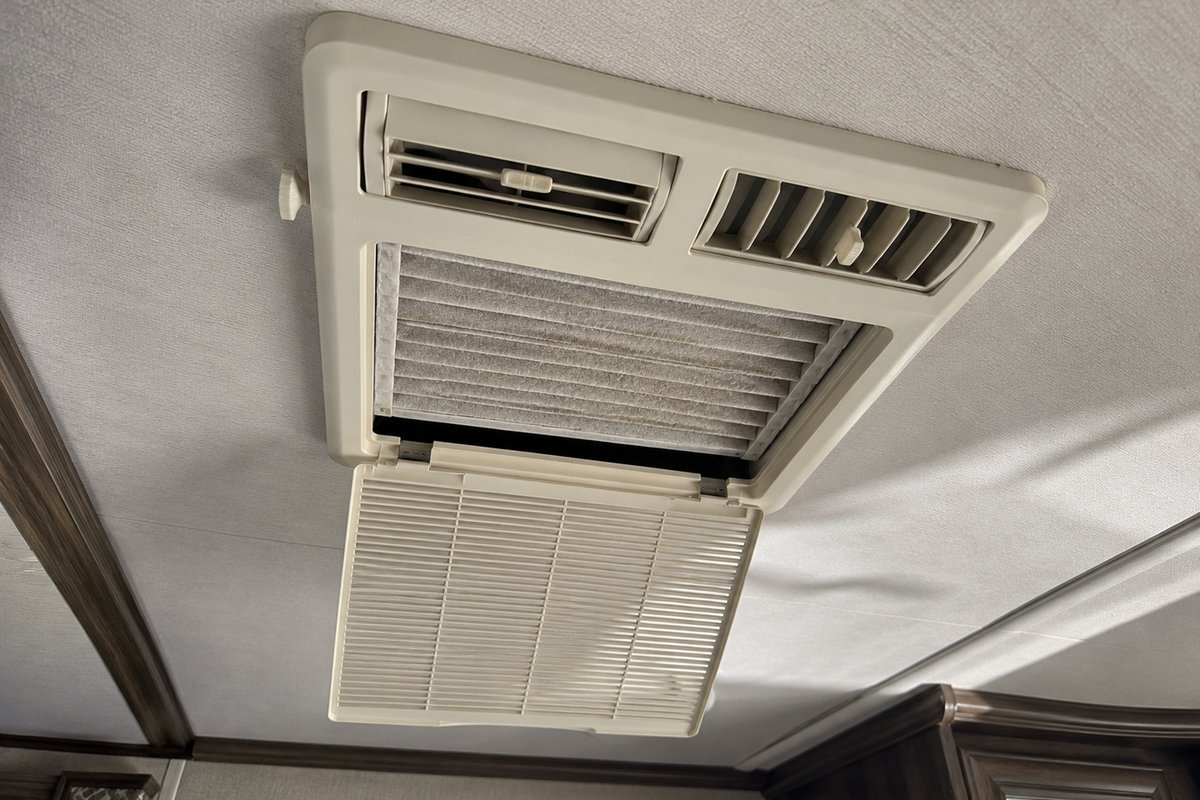
Start with the cheapest test there is, and it needs no tools.
A dead display is a 12-volt problem. A working display with a dead compressor is a 120-volt problem. Dometic's own pre-service checklist points at two separate fuses, one on each side, and those two halves are the whole system in miniature. The thermostat lives on the low-voltage side. The air conditioner lives on the high-voltage side.
If the display works, Dometic units report error codes, and two of them settle the question outright:
- E1 is a loss of communication between the thermostat and the power module boards. That points to the thermostat and the wire running to it.
- E2 and E3 are open or shorted on an indoor temperature sensor.
- E4 and E5 are the outdoor and freeze sensors.
- E7 is a loss of 120-volt power to the boards. That isn't the thermostat. It's the supply to the air conditioner, which means the pedestal, the breaker, or the cord.
- E8 and E9 are invalid zone configurations. They're settings, not faults.
One thing you will find suggested elsewhere but not here. There's a popular trick of jumpering two terminals at the thermostat to see whether the compressor starts. No manufacturer documentation checked for this article publishes that as an owner procedure, so this article isn't going to invent one.
How long does an RV thermostat last?
Nobody publishes a figure. Fourteen documents across Dometic, Coleman-Mach, Micro-Air, ASA Electronics, and Lippert were checked for this article, and not one states an expected service life.
What they will commit to is a warranty. Micro-Air advertises a 2-year warranty on its EasyTouch line, and Dometic publishes a limited 2-year warranty covering air conditioners and heat pumps. However, its warranty terms document couldn't be opened for this article, so what that covers for a thermostat specifically isn't something to take on trust. Read the paperwork that came with your own unit.
Where the work stops
The thermostat sits on the 12-volt side, which is the side of the line this site is comfortable with. The air conditioner it talks to isn't.
The manufacturers are direct about it. Coleman-Mach says the thermostat should be installed only by trained technicians, and its service manual states in capital letters that unqualified people shall not install or service the equipment, adding that some states require a license. Dometic says its units must be serviced by qualified service personnel.
If you do take the wall plate off, both supplies come off first. Disconnect the 120-volt cord and the positive battery terminal, not one or the other. There are 12 volts at the thermostat, and a nominal 120 at the roof, and the two aren't isolated from each other by anything you can see from inside.
Everything above the ceiling is a service call. The RV air conditioner guide covers where that line falls on the unit itself.
What to buy
Match the system first, then the features. Buying on features and then discovering the protocol doesn't match is the expensive way to do this.
The direct replacement. The Dometic Standard CT Single Zone is the like-for-like part for a single-zone Dometic system, sold in versions for cooling, furnace, heat pump, and heat strip, so the model has to match what your RV has. Dometic notes that a system initialization has to be performed after installation, which is worth knowing before the wall plate goes back on.
The upgrade, if you want app control. The Micro-Air EasyTouch RV range replaces the OEM display and adds Wi-Fi and phone control. The 351 is for Dometic single-zone systems, the 352 for 12-volt Coleman-Mach, the 353 for Furrion. Micro-Air is worth naming because it publishes real documentation, including its own compatibility limits, which is rarer in this category than it should be.
What to be careful of. Search results for RV thermostats are full of listings whose titles are someone else's part number, along the lines of a number followed by the words "compatible with Dometic." Several different sellers list the same numbers. If a listing has to name another company's part number to describe itself, it's usually a generic copy rather than the original part. And a residential smart thermostat will appear in those same results, which is worth remembering given everything above.
Both products named above were checked on the retailer before they were linked: the manufacturer's own storefront listing, in stock, and the buy button live at the time of writing. Availability changes, so treat the link as a starting point rather than a promise.
Quick Answers
Is an RV thermostat different from a regular thermostat?
Yes. A home thermostat is built around a 24-volt AC control circuit, while an RV thermostat runs on 12-volt DC from the coach. On Dometic and Furrion systems, it also communicates with the air conditioner over a data line rather than closing contacts.
So can you put a Nest in an RV?
No. Beyond the voltage, there's nothing to wire it to. A Dometic single-zone system uses 12V+, COMM, and ground, and a smart thermostat has no way to speak that protocol and no heat or cool contact to close.
Will any RV thermostat work with your air conditioner?
No. Micro-Air states in its own installation manual that its EasyTouch 351 is only for Dometic single-zone CT or LCD systems. Dometic and Coleman-Mach use entirely different terminal sets, so there's nothing to match wire-by-wire.
How do you tell the thermostat failed and not the air conditioner?
A dead display is a 12-volt problem. A working display with a dead compressor is a 120-volt problem. On Dometic units, error E1 points at the thermostat and its comms link, while E7 is a loss of 120-volt power to the air conditioner.
How long does an RV thermostat last?
No manufacturer publishes an expected service life. Fourteen documents across Dometic, Coleman-Mach, Micro-Air, ASA, and Lippert were checked, and none of them state one. Micro-Air gives a 2-year warranty on its EasyTouch line.
Single zone or multi zone?
The coach builder decided this when the trailer was built. Dometic says its controller runs the appliances your vehicle manufacturer designed to heat or cool specific areas, so one rooftop unit means one zone, and a multi-zone thermostat won't change that.
Where to go next
- RV air conditioners, the unit your thermostat is talking to, including what size you need and why the startup surge matters more than the running draw
- RV surge protectors, because low voltage at the pedestal is what kills the compressor the thermostat is trying to run
- 30-amp surge protectors, if you already know which service your trailer has