
The best RV solar panel kit for most owners is a 400 watt kit with an MPPT charge controller, such as the Renogy 400W Premium kit. In good sun it can produce more than a CPAP machine with a humidifier uses overnight, and RV electrical writer Mike Sokol suggests 400 watts of solar even for a couple running two CPAP machines. If you camp mostly at hookup sites and only need to keep batteries topped up, a 200 watt kit is enough. If you would rather not climb on the roof, a portable kit that plugs into your RV's solar port is the simplest option.
This guide is based on manufacturer manuals and spec sheets, US government solar data and published work by RV electrical experts. It also explains what a kit leaves out, how to size a system and how to install one safely. We have not installed or tested these kits ourselves.
Table of Contents
Our Picks at a Glance
- Best overall: Renogy 400W Premium Solar Kit, four 100 watt panels with a 40 amp MPPT controller
- Best starter roof kit: Renogy 200W N-Type RV Solar Panel Kit, with a wall-mounted 30 amp controller
- Best basic roof kit: ECO-WORTHY 200W Solar Panel Kit, two 100 watt panels with a 30 amp PWM controller
- Best portable kit for solar ports: Go Power GP-PSK-130, a 130 watt folding kit with an SAE plug and clamps
- Best small portable kit: Renogy 100W Portable Solar Panel, a folding panel with a built-in 20 amp controller
How We Chose These Kits
To find the best RV solar panel kit for different needs, we looked for kits that are sold on Amazon, include both panels and a charge controller, and list their contents and specs clearly. We read each listing, checked the controller type, and compared the kits that top-ranking RV solar guides recommend. Renogy and ECO-WORTHY kits appear most often in those guides, and Go Power makes portable kits designed for factory-installed solar ports.
We left out panel-only listings and expansion kits that have no controller, because a first-time buyer needs a complete starting point.
The 5 Best RV Solar Panel Kits
1. Renogy 400W Premium Solar Kit: best overall
The Renogy 400W Premium Solar Kit includes four 100 watt monocrystalline panels, a 40 amp Rover MPPT charge controller, a Bluetooth module, Z-brackets, cables and an adaptor kit, according to the listing. The listing also notes that you need tray cables to connect the controller to your battery, so plan on buying those along with fuses.
Four hundred watts is what RV electrical writer Mike Sokol suggests, along with at least 200 amp-hours of lithium battery, for a couple running two CPAP machines while boondocking, in his guide to CPAP battery sizing. The MPPT controller gets more out of the panels in cold weather and weak light than a PWM controller does, as explained below. The tradeoff is roof space and installation work, since four panels need four sets of mounts and a wire run into the coach. It had 577 Amazon ratings when we checked on October 10, 2026.
2. Renogy 200W N-Type RV Kit: best starter roof kit
The Renogy 200W N-Type RV Solar Panel Kit pairs 200 watts of panels with Renogy's Adventurer-Li 30 amp PWM controller, which is designed to mount flush on an RV wall. The listing says the controller supports lithium and lead-acid batteries and lists a solar cell efficiency of 22 percent and a 5-year warranty.
A 200 watt kit suits owners who camp mostly with hookups and want solar to keep batteries charged between stops, or to cover small loads on short dry camping trips. Because the controller is PWM, it will not get as much out of the panels as an MPPT controller, especially in cold weather. You can add panels later, but a larger array will usually need a larger MPPT controller. It had 544 Amazon ratings when we checked on October 10, 2026.
3. ECO-WORTHY 200W Kit: best basic roof kit
The ECO-WORTHY 200W Solar Panel Kit includes two 100 watt monocrystalline panels, two sets of Z mounting brackets, a 30 amp PWM controller and a pair of 16.4 foot cables, according to the listing. It works with 12 or 24 volt systems. The listing gives a 1-year warranty, compared with 5 years on the Renogy 200W listing.
It is the most basic roof kit here, with no Bluetooth module or wall-mount controller. The listing does not include a battery fuse, so buy one sized according to the controller's manual. It had 1,181 Amazon ratings when we checked on October 10, 2026.
4. Go Power GP-PSK-130: best portable kit for solar ports
The Go Power GP-PSK-130 is a 130 watt folding panel with adjustable legs, a 10 amp controller and a nylon carrying case. It comes with several connectors, including an SAE plug, Anderson-style connectors and battery clamps, and the listing says it works with AGM and lithium batteries. The listing gives an item weight of 28.7 pounds.
Many newer RVs have a factory solar port on the roof or sidewall. Go Power's GP-PSK manual lists an SAE solar plug for connecting to RVs. Factory ports from other brands may use a different connector, so check which port your RV has before you buy. A portable kit lets you park in shade and set the panel in the sun, and you never have to climb on the roof. It had 295 Amazon ratings when we checked on October 10, 2026.
5. Renogy 100W Portable Solar Panel: best small portable kit
The Renogy 100W Portable Solar Panel folds into a suitcase shape, has an adjustable kickstand and comes with a pre-installed, waterproof 20 amp PWM controller, according to the listing. The listing says it works with 12 volt batteries and portable power stations and is rated IP65 for weather.
At 100 watts, it is a top-up tool rather than a full system. It suits a weekend camper who runs a CPAP from a portable power station or a single battery and wants to recover some of that charge during the day. Our guide to solar panels for a CPAP battery covers that setup in more detail. It had 1,697 Amazon ratings when we checked on October 10, 2026.
Comparison Table
| Kit | Panels | Controller | Mounting | Best for |
|---|---|---|---|---|
| Renogy 400W Premium | 4 x 100 W | 40 A MPPT, Bluetooth | Roof | Regular dry camping, CPAP |
| Renogy 200W N-Type | 200 W | 30 A PWM, wall mount | Roof | Topping up between hookups |
| ECO-WORTHY 200W | 2 x 100 W | 30 A PWM | Roof | A basic first system |
| Go Power GP-PSK-130 | 130 W folding | 10 A | Portable | Factory solar ports |
| Renogy 100W Portable | 100 W folding | 20 A PWM, built in | Portable | Power stations, weekends |
Details are from each Amazon listing as of October 10, 2026.
What an RV Solar Kit Includes and What It Leaves Out
A kit usually includes the panels, a charge controller, mounting brackets and the cables from the panels to the controller. None of the five kits in this guide includes a battery or an inverter, according to their listings. Plan on buying some or all of these separately:
- Batteries. Solar charges your house batteries. It does not replace them.
- An inverter. You need one to run 120 volt appliances from the batteries.
- Fuses or breakers. The Renogy Rover Li controller manual lists the battery fuse and solar panel fuse as optional accessories sold separately, but it recommends installing fuses on both the panel and battery sides.
- Battery cables. The Renogy 400W listing says tray cables from the controller to the battery are needed.
- Roof sealant. Go Power's Solar Flex installation instructions say to use a sealant your RV dealer recommends for your roof, so check whether your kit includes one.
- A battery monitor. Optional, but it is the most reliable way to see how much charge you have left.
How Much Solar Does Your RV Need?
Size the system from your daily use, not from the panel wattage. These are the steps:
- Add up your daily watt-hours. For each device, multiply its watts by the hours you use it each day.
- Estimate what each panel produces. Mike Sokol uses about 300 watt-hours per day for each 100 watt panel in his RV air conditioner and solar article. NREL's PVWatts Version 5 technical manual uses a default of 14 percent total system losses, from dirt, shade, wiring and other factors. Your own location changes the result, and NREL's PVWatts calculator can estimate it.
- Divide daily use by output per panel. That gives the number of 100 watt panels you need in good sun. Add more for winter, clouds and shade.
- Size the battery to cover the night and a cloudy day. Lead-acid batteries should stay above about 50 percent charge, while lithium batteries can use nearly all of their capacity, according to Mike Sokol's air conditioner article.
Example: running a CPAP off grid
A CPAP machine with a heated humidifier is often the largest overnight load in a small RV. The ResMed AirSense 11 user guide lists a typical power consumption of 56.1 watts and a peak of 73.2 watts. By our math, 8 hours at the typical figure is about 450 watt-hours. That is close to the up to 500 watt-hours a night with a humidifier that Mike Sokol gives in his CPAP battery guide. The ResMed guide does not say which settings its figures assume, and running without the humidifier uses much less.
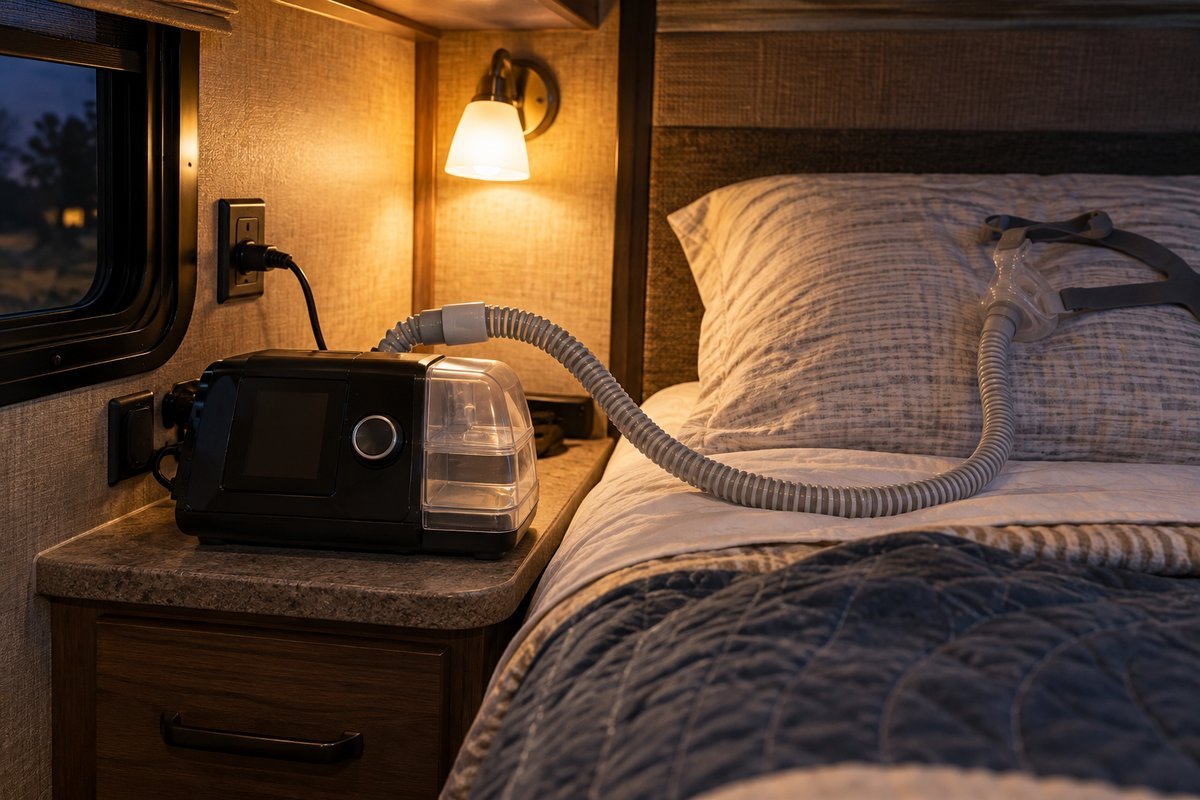
Using the figure of about 300 watt-hours per 100 watt panel, refilling 450 to 500 watt-hours works out to roughly 200 watts of panels on a sunny day, by our math, before any other load. A 400 watt kit leaves room for other loads, cloudy days and weaker winter sun, which is why it is the safer choice for CPAP users who dry camp. Sokol also notes that running a ResMed machine on its 12 volt DC power cord instead of through an inverter can save perhaps 50 percent of the battery power, in his ResMed battery guide. Our guide to off-grid CPAP power covers batteries and adapters.
PWM or MPPT Charge Controller?
The charge controller sits between the panels and the batteries and keeps the batteries from overcharging. Panels should never be wired straight to a battery, as Victron's wiring guide states.
A PWM controller is essentially a switch that connects the array to the battery, which pulls the panel voltage down close to battery voltage, according to Victron Energy. An MPPT controller converts the higher panel voltage into extra charging current. Victron puts the advantage at 10 to 40 percent when panels are cold, very hot or in weak light, and recommends MPPT once the array exceeds a few hundred watts on a 12 volt system. Morningstar gives a more modest 10 to 15 percent and notes that low-current systems can do as well or better with PWM. In practice, PWM is fine for a 100 to 200 watt kit, and MPPT is worth paying for at 400 watts and above.
Whichever controller you use, set it to your battery type right after installation. Renogy's Rover Li controller manual says to set the battery type immediately after installing the controller.
Roof-Mounted or Portable Panels?
Roof panels are always in place and charging whenever the RV sits in the sun, but they lie flat, cannot be moved out of shade and require drilling or adhesive mounts. Portable panels can be set in full sun while the RV is parked in shade, and they can be tilted. The US Energy Information Administration explains that panels tilted at less than your latitude produce more in spring and summer but less in fall and winter, in its article on panel tilt. A flat roof panel is the extreme case.
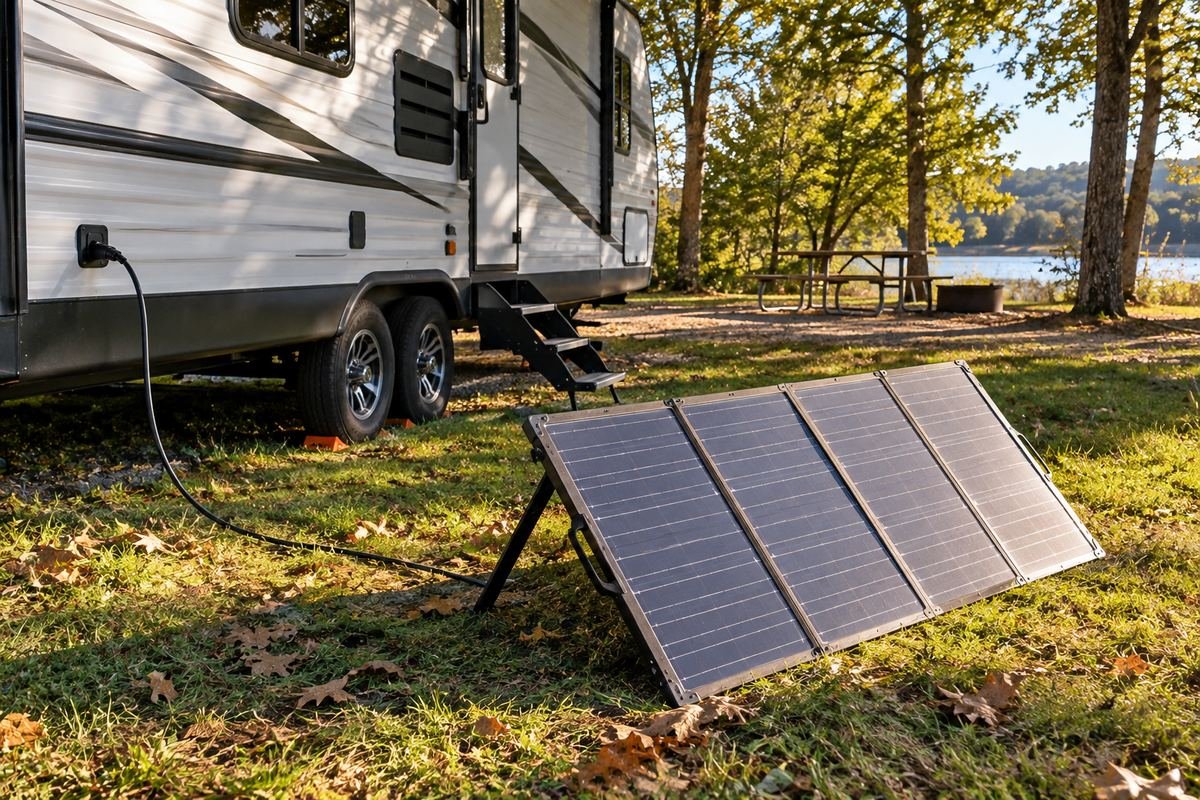
For many older RV owners, the practical question is the roof itself. If climbing a ladder and working on the roof is not safe for you, a portable kit or a professional installation is the better choice.
Rigid or Flexible Panels?
Rigid aluminum-framed panels are the standard choice for RV roofs. Renogy's 100 watt rigid panel spec sheet lists 17.8 percent module efficiency and a 25-year power output warranty. The 22 percent figure on the Renogy N-Type kit listing is a cell efficiency, which runs higher than module efficiency. Renogy's 50 watt flexible panel spec sheet lists 14.4 percent module efficiency. Flexible panels weigh less and suit curved roofs, but with no air gap beneath them they can run hotter, and panel output falls as temperature rises. Renogy's rigid panel loses 0.37 percent of its output for each degree Celsius above 25 degrees. Over the long term, NREL research found a median output loss of about 0.5 percent per year across more than 2,000 reported degradation rates, in its degradation study.
How to Install an RV Solar Kit Safely
- Fuse the battery connection. Victron says each device connected to a battery needs a fuse in the positive cable. Renogy's Rover Li manual recommends a 25 to 30 amp battery fuse for a 20 amp controller, 30 to 40 amps for 30 amps, and 40 to 50 amps for 40 amps.
- Keep the controller close to the battery and use heavy enough wire. Renogy's manual recommends mounting the controller as close to the battery as possible and gives wire sizes that keep voltage drop under 3 percent. Victron suggests aiming for less than 2.5 percent. Handy Bob's solar blog, a long-running RV solar resource, advises erring on the side of heavier wire.
- Connect in the right order. Renogy's manual says to connect the battery first and the panels second, or the controller may be damaged.
- Seal every roof penetration. Go Power's installation instructions call for sealant under, around and on top of each mounting screw, using a sealant your RV dealer recommends for your roof.
- Check your RV warranty. Drilling into the roof can affect a roof or coach warranty. Ask your dealer or manufacturer first, and consider a certified RV technician if you are not comfortable with 12 volt wiring.
Can an RV Solar Kit Run the Air Conditioner?
Not on its own. Furrion lists its 13,500 BTU Chill HE rooftop air conditioner at 1,450 watts when cooling, on its product page. By our math, an hour of continuous cooling at that rating uses about 1,450 watt-hours, close to what five 100 watt panels produce in a day at 300 watt-hours each. Mike Sokol suggests in his air conditioner article that a workable setup for some owners is four 100 amp-hour lithium batteries, perhaps 400 to 600 watts of solar and a small generator, though he calls his chart an educated guess. A solar kit is for lights, fans, pumps, electronics and medical devices like a CPAP, not for air conditioning.
Is There a Tax Credit for RV Solar?
Not for 2026 purchases. The IRS says the Residential Clean Energy Credit is not available for property placed in service after December 31, 2025. This is general information, not tax advice.
Frequently Asked Questions
What is the best RV solar panel kit?
For most owners who dry camp, a 400 watt kit with an MPPT controller, such as the Renogy 400W Premium kit. For keeping batteries topped up between hookups, a 200 watt kit is usually enough.
How many solar panels do I need for my RV?
Add up your daily watt-hours and divide by about 300 watt-hours per 100 watt panel in good sun, the figure RV electrical writer Mike Sokol uses. Add extra for winter, clouds and shade.
Can a solar kit power a CPAP in an RV?
Yes, with a battery. Mike Sokol estimates a CPAP can use up to about 500 watt-hours a night with the humidifier on. For a couple running two CPAP machines, he suggests 400 watts of solar and at least 200 amp-hours of lithium battery.
Do RV solar kits come with batteries?
Many do not, including all five kits in this guide. A typical kit includes panels, a charge controller, brackets and cables. Batteries, an inverter, fuses and battery cables are often sold separately.
Is MPPT worth it for an RV?
For arrays of a few hundred watts or more, usually yes. Victron estimates a 10 to 40 percent gain in cold weather or weak light. For a 100 to 200 watt kit, a PWM controller is often fine.
Can RV solar run the air conditioner?
Not on its own. Furrion rates one 13,500 BTU rooftop unit at 1,450 watts when cooling, so running it on batteries takes a large lithium bank, several hundred watts of solar and usually a generator.
Bottom Line
The best RV solar panel kit depends on how you camp. For regular dry camping, and especially for running a CPAP, the Renogy 400W Premium kit with its MPPT controller is the strongest choice. For topping up batteries between hookups, a 200 watt kit from Renogy or ECO-WORTHY is enough. If you would rather stay off the roof, the Go Power GP-PSK-130 plugs into a factory solar port, and the Renogy 100W portable panel pairs well with a power station. Whatever you choose, budget for batteries, fuses and cables, and size the system from your daily watt-hours.
For more on powering a CPAP, see our guides to the best portable power station for CPAP and the best quiet inverter for CPAP.