
An RV sewer hose support is a folding rack that holds your sewer hose off the ground on a steady downhill run, from the RV's outlet to the campground's sewer inlet. That steady slope lets the tanks drain completely, instead of leaving waste sitting in low spots along the hose. You don't need one every time you dump. It is most useful on longer hookups, flat sites, and long hose runs. For most RVers, the Camco Sidewinder is the safest choice. The Camco Rhino kit fits uneven ground or a tall sewer inlet best, and the Beech Lane support offers the best value.
We built this guide from manufacturer specs and catalogs, state campground codes, RV owner forums, and Amazon ratings checked on October 12, 2026. We have not tested these supports side by side. Where a detail comes only from a product listing or from one owner's report, we say so.
Table of Contents
Our Picks at a Glance
- Best overall: Camco Sidewinder 20 ft RV Sewer Hose Support
- Best for curves and windy sites: Valterra Slunky 20 ft
- Best for uneven ground and tall inlets: Camco Rhino Sewer Hose Support Kit
- Best value: Beech Lane 20 ft RV Sewer Hose Support
- Easiest to spot: Kohree 20 ft RV Sewer Hose Support
What a Sewer Hose Support Does
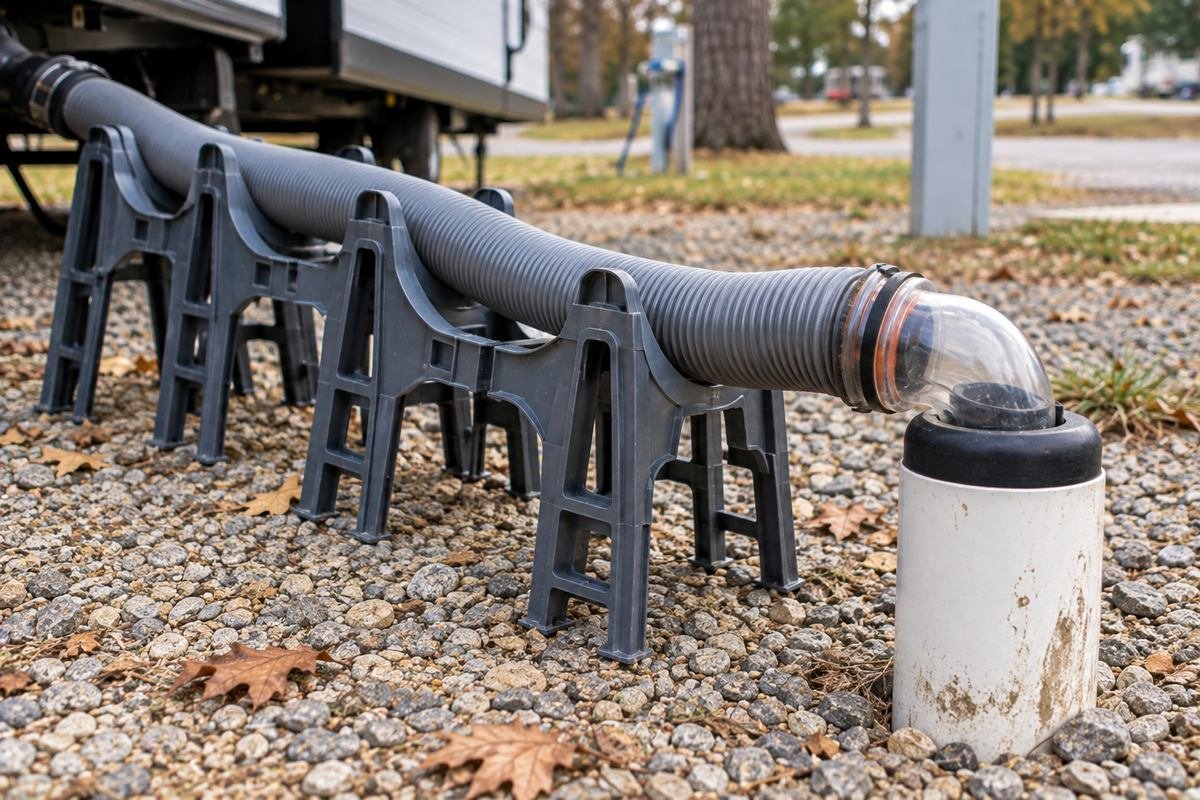
A standard RV sewer hose is 3 inches wide and flexible, so it follows the ground. Every dip in the ground becomes a dip in the hose, and waste settles there instead of draining. A support gives the hose a rigid path with a gradual drop from one end to the other.
Most supports are a row of plastic cradles joined by hinges. Some open like an accordion, some fold out in a zigzag, and others are separate sections that you line up. The RV end sits higher than the sewer end, so gravity moves everything toward the inlet. Lifting the hose off the ground also helps prevent damage, according to Camco's product description for the Sidewinder.
Keystone RV, a major trailer builder, tells owners in its guide to black and gray tanks to route the hose to the sewer while ensuring a good downward slope. A support is simply the easiest way to hold that slope for days at a time.
Do You Need an RV Sewer Hose Support?
Not always. RV owners are split on this. In one Jayco owners forum thread, some posters said they never use one, some use one only on certain sites, and others set one up every time. Here is a practical way to decide:
- Quick stop at a dump station: usually not needed. The hose is short, the run is downhill, and you are done in minutes.
- Full hookups for several days or longer: worth it. The hose stays connected, and low spots have time to collect waste.
- Flat site or a long hose run: worth it. A 20-foot hose lying flat on level ground has almost no fall.
- Campground or local rules: check before you go. Some parks require a support to protect the grass or keep hoses tidy.
Most written rules we found are about a sealed connection, not a support. Virginia's campground regulation says the sewer hose must be watertight, with its lower end secured to the sewer riser with a rubber or similar gasket. Florida's RV park rule says connections must be self-draining and leak-proof. California's park code says a drain connector must be gas-tight. A support helps with self-draining, but these rules prioritize a rubber sewer seal.
We couldn't find a state law requiring the hose to stay off the ground, so treat any such claim with caution. Local rules can differ, though. One poster in the Jayco thread said his county requires the hose to stay off the ground. Check with your campground.
How Much Slope Does an RV Sewer Hose Need?
No RV or sewer hose maker we checked gives a number. They only say the hose should run downhill. Plumbing codes for permanent drains are a useful yardstick, though they were not written for RV hoses.
- The federal standard for manufactured homes, 24 CFR 3280.610, requires drain lines to slope at least 1/4 inch per foot, or 1/8 inch per foot when 1/4 inch is not practical and a full-size cleanout is installed at the upper end. It also sets a 3-inch minimum inside diameter for the drain connector.
- The Uniform Plumbing Code uses the same 1/4 inch per foot minimum for most horizontal drain pipe.
For a 20-foot hose, 1/4 inch per foot equals 5 inches of total drop, and 1/8 inch per foot equals 2.5 inches. Now compare that to the supports. Valterra lists its 20-foot Slunky at 7 inches tall at the RV end and 4.5 inches at the sewer end. That is a 2.5-inch drop over 20 feet, or about 1/8 inch per foot. So the support's built-in drop helps, but the rest of the slope comes from the height difference between your RV's outlet and the sewer inlet. Park so the outlet sits well above the inlet, and use the support to keep the hose from sagging in between.
How We Chose These Supports
We started with the supports that RV publishers and forum members mention most, then checked each one on Amazon for a buy button and a meaningful number of ratings. We read the makers' specs where they exist and noted where a detail comes only from a listing. We also read owner threads on RV forums and added problems that came up more than once as cons. Prices change often, so we did not use them to rank the picks.
The 5 Best RV Sewer Hose Supports
1. Camco Sidewinder: best overall
The Camco Sidewinder is a support RV websites often recommend, and it has the most Amazon ratings by far: 4.7 stars from 15,251. That count covers every length in the listing, not just the 20-foot model. It is an all-plastic support that folds out in a zigzag and bends around obstacles. Its cradles hold the hose without straps, and snap-fit hinges help keep it from creeping closed, according to the listing.
A retailer lists the 20-foot 43051 version at 9 3/4 inches tall at the RV end and 6 3/4 inches at the sewer end, with a one-year warranty. Camco's dealer catalog lists Sidewinders for 10, 15, 20, and 30-foot hoses, so you can match it to your hose.
One owner who reviewed the Sidewinder for The Camping Nerd noted that the legs can shift as the hose fills during a dump, so you may need to adjust the support to keep the hose from sagging or tipping.
Good for: most RVers, especially those with a 20-foot hose and fairly level sites. The 10-foot Sidewinder suits a short hose or a site where the inlet is close.
- Pros: fits 10- to 30-foot hoses, no straps needed, folds compactly, all plastic so nothing rusts.
- Cons: legs can shift during a big dump, and its sewer end can sit too low for a raised sewer inlet.
2. Valterra Slunky: best for curves and windy sites
The Valterra Slunky 20 ft opens like an accordion, so it curves easily around a picnic table post or a utility pedestal. Valterra lists it at 7 inches tall at the RV end and 4.5 inches at the sewer end, weighs about 5 pounds, and includes six tie-down straps to hold the hose in place. Some retailers list taller figures for the current version, 10 inches to 7 1/2 inches, so check the listing before you buy.
It has metal hinges and a ridged bottom that grips grass and gravel. The current Amazon listing says the newer design is 26 percent wider and 30 percent deeper than before. Retailers list a one-year warranty. It holds 4.6 stars from 856 Amazon ratings.
Good for: sites where the hose has to bend, and windy spots where straps help keep the hose seated.
- Pros: bends around obstacles, straps hold the hose, metal hinges, comes in 10, 15, 20, and 25-foot lengths.
- Cons: its RV end is lower than the Sidewinder's in Valterra's figures, and one owner in an RV forum thread said a Slunky cradle snapped at the bottom of the U when he pulled on it too hard.
3. Camco Rhino Support Kit: best for uneven ground and tall inlets
The Camco Rhino Sewer Hose Support Kit takes a different approach. Instead of one folding piece, you get five separate sections that you set down one at a time. Camco's 2023 to 2024 new products catalog says each section is 24 3/16 inches long and 9 1/2 inches wide, with heights from 8 1/2 to 10 1/2 inches, and that the kit fits sewer hoses up to 15 feet long and 3 inches wide. The sections nest together, and a strap holds them for storage. The listing says they are made of UV-stabilized polymer. It holds 4.8 stars from 895 Amazon ratings, the highest average here.
Because each section sits on its own, you can step them down a slope or keep the hose higher where a sewer inlet sticks up out of the ground. That is a common problem. In a Jayco owners thread, an owner wanted a taller Slunky because the campground's sewer inlet was raised and his hose could not run downhill.
Good for: uneven or sloping sites, raised sewer inlets, and hoses up to 15 feet.
- Pros: taller at the sewer end than the Sidewinder or Slunky, separate sections adjust to uneven ground, nests for storage, UV-stabilized material.
- Cons: covers only 15 feet of hose, and loose sections take longer to set up than a one-piece support.
4. Beech Lane: best value
The Beech Lane 20 ft support was the lowest-priced pick on this list when we checked, and it has 4.5 stars from 2,583 Amazon ratings. Its links nest inside the larger panels, so it packs down smaller than many folding supports. The listing says it fits all 3-inch sewer hoses, uses rust-proof nylon hinge pins, and comes with a lifetime warranty from Beech Lane. We could not find a manufacturer website with full specs, so these details come from the Amazon listing.
The listing says clip-on feet that help stop it from tipping in wind or on sloped ground are sold separately.
Good for: RVers who want a full 20-foot support without paying for a big brand name, and anyone short on storage space.
- Pros: low cost, packs small, lifetime warranty, many ratings.
- Cons: anti-tip feet cost extra, and the maker publishes no height or weight figures.
5. Kohree: easiest to spot
The Kohree 20 ft support is bright orange, which the listing says helps prevent tripping. The listing says it's height-adjustable, opens like an accordion, fits hoses up to 20 feet long and 3 inches wide, and comes with a carrying strap. A writer at RVtravel, an independent RV newsletter, reviewed it in July 2026 and liked the deep cradles, but said she could not yet vouch for how long it lasts. It holds 4.6 stars from 673 Amazon ratings.
Good for: busy campgrounds, families with kids, and anyone worried about someone tripping over the hose.
- Pros: high-visibility color, deep U-shaped cradles, adjustable height, carrying strap.
- Cons: newer brand with a shorter track record, and the maker publishes few hard specs.
Comparison Table
| Support | Style | Hose length | Height (RV end to sewer end) | Warranty | Amazon rating |
|---|---|---|---|---|---|
| Camco Sidewinder 20 ft | Zigzag folding | 20 ft (also 10, 15, 30 ft) | 9 3/4 in to 6 3/4 in (retailer listing) | 1 year (retailer listing) | 4.7 (15,251, all sizes) |
| Valterra Slunky 20 ft | Accordion with straps | 20 ft (also 10, 15, 25 ft) | 7 in to 4.5 in (Valterra) | 1 year (retailer listing) | 4.6 (856) |
| Camco Rhino kit | 5 separate sections | Up to 15 ft | 8 1/2 in to 10 1/2 in | Not listed | 4.8 (895) |
| Beech Lane 20 ft | Nesting folding | 20 ft | Not listed | Lifetime | 4.5 (2,583) |
| Kohree 20 ft | Accordion, adjustable | Up to 20 ft | Not listed | Not listed | 4.6 (673) |
Amazon ratings and counts were checked on October 12, 2026, and they change over time.
When the Sewer Inlet Sits Above the Ground
Some campground sewer inlets are pipes that stick up out of the ground. If the end of your support sits lower than the top of that pipe, the hose has to climb at the last moment. Waste then pools just before the inlet. It is one of the most common complaints about supports in RV owner forums.
Measure the inlet height before you buy. Then pick a support whose sewer end is at least that tall, or use one with separate sections, like the Rhino kit, that you can raise on leveling blocks. Remember that the RV's outlet still has to be higher than the inlet. If the inlet sits above your outlet, no support will fix it. Move the RV, or ask the campground for another site. Our RV sewer hose guide also covers macerator pumps, which can push waste uphill.
How to Set Up a Sewer Hose Support
- Put on disposable gloves. Connect the hose to the RV outlet first, then to the sewer inlet with a rubber seal or threaded adapter.
- Open the support beside the hose with the tall end at the RV and the short end at the sewer.
- Lift the hose into the cradles, starting at the RV end. Leave no loops or dips between cradles.
- Check the run by eye from the side. The hose should drop steadily the whole way. Add blocks under a section if the ground dips.
- Dump the black tank first, then the gray tank, which helps rinse the hose. Keystone RV gives the same order in its tank guide.
- Watch the support during the first big rush. If a section shifts or tips, straighten it before the next dump.
Keystone also tells owners not to leave the black tank valve open while hooked up, even when the site has a sewer connection. Keep it closed until the tank is ready to dump.
Odor, Flies and the Gray Valve
A straight, sloped hose has no low spot to hold water, which means it has no water barrier against sewer gas. Owners in an RV Forum thread said a straight run can let sewer odor and flies back toward the RV when the valve is open. A Forest River owner raised the same odor concern. Some owners solve this by closing the gray valve between dumps. Others let the hose form a small loop near the inlet to trap water. Both choices have tradeoffs, and RV owners do not agree on one right answer.
DIY Alternatives
Some RVers make their own support from PVC rain gutter cut into sections. One Forest River owner described using 5 foot gutter sections to give the hose rigidity. He also said one section cracked and that a store-bought support would be easier to store. Leveling blocks or bricks under low spots also work for a short stay. A DIY setup can work, but it is harder to keep an even slope and takes up more room in a storage bay.
Storing and Caring for Your Support
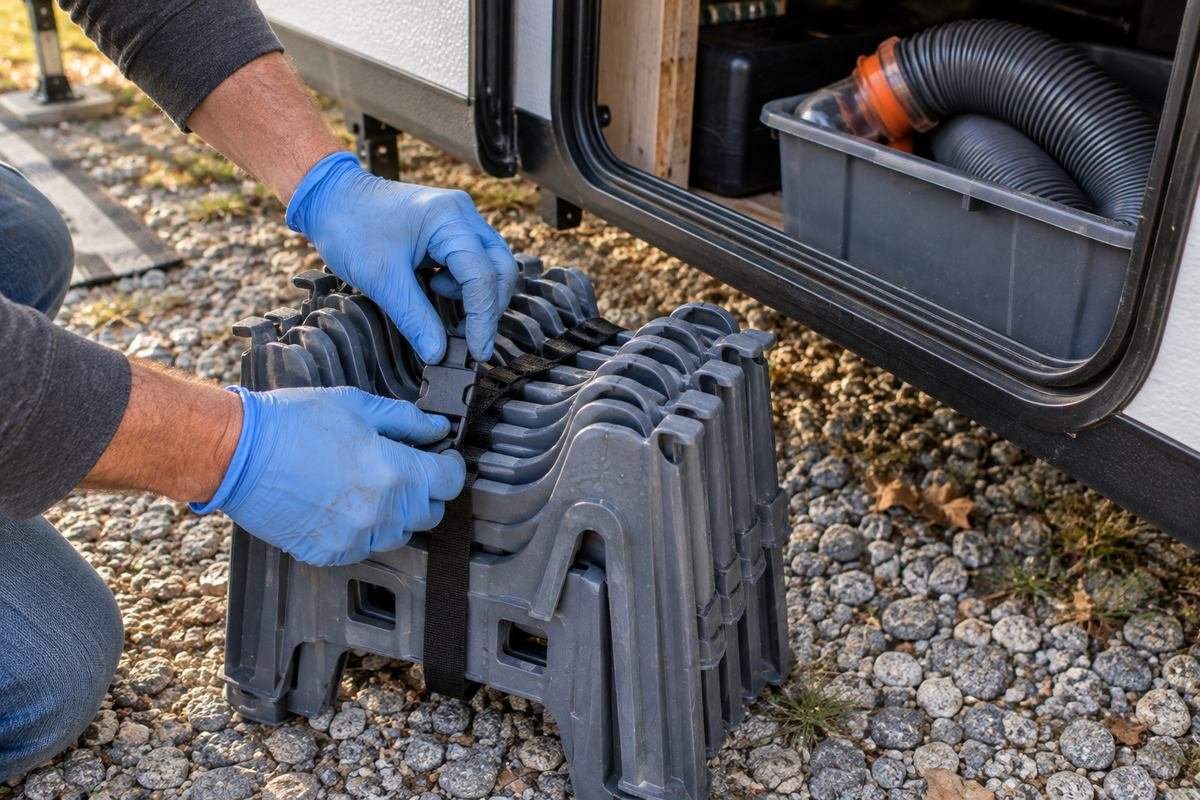
- Rinse it after use. Hose it off at the dump station's rinse hose (not your drinking water hose), then let it dry before you fold it.
- Check the size before you buy. Folding supports collapse to different lengths and widths. Measure your storage bay door first.
- Keep it out of the sun when you can. Long exposure to strong sun is hard on plastic. The Rhino kit listing and some Lippert supports, such as the LC49UK, are sold as UV-stabilized.
- Do not stand on it. Thin plastic cradles and hinges are not made to carry weight, especially in cold weather.
Frequently Asked Questions
Do I need a sewer hose support for my RV?
Not for every dump. A short, downhill run at a dump station drains fine without one. A support helps most at full hookup sites where the hose stays connected for days, on flat ground, and with long hose runs.
How much slope should an RV sewer hose have?
RV makers do not give a number. As a yardstick, the federal standard for manufactured homes calls for at least 1/4 inch of drop per foot. For a 20-foot hose, that is about 5 inches from the RV outlet to the sewer inlet.
Are sewer hose supports required at campgrounds?
Some parks ask for them, but most state rules we found require a watertight or gas-tight connection, such as a rubber sewer seal, rather than a support. Check your campground's rules before you arrive.
What length sewer hose support do I need?
Match the support to the hose you use most. A 20-foot hose needs a 20-foot support, or the extra hose lies on the ground. Many makers sell supports in 10, 15, 20, and longer sizes.
Can I use a sewer hose support at a dump station?
Yes, but most people skip it there. Dump station runs are usually short and downhill, so the hose drains well on its own.
Why does my RV smell after I set up a sewer hose support?
A straight, sloped hose has no low spot to hold water, so sewer gas can travel back toward the RV. Some owners close the gray valve between dumps. Others let the hose dip near the inlet to trap water.
Which Sewer Hose Support to Buy
For most RVers, the Camco Sidewinder is the safest RV sewer hose support. It is widely used and comes in sizes for 10 to 30-foot hoses. Choose the Valterra Slunky if your hose has to curve or you want straps. Choose the Camco Rhino kit for uneven ground or a tall sewer inlet. The Beech Lane support is the best value and packs small, and the bright orange Kohree is the easiest to spot. Whichever you choose, pair it with a good sewer seal and keep the black valve closed until you dump.
Still choosing a hose? See our guide to the best RV sewer hose.