
Here is the part most articles on this subject skip: you may not need one of these at all. Before you buy anything, it's worth testing what the battery has left, because a pack that reads low every spring may be worn out rather than undercharged. The five RV battery maintainer picks below were chosen on one basis: what each manufacturer is willing to put in writing. The battery is one of the things winterizing the plumbing doesn't protect, which is why it needs its own answer. An RV battery maintainer only works if there's power where the trailer sits.
Table of Contents
The five picks
Battery Tender Power Tender 15/8/2 Amp
Best overallThree output settings in one box: 2 amps to maintain, 8 or 15 to bring back a battery that has already sagged. Deltran rates it for 12V batteries from 14 to 250 amp-hours, the widest range anyone on this list publishes, and it has a chemistry selector for flooded, AGM, gel and LiFePO4. Deltran states it's safe for indefinite connection in every mode.
It also has a Winter Mode that raises the charging voltage for a battery in extreme cold. Note that Deltran describes it for lead-acid and publishes no separate cold-charging guidance for lithium. The other gap is weather. Unlike the Battery Tender Plus below, this one carries no IP rating at all, so it belongs in a garage or a dry compartment, not clipped to a tongue-mounted battery in the rain.
What You'll Love
- Rated from 14 to 250Ah, the widest published range here
- Lead-acid and LiFePO4 modes
- Cleared for indefinite connection
- Five-year warranty and ETL listed
Worth Considering
- No IP rating, so keep it dry
- Winter Mode is a lead-acid feature, with no lithium cold guidance
- About 3.5 pounds, bulkier than a pure maintainer
CTEK MXS 5.0
Best documentedThe most thoroughly specified lead-acid charger here, and the only brand publishing IP65 across its entire range together with a stated ambient rating of −4°F to 122°F (−20°C to +50°C). Five-year warranty, and CTEK publishes its back-current drain at under 1Ah a month. The kind of number a company only prints when it's comfortable being held to it.
The catch is decisive for some readers: no lithium mode. CTEK says so directly. This is a lead-acid, AGM and gel maintainer.
One note about the Snowflake button, which is widely misunderstood. It raises charging voltage to 14.7V because cold slows the chemistry, a voltage boost so a cold lead-acid battery accepts charge, not cold protection. CTEK is equally clear that a frozen battery must be thawed before charging at all.
What You'll Love
- Best published specs in the category
- IP65 with a real published temperature range
- Five-year warranty
- Publishes its own back-current drain
Worth Considering
- No lithium mode at all
- RECOND gasses the battery to 15.8V
- No safety standard number published
Battery Tender Plus 12V IP65
Best budget plug-inThe classic. 1.25 amps is slow, but a maintainer isn't meant to be fast. It only has to replace what the battery loses sitting there, plus the trickle the propane alarm and radio memory pull with everything switched off, and 1.25A does that comfortably. IP65, a five-year warranty, and Deltran states it can remain connected indefinitely.
Lead-acid only. Deltran doesn't warn anywhere on the product page that using it on a LiFePO4 pack is a mistake, which is a documentation failure worth naming. If your trailer has lithium, buy the multi-chemistry version instead.
What You'll Love
- Five-year warranty at the lowest price here
- IP65
- Cleared for indefinite connection
- Enormous ownership base
Worth Considering
- Lead-acid only, and the packaging doesn't make that obvious
- 1.25A is slow if the battery is already flat
Victron Blue Smart IP65 12/5
Best for lithiumThe only pick here whose manual states the hazard outright: "Do not charge Li-ion batteries if the battery temperature is below 0°C." That sentence is why it made the list. Several units here will charge lithium. This is the manufacturer willing to write down when you must not.
It's equally clear about its own limits. Victron documents that its temperature compensation is switched off in lithium mode. The charger is temperature-blind by design, and says so. It doesn't measure your battery's temperature, and neither does anything else in this category. What you get is a sealed five-amp unit with Bluetooth, so you can see how full the battery is from your phone standing beside the trailer, and a five-year warranty.
What You'll Love
- States the below-freezing lithium limit in its manual, which almost nobody does
- IP65 on a one-piece unit, no separate control box to shelter
- UL 1236 listed
- Bluetooth. Check the battery level without opening the trailer
Worth Considering
- Five amps is modest for a large house bank
- The cold-weather protection is a written warning, not an automatic cutoff
- Bluetooth range means you have to be at the RV to read it
Victron Blue Smart IP65 12/10
Best for a bigger bank outdoorsTen amps in the same sealed IP65 body as the 12/5 above, for a bank that's too big for five amps. Victron publishes the sizing: 30 to 100 amp-hours for this model, against 20 to 50 for the 12/5. That is the number that tells you which one you need.
Everything that earned the 12/5 its place carries over: the lithium mode, the written warning not to charge lithium below 32°F (0°C), UL 1236 compliance and a five-year warranty. Victron rates it to operate from −40°F to 140°F (−40 to +60°C), with full output up to 86°F (30°C). Past about 100Ah, go to the Battery Tender at the top of this list, which Deltran rates to 250Ah but which has no weather rating.
What You'll Love
- Victron publishes the battery sizes it suits
- IP65 on a one-piece unit that can live outdoors
- UL 1236 compliant
- Bluetooth, so you can read the battery from your phone at the RV
Worth Considering
- 100Ah is the top of its range, small for a big lithium bank
- The cold-weather protection is a written warning, not an automatic cutoff
- Two Victrons in five picks, because this is the size step the 12/5 can't cover
Quick comparison
| Product | Output | Chemistry | Weather | Cold-lithium guidance published |
|---|---|---|---|---|
| Battery Tender Power Tender 15/8/2 | 2, 8 or 15A, 14 to 250Ah | Lead-acid + LiFePO4 | None published | No |
| CTEK MXS 5.0 | 4.3A, to 160Ah | Lead-acid only | IP65, −4°F (−20°C) | n/a, lead-acid only |
| Battery Tender Plus 12V IP65 | 1.25A | Lead-acid only | IP65 | n/a, lead-acid only |
| Victron Blue Smart IP65 12/5 | 5A | Lead-acid + LiFePO4 | IP65, −40°F (−40°C) | Yes: stated in the manual |
| Victron Blue Smart IP65 12/10 | 10A, 30 to 100Ah | Lead-acid + LiFePO4 | IP65, −40°F (−40°C) | Yes: stated in the manual |
Why a battery goes flat in storage
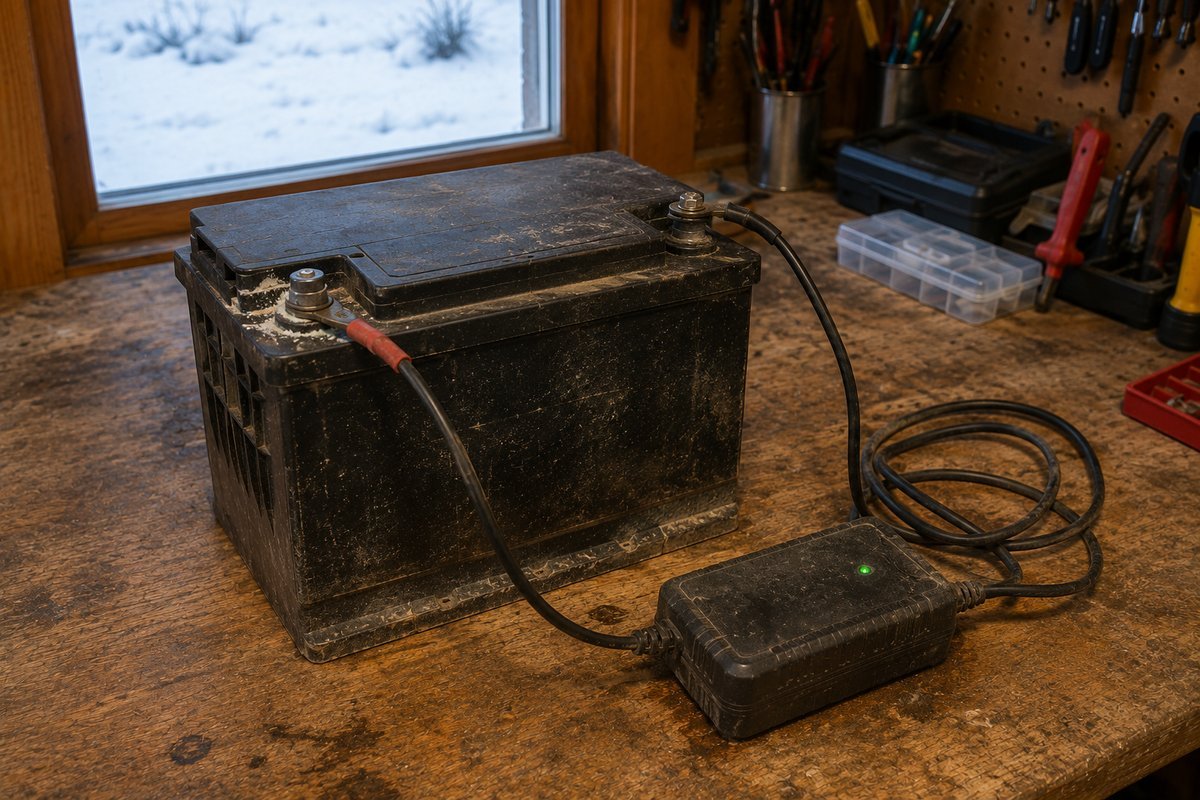
Two things drain it, and they stack.
Self-discharge happens whether or not anything is connected. Published rates vary enormously by battery type. Lifeline says 1 to 3% a month for its AGMs, Rolls says 10 to 12% for flooded and up to 25% for its carbon-additive models. There's no single reliable figure to quote, so we won't invent one. The reliable rule, consistent across sources, is that the rate roughly doubles for every 18°F (10°C) warmer it sits.
The drains that never switch off are the bigger problem, and here there's one solid published number. A propane leak detector, the alarm mounted low on the wall that you can't switch off from the panel, draws 100 mA continuously, per the manufacturer's own manual. That's 2.4 amp-hours a day, about 72 a month. On its own it will flatten a single Group 24 battery in well under a month.
Add the radio memory, the antenna booster, and the CO alarm, and the total climbs, but beyond the detector, nobody publishes a figure for what all of them add up to in a travel trailer. What circulates online is owners measuring their own RVs, spanning 20 mA to over an amp. Useful context, not data.
Now put those together with the freezing chart. A battery at 100% charge freezes around −94°F. At 50%, it freezes somewhere between −13°F and −4°F, depending on which data you use. At 25% it freezes at +9°F, and flat, at about +21°F. That isn't unusual weather. That's February in most of the country.
So the risk isn't the cold. The risk is the discharge, and the cold only finishes the job.
What to look for
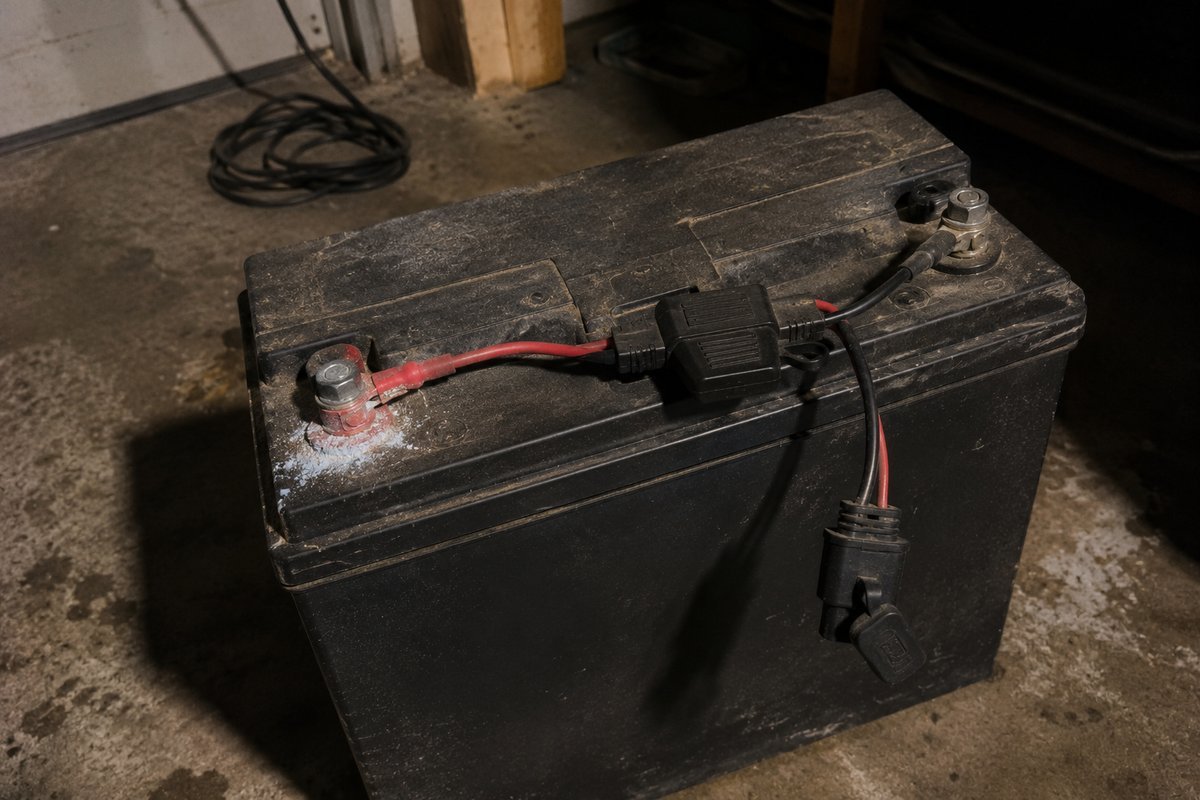
Match the charger to your battery chemistry, and check twice
Most wasted money happens here. A charger built for flooded and AGM batteries applies a voltage profile that a LiFePO4 pack should never see, and several of the most popular maintainers on the shelf are lead-acid only without saying so loudly.
The CTEK MXS 5.0 has no lithium mode at all. CTEK says so plainly in its own FAQ. The Battery Tender Junior and Plus are lead-acid units. Battery Tender's own RV blog warns that its solar chargers "designed for lead-acid batteries should not be used on lithium batteries without a compatible lithium charge controller," which is a concession by the manufacturer that its product pages don't emphasize.
Find out what your battery is before you buy anything. If it came with the trailer and you have never replaced it, it's almost certainly flooded lead-acid.
The cold-weather lithium problem no charger maker solves
If you have upgraded to lithium, this is the section that matters, and the facts aren't reassuring.
LiFePO4 must not be charged below freezing. Charging a cold lithium cell causes permanent lithium plating. Discharging in the cold is fine, only charging does the damage.
Two problems follow, and both are the manufacturers' doing.
First, the battery makers don't agree on where the line is. Victron states that a cell "will sustain permanent damage when charged at temperatures below 5°C," sets its cutoff at that temperature (41°F), and says that lowering it voids the warranty. Battle Born allows charging down to about 24°F and sets its BMS cutoff at 24°F. That is a gap of roughly 23°F (13°C) on a question that decides whether your battery survives. Follow the manual for the battery you own, because there's no industry answer.
Second, every charger brand pushes that job onto the battery's own management system, or BMS. Deltran's temperature compensation is explicitly scoped to lead-acid. Schumacher's two lithium-capable units publish no temperature restriction whatsoever.
OptiMate comes closest, reducing current below 32°F rather than stopping, and it's the only charger we found with any published cold logic at all.
The practical upshot: your protection is the battery's BMS, not the charger. If you can't confirm from your battery's manual that it blocks cold charging, don't leave a lithium pack on a maintainer through a freezing winter.
A standard exists here, and almost nobody cites it
Readers of our wheel and coupler locks guide will remember that no American safety standard for trailer locks exists at all. Battery chargers are different. UL 1236 is a real, ANSI-recognized product safety standard covering chargers for lead-acid starter batteries, and a UL Listing to it means third-party testing plus ongoing factory surveillance rather than a manufacturer's own word.
So it's striking how few brands name it. Schumacher shows UL marks in its spec tables but cites no standard number in any manual. NOCO publishes FCC compliance only. Deltran publishes ETL and CEC. CTEK offers only that its products are "designed for safety following applicable EU Directives."
Two cautions. "UL Listed" is a specific claim, while "meets UL standards" and "UL compatible" are marketing phrases that mean nothing and appear constantly on inexpensive maintainers. And UL 1236 is a safety standard. It means the unit shouldn't start a fire. It says nothing about whether the float algorithm is any good for your battery.
Float, not trickle: the distinction that matters
An old-fashioned trickle charger pushes a roughly constant current whether the battery needs it or not. Once the battery is fully charged, the surplus energy goes into splitting water in the electrolyte. A flooded battery slowly dries out until the plate tops are exposed. A sealed AGM can't be refilled, so it vents and permanently loses capacity. Lifeline's manual says it directly: trickle charging is "not recommended."
A float maintainer holds a regulated voltage instead, around 13.3V for a 12V battery, so once the battery is full, current tapers to the milliamps needed to offset self-discharge. Nothing gasses. That is why a maintainer can stay connected for five months and a trickle charger can't.
Every product above is an RV battery maintainer built on the float-charge principle. The word on the box that matters is "maintainer" or "smart," not "trickle."
Ignore the battery-repair claims
Nearly every maintainer in this category advertises a recovery, repair, or reconditioning mode. NOCO says its Repair mode "will automatically repair and reverse the damage." CTEK's RECOND deliberately gasses the battery at up to 15.8V. OptiMate claims recovery from as low as 0.5V and says it "saves batteries other chargers can't."
Not one of them publishes a capacity-recovery figure, a test result, or any third-party validation. They describe the mechanism in real technical detail and then stop.
The independent evidence is thin to the point of absence. What exists is a handful of very small, uncontrolled studies, one widely cited paper tested two batteries with no control. The document most often circulated as an "independent test" is a hobbyist write-up that, in its own text, concedes that the author "could never really judge the device's efficacy." Meanwhile, Lifeline's engineering manual discusses sulfation at length but never mentions the pulse repair mode these chargers advertise, prescribing a slow conditioning charge instead.
Buy these units for the float circuit. Treat the recovery mode as a free extra that may do nothing, and keep it away from a lithium battery: repair-mode voltages like CTEK's 15.8V aren't something a LiFePO4 pack should ever see.
Does your storage lot even have power?
Worth settling before you buy a plug-in anything.
We went looking for data on how many RV storage facilities offer electrical hookups, and there's none. The self-storage industry publishes plenty on occupancy and rates and nothing on amenities. Extra Space says only that outlets depend on the facility and to ask. One operator-facing article lists electrical hookups among amenities that increase profitability, suggesting they're a paid upgrade rather than a standard feature, but that is an inference, not a statistic, and we aren't going to dress it up as one.
Call your facility and ask. If the answer is no, read the next section before you spend anything. If you store at home on your own driveway, the plug-in units are better in every measurable way.
Why there is no solar pick on this list
We went looking for one and couldn't find a solar maintainer that's both available and adequately documented. That is a finding in itself, so we report it rather than recommend something we would have to hedge.
The 17W and 35W are sold out on Deltran's own store and absent from Amazon. They aren't discontinued, the part numbers are still cataloged, and the manuals are still hosted, but a product you can't buy isn't a recommendation. Their 5W sibling is available and well-documented as IP67, and its rated output is 325 mA.
That maintains a motorcycle. An RV with propane and carbon monoxide detectors and an antenna booster commonly idles above 200 mA, and a short winter day on a flat panel doesn't deliver the rated output.
One popular 20W unit advertises an "intelligent MPPT controller" and publishes three different tracking-efficiency figures across its own pages. A real controller has a datasheet whose number doesn't change from page to page. The same brand advertises solar cells "up to 21% to 30%" efficient. No commercial silicon cell reaches 30%, and the laboratory record is about 27%.
Another manufacturer describes a 15W panel that delivers "5W charge to 12-volt batteries" and doesn't explain where the other two-thirds went. Others publish accurate panel specifications but ship no charge controller at all, which isn't a maintainer. It's a panel you're trusting not to overcharge.
Battery Tender's 35W manual rates the panel IP65 and certifies that control box to FCC and ICES-001, radio interference standards, with nothing about water. The box you have to keep dry is the one without a rating.
Battery Tender is the only brand transparent enough that you can find this out, because it's the only one publishing a separate specification block for the controller.
How we picked these
Specifications come from Deltran, CTEK, and Victron's own published pages and manuals. Where a manufacturer doesn't publish something, and in this category that includes country of manufacture for every brand reviewed, and any UL 1236 certification number for every brand reviewed, we say so rather than estimate.
We haven't bench-tested these units, nor have we run a battery through a winter on each one. What we can do is report what each manufacturer commits to in writing, flag where their own documents contradict each other, and separate the testable claims from the decorative ones.
An RV battery maintainer is doing something a charger doesn't: holding a full battery at rest through months of cold rather than filling an empty one in an afternoon.
If you want the chemistry behind the float stage, Battery University explains why a stored lead acid battery needs its self-discharge topped up, and why a charger without a float function should come off after about 48 hours. Check the chemistry setting on your RV battery maintainer before you connect it.
Quick Answers
Is it bad to leave a battery maintainer on all the time?
No, and leaving it on is the entire point of buying one. A maintainer watches the battery voltage and only pushes current when it has dropped, then stops again. That is the difference between it and a charger.
The thing you shouldn't leave connected for months is a plain trickle charger, which pushes a small current whether the battery wants it or not. On a flooded battery that slowly boils off the water and you come back in spring to a battery that's lower than when you left it.
Battery maintainer or trickle charger: which is better for storage?
A maintainer, without much argument, and the names get used interchangeably in listings, which is why this keeps coming up. A trickle charger is a dumb, constant, small output. A maintainer is a charger with a brain: it monitors, tops up, and switches itself off.
If a product doesn't say it monitors voltage and cycles on and off, treat it as a trickle charger no matter what the box calls it.
How long can a battery stay on a maintainer?
Indefinitely. That is what it's designed for, and a battery left on one all winter is in better shape in spring than one left alone.
Two limits worth knowing. It needs power where the trailer sits, which rules it out in most storage lots. And it maintains a healthy battery rather than reviving a dead one, so a battery that has already been flat for months is a replacement, not a maintenance job.
Can I just disconnect the battery and skip all this?
For a single winter, often yes, if you charge it to full first. A fully charged lead-acid battery is effectively freeze-proof, and disconnecting stops those drains. The catch is self-discharge: check it every couple of months and top it up, or it slides down toward the range where freezing becomes possible.
Should I take the battery out and bring it inside?
No manufacturer requires it. Disconnecting matters far more than removing. Bringing it indoors is a convenience for keeping it topped up, not a technical requirement.
Will a maintainer work if the lot has no electricity?
No. A plug-in maintainer needs an outlet. If your lot has no power, see "Why there is no solar pick on this list" above, and consider the option that always works: take the battery home and maintain it there.
Is lithium better for winter storage?
It self-discharges more slowly, which helps. But it must not be charged below freezing, and no charger we found enforces that. The protection has to come from the battery's own BMS. Discharging in the cold is fine.
Do the repair and recovery modes work?
There's no good independent evidence that they do. Buy for the float circuit, not the recovery mode, and keep recovery modes away from lithium.
Final thoughts
Top pick: Battery Tender Power Tender 15/8/2, because it handles both chemistries, covers everything from a single battery to a 250Ah bank, and Deltran explicitly states it can stay connected indefinitely. Keep it somewhere dry.
Best documented: CTEK MXS 5.0. The most complete published specs in the category, provided your battery is lead-acid.
No power at the lot: take the battery home and put one of these on it. No solar maintainer we could find is both available and properly documented, and a battery on a bench in a garage is easier than any of this.
And the free advice that comes before any of it: charge the battery to full and disconnect it. That single step stops those drains and puts the freezing point somewhere near −94°F. A maintainer is what keeps it there without you having to drive out to check.
Left connected through the winter, an RV battery maintainer is the difference between turning the key in spring and buying a battery in spring. An RV battery maintainer keeps a healthy battery full. It won't bring back one that has already failed.