
A cover is the one bit of storage gear that can make things worse. The best RV cover for storage is the one that keeps rain off without sealing damp in, and that distinction decides everything below. Four of the five here are chosen on what the manufacturer is willing to say about the fabric. The fifth is chosen on what it refuses to say. A cover is the last job of the season, not the first. The plumbing has to be winterized before anything goes over the roof.
Table of Contents
The five picks
ADCO Designer Series SFS AquaShed
Clear about its limitsADCO is the incumbent. This is the cover most storage lots are wearing, and it comes in more length bands than anything else here, which matters when you land between sizes. What it isn't is well specified. ADCO publishes no fabric weight, no denier, no water column rating and no breathability figure for AquaShed, and never says what SFS stands for. The three-ply description repeated all over the internet comes from retailer listings, not from ADCO.
What ADCO does publish is where this cover belongs. Its own catalog puts AquaShed in moderate climates with less intense sunlight, with Olefin above it for all weather and Wolf Tyvek above that for harsh conditions. The warranty says the same thing in numbers: two years on AquaShed, four years on its Tyvek fabric. A manufacturer telling you in writing which of its own products is tougher is worth more than another unmeasured adjective.
What You'll Love
- Reinforced corners and a multi-point strap system, both confirmed by ADCO rather than by a listing
- Sold in more length bands than any other cover here, so a between-sizes trailer has somewhere to go
- Built-in venting to stop the billowing that tears covers in wind
- ADCO states plainly that the cover isn't waterproof, which is the correct thing for a maker to say
Worth Considering
- No published fabric numbers of any kind, so "breathable" is a claim with nothing behind it
- ADCO's own catalog ranks this line below its Olefin and Tyvek covers
- The warranty excludes damage caused by high winds, and wind is what owners report killing these covers
- Owner reports cluster on tears at the gutter spouts and straps pulling out of the cover body
Classic Accessories Over Drive PermaPRO
Longest warrantyFive years is the longest warranty anyone in this category offers, and it's the reason this cover is here. A manufacturer prepared to replace a cover for five seasons is telling you something about expected life that no fabric adjective does.
What it won't tell you is what the cover is made of. The listing says "PermaPRO ripstop fabric," lightweight, protects from water, dirt and sun. There's no fabric weight, no denier, no layer count, no UV rating and no breathability figure anywhere on the product page. You're buying the warranty, not the specification.
What You'll Love
- Five-year limited warranty, the longest found in this category
- Integrated straps with a toss-bag system, which is easier alone
- Air vents built in
- Ten size options, so the fit is closer than a two-size-fits-all cover
Worth Considering
- The product page publishes no fabric weight, denier, layer count or UV rating
- "Ripstop" describes a weave pattern, not a material or a thickness
- No breathability figure, on a cover sold for long-term storage
- No measurement instructions on the page, so sizing is on you
Camco ULTRAGuard Supreme
Best documentedThis is the only cover here whose top is a material you can look up. Camco puts a three-layer DuPont Tyvek top on the Supreme, with two-layer non-woven polymer on the sides, front and back. Tyvek is a known quantity. It's the housewrap under half the siding in North America, chosen there for exactly the property you want on a trailer roof, which is that it sheds liquid water while letting vapor out.
That naming matters. "Ripstop" and "heavy duty" describe nothing you can check, and a Tyvek top can be checked. What Camco doesn't publish is a breathability figure for the finished cover, so you're trusting the material rather than a tested assembly. The sides are ordinary non-woven, which means the strong part of this cover is the roof, and the roof is where the water sits.
What You'll Love
- The top is a named product with a manufacturer behind it, not an invented fabric brand
- Tyvek sheds water while letting vapor out, which is the whole job on a stored roof
- Covered vents rather than open holes
- Zippered entry doors, so you can get in over winter without pulling the whole cover off
Worth Considering
- Tyvek scuffs, so pad the gutter rails and ladder corners before it goes on
- No breathability figure published for the finished cover, only the material name
- The sides and ends are ordinary non-woven, so the named-material argument covers the roof
- Sold in fixed length bands, so measure before ordering rather than going by the listed length
Leader Accessories Windproof Travel Trailer Cover
Best in windThis is the one that publishes numbers. The top is a seven-layer non-woven at 165 grams per square meter, the sides are a breathable non-woven at 110, and no other cover here tells you the weight of its fabric at all. A gram figure isn't a performance rating, but it's a real measurement, and two covers with published weights can at least be compared to each other.
The wind case rests on hardware rather than fabric. Adjustable front and rear tension panels, elasticized hem corners, reinforced straps and inner buckles, and the box includes six protectors for the gutter edges, which is exactly where owners report covers wearing through first. Leader calls it windproof and its own listing then advises extra reinforcement in severe storms, which tells you what that word is worth. The trade-off is the top: a waterproof membrane sheds water well and slows vapor getting out, so this is a cover for wind rather than for damp.
What You'll Love
- Publishes fabric weights, 165g top and 110g sides, the only figures of their kind here
- Six gutter edge protectors in the box, aimed at the place covers tear first
- Adjustable front and rear tension panels, elasticized hem corners and inner buckles
- Three zippered side panels, plus a large repair patch and a toss bag included
Worth Considering
- A gram weight tells you how heavy the fabric is, not how it performs
- The waterproof membrane on top slows vapor leaving, the wrong trade in a damp spot
- Leader calls it windproof, then advises extra reinforcement in severe storms
- No warranty length published anywhere on the listing
RVMasking 600D Oxford Travel Trailer Cover
Most numbers publishedRVMasking publishes more numbers than anyone else here, by a wide margin. A 600D Oxford top over 300D sides, a polyurethane coating, a 2000mm water column rating and a 450 LBF tear figure. Nothing else in this group publishes a water column rating at all. Read them as the seller's own claims rather than test results, because no standard and no test method is named against any of them, but they're at least specific enough to hold the seller to.
The catch sits in the same listing. A 2000mm water column is a properly waterproof coating, and the listing also calls the cover breathable. Both can't be true in the way a stored trailer needs, and if you park somewhere damp it's the waterproofing that will cost you, because what keeps rain out keeps vapor in. Six vents help and they don't turn a coated woven into a fabric that breathes. Buy this for an exposed, windy lot. Don't buy it for a damp corner under trees.
What You'll Love
- Publishes a 2000mm water column rating, which nothing else in this group does
- Four tire covers, a tongue jack cover, six gutter spout covers and a repair patch in the box
- Two over-roof straps plus a long horizontal strap, and front and rear tension panels
- Six vents on the sides and ends rather than the usual two
Worth Considering
- The same listing calls it waterproof to 2000mm and breathable, and those pull against each other
- No warranty length published
- No standard or test method named against the 2000mm or the 450 LBF tear figure
- A heavy wet coated cover is hard to get off a trailer on your own
Quick comparison
| Cover | Top fabric | Woven or non-woven | Warranty published | Fabric spec published |
|---|---|---|---|---|
| ADCO Designer SFS AquaShed | SFS AquaShed, unspecified | Non-woven | 2 years | None |
| Classic Accessories PermaPRO | "PermaPRO ripstop" | Not stated | 5 years | None |
| Camco ULTRAGuard Supreme | DuPont Tyvek, 3 layers | Non-woven | Not stated | Material named |
| Leader Accessories Windproof | 7-ply non-woven, 165g | Non-woven | Not stated | Fabric weight |
| RVMasking 600D Oxford | 600D Oxford, PU coated | Woven | Not stated | Denier, water column, tear |
Fitting it, and what it will not fix
Do RV covers cause mold?
Not by itself. What causes mold is damp air sealed inside a trailer, and a cover does nothing about that. An RV cover stops UV, rain and bird mess reaching the roof. It doesn't stop moisture that's already inside, and if the fabric is properly waterproof it slows that moisture from getting out, which is how a cover ends up blamed for a problem it didn't start. That is why the storage guides on this site treat covering and drying as two separate jobs. See the dehumidifier guide for the other half.
How do you keep an RV cover from ripping?
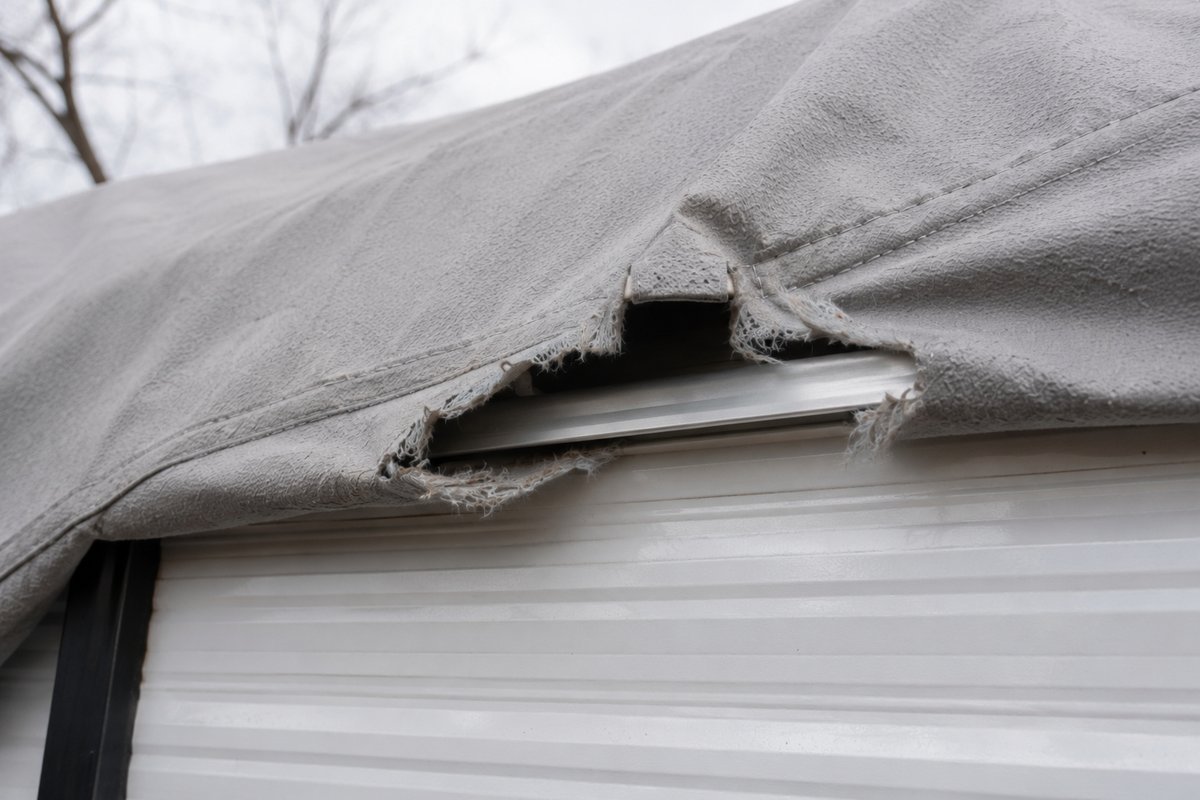
A loose cover is a sail, and a sail wears through at every corner it slaps. Straps go under the frame, not around the tires. Tension panels get pulled properly, not left slack for later. The first windy week tells you whether you got it right, so check it then rather than waiting until March.
Will an RV cover scratch or damage my RV?
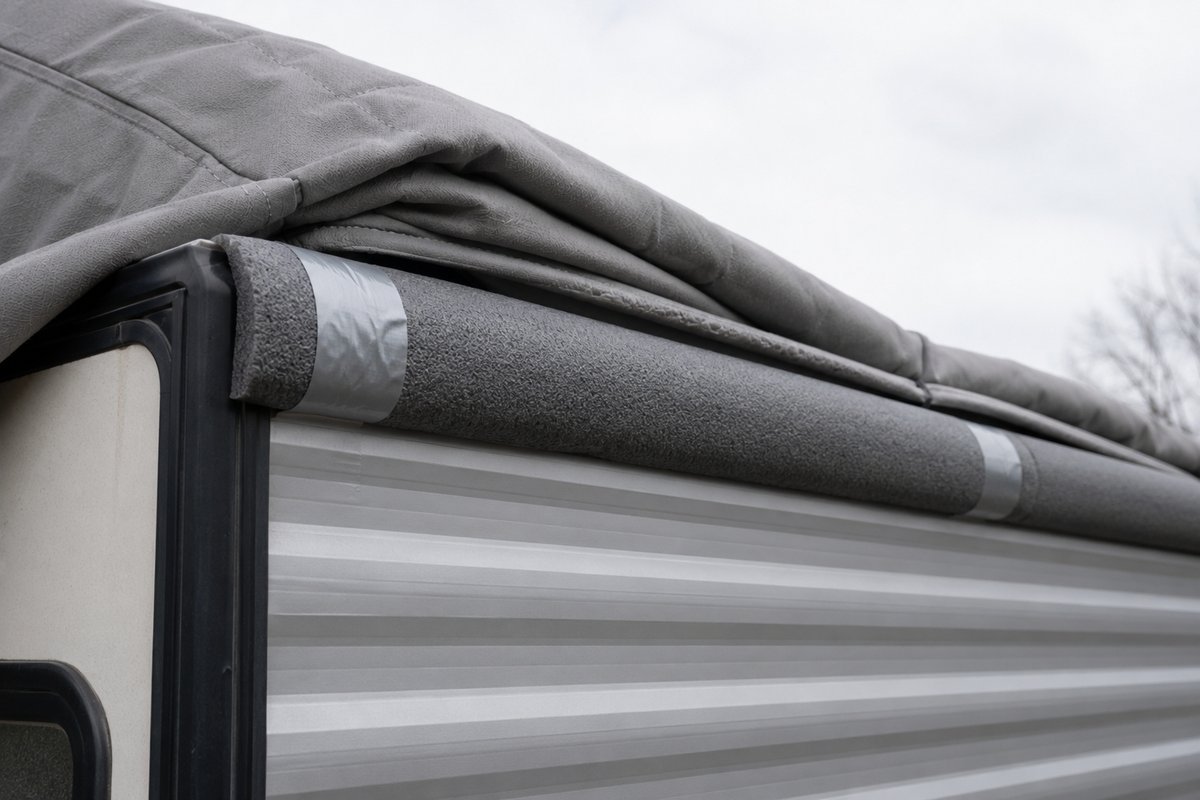
Gutter rails, ladder brackets, awning arms and the tips of the entry-door grab handle are what destroy covers. Foam pipe insulation taped over each one costs very little and is the difference between a cover lasting four seasons and two.
Never cover a wet trailer
Put a cover over a roof that's still damp, and you have built a greenhouse. Wait for a dry day, or at least a dry afternoon, and open the vents inside before you close it up.
A cover does nothing for sealant that has already cracked, either. Check the roof sealant before the cover goes on, because a cover over a leaking roof only hides it until spring.
How to choose the right cover
Answer one question first: Is your RV fighting damp or fighting wind?
Everything else follows from that, because the two things a cover can do well are opposites. A fabric that lets vapor out also lets some weather in. A fabric that seals weather out also seals vapor in.
Parked somewhere damp and sheltered, a field, a yard, under trees? Buy non-woven. The non-woven covers and the Tyvek-topped Camco breathe, which is what keeps the inside of your trailer from staying damp and growing mold over five months. Accept that they scuff more easily.
Parked somewhere open and windy? Buy the coated woven, the 300D or 600D polyester. It holds its shape instead of flapping itself apart, and you deal with the trapped moisture separately with absorbers inside.
If you can't decide, buy for damp. Wind damages a cover. Damp damages the trailer.
What size RV cover do I need?
Every link on this page opens one size band. Covers are sold as a separate listing per length, so the band each card links to is printed in its spec row. Check it against your own measurement before ordering, and change the size on the listing if you need a different one.
Covers are sold in two-foot length bands, and the length on your trailer's spec sheet isn't the number to order from. That figure often leaves out the hitch, the rear bumper, or both.
- Measure from the rear bumper to the coupler, along the side, with a tape rather than a guess.
- Add anything that sticks out and will sit under the cover: a rear ladder, a spare wheel carrier, a bike rack you're leaving on.
- Land between two bands? Take the larger one and pull the tension panels in. A cover you have to stretch will split at a seam in the first strong wind.
- Check the height as well as the length if you have a roof air conditioner. That is where a too-small cover tears first. If clearing it is a struggle, a dedicated rooftop AC cover is worth considering instead of trying to stretch the whole-RV cover over it.
Four things to look for on the cover itself
- Vents. Not decorative. They stop the cover ballooning, which is what tears the panel away from the seam.
- Zippered access panels at the entry door, so you can get in during winter without dragging the whole thing off.
- Straps that go under the frame, not around the tires. Any cover whose instructions say to loop around the wheels will work loose.
- Elasticated corners front and rear. They pull the cover in rather than letting it flap, and flap is what kills covers.
Why you cannot compare covers on breathability or denier
No cover manufacturer publishes a breathability figure. Housewrap and outdoor clothing both print one on the packaging. This industry doesn't. So don't buy on a "breathable" claim, because there's no number behind it on any of them. Buy on woven versus non-woven, which you can see, and treat the rest of the marketing as noise.
Denier is the other trap. 300D and 600D describe how thick the yarn is, not how the cover behaves. The coating decides that, and nobody publishes the coating. A heavier denier is a tougher fabric, not a better cover for storage.
A cover keeps weather off, but damp underneath is the bigger risk. The EPA's guide to mold and moisture recommends keeping indoor humidity below 60 percent, ideally between 30 and 50, which is why a breathable cover over a dry trailer matters more than a thick one.
Quick Answers
Should I cover my RV in storage?
It depends which problem your storage spot has, and that is the question this whole guide turns on. If the trailer sits out in sun, rain and snow, a cover earns its money. If it sits somewhere still and damp with no airflow, a cover can hold moisture against the sides and you're trading one problem for another.
The one rule with no exceptions: never put a cover on a wet trailer. Everything a cover does wrong, it does faster with water already underneath it.
Is it better to store an RV inside or outside?
Inside, and it isn't close. A building removes sun, rain and snow load altogether, which is more than any cover can claim. A cover is the answer to the question of how to store a trailer outside, not a substitute for a roof.
Two things to know if you do get indoor space. Most of it is unheated and unventilated, so damp is still your problem and a dehumidifier still matters. And an enclosed building with no airflow is exactly the place a wet trailer stays wet, so it goes in dry either way.
Is a carport or shelter better than an RV cover?
If you can build one, yes. A carport or a shelter takes the sun, the rain and the snow load off the trailer without touching it, and nothing rubs against the paint in the wind. It's the option with no downside except cost and planning permission.
The real comparison isn't cover against carport, it's cover against nothing. Most people reading this aren't going to put up a structure this season, and a cover is what stands between the roof and another summer of sun.
Can I just use a tarp instead?
A tarp is the one thing worse than no cover at all. It doesn't breathe, so whatever moisture is under it stays under it, and a hard plastic weave moving against the sides in the wind will take the finish off. Every problem this guide describes with covers, a tarp has in a stronger form.
If the budget will only stretch to a tarp, spend the money on a dehumidifier inside the trailer instead and leave the outside uncovered. You will be further ahead.
Should you cover your RV in winter?
For UV and bird mess, yes, clearly. For moisture it depends entirely on whether the trailer went under the cover dry and whether the fabric breathes. A waterproof cover on a damp trailer is worse than nothing.
Do I need to take it off during winter?
No, but check it after every serious wind. Nearly all cover failures are abrasion at a corner or a strap that worked loose, and both are visible from the ground in under a minute.
Why do covers list sizes in two-foot bands?
Because they're cut to a pattern rather than to your RV. Measure bumper to hitch yourself rather than going by the listed length, and if you land between bands take the larger one and pull the tension panels in.
Will a cover stop rodents?
No. It gives them one more sheltered place to sit. Rodent control is a separate job with separate gear.
Final thoughts
If your trailer sits somewhere damp, buy for breathability and accept a shorter life: the ADCO or the Camco. If it sits somewhere windy and exposed, buy the coated woven and accept that you're trapping some vapor: the Leader or the RVMasking. If you want the longest guarantee and are content not to know what you bought, the Classic Accessories is the only five-year cover here.
Whichever you pick, pad the sharp edges first and put it on dry. Those two habits do more for how long a cover lasts than the difference between any two products on this page.
Related guides
- 5 Best RV Dehumidifiers for Winter Storage. The other half of the damp problem, and the more important half.
- 5 Best Battery Maintainers for RVs in Winter Storage. The battery is the thing most likely to die while the trailer sits.
- RV Storage & Security: The Complete Guide. Everything that goes wrong in storage, and which guide covers it.
- 5 Best Smart Temperature Sensors for RVs in Storage. For knowing what the air under that cover is doing.