
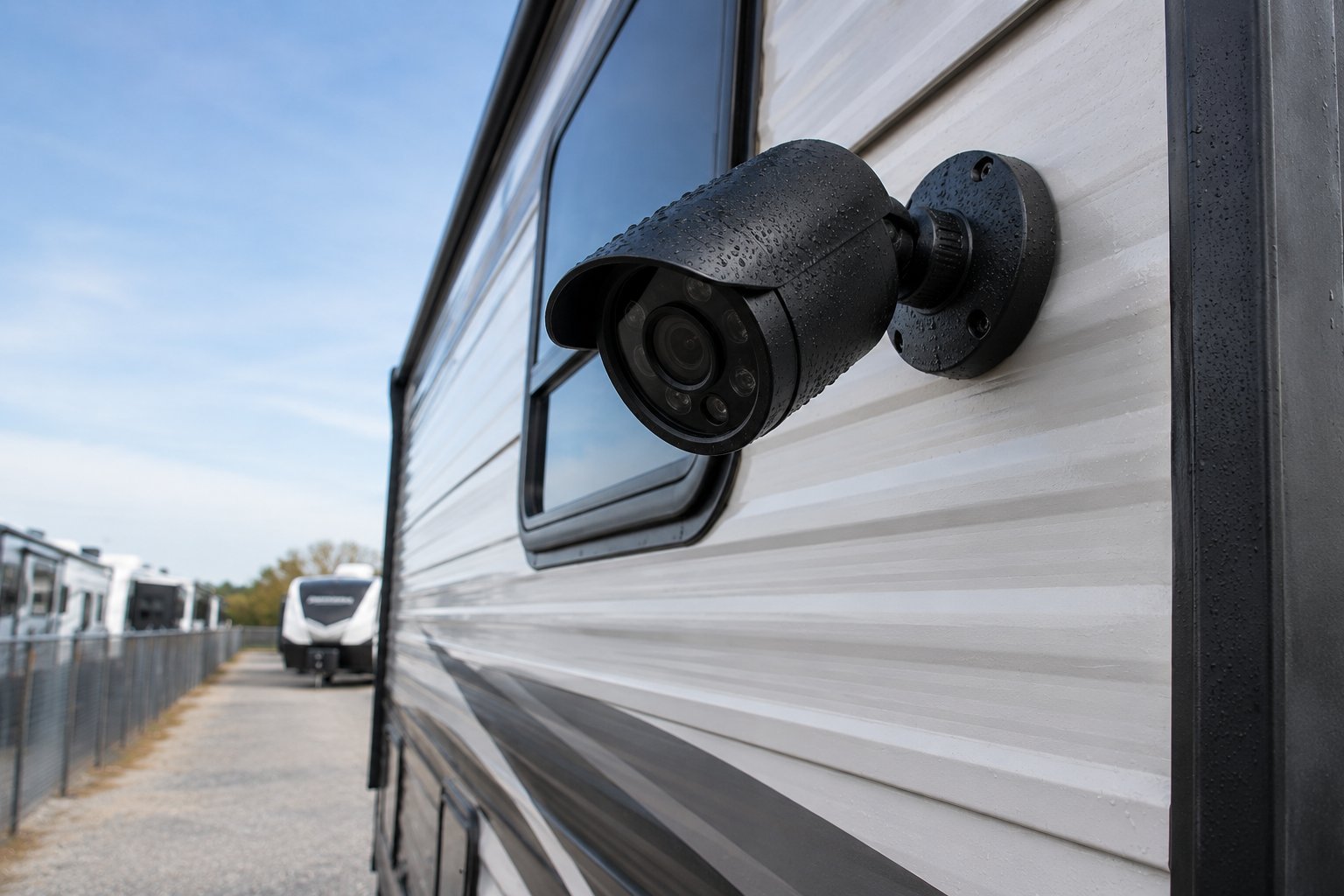
You lock up the trailer, hitch up the tow vehicle, and head home for the season, leaving your rig parked in a storage lot or on a rural piece of land for weeks or months at a time. An RV security camera is the obvious answer for a rig left alone, and the obvious answer has a power problem.
Then the worry sets in: is anyone messing with it? Did that storm knock a branch onto the roof? Is the door still locked? For retirees who have poured savings into an RV, that kind of uncertainty is exhausting, and driving out just to check on things gets old fast.
Table of Contents
The 5 Best Security Cameras for Unattended RVs
4K through two lenses covering 180 degrees, which means one camera watches the whole side of a trailer instead of just the door. The solar bundle includes a 6-watt panel that keeps the battery up on a few hours of sun a day.
Storage is a microSD card up to 256GB or a cloud plan, whichever you prefer, so there is no subscription unless you want one. It needs WiFi at the storage site, and that is the thing that rules it in or out. Mounting the panel where it can actually see sky is fiddly around awnings and slide-outs.
What You’ll Love
- 180-degree coverage from one camera
- 6W solar panel included in the bundle
- Color night vision
- No subscription if you use a microSD card
- Works with Reolink’s home hub for local storage
Worth Considering
- Needs WiFi at the storage location
- The solar panel needs a clear view of the sky
- Setup takes more patience than the simpler cameras
Skip this one if your storage spot has no Wi-Fi at all, you’ll want a cellular option instead.
Two AA lithium cells, which Blink rates for up to two years. That is the whole appeal. Mount it, leave it, and stop thinking about a charging schedule between trips.
1080p with infrared night vision, WiFi only. Clips go to a cheap cloud plan, or add the Sync Module and keep them on a USB stick with no monthly fee at all. At 1080p a face or a plate at any distance is a guess rather than evidence.
What You’ll Love
- Cheap to buy and cheap to run
- Up to two years on AA lithium cells
- Simple app to set up
- Optional local storage with no subscription
Worth Considering
- 1080p, so distant faces and plates are hard to read
- No solar option, so batteries are changed by hand
- Needs WiFi at the storage site
Skip this one if you want the sharpest possible video quality or need cellular connectivity. This camera is built for value, not top-tier resolution.
It carries its own 4G LTE connection, so it needs no router and no hotspot. For a gravel lot or a piece of rural land with no network, that is the only specification that matters.
A 9,000mAh battery, 2K video, 300-degree pan, two-way talk, and a siren you can set off from the app. The costs are a data plan on top of the camera and a dependency you do not control. In genuinely remote or mountainous country it may not report at all.
What You’ll Love
- No WiFi needed anywhere with cell coverage
- Large 9,000mAh battery
- Siren and two-way talk you can trigger remotely
- 2K video
Worth Considering
- Monthly or annual data subscription
- Depends on cell signal, which is poor in some remote areas
- Video is not as sharp as the best WiFi cameras here
Skip this one if your storage lot already has strong Wi-Fi. You’d be paying for cellular data you don’t need.
WiFi when it is there, 4G LTE when it is not, switching between them on its own. If the trailer moves between storage spots through the year, that is one camera instead of two.
1080p, with person and animal detection to cut down false alerts, and a removable battery you can swap for a charged spare in seconds. It is also the most expensive here, the solar panel is extra, cellular needs its own plan, and the SD slot backs up clips rather than replacing cloud storage.
What You’ll Love
- Switches between WiFi and cellular automatically
- Optional solar panel keeps it charged in sunny spots
- Removable battery swaps in seconds
- Person and animal detection reduces false alerts
Worth Considering
- The highest upfront cost on this list
- Solar panel sold separately
- Cellular needs its own data plan
- The SD card backs up clips rather than serving as primary storage
Skip this one if you’re on a tight budget. The combination of camera cost, solar panel, and data plan adds up quickly compared to the other options here.
The middle option, and the familiar one. 1080p with color night vision, a removable rechargeable pack, and the Ring app that plenty of people already have on their phone for the house.
Protect is inexpensive and holds 60 days of history, with local storage possible through a compatible Ring device. There is no cellular version, so no WiFi means no camera, and the battery wants recharging more often than the Blink’s AAs or the Waggle’s larger pack.
What You’ll Love
- An app most people already know
- Removable battery pack, easy to swap or recharge
- Color night vision, with a spotlight on some versions
- Works alongside other Ring devices
Worth Considering
- No cellular option, so it needs WiFi at the site
- Shorter battery life than the Blink or the Waggle
- Full video history needs a Ring Protect subscription
Skip this one if you need months of unattended battery life or there’s no Wi-Fi where you park.
A camera turns that into a question you can answer from the sofa. The difficulty is that almost every camera on the shelf assumes a house: an outlet, a router, and a roof overhang keeping the rain off. A trailer in a storage lot has none of the three.
This guide is based on independent research, not hands-on testing. We compare published manufacturer specifications, cross-check them against verified customer reviews on retail sites and RV forums, and weigh each product on how each one performs on an RV left unattended in a storage lot or driveway. We have not physically tested these units ourselves, and where the published specs and real-world owner reports disagree, we say so in the write-up.
Quick Comparison
Before we get into the details, here’s a side-by-side look at all five cameras so you can see how they stack up on power source and storage.
| Camera | Best For | Power Source | Storage |
|---|---|---|---|
| Reolink Argus 4 Pro | Best Overall | Rechargeable battery + included solar panel | MicroSD card (local) or optional cloud plan |
| Blink Outdoor 4 | Best Budget Pick | Two AA lithium batteries (up to 2 years) | Cloud subscription or local storage with Sync Module |
| Waggle 4G LTE Camera | Best Cellular Option for Remote Lots | Rechargeable 9,000mAh battery | MicroSD card plus cloud app access |
| Arlo Go 2 | Best Solar-Powered Option | Rechargeable battery, extendable with Arlo solar panel | Cloud subscription (SD card slot for local backup) |
| Ring Stick Up Cam (Battery) | Best Battery-Powered WiFi Camera | Removable rechargeable battery pack | Cloud subscription (Ring Protect) or local with optional storage device |
Why RV Cameras Are Different From Home Security Cameras
Most security cameras are designed for a house: plugged into an outlet, connected to a home Wi-Fi router, and tucked under an eave that keeps rain off. None of that applies to a parked travel trailer. There’s no outlet nearby, so the camera has to run on battery or solar power for months without you touching it. There’s no roof overhang, so it needs a housing that can shrug off rain, dust, heat, and freezing nights. And depending on where you store the rig, there may not be any Wi-Fi network within range at all.
That combination of no power, weather exposure, and spotty connectivity is why the “best” camera for your house isn’t automatically the best one for your trailer. The cameras below were chosen specifically because they hold up under those conditions.
What to Look for in an RV Security Camera
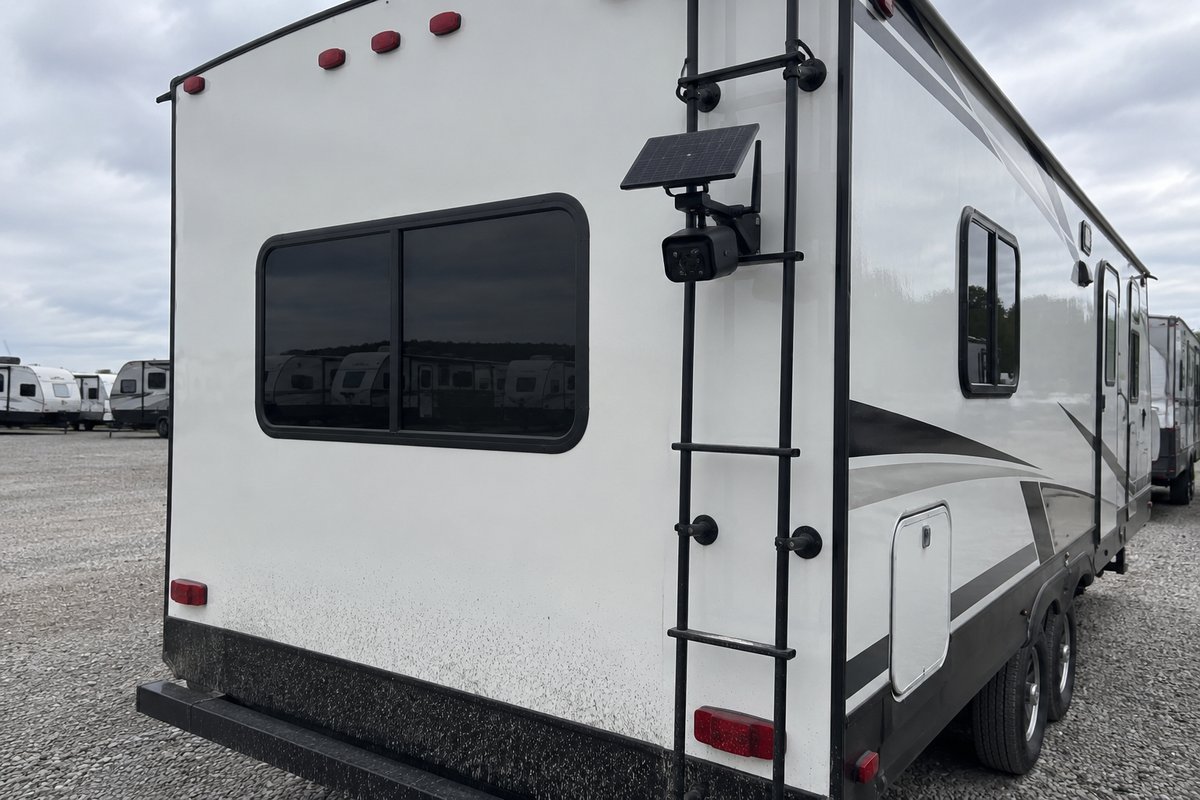
Power source. Since you likely won’t have shore power running to your trailer while it sits in storage, look for a camera built around a large rechargeable battery, solar charging, or both. A camera that claims “long battery life” but is really designed to be recharged every few weeks off a wall outlet isn’t going to work for a rig parked three states away. Solar add-ons are worth the extra cost if your storage spot gets decent sun, since they can keep a camera running indefinitely without you lifting a finger.
Connectivity. If your storage lot or rural property has a strong Wi-Fi signal, a standard Wi-Fi camera will do the job and save you money. If you’re storing the trailer somewhere with no internet at all, such as a friend’s back acreage or a remote RV park off-season, you’ll need a cellular camera that uses its own SIM card and data plan instead of relying on a router.
Storage type. Cameras generally save footage in one of two ways: onto a physical microSD card inside the camera, or up to the manufacturer’s cloud servers through a paid subscription. A microSD card is a one-time cost and keeps your footage local, but if someone steals or damages the camera, the card usually goes with it. Cloud storage protects your footage even if the camera itself is destroyed, but it comes with a recurring monthly fee.
Night vision quality. Most break-ins and vandalism at storage lots happen after dark, so this matters more for an RV camera than it might for a porch camera that’s watched all day. Look at whether the camera uses infrared night vision (black-and-white, works in total darkness) or color night vision (requires a bit of ambient or spotlight light but shows more detail, including clothing color).
Weatherproofing. Check the IP rating, which tells you how resistant a camera is to dust and water. Anything rated IP65 or higher is a safe bet for year-round outdoor mounting on a trailer, whether it’s baking in Arizona heat or sitting under snow in Montana.
How We Picked These
These recommendations are based on published manufacturer specifications, pricing from major retailers, and patterns we found across verified owner reviews, rather than hands-on testing. We focused on cameras with a genuine track record for outdoor, off-grid use rather than models simply marketed for RVs without the battery capacity or weatherproofing to back it up. As always, double-check current pricing and availability before you buy, since retailers adjust both fairly often.
Frequently Asked Questions
Is this a security camera or a backup camera?
A security camera, and the difference matters because searching for an RV camera turns up both. A backup camera is wired into the trailer, powered by the tow vehicle and shows you what is behind you while you drive. Everything in this guide is the opposite: battery or solar powered, works while the trailer is parked and you are somewhere else, and sends an alert rather than a live view to a dash screen.
If what you want is help reversing, none of these is the right purchase.
Which RV security cameras have no monthly fee?
The ones that store footage on a card inside the camera rather than in the cloud. That is the pattern to look for, and it is independent of brand: local storage means no subscription, cloud storage usually means one.
There is a catch worth understanding before you optimize for it. A camera on a cellular connection needs a data plan whatever it does with the footage, because that is what carries the alert to you. Avoiding a cloud subscription does not avoid the cellular bill, and for a trailer in a storage lot with no Wi-Fi, cellular is the whole point.
What usually goes wrong with RV security cameras?
Three things, in this order. The battery dies faster than the specification suggested, because cold weather and frequent triggering both drain it. The connection is worse than expected, because storage lots sit on the edge of town where coverage is thin. And the alerts become noise, because a camera pointed at a road or a tree line triggers on everything that moves until somebody narrows the detection zone.
All three are setup problems rather than product faults, which is why they are worth knowing about before you buy rather than after.
Do I need cellular or Wi-Fi for an RV storage lot camera?
It depends entirely on your storage location. If the lot or property has a Wi-Fi network you can connect to, a Wi-Fi camera is cheaper to buy and run since it has no ongoing data cost. If there’s no internet access nearby at all, you’ll need a cellular camera with its own SIM card and data plan, since it creates its own connection independent of any local network.
How long does a solar-powered RV camera battery last?
With a solar panel mounted where it gets several hours of direct sun each day, most solar-compatible cameras can run indefinitely, since the panel offsets what the battery uses to record and transmit clips. Without sun, or if the panel is shaded by trees or an awning, expect the internal battery alone to last anywhere from a few weeks to a few months depending on how much activity it records.
Does a stored RV need a subscription for camera storage?
Not necessarily. Many cameras, including several on this list, can save footage to a microSD card inside the camera itself with no monthly fee. Cloud subscriptions are optional add-ons that back up footage off-site, which is useful if you’re worried about the camera being stolen or damaged, but they aren’t required to simply record and review video.
Will a security camera drain my RV’s house battery?
Not if you choose one of the battery or solar-powered models covered here. These cameras have their own internal battery and don’t draw from your trailer’s house battery or converter at all, which is exactly why they work for units left unattended without shore power.
Can I check my RV camera from my phone while traveling?
Yes. Every camera on this list connects to a smartphone app that lets you view live video, receive motion alerts, and review recorded clips from anywhere with a cell or Wi-Fi signal, whether you’re a mile away or across the country.
How cold or hot can these cameras get before they stop working?
Most outdoor security cameras built for year-round use are rated to operate in a range of roughly minus 4 to 122 degrees Fahrenheit, though extreme cold can shorten battery life temporarily. Check the specific operating temperature range listed by the manufacturer if you store your RV somewhere with harsh winters or desert summers.
Related guides
Cameras are one layer. These cover the others worth having on an RV you cannot check on daily.
- Best GPS Trackers for Travel Trailers. What recovers a trailer after a camera records it leaving.
- Best Water Leak Detectors for Travel Trailers. The damage that happens quietly while nobody is watching.
- Best Freeze Alarms for Winterized RVs. For anything stored through a cold season.
- RV Storage & Security: The Complete Guide. The overview that ties the storage guides together.
Final Thoughts
Pick backwards from the lot rather than forwards from the features. No network at all means the Waggle or the Arlo, and a data plan you will be paying for indefinitely. A lot with WiFi opens up the Reolink, which is the most camera for the money here. If you want to mount something and genuinely forget it, the Blink runs two years on a pair of AA cells and asks nothing of you in between.