
A slow drip under the kitchen sink doesn’t announce itself. An RV water leak detector is meant to catch exactly that, although in storage the real risk is not the plumbing at all. There’s no siren, no smell, nothing you’d notice on your way to bed.
By the time you spot a soft spot in the floor or a musty smell in the closet, the damage is usually already done, and in a travel trailer, “done” can mean thousands of dollars in rotted subfloor, delaminated walls, and ruined insulation.
That’s the quiet danger of RV water damage: it happens out of sight, and most of it happens while nobody is in the rig at all.
Table of Contents
5 Best Water Leak Detectors for Travel Trailers
The top pick because it does the job with the fewest dependencies. 4GHz Wi‑Fi network without a separate hub, which keeps setup to about five minutes: download the Govee Home app, scan the QR code, join the network, and place it wherever you’re most worried. When the probes on the bottom sense moisture it sounds a 105‑decibel local alarm and pushes a notification to your phone within seconds.
It’s rated IP67, the battery is rated for roughly five years of standby, and it’s small enough to tuck behind a water heater access panel. Connectivity: direct Wi‑Fi, no hub, which also means no Wi‑Fi, no alert. In a storage lot with no network it will still shriek locally, but only the seagulls will hear it.
What You’ll Love
- Easy setup with no hub required
- 105dB local alarm, loud enough to wake you if you are camped nearby
- Long battery life
- Cheap enough to buy two or three
Worth Considering
- It depends entirely on your trailer having a working Wi-Fi connection
- So it’s not the right choice for boondocking or storage lots without internet access.
If one sensor makes sense, five usually makes more sense, and this bundle covers every risk point in a trailer for far less than five singles. 4GHz Wi‑Fi, no hub, 105dB alarm, five‑year battery, just sold five to a box, and each unit reports separately in the app so you know which one tripped.
Govee sells a cheaper, older‑looking 5‑pack that carries the phrase “Cannot Connect to Wi‑Fi Directly” right in the product title: those sensors talk only to a separate Govee gateway, and without that gateway you get five loud local alarms and nothing on your phone.
The 1s pack linked here needs no gateway. The two listings look nearly identical in search results and differ by about the price of the gateway, which is exactly the trap. Connectivity: direct Wi‑Fi, no hub, but like any Wi‑Fi sensor, no network means no alert.
What You’ll Love
- Excellent price per sensor compared to buying individually
- No gateway to buy or power
- Full coverage of a typical trailer’s leak-prone areas
- Each unit reports separately, so you know which one tripped
Worth Considering
- Still Wi-Fi dependent like the single unit
- Easy to confuse with Govee’s cheaper gateway-only 5-pack
- And pairing five sensors at once can be a bit tedious the first time through.
YoLink takes a different approach, and it’s the right one for a trailer that lives somewhere without a good network. Instead of each sensor connecting to Wi‑Fi, a central hub talks to the sensors over LoRa, a long‑range, low‑power radio that reaches up to a quarter mile line of sight and punches through a metal‑skinned trailer far better than Wi‑Fi. Only the hub needs internet. 4GHz Wi‑Fi and a 120V outlet, which still assumes power and a network at the trailer.
The version worth knowing about for storage is YoLink’s 4G LTE cellular hub kit, which carries its own cellular connection on a subscription and sends SMS, email and push alerts with no local internet at all. It still needs 120V power at the hub, so it works in a covered storage building or a lot with a pedestal, not a bare gravel lot. Connectivity: the only pick here that can alert you with no Wi‑Fi, if you buy the LTE hub.
What You’ll Love
- Exceptional range and signal penetration through metal trailer walls
- Works with any single internet source rather than requiring each sensor to have its own connection
- Expandable with other YoLink sensors
Worth Considering
- The upfront cost is higher than a simple Wi-Fi sensor because you’re paying for the hub
- And you still need some internet connection at the hub itself for remote alerts to reach your phone.
A plain puck, and priced like one: connects to your Wi‑Fi, sounds a local alarm when the probes touch water, sends a push notification. The battery is a standard replaceable cell you can buy at any hardware store rather than a sealed rechargeable, which several owners prefer. The app is noticeably more basic than Govee’s, with fewer notification options, but the core job works.
Zircon also sells a non‑Wi‑Fi Leak Alert for a few dollars. Worth knowing about, because for a trailer where nobody will hear an alarm anyway, the cheap one is arguably the more honest purchase. Connectivity: needs a live Wi‑Fi network for alerts.
What You’ll Love
- Low price point that makes it an easy add-on purchase
- Standard replaceable battery
- Simple operation with nothing to configure
Worth Considering
- The app is more limited than competitors
- With fewer notification customization options and a less polished interface.
The Flo by Moen is in a different category from the puck sensors above. It installs inline with the main fresh water supply and continuously monitors flow rate, pressure and temperature; if it sees an unusual pattern, water running at 3am, or a spike consistent with a burst line, it closes the main valve within seconds. That makes it the only pick here that intervenes rather than just alerting. Two practical caveats decide whether it belongs in your rig.
It’s built for household 3/4” and 1” pipe, not the 1/2” PEX most trailers run, so plan on adapters and real plumbing work. 4GHz Wi‑Fi to function. Connectivity: Wi‑Fi and constant power required. This is a strong choice for a trailer parked at home on shore power, and the wrong choice for an unpowered storage lot. Despite how often it gets recommended for exactly that.
What You’ll Love
- Automatic shutoff stops leaks even when nobody is around to respond
- Continuous flow and pressure monitoring can catch problems a simple puck sensor would miss
- Detailed water usage history in the app
Worth Considering
- Significantly more expensive than a puck-style sensor
- And installation requires cutting into your water line rather than simply setting a device on the floor.
There’s an obvious question here, and it’s worth answering before you spend a dime. com/rv-storage-security-the-complete-guide/”>storage lot, the plumbing is drained, so what is there to leak? The honest answer is that the plumbing is only one of the ways water gets into a trailer, and in storage it is the least likely one.
Far more stored trailers are ruined by rain and snowmelt finding a cracked roof seam, by condensation with nowhere to go in a sealed rig, or by a fitting that split over the winter and doesn’t reveal itself until you pressurize the system in the spring.
A leak sensor sitting on the floor catches all of those, because they all end the same way: water pooling on a floor you can’t see.
That distinction matters for what you buy, too. A sensor is only useful if the alarm actually reaches you, and a storage lot usually has no Wi-Fi, no power pedestal, and nobody around to hear a beeping puck. In this guide we walk through five leak detectors for travel trailers, say plainly what each one needs in order to reach your phone, and cover the questions we hear most from owners who park their rig for months at a time.
This guide is based on independent research, not hands-on testing. We compare published manufacturer specifications, cross-check them against verified customer reviews on retail sites and RV forums, and weigh each product on how each one performs in a travel trailer, including whether its alerts can reach you in storage. We have not physically tested these units ourselves, and where the published specs and real-world owner reports disagree, we say so in the write-up.
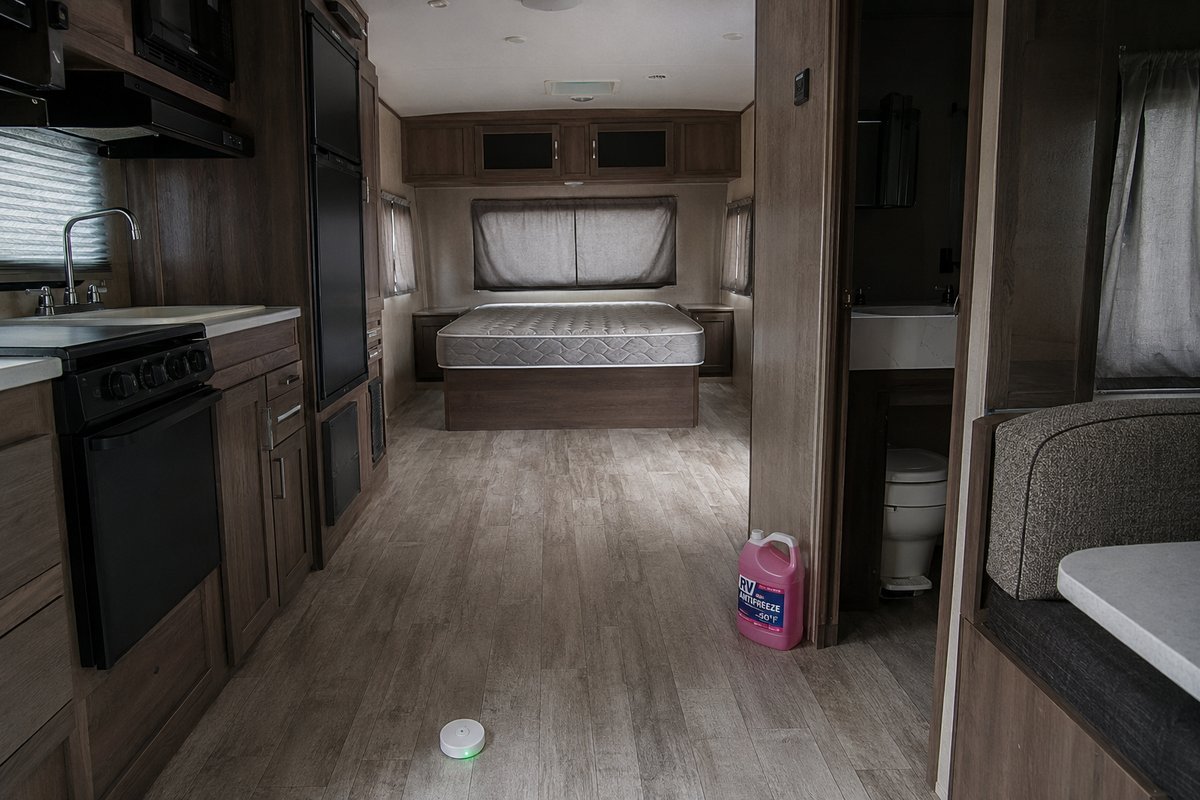
Quick Comparison
| Product | Best For | Key Spec | Will It Reach You In Storage? |
|---|---|---|---|
| GoveeLife Water Leak Detector 1s | Best Overall (single sensor) | Direct Wi‑Fi, no hub, 105dB alarm, 5‑year battery, IP67 | No. Needs a live 2.4GHz Wi‑Fi network; local alarm only without one |
| GoveeLife Water Leak Detector 1s, 5-Pack | Best Value for Multiple Sensors | Five direct Wi‑Fi sensors, no hub, 105dB each, 5‑year battery | No, needs a live Wi‑Fi network |
| YoLink Water Leak Starter Kit | Best Range (works away from home Wi-Fi) | LoRa hub, up to 1/4‑mile line of sight; LTE hub version available | Only with the LTE cellular hub (subscription) plus 120V power at the hub |
| Zircon Leak Alert Wi-Fi | Best Budget Single Sensor | Simple Wi‑Fi puck, standard replaceable battery | No, needs a live Wi‑Fi network |
| Flo by Moen Smart Water Monitor & Shutoff | Best for a Trailer Parked at Home | Inline shutoff valve with flow monitoring, fits 3/4” and 1” pipe | No. Needs 2.4GHz Wi‑Fi and a permanent AC outlet |
Why This Matters
Water damage is different in a travel trailer than in a house. A stick-built home has a full foundation, a slab, and walls made of solid lumber and drywall that can absorb some moisture without immediately falling apart. A travel trailer’s floor is typically thin plywood or composite decking sitting on an aluminum or steel frame, and the walls are often a foam-and-luan sandwich designed to be light, not waterproof.
Once water gets into that sandwich, it doesn’t just sit there, it wicks sideways through the seams, soaks into the insulation, and starts breaking down the glue that holds the wall panels together.
A leak that would leave a small stain on a house’s drywall can turn an RV’s wall or floor into mush within a few weeks. That speed is exactly why an RV water leak detector earns its place on a checklist most owners otherwise skip.
Storage is where most of that damage happens, and it usually isn’t the plumbing. A winterized trailer has been drained and pumped full of antifreeze, so there isn’t much left in the lines to leak. What there is instead is a roof. Sealant around the vents, the skylight, the AC shroud and the front and rear caps gives up a little more every season, and once it cracks, every rain and every thaw sends water down inside the wall cavity.
Window and slide seals fail the same way. This is the single most common way a trailer gets written off, and it happens almost entirely while the rig is parked and nobody is looking at it.
Condensation is the second problem, and it needs no leak at all. A sealed, unheated trailer going through a wet fall or a freeze‑thaw cycle builds up moisture that has nowhere to escape, and that moisture settles into the subfloor and the corners. Then there’s mold, which follows either of the above within a week or two in warm, humid conditions, and mold remediation in an RV is expensive and sometimes not worth doing at all, meaning the trailer gets sold for parts.
The plumbing does get its turn, but later: a fitting in a low spot that didn’t fully drain can split over the winter and stay silent until you hook up city water in the spring, at which point it runs freely into the floor.
A sensor on the floor near your low points is what turns that from a discovery into an alert. Beyond the repair bill, water damage is one of the fastest ways to tank a trailer’s resale value, a buyer who finds soft flooring near the bathroom will walk away or expect a steep discount, even if the leak itself was fixed years ago.

What to Look For
Not every leak detector is built the same way, and the right choice depends almost entirely on where your trailer spends its time. Someone who full‑times and is always within earshot of the rig has very different needs from someone who parks it in a storage lot for six months a year. Here’s what actually matters when you’re comparing options.
If Your Trailer Is in Storage, Check This First
Before you compare features, answer one question about your storage spot: is there power, and is there a network? Almost every leak detector sold today assumes the answer to both is yes, because they were designed for basements. In a gravel lot with neither, a Wi‑Fi puck is a very quiet smoke alarm. It will detect the leak faithfully and tell nobody.
If your lot has a 120V outlet, you have real options: a YoLink LTE cellular hub covers the trailer with no local internet, or a battery‑backed hotspot can feed a standard Wi‑Fi sensor. If your storage is indoors at a facility with guest Wi‑Fi, a plain Wi‑Fi sensor is fine.
com/rv-roof-sealant/”>fresh sealant on the seams and vents, and a breathable cover. Prevention beats detection when nobody is there to receive the alert.
Simple Sensors vs. Whole-Trailer Shutoff Systems
Most of the products on this list are passive sensors: small pucks with two metal contacts on the bottom that complete a circuit when they touch water, triggering a local alarm and a phone notification. com/rv-water-heater-repair/”>water heater, and they tell you a leak is happening, but they don’t do anything to stop it.
If you’re away from the trailer when the alert comes in, water keeps flowing until you or someone else gets there to shut off the pump or the city water connection.
A whole‑trailer shutoff system, like the Flo by Moen, installs inline with your main water line and can close the valve automatically when it sees an unusual flow pattern. 4GHz Wi‑Fi network to do anything, and it’s built for household 3/4” and 1” pipe rather than the 1/2” PEX most trailers run.
In practice that makes it a good fit for a trailer parked at home on shore power and your house Wi‑Fi, and a poor fit for an unpowered storage lot, which is the opposite of how these systems are usually pitched to RV owners.
Connectivity and Range Inside a Metal Box
Travel trailers are essentially metal boxes, and metal is not friendly to wireless signals. A Wi‑Fi sensor tucked into a cabinet under the bathroom sink can struggle to reach a router through an aluminum wall or a steel frame member. This is where hub‑based systems have an edge: YoLink’s sensors use a low‑power, long‑range LoRa radio that punches through obstacles far better than Wi‑Fi, and only the hub itself needs an internet connection.
Note the word hub, though. 4GHz Wi‑Fi, so it solves the range problem, not the no‑power‑no‑internet problem.
Battery Life and Maintenance
A leak detector is only useful if its battery is still alive when the leak happens, and that’s easy to forget about on a device tucked behind a water heater you never look at. Standby ratings vary more than you’d expect: the GoveeLife 1s is rated for about five years, while older puck designs run one to two.
Cold matters too. Coin cells lose a meaningful chunk of their capacity below freezing, which is exactly the condition a stored trailer sits in all winter, so treat published ratings as optimistic for storage use. Look specifically for a low‑battery alert, since a sensor that just goes silent gives you no way of knowing it failed.
How Many Sensors Your Rig Actually Needs
A typical travel trailer has several spots where water shows up: under the kitchen sink, under the bathroom sink, behind or under the water heater, near the toilet’s water connection, and at the low point drains or fresh water inlet. If the trailer spends time in storage, add the places where outside water lands after it gets in. The floor directly below a roof vent or skylight, the corners of slide‑outs, and the lowest point of any closet or closet backing onto an exterior wall.
For a smaller trailer, three or four sensors covering the highest‑risk spots is usually enough. Larger fifth wheels may want five or six, which is a big part of why multi‑packs tend to be better value than buying singles.
How We Picked These
We did not physically install and test each of these devices inside a travel trailer. Instead, this list was built by researching published manufacturer specifications, comparing battery life, connectivity type, alarm volume, and pricing across each product, and cross-referencing that information with patterns we found consistently repeated in verified owner reviews on retail sites and RV forums. Where specs weren’t explicitly published by the manufacturer, we relied on the most commonly reported real-world figures from multiple independent reviewers rather than a single source.
We focused specifically on how each product performs in the context of a travel trailer’s metal construction, limited storage space, and often-inconsistent internet access, rather than treating these as generic household gadgets. As always, individual results can vary based on your trailer’s layout, wall materials, and local Wi-Fi or cellular conditions.
FAQ
How many water leak sensors do I need in an RV?
For most travel trailers, three to five sensors covering the highest-risk areas is a good starting point: under the kitchen sink, under the bathroom sink, near or under the water heater, and at the toilet’s water connection. Larger fifth wheels with additional plumbing, like an outdoor kitchen or a washer and dryer hookup, may need six or more to get full coverage. It’s better to start with the spots that have caused problems before, or that are hardest to see during a routine walk-through, and add sensors from there.
What is the best water leak detector that works away from home Wi-Fi?
If your trailer sits somewhere without a stable Wi‑Fi connection, a hub‑based system is the better choice, and specifically YoLink’s 4G LTE cellular hub kit. The sensors reach the hub over long‑range LoRa radio rather than Wi‑Fi, and the LTE hub carries its own cellular data connection on a subscription, so it can send SMS, email and push alerts with no local internet at all.
The one thing it still needs is a 120V outlet for the hub. If your storage spot has no power whatsoever, no system on this list will reach your phone, and you’re better off spending the money on roof sealant and a good cover.
Do water leak detectors work when the RV is in storage with no internet?
Only if something at the trailer can carry the alert out. A Wi‑Fi sensor with no network will still sound its local alarm, but in a storage lot that alarm reaches nobody. To actually get notified you need one of three things: a cellular hub like YoLink’s LTE kit, a battery‑backed hotspot left running at the trailer, or a storage facility that offers Wi‑Fi.
All three need power at the rig. This is the part most buying guides skip, and it’s the difference between a sensor that protects your trailer and a sensor that documents its destruction for you to find in the spring.
Can a water leak detector actually stop a leak, or does it just alert me?
Most of the sensors covered here, including the Govee and Zircon products, only detect and alert; they don’t have any way to physically stop water flow. If you want a device that can automatically shut off the water, you need a system like the Flo by Moen, which installs inline with your main water supply and closes the valve when it detects abnormal flow.
For many owners, a combination approach works well: simple puck sensors in high-risk spots for early warning, paired with a shutoff valve on the main line for true worst-case protection.
How long do the batteries last in RV leak detectors?
It varies more than the marketing suggests. The GoveeLife 1s is rated for about five years of standby; most older puck designs are rated one to two. Devices that check in with the app frequently drain faster than ones that only transmit when they detect water. Cold is the factor nobody mentions: coin cells lose a significant share of their usable capacity below freezing, so a sensor left in an unheated trailer through a northern winter will not hit its rated life.
Look for a low‑battery notification, and plan on swapping batteries when you winterize rather than trusting the number on the box.
Where should I place leak sensors in a travel trailer?
Place sensors flat on the floor or the lowest surface near a risk point, since water pools at the lowest spot in a cabinet before spreading. Good plumbing spots: directly under the kitchen and bathroom sink traps, next to or under the water heater, near the toilet’s supply line, and by the low point drains or fresh water inlet. For a stored trailer, add the spots where outside water lands.
The floor beneath each roof vent and the skylight, the corners of slide‑outs, and the lowest point of any closet backing onto an exterior wall. Avoid places where a sensor will get knocked around while towing, but keep it low enough to still catch water after normal road vibration.
Do these leak detectors work in a metal-sided travel trailer?
Yes, but signal strength can be a real factor. A trailer’s aluminum skin and steel frame can weaken Wi-Fi signals, especially for sensors placed deep inside cabinets or storage bays. Standard Wi-Fi sensors generally work fine near the center of the trailer where they’re closer to your router, but for sensors placed in far corners or enclosed bays, a long-range hub system like YoLink tends to maintain a more reliable connection.
Is a whole-trailer shutoff system worth the extra cost over simple sensors?
It depends almost entirely on where the trailer sits. For weekend campers who are usually near the rig, a set of simple Wi‑Fi sensors is often enough, since you can respond to an alert quickly. For a trailer parked at home on shore power and your house network, a shutoff system like the Flo by Moen adds real protection, because it acts instead of just alerting.
For a trailer in an unpowered storage lot, a shutoff system is the wrong purchase. It needs constant AC power and Wi‑Fi to do anything, and the water is turned off anyway. Spend that money on a cellular‑hub sensor kit if you have power, or on roof sealant and a cover if you don’t.
Final Thoughts
None of these devices cost more than a single insurance deductible, and most cost less than a weekend of RV park fees. The right one, though, depends less on the sensor than on where your trailer sleeps. If it’s in the driveway on your home network, a couple of GoveeLife 1s sensors in the highest‑risk spots is an easy first step, and a Flo by Moen adds automatic shutoff if you want the belt‑and‑suspenders version.
If it’s in a storage lot with power, YoLink’s LTE cellular hub is the only setup here that will actually reach your phone. And if it’s parked somewhere with no power and no signal at all, skip the smart sensor, put a cheap local alarm on the floor, and spend the difference on roof sealant, because in storage, the leak almost always starts above your head, not under the sink.