
You come back from a week away and the driveway spot where your travel trailer used to sit is empty. An RV GPS tracker is the one device that still helps after the trailer is already gone. Maybe it happened in broad daylight while you were inside the house. Maybe it sat in storage for three days before anyone noticed it was gone. Trailer theft is quiet by nature. There’s no alarm going off, no shattered glass, just a hitch and some tire marks in the gravel. By the time most owners realize their rig is missing, the trail has gone cold.
Table of Contents
The 5 Best GPS Trackers for Travel Trailers
A waterproof puck with a magnet strong enough to hold on a steel crossmember, so fitting it is a matter of reaching underneath and letting go. No tools and no wiring.
It reports over 4G LTE, which means anywhere with signal rather than only near the house. The plan lets you choose how often it checks in, and that choice is the whole trade. Frequent reporting drains the battery in days instead of weeks, it wants charging every couple of weeks in active use, and it does nothing at all without the subscription.
What You’ll Love
- Magnetic install with no wiring
- Waterproof housing
- 4G LTE tracking with movement alerts
- Reporting interval is adjustable
Worth Considering
- Battery drains fast at frequent reporting intervals
- Needs recharging every couple of weeks in active use
- Does nothing without an ongoing data plan
Skip this one if you don’t want to think about recharging a device on a schedule, or if you’d rather avoid a monthly bill altogether.
No cellular, no subscription, and about a year on a coin cell. It works by pinging any nearby iPhone through Apple’s Find My network, and that phone reports the location back to you without its owner ever knowing.
In a town it updates more often than you would expect. On rural land with no iPhones passing it is blind, which is unfortunately where trailers tend to be taken from. Apple’s anti-stalking alerts will also warn a thief that an unfamiliar AirTag is travelling with them, which is how they end up in a ditch. Treat this as a cheap second layer rather than the tracker.
What You’ll Love
- No subscription of any kind
- Very low cost
- About a year on one battery
- Uses one of the largest device networks in the world
Worth Considering
- Blind in remote areas with few iPhones around
- Works fully only with Apple devices
- Anti-stalking alerts can tell a thief it is there
Skip this one if you frequently camp in remote areas with little foot or cell traffic, or if you use an Android phone.
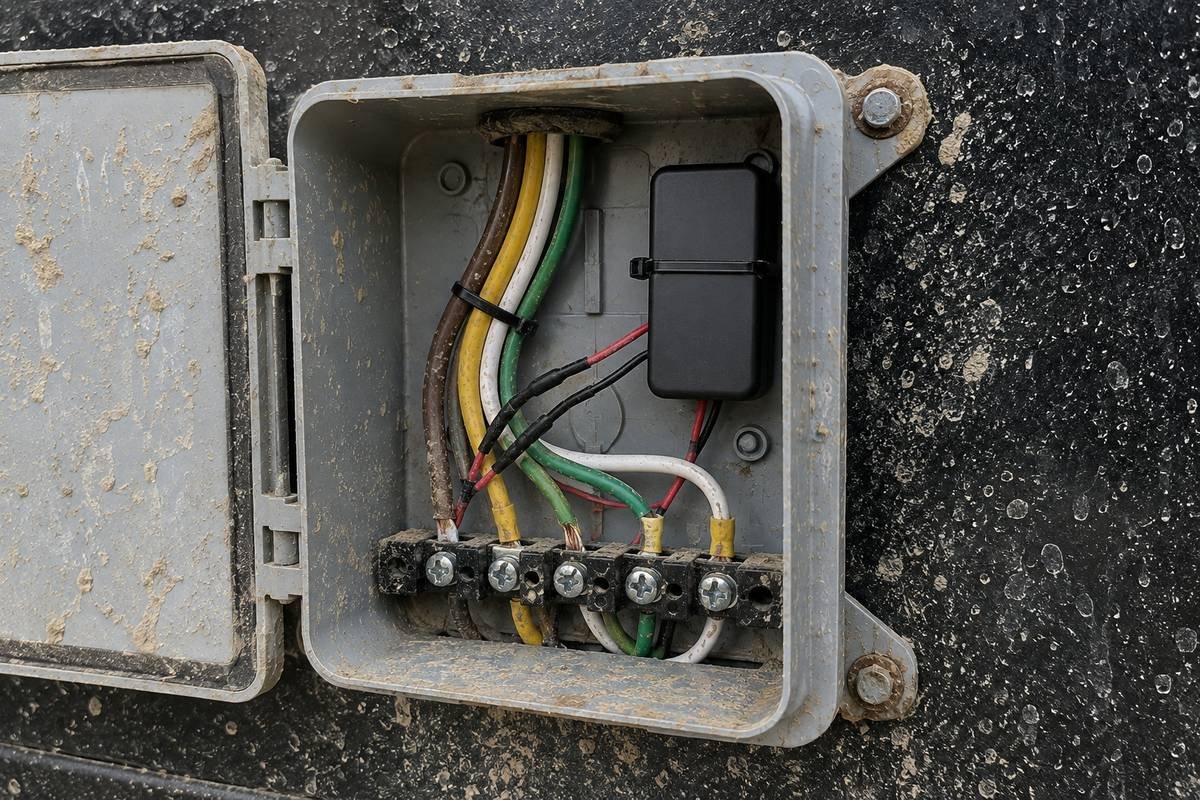
Wired into the trailer’s 12-volt system rather than running on its own battery. Connect it once, usually at a battery terminal or a fused circuit, and there is no charging schedule to forget.
4G LTE, sold as a one-time purchase with no required monthly fee, which is unusual for a cellular tracker. There are two costs instead. Running the wire is real work, and it draws a small current continuously. On a trailer stored for months without a maintainer, that draw comes out of your house battery.
What You’ll Love
- No ongoing subscription
- Never needs charging
- Cellular range rather than Bluetooth
Worth Considering
- Installation means running a wire
- Draws current continuously from the trailer battery
- That draw is a problem in long storage without a maintainer
Skip this one if you’re not comfortable doing basic wiring or don’t want to pay a higher price upfront in exchange for skipping monthly fees.
A magnetic weatherproof puck built around a modular battery. The stock cell gives a week or two in active use, and the extended cases stretch that to a month or several, depending on how often it checks in.
That makes it the adjustable one. You decide where to sit between reporting frequency and how often you have to go and fetch it. The extended cases cost extra on top of the device and the plan, and if you want both long life and frequent updates the total climbs quickly.
What You’ll Love
- Adjustable reporting intervals
- Magnetic weatherproof case
- Extended battery packs available
Worth Considering
- Extended battery cases cost extra
- Total cost climbs if you want both long life and frequent updates
Skip this one if you want the lowest possible ongoing cost, since between the plan and optional accessories this can end up pricier than the LandAirSea over time.
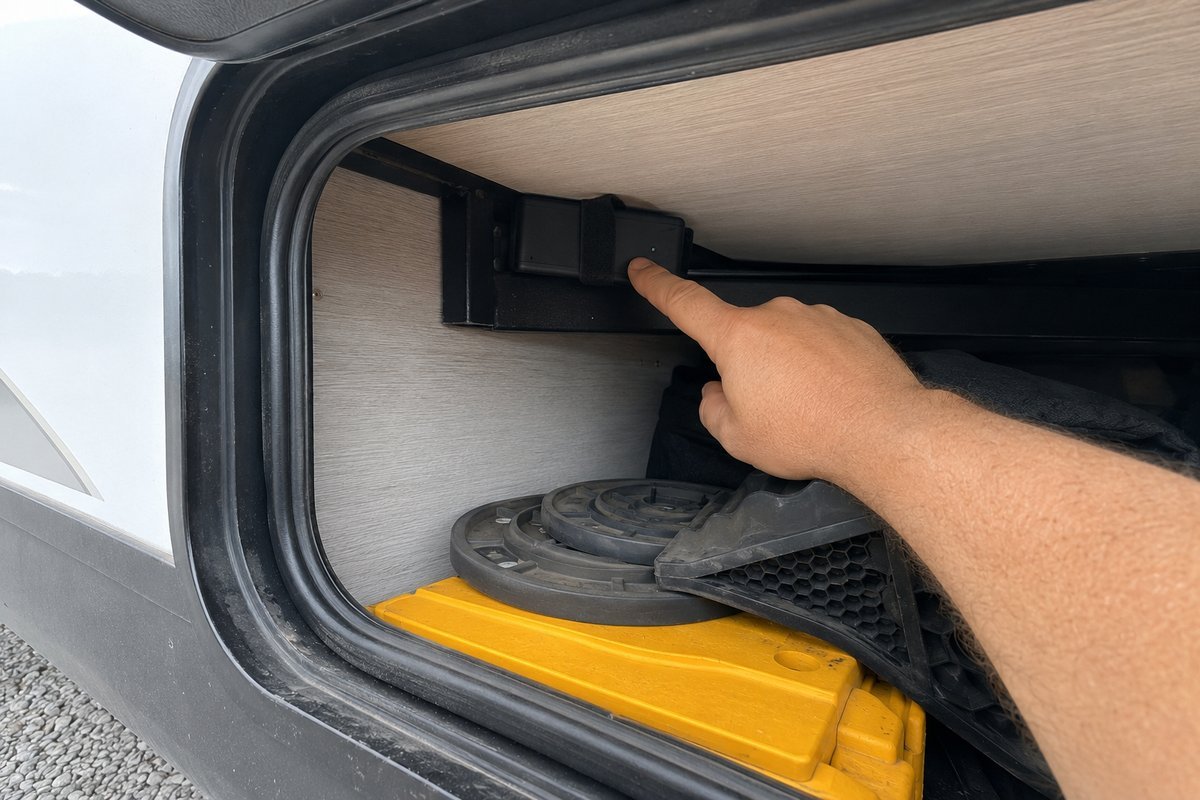
Built to disappear against a steel frame. Sealed housing, a strong magnetic back, and a profile low enough to sit inside a frame rail or a wheel well and survive a walk-around.
It reports over cellular on an internal rechargeable battery, with runtime depending on how often it checks in. Concealment is what the money buys, and it is worth buying, because a tracker that gets found is a tracker in a ditch. It costs more than the plain magnetic pucks and still needs a data plan.
What You’ll Love
- Housing built for road grime, weather and vibration
- Magnet strong enough to hold on rough ground
- Low profile, hard to spot in a quick inspection
Worth Considering
- Costs more than the simpler magnetic pucks
- Still needs a recurring data plan
Skip this one if you’re on a tight budget, since there are cheaper magnetic trackers that will still do a reasonable job of staying hidden.
A GPS tracker won’t stop someone from hitching up and driving off, that job belongs to a wheel or coupler lock. But it gives you a fighting chance to find your trailer before it’s stripped, resold, or hauled across a state line. In this guide we’ll walk through five real trackers worth considering, what each one costs to own, and how to pick the right style for the way you camp.
This guide is based on independent research, not hands-on testing. We compare published manufacturer specifications, cross-check them against verified customer reviews on retail sites and RV forums, and weigh each product on how each one performs at locating a travel trailer that has been moved or stolen. We have not physically tested these units ourselves, and where the published specs and real-world owner reports disagree, we say so in the write-up.
Update Interval and Battery Life at a Glance
How often a tracker checks in and how long its battery lasts between charges both matter for a trailer that might sit parked for weeks at a time. The table below compares these two specs side by side, along with whether the device requires a cellular subscription to work.
| Tracker Type | Typical Update Interval | Battery Life Between Charges |
| Real-Time Cellular Tracker | Every 1-5 minutes when moving | 2-4 weeks typical, requires subscription |
| Hardwired Cellular Tracker | Every 1-5 minutes when moving | N/A, wired to trailer power |
| Battery-Only Tracker | Every 15-60 minutes to conserve battery | 2-6 months typical |
Quick Comparison
Here’s a side-by-side look at all five picks before we get into the details of each one.
| Tracker | Best For | Connectivity | Battery/Power |
|---|---|---|---|
| LandAirSea 54 | Best Overall | Cellular (4G LTE), monthly or annual plan | Rechargeable, roughly 1 to 3 weeks active use per charge |
| Apple AirTag (with weatherproof case) | Best Budget/Subscription-Free Pick | Bluetooth via Apple’s Find My crowd network | Replaceable coin battery, roughly 1 year |
| Moto Watchdog Wired GPS Tracker | Best Hardwired Cellular Option | Cellular (4G LTE), hardwired to trailer power | Wired to 12V trailer battery, no recharging needed |
| Spytec Atlas GPS Tracker | Best Battery-Powered Cellular Option | Cellular, monthly or annual plan | Rechargeable, 1 to 2 weeks standard, up to several months with extended battery case |
| Trackhawk GPS Trailer Tracker | Best Discreet/Magnetic-Mount Option | Cellular, monthly or annual plan | Rechargeable internal battery, several weeks to months depending on ping frequency |
Why Travel Trailers Are an Easy Target
A travel trailer is basically a house on wheels with no ignition key to worry about. Anyone with a hitch, a ball mount, and a few minutes can back up, lock in, and pull away. Storage lots, rural driveways, and even campground sites are often unattended for long stretches, which gives a thief plenty of time to work without being noticed. Many trailers also sit for weeks between trips, so an owner might not even open the door and realize something is wrong until the unit is long gone.
Trailers are also appealing because they’re harder to trace than a car. There’s no license plate reader watching for a trailer VIN the way there is for a stolen truck, and many owners never record their VIN anywhere they can find it in a hurry, the National Insurance Crime Bureau’s free VIN check only works if you actually have that number written down somewhere. That combination, easy to steal, slow to notice, hard to trace, is exactly why a dedicated RV GPS tracker earns its keep.
Insurance can help cover the financial loss, but most policies won’t replace the years of memories tied up in a trailer you’ve outfitted just the way you like it, and a claim payout rarely arrives before you’ve had to buy a replacement out of pocket anyway.
What to Look for
Cellular vs. Bluetooth. A cellular tracker uses a SIM card to report its location almost anywhere there’s cell coverage, which makes it the better choice if your trailer might travel far or sit somewhere remote. A Bluetooth tracker like an AirTag relies on nearby Apple devices to relay its position, so it works best in populated areas where other iPhones are constantly passing by. In a busy storage lot or city, Bluetooth can actually update surprisingly fast. In a rural pole barn miles from the nearest neighbor, it may not report at all.
Hardwired vs. battery-powered. A hardwired tracker taps into your trailer’s 12-volt system, so it never needs to be charged and can report its location continuously without worrying about battery drain. The tradeoff is a slightly more involved install, usually running a wire to a battery terminal or fuse box. A battery-powered unit is simpler to place, stick it on and go, but you’ll need to recharge or swap batteries on a schedule, and that schedule gets shorter the more often it checks in.
Motion alerts. Most cellular trackers can send a push notification or text the moment the trailer starts moving. This is the feature that actually catches a theft in progress rather than just helping you locate the trailer a day later. If a tracker will not alert you to movement, or when the trailer leaves an area you have marked on the map, you’re relying on remembering to check the app, which most of us won’t do consistently.
Discreet placement. A tracker only helps if it isn’t found and tossed in the ditch. Look for something small enough to tuck inside a bumper, storage compartment, or underbelly, and avoid mounting it somewhere obvious like the tongue box lid. Magnetic cases make it easy to stash a unit inside a steel frame member where it’s out of sight but still gets enough signal to report.
Ongoing cost. Cellular trackers almost always carry a monthly or annual data plan on top of the device price, since they’re using cellular networks the same way a phone does. Bluetooth trackers and some hardwired units skip that fee entirely. Factor the subscription into your decision, a cheap tracker with an expensive plan can cost more over three years than a pricier one with no ongoing fee.
How We Picked These
These recommendations are based on published manufacturer specifications, pricing pages, and patterns we found across verified owner reviews, rather than hands-on testing of every unit in our own garage. We cross-checked battery life, connectivity type, and pricing claims across multiple sources to filter out marketing exaggeration, but your real-world results, especially battery life and cell coverage, will vary depending on your climate, reporting frequency, and where you travel. We also gave extra weight to trackers with a track record of real owners using them successfully after a theft, since a feature list on a box doesn’t always translate to results when it matters.
Frequently Asked Questions
Is there a trailer GPS tracker without a monthly fee?
For a real GPS tracker, essentially no, and it is worth understanding why rather than hunting for the exception. The tracker has to tell you where it is, and that means a cellular connection, which means a SIM and a data plan. The fee is not the manufacturer being greedy, it is the airtime.
What does exist fee free is the Bluetooth tag, the kind you put on keys. Those have no subscription because they have no connection of their own, and rely on other people’s phones passing close enough to report a position. For a trailer sitting in a rural storage lot, that is close to useless, which is exactly the situation you bought a tracker for.
Does a GPS tracker need a monthly subscription?
It depends on the type. Cellular trackers, which include most of the dedicated trailer trackers on this list, need an active data plan to transmit their location, similar to how a cell phone needs service. Bluetooth trackers like an AirTag don’t require any subscription because they rely on nearby devices instead of cellular data. If avoiding a monthly bill matters most to you, a Bluetooth tracker or a hardwired unit sold with no required plan are your best options.
Where should I hide a GPS tracker on a travel trailer?
Good spots include inside a frame rail, tucked behind a bumper, inside an underbelly storage compartment, or mounted to a steel crossmember with a magnetic case. Avoid anywhere a thief would naturally look first, like the tongue box, hitch area, or anywhere visible from the outside. It’s also smart to place a second, cheaper tracker somewhere less obvious as a backup in case the first one is found and removed.
Will a GPS tracker help police recover a stolen trailer?
Yes, in most cases, but you’re still working with local law enforcement rather than chasing the trailer down yourself. A live location gives officers something concrete to act on instead of an open-ended search, and many owners have used tracker data to help police locate a stolen trailer within hours or days rather than never seeing it again. Always let law enforcement handle the actual recovery rather than confronting anyone yourself.
How long does a GPS tracker battery last on a parked trailer?
For battery-powered cellular trackers, expect anywhere from one to several weeks on a standard setting, or up to a few months if you use an extended battery accessory and reduce how often it checks in. Hardwired trackers avoid this issue entirely since they draw power from the trailer’s own battery system, though that means you’ll want a battery maintainer if the trailer sits unused for long stretches.
Can I use an AirTag instead of a dedicated GPS tracker?
An AirTag can work well as a low-cost backup, especially if you mostly camp near towns or busy storage facilities where other iPhones are nearby to relay its location. It’s less reliable in remote or rural settings with little foot traffic, since it depends entirely on Apple devices passing within Bluetooth range. Many owners use an AirTag alongside a cellular tracker rather than as a full replacement for one.
Do I need more than one tracker on my trailer?
It’s not required, but many experienced RV owners place a second, cheaper tracker in a separate hiding spot as insurance. If a thief finds and disables the obvious one, a backup tucked somewhere less predictable can still lead you or the police to the trailer. This is especially common with a pairing of one cellular tracker and one inexpensive Bluetooth tag.
Final Thoughts
No RV GPS tracker can stop a determined thief from hitching up your trailer, but any of the five options above can turn a total loss into a recoverable one. If you want the simplest all-around setup, the LandAirSea 54 is a safe starting point. If you’d rather skip monthly fees entirely, an AirTag in a weatherproof case or a hardwired unit like the Moto Watchdog Wired GPS Tracker will get you there. Whichever you choose, the goal is the same: know where your trailer is before you need to.
Related guides
- RV Storage & Security: The Complete Guide
- Best Freeze Alarms for Winterized RVs
- Best Water Leak Detectors for Travel Trailers
- Best Smart Temperature Sensors for RVs in Storage
- Best Security Cameras for Unattended RVs
- Entry door locks, stopping the trailer being opened, rather than finding it afterwards.
- Hitch locks, the difference between a receiver lock and a coupler lock.