
If you rely on a CPAP machine to sleep well, camping off the grid can feel like a gamble. A power inverter for CPAP use solves half of it, provided you pick one whose fan will not wake you. Will the battery last through the night? Will the inverter hum loud enough to defeat the purpose of a peaceful campsite? For retirees who’ve traded the commute for a windshield view of the mountains, these questions matter as much as tire pressure or propane levels. A CPAP machine is not a luxury item on the road; it is medical equipment, and keeping it running quietly and reliably overnight is part of what makes boondocking sustainable long-term.
Table of Contents
5 Best Quiet Inverters for Overnight CPAP Use
700 watts continuous is more than a CPAP with a humidifier will ever ask for, and that is the point. An inverter running at a third of its rating stays cooler and quieter than one working near its limit. It is also small enough to mount near the battery bank without giving up a locker.
The controls are plain: an on/off switch and labeled outlets, nothing to configure. The catch is standby draw. On a bank under 100 amp-hours, the current it uses simply by being switched on is a real fraction of your reserve, and a smaller inverter would cost you less overnight.
What You’ll Love
- Pure sine wave output
- 700W continuous, well above CPAP draw
- Compact enough to mount near the batteries
- Renogy parts and support are easy to find
Worth Considering
- The fan becomes audible above about half load
- No remote switch, so it has to be mounted within reach of the bed
- Standby draw eats into a bank under 100 amp-hours
The cheap way in, and honest about what it is. 300 watts runs a CPAP blower on its own and not much else. It fits in a glove box and runs from a 12-volt socket, so there is no installation to speak of.
It is modified sine wave, not pure sine. For a basic machine that is usually fine. For one with a heated humidifier and hose it is the wrong tool. Modified sine can put an audible hum into the CPAP’s own power supply, and the humidifier electronics are the part most likely to object.
What You’ll Love
- Cheapest here by a wide margin
- Small enough for a glove box
- Runs from a 12V socket with no wiring
- Quiet at low load
Worth Considering
- Modified sine wave, so not suited to heated humidifiers
- 300W leaves no headroom beyond the CPAP itself
1100 watts continuous is roughly ten times what a CPAP with a heated humidifier draws. That sounds like overkill and largely is, but it means the inverter never works near its limit, and an inverter loafing along runs cooler and spins its fan less.
LED indicators show battery and load state, which is worth a glance before bed. It ships with both battery clamps and a hardwire kit. The cost is physical. This is the biggest unit here and it wants several inches of clearance around it for air.
What You’ll Love
- 1100W continuous, far above any humidifier setup
- Pure sine wave output
- LED battery and load indicators
- Ships with clamps and a hardwire kit
Worth Considering
- Physically the largest here and needs ventilation clearance
- The fan runs continuously once powered rather than on a thermostat
The fan is thermostatic, and that is the whole reason this one is on the list. Below moderate load it does not spin at all, which covers a CPAP running on its own. It starts only when internal temperature climbs, usually when a humidifier heater is working on a cold night.
If silence beside the bed is what you care about most, that behavior matters more than any other number on the page. There is a USB port alongside the AC outlets. Run the CPAP together with other heavy draws and you lose the advantage, because sustained load near the rating brings the fan on anyway.
What You’ll Love
- Thermostatic fan, silent at low load
- Pure sine wave output
- 1000W continuous
- USB port alongside the AC outlets
Worth Considering
- Runs warm to the touch even with the fan off
- Priced above the budget units for mid-tier hardware
Xantrex has been in marine and RV power a long time and the build shows it. Protection against low voltage, overload and overtemperature is built in, and each has its own status light. When the CPAP stops at three in the morning you can see why instead of guessing in the dark.
That is what the extra money buys. For a weekend camper it is hard to justify. For someone living in the rig for months at a time, a fault you can diagnose is worth more than the price difference.
What You’ll Love
- Documented protection circuitry with individual status lights
- Pure sine wave output
- Long track record in marine and RV power
- Responsive support
Worth Considering
- The most expensive of these
- The fan runs more consistently under load than the GoWISE’s thermostatic design
Inverters have got better at this. Plenty of current models run cool, draw little current at idle, and produce a waveform clean enough for a CPAP’s power supply. The problem is that the specification that decides all of that is not the one printed largest on the box.
The five below come up repeatedly in RV forums and owner reviews for overnight CPAP use. What follows explains which numbers actually decide whether an inverter is suitable, and which ones are there to fill out the listing.
This guide is based on independent research, not hands-on testing. We compare published manufacturer specifications, cross-check them against verified customer reviews on retail sites and RV forums, and weigh each product on how quietly each one runs with a CPAP machine a few feet away. We have not physically tested these units ourselves, and where the published specs and real-world owner reports disagree, we say so in the write-up.
Noise, Wattage, and Wave Type at a Glance
A CPAP machine needs clean power and a quiet inverter to avoid disturbing your sleep. The table below compares wave type, rated wattage, and typical fan noise so you can see how these inverters stack up before diving into the full reviews below.
| Inverter Class | Wave Type | Rated Continuous Wattage / Typical Fan Noise |
| Standard Pure Sine | Pure sine wave | 300-500W / ~40-50 dB at full load |
| Compact Pure Sine | Pure sine wave | 150-300W / ~35-45 dB at full load |
| Modified Sine (Budget) | Modified sine wave (not recommended for CPAP) | 300-500W / ~45-55 dB at full load |
Quick Comparison
| Product | Best For | Key Spec |
|---|---|---|
| Renogy 700W Pure Sine Wave Inverter | Best Overall | 700W continuous / 1400W surge, pure sine wave |
| BESTEK 300W Compact Inverter | Best Budget | 300W continuous / 700W surge, modified sine wave |
| Krieger KP1100 Pure Sine Wave Inverter | Best for Humidifier CPAP Setups | 1100W continuous / 2200W surge, pure sine wave |
| GoWISE PS1002 Pure Sine Wave Inverter | Best Fan-Noise Control | 1000W continuous / 2000W surge, thermostatic fan |
| Xantrex PROwatt SW1000 | Best for Long-Term Reliability | 900W continuous / 2000W surge, pure sine wave |
Why This Matters
A CPAP machine doesn’t ask for much power on paper, but the way it draws that power matters more than most shoppers expect. Most CPAP units are designed to plug into standard household AC current, which comes as a smooth, rounded wave called a pure sine wave. Off-grid in an RV, that same style of power has to be manufactured by an inverter, which pulls low-voltage DC electricity from your battery bank and converts it into the AC current your CPAP expects. Not every inverter does this conversion the same way, and the quality of that conversion can affect everything from motor noise on your CPAP’s internal blower to whether the humidifier heating plate functions correctly.
There’s also the matter of noise from the inverter itself. Many inverters include a cooling fan that kicks on under load, and in a quiet rig at 2 a.m., even a soft fan whir can be enough to wake a light sleeper or an anxious travel companion. Some inverters use fanless, convection-cooled designs for smaller loads, while others rely on thermostatically controlled fans that only spin up when the unit warms up. Because a CPAP with a heated humidifier draws more power than the blower alone, it’s worth checking whether a given inverter’s fan behavior has been reported as noticeable by other CPAP users, not just campers running a coffee maker for two minutes.
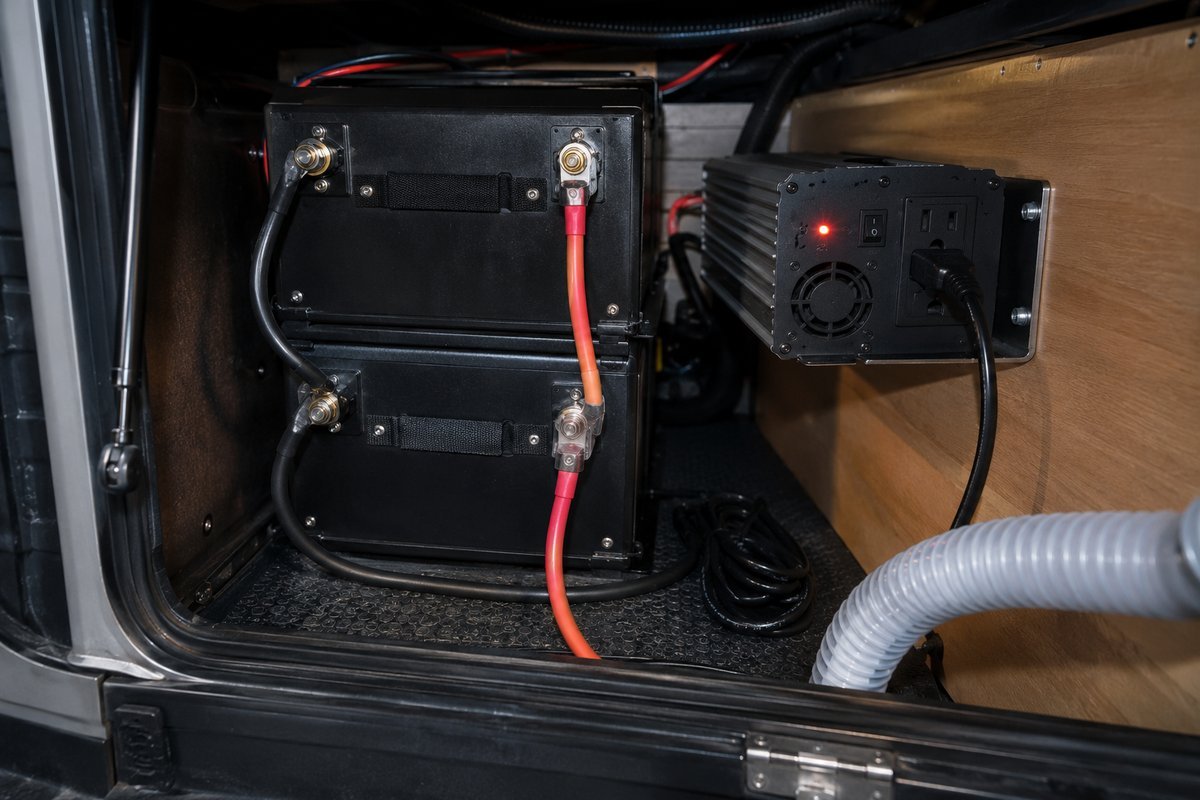
Finally, overnight reliability depends on more than the inverter. Battery capacity, wire gauge, and how the inverter is wired into your electrical system all play a role. But the inverter is the piece that determines whether your CPAP receives clean, stable power for the full night or whether you wake up to an error code and a dead unit at 4 a.m. Getting this one component right takes a lot of the guesswork out of boondocking with a CPAP.
What to Look For
Four specifications decide whether an inverter is any good for this. Most of what else is printed on the box is aimed at people running power tools.
Pure Sine Wave vs. Modified Sine Wave
Pure sine is a smooth wave, the same shape that comes out of a wall socket at home. Modified sine is a stepped approximation of it, cheaper to build and harder on delicate electronics. ResMed and Philips Respironics both recommend pure sine, and they are firmer about it for machines with a heated humidifier. What modified sine looks like in practice is a power supply that hums, runs warm, and in the worst case gives up early. You will not know which sort you have until you have slept a few nights on it. For the money involved, that is not a gamble worth taking with the expensive part of the setup.
Wattage Sizing
A blower on its own pulls 30 to 60 watts. Add the humidifier and the heated hose and you are at 80 to 100, more on a cold night when the heater is cycling hard to keep up. So a 150-watt inverter runs a bare machine and nothing else, with no margin for the surge when it first kicks on. Three hundred watts is the floor if you use a humidifier. Seven hundred leaves room for a phone and a fan as well, and there is a quieter benefit: an inverter loafing at a third of its rating runs cooler and spins its fan less than one working near the top of its range.
Fan Noise and Cooling Design
A CPAP with a humidifier is a steady load for eight hours, which means the inverter’s fan is not popping on and off for a minute at a time. It is running most of the night. Some inverters only spin the fan when the internals warm up, which on a mild night can mean silence. Others run it whenever the unit is switched on, load or no load. That is the difference you will notice at three in the morning, and it is worth more to you than a hundred watts of capacity you were never going to use.
Efficiency and Standby Draw
There are two losses here, and the second one catches people out. An inverter wastes 10 to 15 percent of everything passing through it as heat, which is simply the cost of doing business. It also draws current purely for being switched on, with nothing plugged into it at all. Over eight hours that standby draw is real money on a small bank. Look for 85 to 90 percent efficiency and a no-load draw under half an amp, and get into the habit of switching it off during the day rather than leaving it idling.
How We Picked These
None of these inverters were tested hands-on for this article. Instead, this list was compiled by comparing published manufacturer specifications, cross-referencing wattage and wave-type claims, and reading through a wide range of owner reviews from RV forums, retailer Q&A sections, and CPAP user communities to identify recurring themes around noise levels, reliability, and real-world performance with medical devices. Where reviewers consistently mentioned fan noise, heat buildup, or compatibility issues with CPAP humidifiers, we weighted those observations heavily, since they reflect the kind of overnight, real-world use this guide is meant to address. We’d encourage anyone shopping for an inverter to also check current owner reviews before buying, since manufacturers occasionally update internal components without changing the model name.
FAQ
Do I need a pure sine wave inverter for CPAP?
Most CPAP manufacturers recommend pure sine wave power, especially for machines with a built-in heated humidifier. A modified sine wave inverter can technically run a basic CPAP blower, but it’s more likely to cause audible interference, extra internal heat, or, over time, reduced lifespan of the machine’s power supply. If your CPAP includes a humidifier and heated hose, treat pure sine wave as a requirement rather than a nice-to-have.
What size inverter do I need to run a CPAP overnight?
A CPAP blower alone typically draws 30 to 60 watts, but adding a heated humidifier can push total draw to 80 to 100 watts or more. A 300W inverter can handle a blower-only setup, but for any machine with a humidifier, 700W to 1000W of continuous capacity gives comfortable headroom without running the inverter near its limit all night.
What’s the quietest inverter for RV boondocking with a CPAP?
Among the models covered here, the GoWISE PS1002 stands out for its thermostatically controlled fan, which stays off during light to moderate loads and only activates once internal temperatures rise. For CPAP-only use without a humidifier running full-time, this design tends to produce the quietest overnight experience.
How long will my RV battery run a CPAP inverter overnight?
This depends heavily on your battery’s amp-hour capacity and your CPAP’s average draw. As a rough estimate, a single 100 amp-hour lithium battery can typically power a humidifier-equipped CPAP through an eight to ten hour night with some margin to spare, accounting for the inverter’s own conversion losses. A basic blower-only CPAP will draw considerably less and stretch that same battery further.
Can an inverter damage my CPAP machine?
A properly sized pure sine wave inverter is very unlikely to damage a CPAP. Risk goes up with modified sine wave inverters, which can stress the machine’s internal power supply over repeated use, and with undersized inverters that get pushed near or past their rated capacity, since voltage sag under strain can affect connected electronics. Sticking with a pure sine wave unit rated well above your CPAP’s peak draw is the simplest way to avoid this issue entirely.
Should I turn off the inverter’s other outlets while sleeping?
It’s generally fine to charge a phone or run a small fan off the same inverter as your CPAP, provided the combined load stays comfortably under the unit’s continuous wattage rating. If you’re running a smaller inverter like the BESTEK 300W, though, it’s worth reserving that capacity for the CPAP alone and using a separate USB source for other devices.
Do heated CPAP hoses need a bigger inverter?
Yes. A heated hose adds its own draw on top of the blower and humidifier, and that draw can spike further on cold nights as the heating element cycles to maintain temperature. If your setup includes a heated hose, lean toward the higher end of the wattage range, such as the Krieger KP1100 or Xantrex PROwatt SW1000 (rated 900W continuous), rather than a 300W unit.
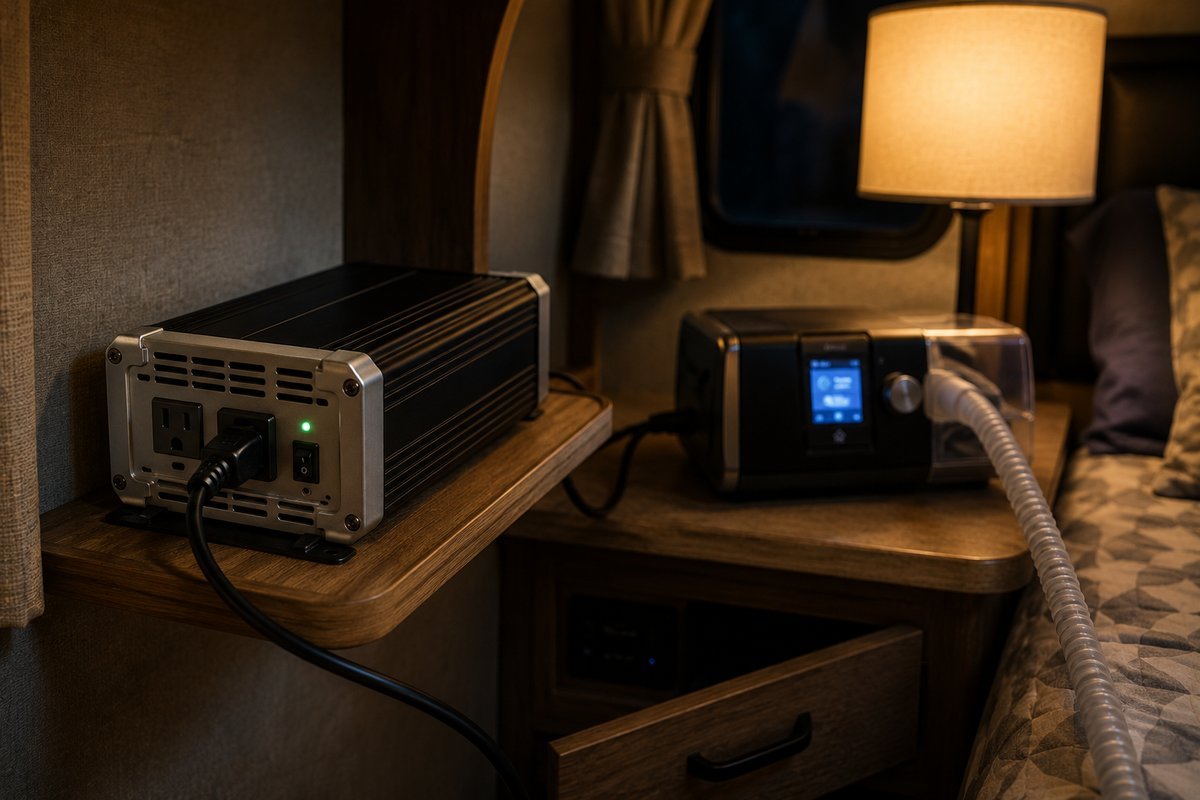
Where should I mount the inverter so it doesn’t disturb my sleep?
Because fan noise is the main disturbance most CPAP users report, it helps to mount the inverter somewhere with a few feet of distance from the bed, such as a nearby storage compartment or under a dinette seat, rather than directly on a headboard shelf. Make sure the mounting location still has adequate airflow around the unit’s vents, since restricting airflow can cause the fan to run harder and louder than it would otherwise.
Final Thoughts
There is no single best power inverter for CPAP use here. There is the one that matches your machine, your battery bank and how much noise you can sleep through. If your CPAP has a heated humidifier, that narrows it to pure sine immediately. If the inverter has to sit near your head, fan behavior matters more than wattage. And if the battery bank is small, standby draw will cost you more overnight than the efficiency rating ever will.