
If you rely on a CPAP machine to sleep well, boondocking or dry camping in your RV can feel like a gamble. A portable power station for CPAP use is the usual answer, and the whole question is how many watt-hours you actually need.
No hookups means no wall outlet, and a bad night’s sleep can turn a relaxing trip into a miserable one. That’s where a portable power station comes in. These compact battery packs plug in just like a wall outlet would, quietly running your CPAP through the night whether you’re parked at a full-service campground or tucked into a scenic overlook fifty miles from the nearest plug.
Table of Contents
5 Best Portable Power Stations for CPAP Users
288 watt-hours covers eight to ten hours on a standard CPAP with the humidifier off. That is a normal night with a little in reserve, and not much more than that. The inverter is pure sine wave, so machines that fault or whine on modified sine will not notice the difference.
It weighs 8.3 pounds, which matters more than it sounds like it should when the battery lives in the truck bed and the trailer is forty feet away in the dark. The cells are LiFePO4, rated around 4,000 cycles, so charging it nightly puts replacement roughly a decade out. Run a heated humidifier every night and none of that arithmetic holds. Go up to the Yeti 500X.
What You’ll Love
- LiFePO4 cells rated near 4,000 charge cycles
- 8.3 pounds
- One-button interface with an LED display
- Jackery has the most established service network of these brands
Worth Considering
- 300-watt AC ceiling, so nothing heavy runs alongside the CPAP
- The display does not break runtime down by device
Empty to full in about an hour on shore power, per EcoFlow’s own River 3 specification. That is the whole argument for this one, and it is a better argument than it first looks. If you move camp often, or you only get an hour or two plugged in somewhere, recharge speed is what decides whether the battery is full at bedtime.
245 watt-hours is less than the Jackery. A basic CPAP will still run the night. Add a heated humidifier and you are down to six or seven hours, which is short of most people’s night. The fast-charge mode also works the fan harder, worth knowing if the unit sits near your head.
What You’ll Love
- Recharges in roughly an hour
- Small enough for a cabinet
- App reports charge level
Worth Considering
- 245Wh is the smallest capacity here
- Fast charging makes fan noise at bedtime
288 watt-hours out of the box, the same as the Jackery. The difference is the expansion port. Add a second pack and you roughly double the runtime without replacing the unit you already own.
That only matters if you boondock three nights or more. At a campground with hookups you are paying for a port you will never use. The display gives a runtime estimate rather than a bare percentage, which is more useful than it sounds when you are deciding whether to run the humidifier tonight.
What You’ll Love
- Takes an add-on battery for longer trips
- Display estimates runtime, not just percentage
- Same 288Wh as the Jackery
Worth Considering
- The expansion pack is a separate purchase and not a cheap one
- Runs warmer than the others over a long night
505 watt-hours. This is the one that runs a heated humidifier all night without you doing arithmetic first. It is also the heaviest here at about thirteen pounds, and the most expensive.
Goal Zero has been building outdoor power longer than most of these brands and the Yeti shows it: metal carry handle, weather-resistant case, and an app that caps the charge level, which is how a battery stays healthy over years instead of seasons. If you are counting ounces or dollars, the lighter units here will still get most people through a night.
What You’ll Love
- 505Wh runs a heated humidifier overnight
- Metal handle and weather-resistant case
- App can cap the charge level to preserve battery life
Worth Considering
- About thirteen pounds
- The most expensive on this list
268 watt-hours and a 600-watt pure sine inverter, which is far more inverter than a CPAP will ever ask for. Capacity sits just under the Jackery and the Anker, and it is usually the cheapest way to get genuine pure sine output.
That last part is the reason it is on the list. Pure sine is the specification that actually matters for a CPAP, and cheaper units often fudge it. The trade is polish. The interface is cruder than Anker’s or Jackery’s, and Bluetti’s support has a reputation for slower replies.
What You’ll Love
- The cheapest genuine pure sine wave option here
- LiFePO4 cells
- 600-watt inverter, well beyond what a CPAP needs
Worth Considering
- Interface is less refined than Anker’s or Jackery’s
- Support is reported slower than Jackery or Goal Zero
The field is crowded and most of what is printed on the box does not matter for a CPAP. Two things do. Watt-hours set how long the machine runs. Pure sine wave decides whether it runs properly at all. Weight comes third, and only because somebody has to carry it. The five units below were chosen against those, and the sections underneath explain how to read them against your own machine.
A CPAP with heated tubing draws roughly double what a bare one does, so the size you need depends less on the brand of machine than on whether you run the humidifier.
This guide is based on independent research, not hands-on testing. We compare published manufacturer specifications, cross-check them against verified customer reviews on retail sites and RV forums, and weigh each product on how each one performs powering a CPAP machine overnight, away from shore power. We have not physically tested these units ourselves, and where the published specs and real-world owner reports disagree, we say so in the write-up.
Wattage and Runtime Cheat Sheet
Use this quick reference to estimate how many hours of overnight runtime a given power station capacity provides for your CPAP, based on typical draw with and without a heated humidifier.
| Power Station Capacity | Runtime (No Humidifier, ~45W) | Runtime (With Humidifier, ~70W) |
| ~150 Wh | ~3.3 hours | ~2.1 hours |
| ~300 Wh | ~6.7 hours | ~4.3 hours |
| ~500 Wh | ~11 hours | ~7 hours |
Quick Comparison
| Product | Best For | Key Spec |
|---|---|---|
| Jackery Explorer 300D | Best Overall | 288Wh, 300W pure sine wave inverter |
| EcoFlow River 3 | Best Fast Charging | 245Wh, 300W inverter, fast recharge (empty to full in about an hour) |
| Anker SOLIX C300 | Best for Multiple Nights | 288Wh, 300W inverter, part of an expandable ecosystem (confirm C300 compatibility) |
| Goal Zero Yeti 500X | Best Build Quality | 505Wh, 300W inverter, app monitoring |
| Bluetti EB3A | Best Budget Pick | 268Wh, 600W inverter, LiFePO4 battery |
Why This Matters
CPAP machines are not power-hungry compared to something like an RV air conditioner, but they do need a steady, reliable source of electricity for six to eight hours at a stretch, every single night. A power interruption mid-sleep isn’t just an inconvenience. For many retirees managing sleep apnea, it means waking up gasping, feeling groggy the next day, or simply avoiding the trip altogether out of worry about running out of juice.
Traditional RV house batteries can technically run a CPAP, but they’re often shared with lighting, water pumps, slide-outs, and other systems, which makes it easy to accidentally drain them overnight. A dedicated portable power station solves this by giving your CPAP its own isolated, predictable power source. You charge it during the day from your RV’s 12-volt outlet, a wall plug at a campground, or a portable solar panel, then set it aside at bedtime knowing exactly how much runtime you have.
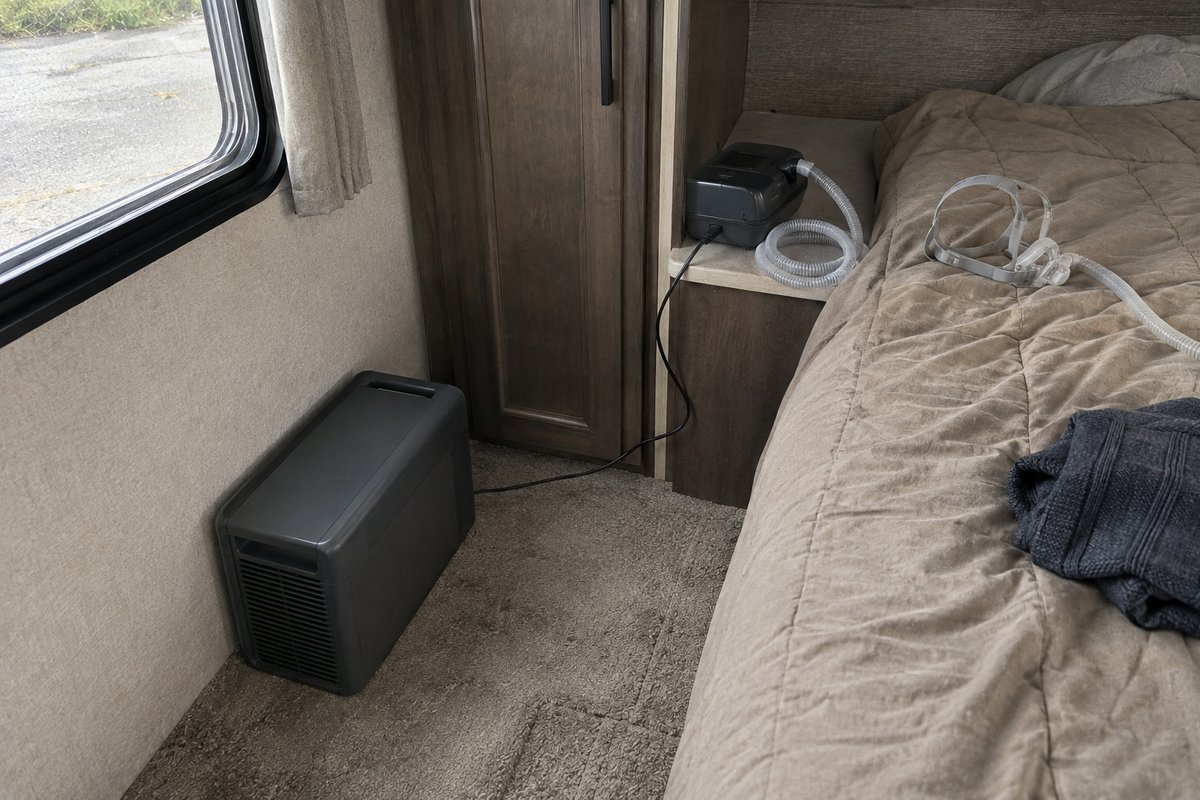
It matters most without hookups. A dedicated battery means the CPAP is not competing with the water pump and the lights for the same amp-hours, and it is not your problem at midnight if the house bank was lower than you thought.
What to Look For
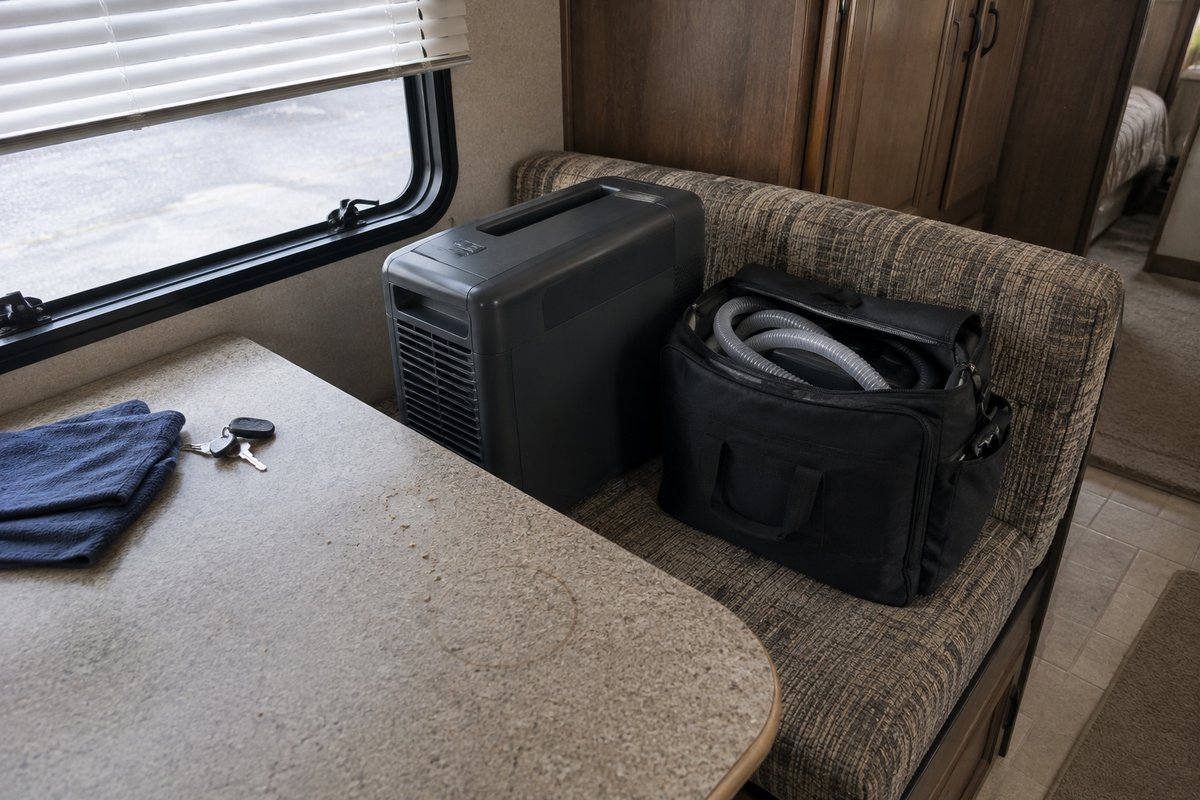
The wrong unit is usually wrong in one specific way: too heavy to move, too small to reach morning, or loud enough to keep you awake. Here is what to check before you buy.
Battery Capacity (Watt-Hours)
Watt-hours are just fuel in the tank. Your CPAP is the engine, and it burns 30 to 60 watts with the humidifier off, 70 to 90 with the heater and hose working on a cold night.
So the arithmetic is easy. A 300Wh battery against a 35-watt machine is about eight hours. The same battery against 80 watts is closer to four. That is why the humidifier is the biggest single decision on this page. Switch it off and a 300Wh unit walks through the night. Run it on high in October and you want 500Wh, or you want to accept a shorter night.
Pure Sine Wave Output
This is the specification that matters most and the one almost nobody checks. Cheap inverters put out a blocky approximation of household AC called modified sine. Some CPAPs run on it happily. Others buzz, run hot, or throw an error and refuse to start. The machine is the expensive part of this setup, and you will not find out which camp yours is in until you are three hours from anywhere. All five units here are pure sine, which is most of the reason they are here.
Weight and Portability
Six pounds and thirteen pounds look similar on a spec sheet. They stop looking similar at ten at night, in the rain, carrying the thing from the truck bed to the bedside table.
Pick it up in your head before you buy. If you have a shoulder or a back that complains, the gap between the Jackery at 8.3 pounds and the Yeti at thirteen is the gap between grabbing it one-handed and making a trip of it.
Charging Speed and Options
There are three ways to fill one of these: a campground outlet, the truck’s 12-volt socket while you drive, and a solar panel. A unit that takes all three leaves you options on the day the weather or the schedule takes one away.
Recharge speed matters more than people expect if you move camp often. An hour plugged in somewhere is a full battery on the EcoFlow and about a third of one on something slower. If your pattern is a stop for lunch and then back on the road, that difference is what decides whether you start the night full.
Noise Level
It sits next to your head for eight hours. A fan you would never notice in a kitchen is a different animal at two in the morning, six feet from your ear, in a trailer where the loudest competing sound is the fridge cycling.
Look for a thermostatic fan that stays off at low load rather than one that spins whenever the unit is switched on. And if you sleep lightly, put the battery on the floor across the rig rather than on the nightstand. A longer cable is cheaper than a bad week of sleep.
How We Picked These
We did not physically test these five power stations side by side in an RV. Instead, this guide was compiled by comparing manufacturer specifications, verified owner reviews, and publicly available third-party testing data for battery capacity, inverter type, charge cycle ratings, weight, and price.
We prioritized units with pure sine wave output, since that’s the safest choice for CPAP machines, and we favored LiFePO4 battery chemistry over older lithium-ion designs because of its longer lifespan and better safety profile. Pricing can shift with sales, bundle deals, and seasonal promotions, so always check current pricing before buying.
FAQ
Can a portable power station run a CPAP machine?
Yes, and for most people it is the simplest answer that also does other jobs. The machine draws a modest amount and a power station of any real size will carry it through a night.
The question underneath it is not whether it works but how much of the station your machine eats, and that is decided almost entirely by whether the humidifier and the heated hose are switched on.
What size power station do I need for a CPAP?
Work backwards from one night rather than from a headline number. A machine with the humidifier off draws far less than the same machine with the humidifier and heated hose working on a cold night, and the gap between those two states is bigger than the gap between most power stations.
So the honest sizing advice is to check what your own machine draws in the setup you actually sleep in, then buy enough capacity for two nights of that. Two nights, because the day you need it most is the day you cannot recharge.
How long will a power station run a CPAP machine overnight?
A 250 to 300Wh unit runs a basic CPAP for eight to ten hours, which covers most nights. Add a heated humidifier and heated tubing and the same battery gives six to eight, because the heating elements draw far more than the blower does. If you run the humidifier on a high setting, or you would rather have margin than a close call, a 400 to 500Wh unit like the Goal Zero Yeti 500X is the honest answer.
What is the best CPAP battery for RV camping without hookups?
For most people camping without hookups, 288Wh in a pure sine unit like the Jackery Explorer 300D or the Anker SOLIX C300 is enough for the night, light enough to move, and small enough to refill from a solar panel or the truck’s 12-volt socket during the day. Three or more nights with no way to recharge is a different problem. That is where the expandable Anker (check Anker’s current lineup for compatible expansion packs) or the 505Wh Yeti 500X earn their weight.
Do I need a pure sine wave power station for my CPAP?
Yes, in almost all cases. Most CPAP manufacturers recommend pure sine wave power for their machines because it closely mimics the clean, stable electricity that comes out of a home wall outlet. Modified sine wave power, which is common in cheaper power banks and older inverters, can cause a CPAP to run louder, hotter, or in rare cases stop working correctly. All five power stations featured in this guide produce pure sine wave output specifically because that’s the safest and most reliable choice for medical devices like CPAP machines.
Can I charge a power station using solar panels while camping?
Yes, all five of the power stations in this guide can be recharged using a compatible portable solar panel, which is a popular option for boondockers who want to stay off-grid indefinitely. Charging speed from solar depends on panel wattage and sunlight conditions, so a cloudy day will recharge your unit more slowly than a full day of direct sun. Pairing your power station with even a modest 100-watt solar panel is usually enough to fully recharge it over the course of a sunny afternoon.
How much does a good CPAP power station cost?
Budget-friendly options like the Bluetti EB3A and EcoFlow River 3 sit at the lower end of the price spectrum, while mid-range picks like the Jackery Explorer 300D and Anker SOLIX C300 cost a bit more for the added capability. Larger, more feature-rich units like the Goal Zero Yeti 500X are among the pricier options in this category. Keep in mind that sales and bundle promotions are common, especially around major shopping holidays, so it’s often worth waiting for a discount if your travel plans allow some flexibility.
Will a power station work with a CPAP that has a heated humidifier?
Yes, but you should plan for a shorter runtime than you would get with a standard CPAP. Heated humidifiers and heated tubing draw significantly more power, especially on cooler nights when the heating element works harder. If your CPAP has a heated humidifier, we recommend a power station with at least 300Wh of capacity, and ideally closer to 400 to 500Wh if you want to comfortably cover a full night without watching the battery percentage.
Is it safe to leave a power station charging a CPAP unattended overnight?
All five power stations featured here include built-in safety protections such as overcharge protection, short-circuit protection, and temperature monitoring, which makes overnight use reasonably safe for most travelers. That said, it’s still good practice to place the unit on a flat, stable, non-flammable surface with a bit of airflow around it, rather than tucking it under blankets or in a cramped, enclosed space, so any heat it generates can dissipate normally.
What size power station do I need if I also want to run a CPAP and charge my phone?
A CPAP machine alone typically draws far less power than the total capacity of any unit on this list, so there’s usually plenty of headroom left over for charging a phone, tablet, or e-reader through the same power station overnight via USB. If you plan to top off multiple devices every night in addition to running the CPAP, it’s still wise to size up slightly, choosing something in the 300 to 500Wh range rather than the smallest available option, just to keep a comfortable safety margin.
Final Thoughts
All five will run a CPAP through the night. The choice is really about which compromise you would rather make. The Jackery Explorer 300D is the one to buy if you do not want to think about it again. The Bluetti EB3A is the one to buy if price is what has been stopping you.
And if you camp off-grid for several nights with no way to recharge, the expandable Anker SOLIX C300 (confirm expansion-pack compatibility with Anker) or the 505Wh Goal Zero Yeti 500X are the two with enough capacity to make that a non-issue.