
There’s a fair objection to this whole category, and it’s worth dealing with before anything else: if you winterized the trailer properly, there is no water in the pipes to freeze. That’s true, and it is worth asking what a freeze alarm for winterized RV storage is actually protecting. RV antifreeze is rated to roughly −50°F, and a rig that was drained, blown out, and filled correctly is not going to split a line no matter how cold the lot gets. If that describes your trailer and there is nothing else inside it, a freeze alarm is a low-value purchase and we’d rather tell you that up front.
Table of Contents
5 Best Freeze Alarms for Winterized RVs
Restful RV is a participant in the Amazon Services LLC Associates Program, an affiliate advertising program designed to provide a means for sites to earn advertising fees by advertising and linking to Amazon.com.
The sensor talks to a YoLink hub over long-range radio rather than WiFi, reaching up to a quarter mile in the open. That is what makes it work for a trailer at the back of a large storage yard, or parked well away from the house.
The sensor itself is small enough to tuck into a wet bay or a cabinet near the plumbing and runs a long time on its battery. The hub is the catch. It is a separate purchase, it needs an outlet, and it needs a network of its own to pass alerts along. Long range from the sensor does not help if the hub has nothing to talk to.
What You’ll Love
- Quarter-mile range in open conditions
- No monthly subscription
- Works with other YoLink sensors
- Straightforward app setup
Worth Considering
- The hub is a separate purchase and needs an outlet
- The hub still needs a WiFi connection
- Not the answer for a storage lot with no connectivity
Its own cellular connection, so it needs nothing from the storage site. For a rural lot or a seasonal site with no internet, that is the only thing that makes an alarm work at all.
It watches temperature, humidity and power loss, and it can reach you by phone call, text or app depending on what you set. The battery backup matters more than it sounds: a power cut is often what causes the cold in the first place, and a device that dies with the power tells you nothing. It is the most expensive here and it needs a subscription.
What You’ll Love
- Works anywhere with cell coverage, no WiFi needed
- Phone call alerts, not only push notifications
- Monitors power loss as well as temperature
- Battery backup keeps it running during an outage
Worth Considering
- Highest upfront cost on this list
- Requires a recurring subscription
- Setup means activating cellular service rather than joining an app
It does one thing. When the temperature near the sensor falls to somewhere around 40 to 45 degrees Fahrenheit, it dials a number you programmed and plays a recorded warning. No app, no account, no smartphone.
That simplicity is both the appeal and the limit. It needs a landline or a compatible phone connection, which is getting harder to find every year, and it has no battery backup, so a power cut takes it out at exactly the moment you need it. There is no history to look at and nothing to adjust from a distance.
What You’ll Love
- Cheapest here
- No subscription and no app
- A phone call anyone can understand
- Long track record
Worth Considering
- No battery backup, so an outage disables it
- Needs a landline or compatible phone connection
- No app, so no history and no remote adjustment
Built originally for wine cellars and greenhouses, which is why the app logs graphs of temperature over time rather than only firing an alert. If you want to know how cold the trailer actually gets, instead of just when it crosses a line, this is the one that tells you.
It is Bluetooth first, connecting straight to your phone when you are near it. Remote monitoring needs the WiFi gateway, which is a separate purchase and needs power at the site. The app asks more of you than a simple alarm does.
What You’ll Love
- Detailed logged history and graphs
- The most accurate readings here
- Small enough for tight spaces
Worth Considering
- Remote alerts need the gateway, sold separately
- Bluetooth range only without it
- The app takes more learning than a simple alarm
Resideo L1 Wi-Fi Water Leak and Freeze Detector (3-Pack)
Best for Multi-Purpose Home and RV MonitoringThe L1 is sold under both the First Alert and Resideo names, same device, same company, and on Amazon it currently shows up as a Resideo three-pack. Each unit watches for water, freezing temperatures and humidity outside a range you set, then sends a push notification and an email through the app while sounding a 100-decibel alarm on the spot. There is no hub to buy: each detector talks straight to your Wi-Fi.
Three units is the reason to look at it. One near the water heater, one under the galley sink and one in a basement or cabin covers the places freezing and leaking both tend to start, and each ships with a five-foot sensor cable that detects water anywhere along its length rather than only where the unit sits. The cables chain out to 500 feet if you want to run one along a whole bay.
What You’ll Love
- Watches water, freezing temperatures and humidity in one unit.
- Three detectors cover the water heater, a sink and one more spot.
- No hub required, each unit connects straight to Wi-Fi.
- Five-foot sensor cable per unit, extendable to 500 feet.
- 100-decibel alarm sounds locally even if the network is down.
Worth Considering
- Needs a live 2.4GHz Wi-Fi network to reach your phone. Useless for alerts in a storage lot with no signal.
- Sold as a three-pack, so it costs more up front than a single sensor.
- Branding is confusing: the same product appears as First Alert L1 and Resideo L1.
- Battery powered, so the batteries are one more thing to check before winter.
The case for one rests on the gap between winterizing done properly and winterizing done in a hurry in late October. Plus the things antifreeze in the plumbing was never protecting in the first place. A freeze alarm doesn’t stop a freeze. What it does is tell you the inside of your trailer is heading below freezing while there’s still time to drive over and deal with it.
This guide is based on independent research, not hands-on testing. We compare published manufacturer specifications, cross-check them against verified customer reviews on retail sites and RV forums, and weigh each product on how each one performs in a winterized RV parked through a cold season. We have not physically tested these units ourselves, and where the published specs and real-world owner reports disagree, we say so in the write-up.
Connectivity and Backup Power at a Glance
A freeze alarm is only useful if it can actually reach you when you’re away from the storage lot. The table below compares how each connection type holds up without a home WiFi network nearby, and whether the alarm has its own backup power if the RV’s batteries die.
| Connection Type | Works Without Home WiFi | Has Its Own Backup Battery |
| WiFi Only | No, requires nearby WiFi | Varies by model |
| Cellular (Built-In SIM) | Yes, works anywhere with cell signal | Varies by model |
| Bluetooth + Gateway Hub | Only if hub has its own connectivity | Varies by model |
Quick Comparison
| Product | Best For | Alert Method | Power Source |
|---|---|---|---|
| YoLink Freeze Alarm | Best Overall | App push notification via YoLink hub (long-range wireless, up to ~1/4 mile) | Battery (CR123A, ~2-3 year life) |
| MarCELL PRO Wireless Monitor | Best for Boondocking / No Wi-Fi | Cellular text, call, and app alert (built-in cell connection, no home Wi-Fi needed) | AC adapter with battery backup |
| Honeywell Winter Watchman | Best Budget / Simplicity | Automated phone call to landline or cell number | Plug-in AC power |
| SensorPush Wireless Sensor | Best for Data Nerds | Bluetooth to app directly, or Wi-Fi range extension with optional gateway | Battery (CR2477, ~1 year life) |
| Resideo L1 | Best for Multi-Purpose Monitoring | App push notification via Wi-Fi | Battery with low-battery alert |
Why This Matters
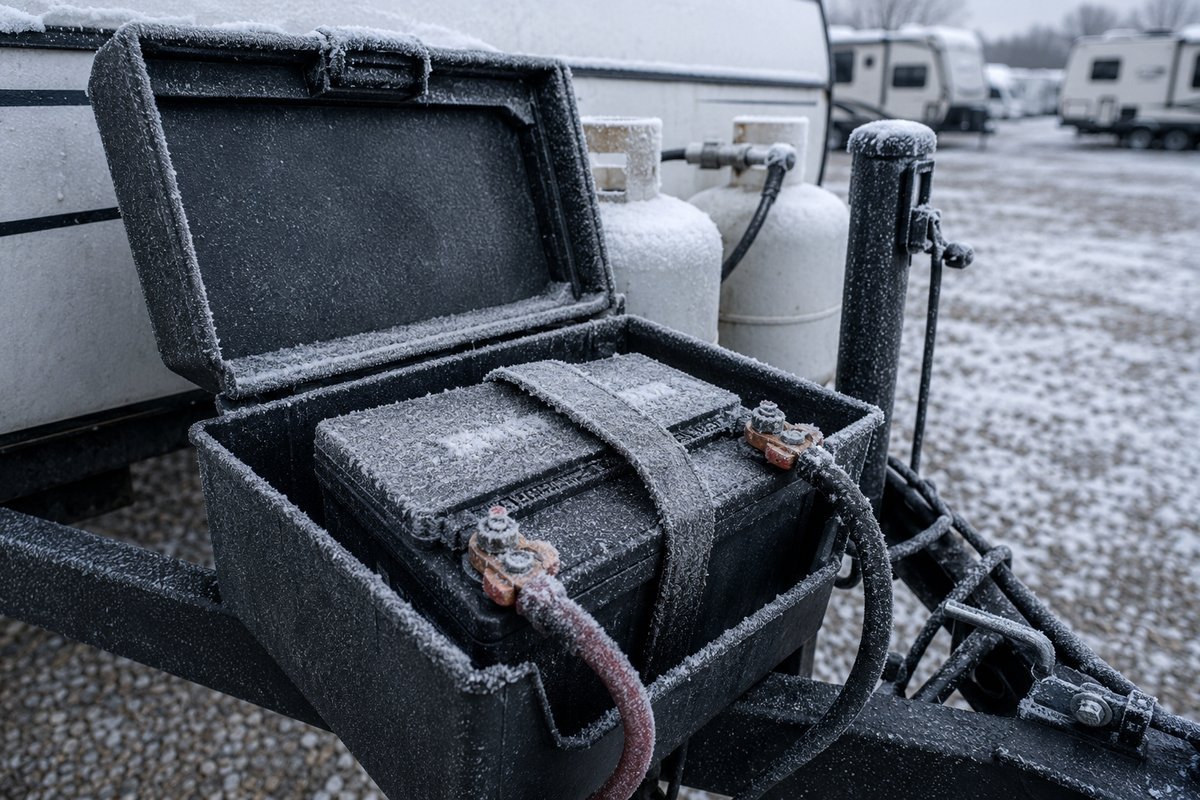
Start with what winterizing actually covers, because it isn’t everything in the trailer. Antifreeze in the fresh water lines protects those lines. It does nothing for a battery left on board, a lead‑acid battery that has self‑discharged over a couple of months can freeze and be permanently ruined not far below 20°F, while a fully charged one shrugs off far colder. It does nothing for the residual liquid sitting in a water heater that wasn’t fully drained, in P‑traps, or in the bottom of a gray or black tank. And it does nothing for whatever got left in the cabinets. Canned food, drinks, cleaning products, all of which burst and make a mess that takes the floor with it.
Then there are the cases where the plumbing genuinely is at risk. A low point that never fully cleared during the blow‑out. A bypass valve left in the wrong position so the water heater never got antifreeze, which is one of the faults worth checking before you call anyone about the water heater. A fitting loose enough that antifreeze slowly worked its way out over the winter. None of these are exotic; they are the ordinary result of doing a ten‑step job from memory in the cold.
A freeze alarm is how you find out your winterizing didn’t fully take, before spring, rather than after. It’s also the whole point if you pay for heated indoor storage (a heater failure is exactly what you’re insuring against), if you store the rig un‑winterized in a mild climate that occasionally surprises everyone, or if you use the trailer on and off through the winter and re‑winterize between trips, which is when steps get skipped.
What to Look For
The right alarm is decided by where the rig sits, not by which box lists the most features. Answer these five questions about your storage spot and the choice mostly makes itself.
Connectivity at the storage location
This is the single most important factor. If your RV is parked in your own driveway or garage within range of your home Wi-Fi, a Wi-Fi-based alarm works fine. If it’s at a storage lot, a rural property, or anywhere without a reliable internet connection, you need either a cellular-based unit or a long-range wireless system with its own hub that doesn’t depend on a local network.
Power source and backup
A freeze alarm is only useful if it’s still running when the temperature actually drops. Battery-powered units avoid the risk of a power outage silencing the alarm, but batteries eventually die, so look for a device with a low-battery warning that reaches your phone rather than just beeping locally in an empty RV. Plug-in units are simple and reliable as long as shore power stays connected, but a tripped breaker or a storage lot without power access defeats the purpose.
Alert method and redundancy
Some alarms only send a push notification, which is fine if you check your phone often, but a phone call or text message is harder to miss, especially for owners who aren’t glued to an app all day. A few units offer multiple alert channels at once, which adds a layer of redundancy in case one method fails to reach you.
Ease of setup
If you’re not particularly tech-savvy, a plug-and-call device with no app required is going to be far less frustrating than a system that needs a hub, a smartphone account, and a few rounds of firmware updates. Weigh how much time you want to spend on setup against how much monitoring detail you actually want.
Range and placement
Consider where inside the RV you’ll place the sensor. Low points near plumbing runs, the water heater bay, and enclosed underbelly compartments tend to freeze first, so a sensor that can be tucked into a tight space and still transmit reliably is worth more than one with extra bells and whistles but weak signal range.
How We Picked These
We did not physically test each of these devices inside an RV over a winter season. Instead, this comparison is based on manufacturer specifications, published pricing, verified owner reviews across retail platforms, and how each product’s connectivity method, power source, and alert system line up with the real-world conditions RV owners face when storing a rig for the winter. We paid particular attention to how each device performs when Wi-Fi isn’t available, since that’s one of the most common failure points for freeze alarms used in RV storage rather than in a house. Where pricing or specs may shift due to manufacturer updates, we’ve noted ranges rather than exact figures so this guide stays useful even as individual listings change.
FAQ
How do I know if my RV pipes are freezing?
Without a sensor in place, the honest answer is that you often don’t know until the damage is already done. Warning signs after the fact include reduced or no water flow when you first hook up in spring, visible cracks or splits in exposed PVC fittings, water stains near the plumbing bay, or a water heater that won’t hold pressure. A freeze alarm placed near the lowest, coldest point in your plumbing system, such as the underbelly compartment or the water heater bay, is the only reliable way to catch a freezing pipe before it splits, since it alerts you while the temperature is still dropping rather than after ice has already formed.
What is the best RV freeze alarm for boondocking or off-grid storage?
For rigs stored somewhere without reliable Wi-Fi, the MarCELL PRO Wireless Monitor is generally the strongest choice because it uses its own cellular connection rather than depending on a local network. The YoLink Freeze Alarm is a solid second option if there’s at least one power outlet and a rough Wi-Fi signal somewhere on the property to host the hub, since its long-range wireless network can bridge the gap between a distant storage spot and that connection point.
Do freeze alarms work if the RV loses power?
It depends on the device. Battery-powered sensors like the YoLink, SensorPush, and Resideo L1 keep monitoring temperature even during a power outage, though their ability to send an alert may depend on whether their hub or gateway also has backup power. The Honeywell Winter Watchman has no battery backup at all and stops functioning the moment it loses AC power, which is worth considering if your storage location has occasional outages. The MarCELL PRO includes battery backup specifically so it can continue reporting during a power loss.
Can I use a regular smart home sensor instead of a dedicated freeze alarm?
Some general-purpose smart temperature sensors can technically work, but dedicated freeze alarms are built with lower minimum temperature thresholds, more reliable cold-weather battery performance, and alert systems designed specifically to flag approaching freeze conditions rather than general climate monitoring. Standard smart home sensors are often optimized for comfortable indoor ranges and may not perform as reliably once temperatures drop well below freezing.
Where should I place a freeze alarm sensor in my RV?
Place the sensor as close as possible to the coldest, most vulnerable plumbing point in the rig, typically the underbelly compartment, the water heater bay, or a low-point drain area. Interior living space temperatures can stay relatively mild even when an exposed compartment underneath is well below freezing, so a sensor mounted in the main cabin may give a false sense of security. If your RV has multiple vulnerable areas, some owners choose a system that supports multiple sensors on one hub, such as YoLink, so they can monitor more than one zone at once.
Do I still need a freeze alarm if I already winterized my RV?
Honestly, it depends on how well you winterized and what’s still in the rig. If you drained the system, blew out the lines, ran antifreeze through every fixture including the water heater bypass, and pulled the battery and everything else out, the plumbing is protected to around −50°F and an alarm has very little left to warn you about. Where it earns its money is the messier reality: a low point that didn’t fully clear, a bypass valve left the wrong way, antifreeze that worked its way out of a loose fitting, a battery still sitting on the tongue slowly self‑discharging, or liquids left in a cabinet.
It’s also worth it if you store the rig in heated storage and are really monitoring the heater, or if you dip in and out of the trailer over the winter. If you’re confident in your winterizing and the trailer is empty, spend the money elsewhere.
How much does it cost to run a freeze alarm all winter?
Most of the devices on this list have no ongoing cost beyond the initial purchase and occasional battery replacement, which is a minor annual expense. The exception is the MarCELL PRO, which requires a monthly cellular service fee to maintain its independent connection. When weighing the subscription cost, it helps to compare it against the potential expense of a burst pipe or a cracked water heater tank, which can easily run into the thousands of dollars in repairs and lost storage time.
Will a freeze alarm alert me fast enough to actually prevent damage?
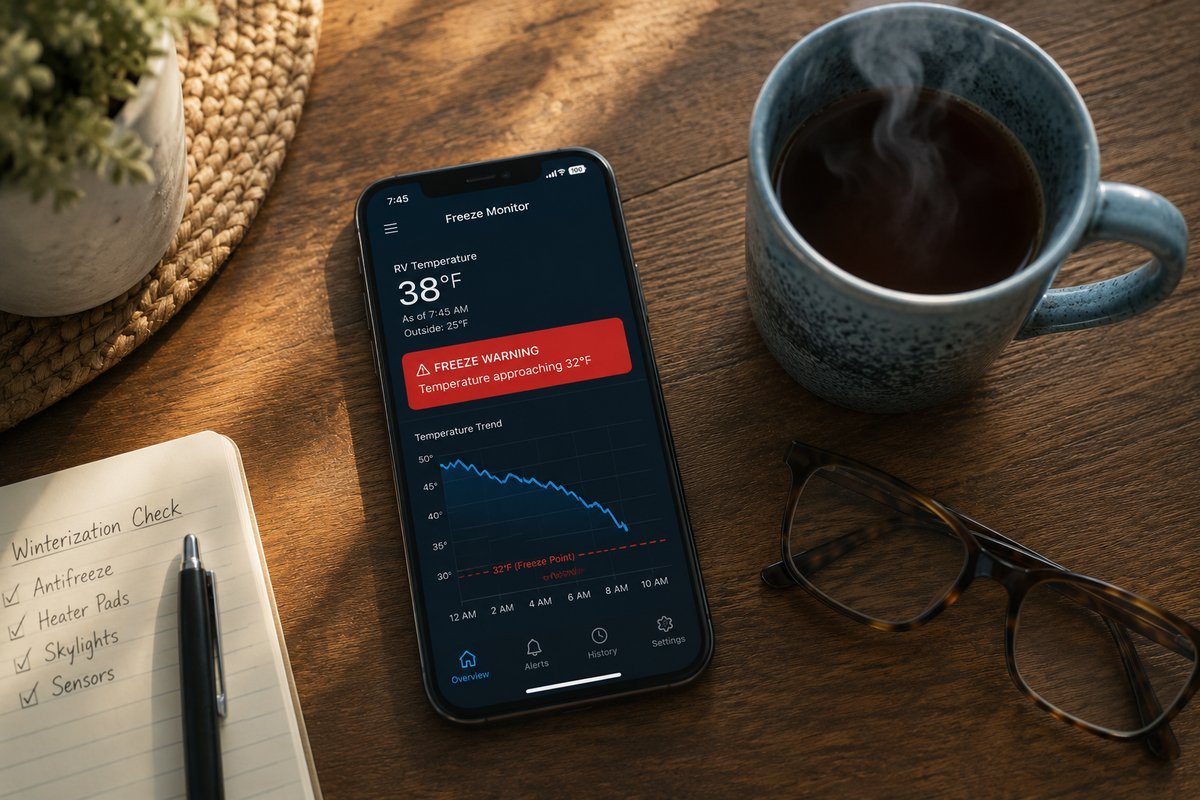
In most cases, yes, especially if you set the alert threshold a few degrees above freezing rather than waiting until it hits exactly 32 degrees. Water in enclosed lines typically takes some time to freeze solid even after the surrounding air temperature drops, so an alert at 38 to 40 degrees usually gives you a window to act, whether that means driving over to check on the RV, calling a neighbor to look in on it, or arranging for a heat source to kick on remotely if your setup allows for that kind of control.
Related guides
A freeze alarm is one part of keeping a stored RV out of trouble. These cover the rest.
- Best Smart Temperature Sensors for RVs in Storage. Continuous readings rather than a single alert threshold.
- Best Water Leak Detectors for Travel Trailers. The damage a freeze alarm is trying to prevent, caught from the other direction.
- RV Storage & Security: The Complete Guide. The overview that ties the storage guides together.
- Best Portable Power Stations for CPAP Users. Because an alarm and a CPAP both need power in a parked RV.
- 5 Best Battery Maintainers for RVs in Winter Storage. The battery is the thing most likely to die while the trailer sits.
- 5 Best RV Dehumidifiers for Winter Storage. Freezing is one problem, damp is the quieter one.
- RV Water Pressure Regulator: The Cheap One Wins
Final Thoughts
The right answer here is decided by your storage spot, not by the feature list. If the rig sits somewhere with a usable network, the YoLink gives you the most range for the money with nothing to pay monthly. If your rig sits somewhere with no Wi-Fi at all, the MarCELL PRO’s cellular connection removes that limitation entirely, even with the added monthly cost. Owners who want the simplest possible setup with no app to manage will appreciate the Honeywell Winter Watchman, while those who enjoy tracking detailed trends will get the most out of SensorPush.
And if you’d rather have one device watching for both freezing and leaks, the Resideo L1 covers both bases at once. Whichever you pick, set the threshold a few degrees above freezing rather than at it. A warning at 38 degrees gives you time to drive over. A warning at 32 tells you what already happened.