
Ask anyone who has had a trailer stolen and you will hear the same shrug: a determined thief with an angle grinder gets through anything in about two minutes. That is true, and it is also the wrong way to think about wheel and coupler locks for travel trailers.
Table of Contents
5 Best Wheel and Coupler Locks for Travel Trailers
Restful RV is a participant in the Amazon Services LLC Associates Program, an affiliate advertising program designed to provide a means for sites to earn advertising fees by advertising and linking to Amazon.com.
The one to buy if you are buying one thing. It clamps the wheel and covers the lug nuts, closing the obvious workaround of unbolting the wheel and leaving the clamp lying in the gravel. It adjusts across 10" to 18" wheels, which covers essentially every travel trailer, with no brake or weight restriction to catch you out.
Trimax publishes very little hard data, no material grade, no hardness figure, no weight, which by this article’s own logic counts against it. What it has instead is fitment that matches the audience and 437 ratings behind its average.
What You’ll Love
- Covers the lug nuts, so the wheel cannot be unbolted around it
- Genuinely universal fitment, no weight or brake limits
- Epoxy powder coat for weather
Worth Considering
- Heavy and awkward to fit in the dark
- No published material or hardness specs
The better reviewed of the two Trimax wheel locks, and the reason is simple: it is light, low, and you can fit it without kneeling in wet gravel. Rubber-coated jaws, a weather cap over the cylinder, and a span of 6" to 10.5".
Be clear-eyed about the trade. A chock lock wedges against the tire rather than enclosing the wheel, and it leaves the lug nuts exposed. It is less lock than the TWL100. For someone who would otherwise leave a heavy boot in the bay it is still the better buy, because the lock you fit beats the lock you do not.
What You’ll Love
- Light enough to fit every time without a fight
- Weather cap over the cylinder
- Rubber jaws will not mark the wheel
Worth Considering
- Least secure of the wheel options
- Does not protect the lug nuts
The cheapest way to put something visible on a wheel, and by a distance the most owned wheel lock here, roughly 6,000 ratings behind a 4.5 average. It clamps tires from 7" to 11" wide, which covers a standard travel trailer tire comfortably, and it comes in bright red and yellow, which is most of the point.
Be clear about what you are buying. Tevlaphee publishes no material grade, no hardness figure, no country of manufacture and no warranty, and the lock weighs 4.6 lb, roughly a third of what the heavier clamps weigh. By this article’s own test it is the least documented product on the list. It is also the one most likely to actually be on the wheel every time you walk away.
So treat it the way you would treat the Master Lock below: a deterrent, not a barrier. Bright, obvious, and enough to move an opportunist down the row. It will not survive a determined attack, it does not cover the lug nuts, and its own listing quotes two different fitment ranges, measure your tire before ordering.
What You’ll Love
- Around 6,000 owners behind a 4.5 average
- Bright color does the deterrent job
- Light enough that you will keep fitting it
- Three keys supplied
Worth Considering
- No published material grade, origin or warranty
- 4.6 lb, and does not cover the lug nuts
Machined from billet aluminum, or 303 stainless if you prefer, and made in the USA. It is the only product here where you choose the cylinder, the standard tubular Cobra, or an upgrade to disc-detainer, Medeco M3 or Abloy. Keyed-alike is offered, which matters if you are locking more than one thing.
It is also the rare case where the best-documented product is also the best-reviewed. Proven publishes materials, options and country of origin, and does not hide behind heavy duty.
Check your coupler size first: the 2516 is for 2-5/16" couplers only. Proven’s 2517 series is cut for specific coupler brands, so match the model to what is on your trailer.
What You’ll Love
- Made in the USA with published materials
- Choice of cylinder, up to Abloy
- Keyed-alike available
Worth Considering
- One coupler size only
- Cylinder upgrades cost extra
Seventeen thousand ratings. Whatever else is true, an enormous number of people have bought this and not regretted it, and it fits all three common coupler sizes, so the fitment trap does not apply.
Master Lock publishes essentially nothing about materials or hardness, which is exactly the pattern this article warns about. Treat it as a deterrent rather than a barrier: enough to send a passing thief to the next trailer, not enough to stop someone who came prepared. Paired with a wheel lock, that is a reasonable place for a budget to land.
What You’ll Love
- Fits every common coupler size
- Huge ownership base
- Keyed-alike packs available in the 377KA
Worth Considering
- No published material or hardness data
- A deterrent, not a barrier
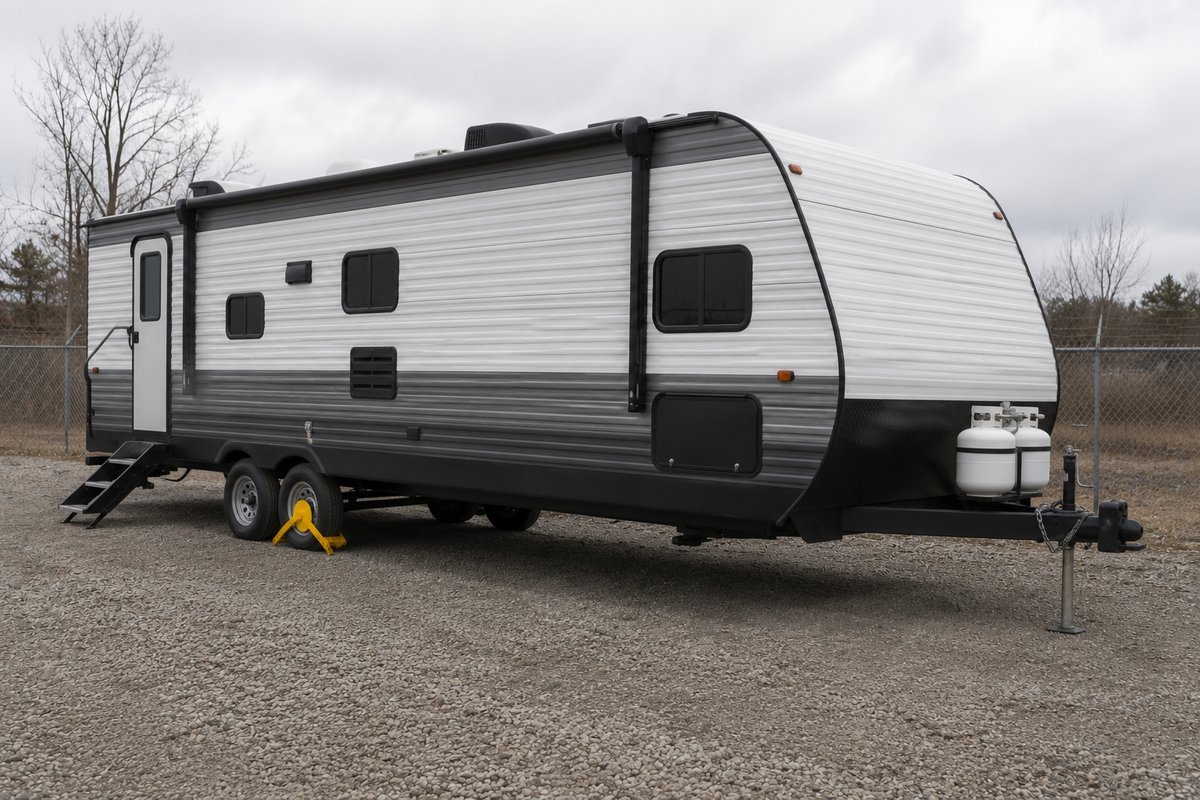
Most trailer theft is a crime of opportunity. Nobody is watching your rig for weeks and planning a job. Someone drives through a storage lot, looks down a row of forty trailers, and takes whichever one can be hitched up and towed away fastest. That is the whole business model, and it is why a lock does not have to be unbeatable. It only has to make your trailer the slow choice when there are easy ones parked on either side.
That is the whole argument for the gear below, and it is worth saying up front rather than pretending any of these products are theft-proof. The five wheel and coupler locks for travel trailers below were chosen on that basis: fitment you can actually verify, and specifications the manufacturer is willing to put in writing.
As an Amazon Associate I earn from qualifying purchases.
Quick comparison
| Product | Type | Fits | Body | Ratings |
|---|---|---|---|---|
| Trimax TWL100 | Wheel lock | 10″ to 18″ wheels | Powder-coated steel | 4.2 / 437 |
| Trimax TCL65 | Wheel chock lock | 6″ to 10.5″ span | Heavy gauge steel | 4.6 / 2,500 |
| Tevlaphee Universal Wheel Lock | Wheel lock | Tires 7″ to 11″ wide | Steel, no grade published | 4.5 / 6,000 |
| Proven Industries 2516 | Coupler lock | 2-5/16″ couplers | Billet aluminum or 303 stainless | 4.7 / 1,700 |
| Master Lock 389DAT | Coupler lock | 1-7/8″, 2″, 2-5/16″ | Not published | 4.7 / 17,000 |
Why this matters
A stored trailer is the easiest thing you own for someone to steal. It has no engine to hotwire, no alarm, no ignition. It needs a ball and a truck, both of which the thief already has. Unlike a car, it can sit missing for days before anyone notices.
And here is something almost every article on this subject gets wrong: no US agency publishes trailer theft counts. The NICB tracks vehicle theft nationally but does not break trailers out, and the FBI folds them into a general other vehicles category. Any article quoting a precise number of trailers stolen per year, or a recovery percentage, is repeating something a lock manufacturer made up. We would rather tell you the data does not exist than invent it.
What to look for
Check fitment before you look at anything else
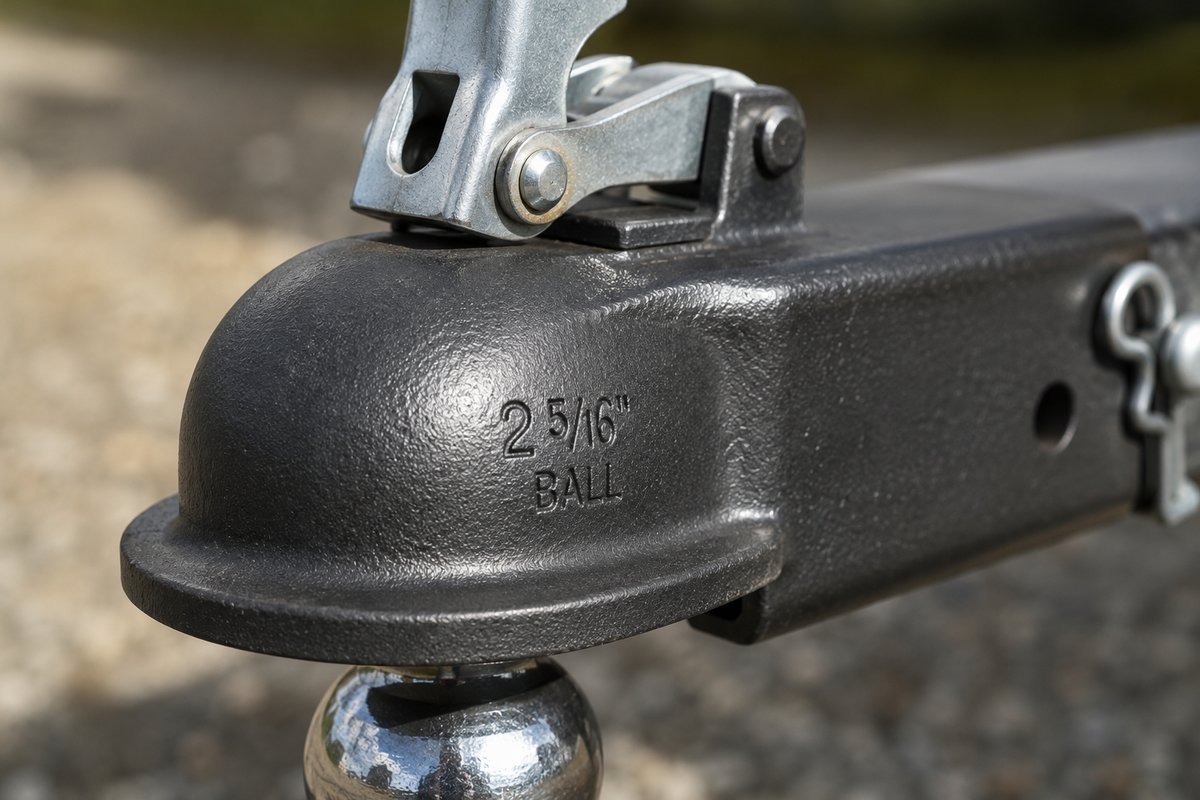
This is the mistake that wastes the most money, and star ratings actively hide it.
While researching this article we nearly recommended a wheel lock with a 4.4-star rating. Then we read the manufacturer’s own page. It does not fit trailers with brakes on more than one axle, and it is not rated for anything over 2,000 pounds, which rules out essentially every travel trailer on the road. The rating is genuine. It simply comes from owners of small utility and boat trailers, which is the job that lock is built for.
Brakes on more than one axle is the ordinary case on a travel trailer, and those brakes are electric, which is a system of its own. If yours have stopped working, start with what to check on a trailer brake controller rather than the controller itself.
Coupler locks have the same trap in a different form. Couplers come in 1-7/8″, 2″, and 2-5/16″, and a lock cut for one will not close on another. The size is stamped on the coupler itself, usually on the top or the side near the latch. Go and look before you order.
There is no American standard, and that changes how you read the packaging
Every trailer lock sold here says hardened, pick-resistant, or solid steel somewhere on the box. None of those words mean anything, because there is no ASTM, UL, or ANSI standard for trailer locks. Nobody tests these products against an agreed benchmark and no independent body grades them.
Britain has one. Sold Secure runs a published, independently graded scheme for hitch locks and wheel clamps, and Thatcham approval feeds straight into insurance discounts. American buyers have nothing equivalent. None of the five products below carries an independent security rating, and neither does anything else on the shelf.
So what can you actually judge? With no testing to rely on, the only honest signals are the things a manufacturer is willing to put in writing: what the lock is made of, where it was made, and what warranty comes with it. A company that states billet aluminum or 303 stainless, names the country it was machined in, and lets you choose your own cylinder has made specific claims it can be held to.
A company whose packaging says only “heavy duty” has committed to nothing at all. Warranty is the third signal, and the hardest to find in this category, most of these manufacturers publish no usable terms at all. That difference shaped the picks below more than anything else.
Star ratings measure convenience, not security
The most owned wheel lock in this article is the budget clamp, with roughly 6,000 ratings and an average of 4.5. It is also the least documented product on the list, and the lightest by some way. It rates well because it is cheap, bright, and takes seconds to fit.
That is not a criticism, a lock you will actually put on every time beats a better one that stays in the storage bay. But do not read a high average as evidence of strength. Reviewers are rating how a product feels to use, not how it holds up against a cordless grinder, because almost none of them have found out.
Trailer wheel lock vs coupler lock: Which to buy first
If you buy one thing, buy a wheel lock. A coupler lock protects one small replaceable component; a wheel clamp immobilizes the trailer. Insurers in markets that grade these products typically require both, and specifically will not accept a hitch lock on its own.
The documented failure modes, in order of how well they are evidenced: an angle grinder through the lock body, which owners report takes a couple of minutes; and towing the trailer a short distance on a locked wheel to cut it off somewhere private. Claims that thieves bring their own coupler or crane the trailer onto a flatbed are all over vendor blogs. We could not corroborate either with any police force, insurer, or agency, so treat them as plausible rather than established.
One recall worth a quick check
If you already own a receiver lock, it is worth 30 seconds to check the part number. Horizon Global recalled 145,431 Reese-branded hitch receiver locks, part numbers 7057030, 7057230, 7057033, 7054630 and 7057130, made between September 2019 and June 2024. They were built with a two-piece pin whose cap can lose its grip and come off. That is NHTSA campaign 24E-110.
Nothing to worry about if yours is not one of them, and safety chains do their job regardless. But if the number matches, it is worth sorting before your next trip.
Do not tow with a wheel lock fitted
Obvious once said, easy to do at six in the morning in a dark storage lot. Towing with a clamp on flat-spots the tire, heats the hub and bearing, and can damage the brake assembly.
AL-KO goes further in its own manual: after any attempted theft on a locked wheel, have the trailer inspected at an approved workshop before towing it. An attempted defeat can compromise the wheel-and-brake assembly in ways that are not visible from the outside.
Where locks actually rank
Two sheriff’s departments we looked at put hardware last. Their order is a permanently welded frame identification with your name and phone number, a reflective ID inside the trailer, documented VIN and plates, and only then locks. The reasoning is resale economics, an identifiable trailer is worth very little to the person trying to sell it. Insurers invert this, because hardware is what they can underwrite.
A fair synthesis for a trailer in storage: ID and paperwork first, wheel lock second, coupler lock third, hidden tracker fourth, and where you park it fifth. The coupler lock is the layer most people buy first and the one that earns its keep least.
How we picked these
We started from manufacturer documentation rather than retail listings, because listing titles are unreliable. Twice during this research, a search returned a sponsored advert for a completely different product, a coupler lock cut for Airstreams, presented in the results for a wheel lock.
Specifications come from Proven Industries, Trimax and Master Lock’s own published pages, and from the retail listing where a manufacturer publishes nothing at all. Where a manufacturer does not publish information, we state that rather than estimate. Ratings were checked at the time of writing and will drift.
We have not cut any of these locks with an angle grinder, and neither has anyone else publishing a comparison of them. Nobody in the United States tests trailer locks to a standard. What we can do is tell you what each manufacturer will commit to in writing, and where the fitment traps are.
FAQ
Do I need both a wheel lock and a coupler lock?
Insurers in markets that grade these products generally require both and will not accept a coupler lock alone. If you are buying in stages, buy the wheel lock first.
Will a lock stop a determined thief?
No. It buys time and makes your trailer a worse target than the one parked next to it. That is genuinely how opportunistic theft works, and it is the realistic goal.
Do these freeze up in winter?
Owners discuss it constantly, but we could not find a manufacturer statement or any testing to cite, so we are not going to make a claim either way. A cylinder cover and a squirt of graphite lubricant before winter is cheap insurance regardless.
Is a keyed-alike set worth it?
If you are fitting more than one lock, yes. One key for the wheel lock and the coupler lock removes the most common reason people stop using them. Proven and Master Lock’s 377KA both offer it.
What about my brakes?
Never tow with a wheel lock fitted. And if you find evidence someone tried to defeat a lock on a wheel, have the wheel and brake assembly inspected before towing. AL-KO recommends exactly this in its own manual. A wheel that has been tampered with is also worth watching on the road, which is one job a travel trailer TPMS does well.
Final thoughts
Best wheel lock for travel trailer use: the Trimax TWL100, because immobilising a wheel does more than protecting a coupler, and its fitment actually matches a travel trailer rather than a utility trailer.
Best coupler lock for travel trailer owners: the Proven Industries 2516. Well documented, made in the USA, and the rare case where the best-specified product is also the best-reviewed. Check your coupler is 2-5/16″ first.
Budget pick: the Master Lock 389DAT, understood for what it is, a deterrent that fits everything.
And the unglamorous advice the police give before any of it: weld your name and phone number to the frame. It costs almost nothing, and it is the single thing that makes your trailer hard to sell.
Related guides
- RV Storage & Security: The Complete Guide
- 5 Best GPS Trackers for Travel Trailers
- 5 Best Security Cameras for Unattended RVs
- 5 Best Smart Temperature Sensors for RVs in Storage
- Hitch locks, the receiver lock and the coupler lock are sold under the same name and do different jobs.
- Entry door locks, for the way in, once the trailer is staying put.
- Battery locks, the cheapest thing on the trailer to steal, and the advice that gets it wrong.