
An RV sitting in storage for weeks or months is exposed to freezing pipes, dead batteries, leaks, and theft, and most of that damage happens quietly, long before you’d notice on your own. This guide rounds up the monitoring and security gear we’ve researched for keeping a stored or unattended RV safe. It also covers RV winter storage preparation, and what is worth checking while it sits.
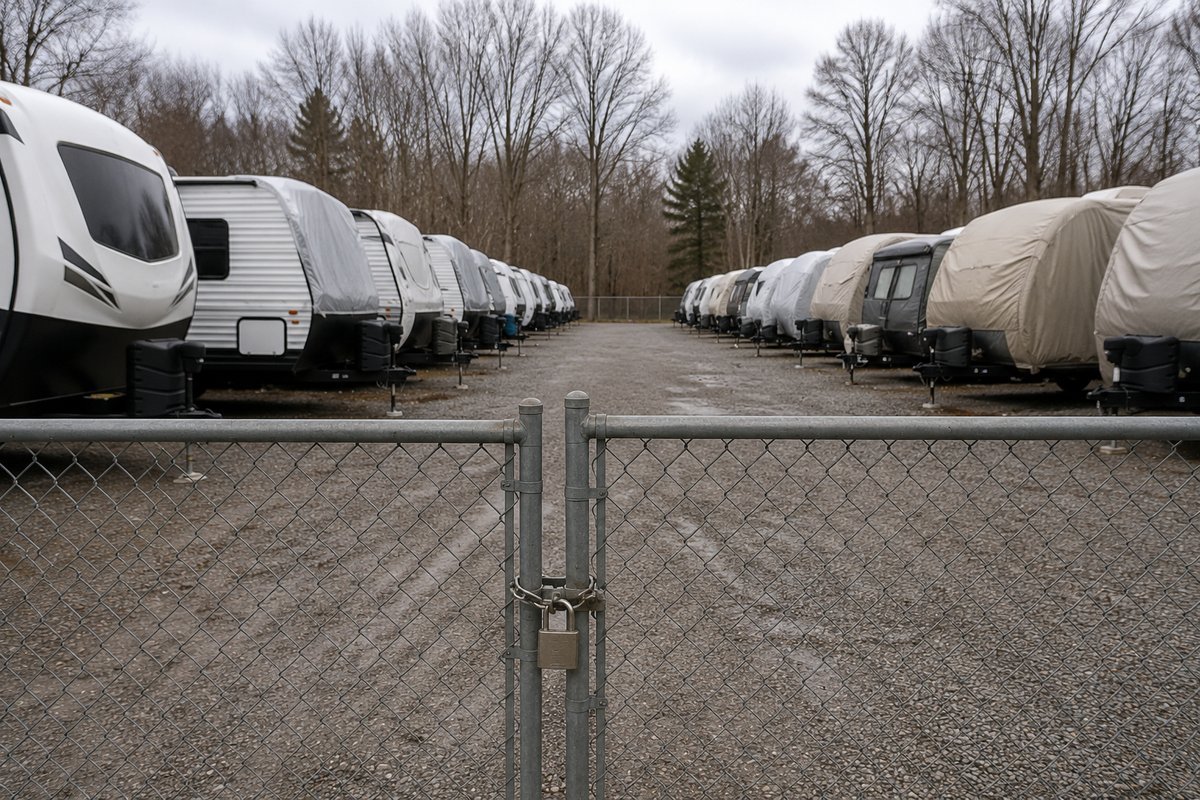
Almost every RV winter storage problem traces back to one of three things: water that was left in, air that could not move, or an animal that found a hole.
Table of Contents
Common Questions
What should you take out of an RV for winter?
Anything that freezes, anything that attracts mice, and anything you would rather not worry about. Water is the obvious one. Food is the one people miss, because a sealed box of pasta is still a reason for a mouse to chew through a wall to reach it.
Then the things simply better off indoors: bedding and fabric, which hold damp all winter, batteries if there is nowhere to keep them charged, and electronics that would rather not spend four months below freezing.
How cold is too cold to leave an RV outside?
There is no single temperature, because what fails is not the trailer, it is the water left in it. A properly drained trailer sits through a hard winter without complaint. One with water in a low spot splits a fitting at the first hard freeze, and that happens a few degrees below freezing rather than at some dramatic number.
So the question is not how cold it will get. It is whether there is water anywhere in the system. If there is not, cold is not your problem. Damp is, and that is covered further up.
What’s in this guide
- The guides in this series
- What actually threatens a stored trailer?
- How much moisture is a problem?
- What does storage protection cost?
- The one-page storage checklist
- Where to go next
Start here: The guides in this series
- Best Freeze Alarms for Winterized RVs. Get alerted before pipes freeze, not after.
- Best Water Leak Detectors for Travel Trailers. Catch slow leaks before they become expensive repairs.
- Best Smart Temperature Sensors for RVs in Storage. Monitor interior temperature and battery health remotely.
- Best Security Cameras for Unattended RVs. Keep an eye on the outside of the rig while you’re away.
- Best GPS Trackers for Travel Trailers. Recover a stolen trailer, or just keep tabs on it in a storage lot.
How to pick a starting point
If your biggest risk is winter weather, start with a freeze alarm and a water leak detector. Together they cover the two most common causes of costly RV winter storage damage. If your RV is stored somewhere you can’t check on regularly, add a temperature sensor for battery and climate monitoring. If theft is the bigger concern, especially in an open storage lot, a security camera and a GPS tracker are the better starting points.
What actually threatens a stored trailer?
Eight things account for nearly all of it. They arrive on different schedules, they announce themselves at very different speeds, and only some are worth spending money on for the way you happen to store your rig.
| What goes wrong | How you’d find out | Season | Which guide covers it |
|---|---|---|---|
| Battery discharges, then freezes | Dead rig in spring, or a swollen case | Winter | Battery maintainers |
| Water gets in through roof seams | A stain on the ceiling, months late | Any | Leak detectors |
| Pipes freeze and split | A flood the first time you turn the pump on | Winter | Freeze alarms |
| Damp builds up and mold follows | The smell, before you see anything | Winter | Dehumidifiers |
| Rodents chew wiring and nest | Wiring faults, droppings, shredded insulation | Fall onward | Covered on this page |
| Interior cooks, seals and screens perish | Cracked trim, brittle blinds | Summer | Temperature sensors |
| Someone hitches up and drives off | An empty space where the trailer was | Any | Wheel & coupler locks and GPS trackers |
| Break-in, contents taken | Damage at the door, gear missing | Any | Security cameras |
Read down the second column rather than the first. The problems that cost real money aren’t the dramatic ones. They’re the quiet ones that run for four months before anything visible happens.
What goes wrong while a trailer sits?
Almost nothing on this list happens suddenly. A stored trailer fails slowly and quietly: a battery drains over six weeks, a roof seam lets water past over a winter, a mouse finds a gap in October and is still there in April. That is what makes storage damage expensive. By the time anyone goes out to look, the cheap fix has already become the costly one.
It is also why monitoring earns its keep here more than almost anywhere else in RV ownership. You are not trying to prevent a dramatic event. You are trying to shorten the gap between something starting to go wrong and you finding out about it.
Why does the battery die first?
A trailer draws power even with everything switched off. The propane and CO detectors, radio memory, antenna booster and control boards all sip current continuously. Owners who have measured it commonly report somewhere between 0.02 and 0.5 amps. At 0.3 amps you are losing roughly 7 amp-hours a day, which is enough to flatten the usable half of a 100Ah lead-acid battery in about a week. Worth knowing: on many trailers the battery disconnect switch does not isolate everything.
That matters more in winter than it sounds, because a discharged lead-acid battery freezes at a temperature a charged one shrugs off. Fully charged, the electrolyte is dilute acid and stays liquid to somewhere around minus 75F. At half charge it is closer to minus 10F. Fully discharged it is mostly water, and it can freeze at around 20F to 32F. A frozen case is usually a dead battery.
Even without freezing, sitting discharged causes permanent damage. Lead sulfate crystals harden and the capacity does not come back. Flooded batteries self-discharge somewhere around 4 to 6 percent a month at room temperature and AGM closer to 1 to 3 percent, and the rate roughly doubles for every 18F warmer.
Lithium behaves differently. LiFePO4 can be discharged and stored well below freezing, but it must not be charged below about 32F. Most modern batteries have a battery management system that blocks cold charging on its own, but if yours does not, leaving solar connected through the winter is the way people damage them. Store lithium at roughly half charge rather than full or empty.
If any of that sounds like your storage situation, a smart temperature sensor that reports battery-killing cold is the single most useful thing you can leave in the trailer, and a freeze alarm covers the same ground from the other direction.
Where does the water actually get in?
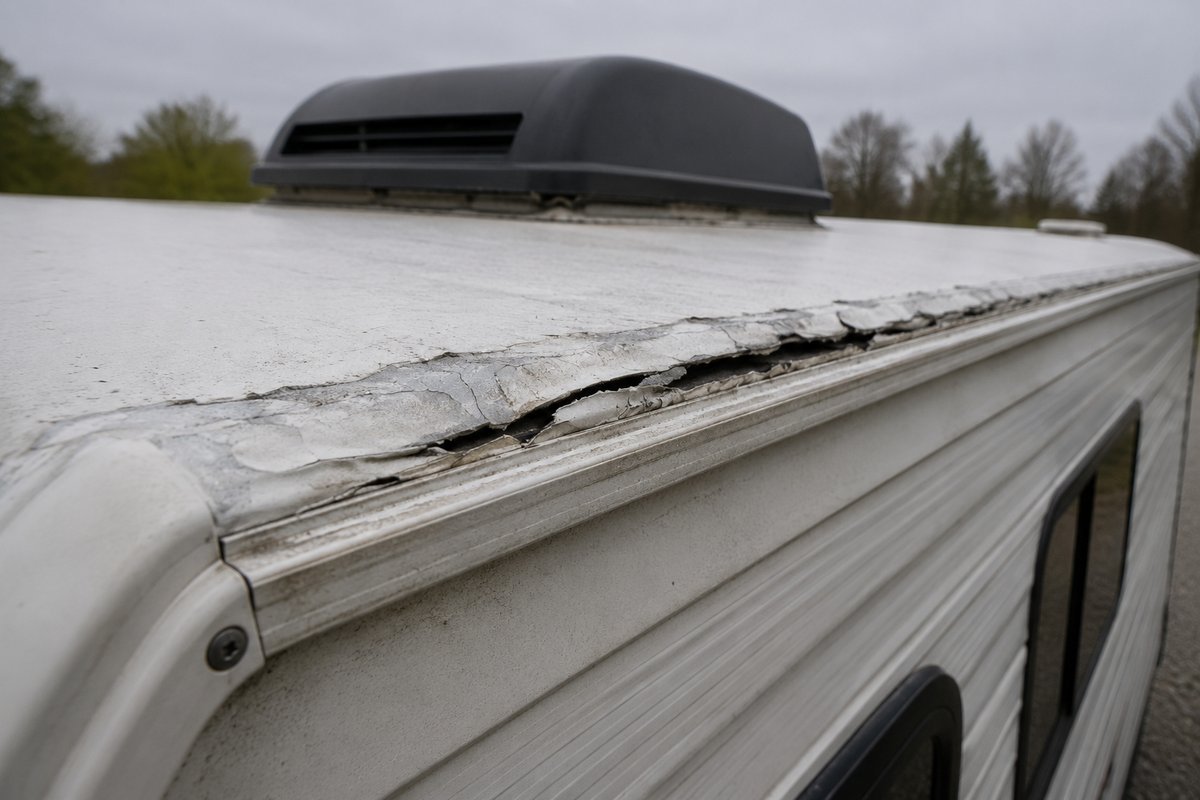
This is the correction most storage advice gets backwards. A properly winterized trailer has no water in its lines, so the burst-pipe scenario people picture is largely off the table. What actually soaks a stored rig comes in from the outside: roof seams, the sealant around vents, air conditioners, antennas and skylights, and the joints where the front and rear caps meet the walls. The membrane itself rarely fails first. The places where something penetrates it do.
Keystone tells owners to look at the roof at least every three months and to do a full exterior seal inspection at least twice a year. That is a reasonable bar for anyone, and it is the sort of job that is easy to skip precisely because the trailer is out of sight. A water leak detector placed under the likely entry points is the backstop for the months between inspections.
What do rodents do, and will insurance cover it?
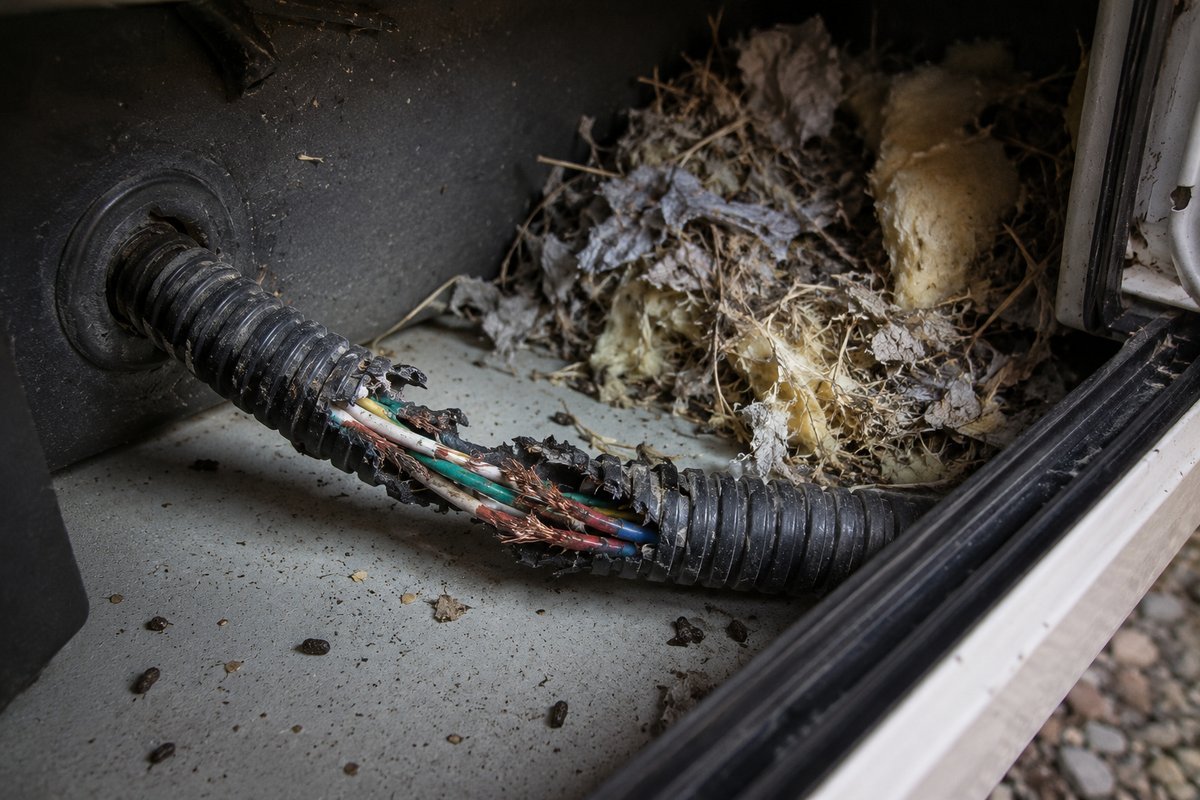
Rodent damage is consistently named by RV insurers among the more common off-season claims, and the expensive version is chewed wiring rather than shredded upholstery. You will see confident percentages quoted online for how much of all RV damage rodents cause. As far as we can tell those figures trace back to content farms rather than any insurer or industry body, so treat them accordingly.
The practical points are duller and more useful: block entry gaps before you close the trailer up, take every scrap of food out including what is in the cabinets you forgot about, and check your policy. Rodent damage is often covered only under comprehensive, and some policies exclude it outright.
What happens to the tires and the outside?
Flat spots get overstated. On modern steel-belted radials the flat spot from sitting is usually temporary. You feel it as vibration for the first few miles and it goes once the tires warm up. Permanent flat spotting needs under-inflation, weight, cold and a long time all together.
The real tire problem in storage is sunlight. UV and ozone degrade sidewalls, which is why RV tires normally age out at around five to seven years rather than wearing out. Inflate to the pressure on the sidewall before you park, cover the tires, and either move the trailer occasionally or take the weight off them. Pressure is also the thing worth watching once you are back on the road, which is what a TPMS on a travel trailer is for.
Will an alert actually reach you?
This is the question that decides whether any of this gear does anything at all, and it is the one product listings are quietest about. Many storage lots have no electrical hookup and no Wi-Fi. If yours does not, then whatever you leave in the trailer needs to bring its own power and its own connection, usually cellular, though sub-GHz gateways and satellite trackers exist too.
There is a cost attached to that either way. Cellular airtime has to be paid for by somebody, so the only real question is whether it is billed to you monthly or bundled into the purchase price. Be suspicious of anything advertised as having no ongoing cost without saying how.
And the blunt version: a sensor that needs your home Wi-Fi is a sensor for a trailer parked at home. It is a perfectly good product in a driveway and completely useless three miles away in a storage lot. Every one of the five guides below flags which side of that line a given device falls on.
What actually deters theft?
Nobody can tell you how likely your trailer is to be stolen, and anyone who quotes you a precise figure is probably repeating a vendor blog. The NICB publishes national vehicle theft totals, 334,114 in the first half of 2025, down 23 percent year on year, but does not break trailers out separately, and the FBI folds them into a general “other vehicles” bucket. The honest answer is that trailer theft is common enough to plan around and not measured well enough to quantify.
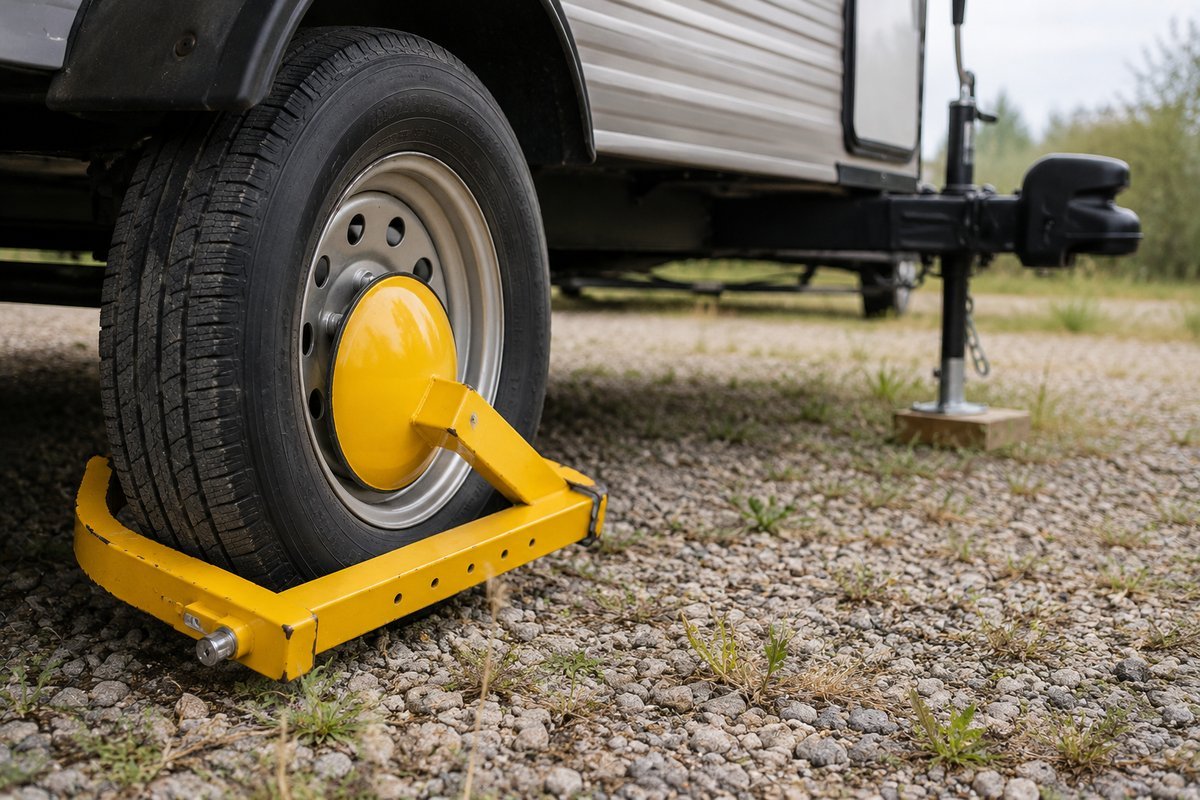
So judge deterrents on logic rather than statistics. Theft from a storage lot is opportunistic, which means the goal is simply to be a worse target than the trailer parked next to you. A visible wheel lock does that; coupler locks alone are widely reported as easy to defeat. Layer a GPS tracker underneath for recovery if the deterrent fails, and a camera if you want to know something happened rather than find out on your next visit.
How much moisture is a problem, and what do you do about it?
Damp is the failure nobody photographs. There’s no dramatic moment. Just a closed box sitting through a season of cold nights and mild afternoons, with the air inside reaching the temperature where moisture turns back into water every time the sun comes out.
Where the water actually comes from
Almost none of it comes in as rain. It’s already there, in the cushions, the mattress, the plywood, and it moves as the temperature swings. That’s why a rig can smell musty in spring with no leak anywhere.
Nobody publishes a target
You’d expect a number. Keep it under such-and-such percent and you’re fine. No RV manufacturer publishes a storage humidity target, and no absorber sold for the job carries a cold-weather performance rating. The advice online that sounds authoritative is generally borrowed from house basements, which sit thirty degrees warmer.
What works anyway
Airflow does half the job for free. Cabinet doors open, drawers cracked, cushions on edge rather than flat. After that it’s absorbers, and the honest guidance is in the dehumidifier guide. Including why a plug-in unit is the wrong answer in a lot with no power.
What does storage protection cost?
Prices shift too often to print, but the ranking rarely does, and it’s worth seeing before you spend anything.
The cheapest things are not gear
Opening the cabinets, propping the mattress on edge, covering the tires, and pulling the battery out if you have somewhere warm to put it. All free, and between them they prevent more damage than any device on this site.
The first purchase worth making
A battery maintainer, if the lot has power, and an RV surge protector between the trailer and that outlet if it will be connected all winter. A dead battery is the single most likely thing to go wrong, and it’s the cheapest failure to prevent outright rather than detect after the fact.
Where monitoring earns its keep
Sensors don’t stop anything. They shorten the gap between a problem starting and you knowing about it, and that gap is where the cost lives. A leak found in week one is a tube of sealant. The same leak found in spring is a floor.
The recurring cost people miss
Cellular monitors carry a subscription. Wi-Fi ones don’t, and also don’t work in a storage lot with no network. That’s the actual trade, not price against price, but a monthly fee against a device that can’t reach you.
What should be on your storage checklist?
Before you leave it
- Charge the battery fully, then disconnect or remove it, or store lithium at about half charge.
- Inspect the roof seals and every penetration; reseal anything questionable.
- Block rodent entry points and remove all food.
- Inflate tires to the sidewall pressure and cover them.
- Photograph the interior and exterior, for insurance and for comparison in spring.
While it sits
- Check temperature and battery remotely if you have monitoring in place.
- Visit after major storms rather than on a fixed schedule.
- Top up a lead-acid battery periodically if you left it connected.
Before you use it again
- Recheck the seals and tire pressures.
- Look for droppings and chewed wiring before switching anything on.
- Compare against your photos.
None of this is complicated. It is just easy to postpone, which is exactly what monitoring gear is for. It turns “I should go check on it” into a phone that tells you when there is actually something to check.
Where to go next
The pattern across all of this is the same. Nothing on a stored trailer fails loudly. The battery goes flat in week three and freezes in week nine, the seam opens in October and shows up on the ceiling in April, and the trailer that gets stolen goes in the small hours of a weekday when the lot is empty.
Prevention comes first: a maintainer on the battery, moisture absorbers in the cabin, a wheel and coupler lock on the outside. Detection comes second, and only for what prevention can’t cover freeze alarms, leak detectors, temperature sensors, cameras and GPS trackers.
If you only do one thing before the next season, walk the roof seams with a flashlight. It costs an afternoon, it needs nothing you’d have to buy, and it catches the failure that does the most expensive damage the most quietly.
Done properly, RV winter storage is boring, and boring in March is the whole objective.
Quick Answers
What goes wrong while a trailer sits?
Almost nothing on this list happens suddenly. A stored trailer fails slowly and quietly: a battery drains over six weeks, a roof seam lets water past over a winter, a mouse finds a gap in October and is still there in April.
Why does the battery die first?
A trailer draws power even with everything switched off. The propane and CO detectors, radio memory, antenna booster and control boards all sip current continuously.
Where does the water actually get in?
This is the correction most storage advice gets backwards. A properly winterized trailer has no water in its lines, so the burst-pipe scenario people picture is largely off the table.
What do rodents do, and will insurance cover it?
Rodent damage is consistently named by RV insurers among the more common off-season claims, and the expensive version is chewed wiring rather than shredded upholstery. You will see confident percentages quoted online for how much of all RV damage rodents cause.
What happens to the tires and the outside?
Flat spots get overstated. On modern steel-belted radials the flat spot from sitting is usually temporary.
Will an alert actually reach you?
This is the question that decides whether any of this gear does anything at all, and it is the one product listings are quietest about. Many storage lots have no electrical hookup and no Wi-Fi.