
Leaving your RV in storage for the winter, or even just a few weeks while you are back home between trips, means handing over control of your rig’s interior climate to whatever the weather decides to do. An RV temperature monitor is how you find out before the damage is done, provided it can actually reach you. A hard freeze can split a water line or crack a holding tank fitting before you even know the temperature dropped. A sensor tells you the cold arrived; winterizing the plumbing is what stops the cold mattering.
A stretch of warm, damp weather can turn a closed-up cabin into a mold incubator. Neither problem announces itself until you open the door and the damage is already done. This guide compares smart temperature sensors for RVs in storage, and is honest about which ones can actually reach you when the trailer has no power and no Wi-Fi.
Table of Contents
5 Best Smart Temperature Sensors for RV Storage
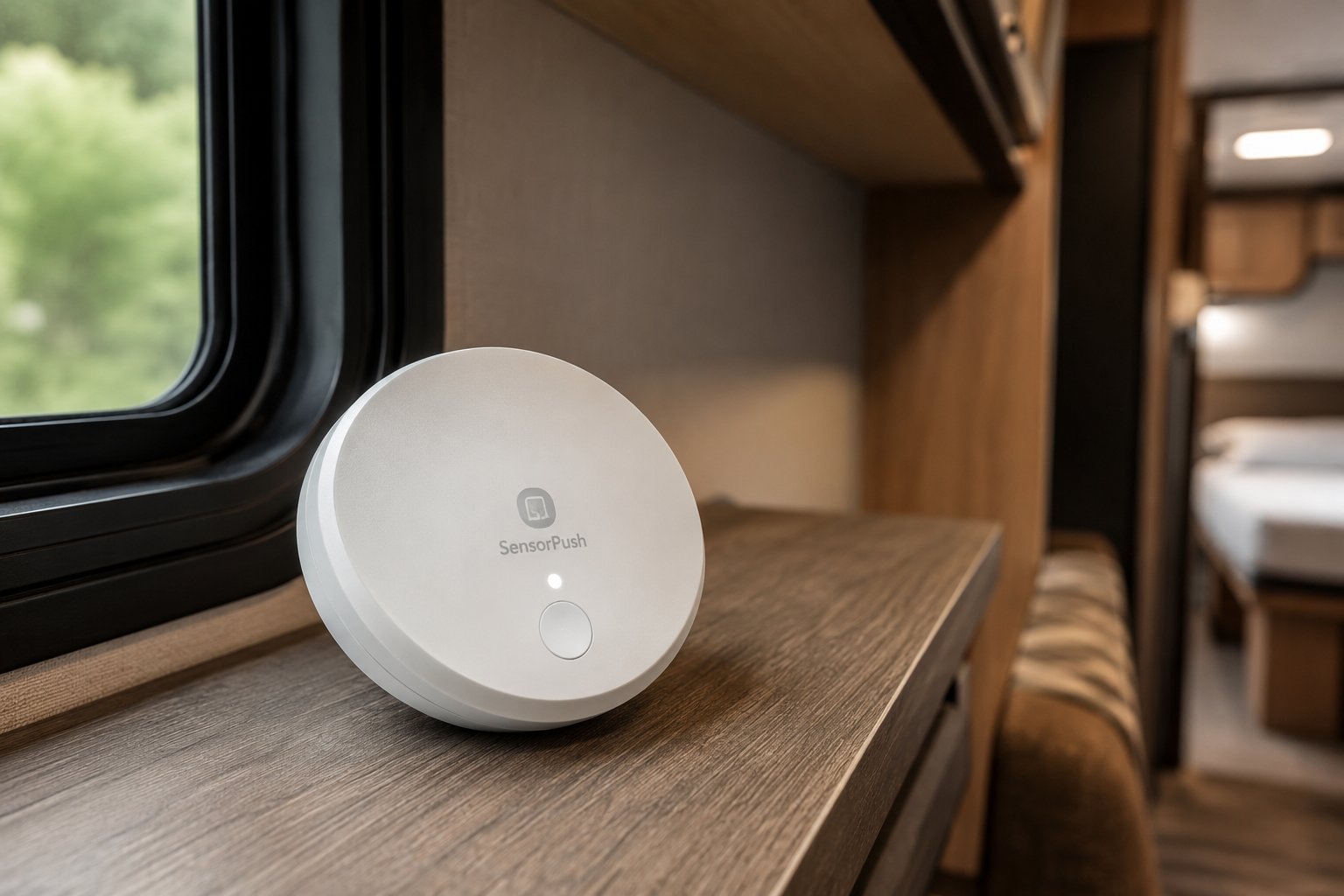
Plus or minus 0.5 degrees Fahrenheit and 1.8 percent relative humidity. That is tighter than anything else here, and tight enough that a reading near freezing is worth trusting rather than treating as a rough guide.
On its own it is a Bluetooth device with about 325 feet of open-air range, so you can pull months of logged history off it standing beside the trailer without opening the door. Add the WiFi gateway and it reports from anywhere. The gateway is a separate purchase and needs power at the storage site, which plenty of lots do not have.
What You’ll Love
- Plus or minus 0.5°F and 1.8% RH, the most accurate here
- Battery life measured in months
- About 325 feet of Bluetooth range
- Full logged history you can export
Worth Considering
- Remote alerts need the gateway, sold separately
- The app takes more learning than the simpler competitors
Connects straight to WiFi with no hub, and it is the cheapest route to remote alerts on this list. Setup is quick: install the app, join a 2.4GHz network, and readings start arriving.
Accuracy runs around 1 degree Fahrenheit and 3 percent humidity, fine for knowing whether the trailer is near freezing and not fine for anything needing precision. Two catches. It will not join a 5GHz network, which catches people out on modern routers, and holding a WiFi connection all day drains batteries faster than the Bluetooth units.
What You’ll Love
- The cheapest remote-alerting option here
- No hub required
- Quick app setup
- Alerts on both temperature and humidity
Worth Considering
- 2.4GHz networks only, not 5GHz
- Shorter battery life than the Bluetooth sensors
Most RV storage yards have no WiFi, and rural lots and covered barns certainly do not. This one carries its own cellular connection, so it needs nothing from the facility except a signal.
That is the whole argument and it is a strong one. The costs are a monthly fee and a dependency you cannot do anything about. Inside a metal building, or a covered barn with poor coverage, it will not report, and there is no router you can go and reset.
What You’ll Love
- Works anywhere with cell coverage
- Needs nothing from the storage facility
- Not affected by someone else’s router going down
Worth Considering
- Monthly subscription
- Unreliable in metal buildings and covered barns with weak signal
The alerting is the reason to buy it. Push, email and text at the same time, an optional phone call for the thresholds that matter most, and offline detection so you hear about it when the sensor itself stops reporting.
For freeze protection that redundancy is the point. One missed notification on a January night is a split pipe by morning. It costs more than the Govee for much the same readings, and like any WiFi sensor it is only as good as the network at the lot.
What You’ll Love
- Push, email and text alerts at once
- Detects when the sensor itself goes offline
- No subscription for basic alerting
- Clean historical graphs
Worth Considering
- Costs more than the Govee for similar readings
- Depends entirely on a working local network
Three sensors for less than most single units. That is how you cover the basement bay, the cabin and the refrigerator compartment at once and read all three in one app.
Out of the box it is Bluetooth only, about 230 feet, which makes this a walk-up check rather than remote monitoring. Govee sells a compatible WiFi gateway separately if you want push notifications from home, though it only comes bundled with another sensor rather than on its own. Accuracy sits a step below the SensorPush. For working out which part of the trailer actually gets cold, this is the cheapest way to find out.
What You’ll Love
- Three zones for the price of one better sensor
- Small enough for tight spaces
- One app manages all three
- Decent battery life
Worth Considering
- Bluetooth only unless you buy the gateway
- The gateway is only sold bundled with another sensor
- Less accurate than the SensorPush
A sensor does not stop any of that. What it does is tell you it is happening while there is still time to drive over, which is the difference between a wet carpet and a rebuilt floor. It is worth saying plainly that a sensor is the last line, not the first: the right cover and an hour spent sealing gaps prevent more damage than any alert will catch.
Five sensors below, chosen mostly on one question: can the alert actually reach you from where your RV is parked? That eliminates more products than accuracy does.
This guide is based on independent research, not hands-on testing. We compare published manufacturer specifications, cross-check them against verified customer reviews on retail sites and RV forums, and weigh each product on how each one performs in a stored RV, including whether its alerts can reach you there. We have not physically tested these units ourselves, and where the published specs and real-world owner reports disagree, we say so in the write-up.
Quick Comparison
| Product | Best For | Key Spec |
|---|---|---|
| SensorPush HTP.xw | Best Overall | Bluetooth range up to 325 ft, needs a WiFi gateway accessory for remote alerts |
| GoveeLife WiFi Thermo-Hygrometer H5179 | Best Budget Option | Direct 2.4GHz WiFi connection, no hub required |
| Waggle 4G Cellular RV Monitor | Best for No-WiFi Storage Lots | Built-in cellular data connection, works anywhere with cell coverage |
| Temp Stick WiFi Sensor | Best for Reliable Alerts | Direct WiFi with redundant alert channels (text, email, call) |
| Govee H5100 Mini (3-Pack) | Best for Multiple Zones | Bluetooth sensors, in-range app monitoring for several zones on one account; WiFi gateway sold separately for remote alerts |
Why This Matters
Most RVs are not designed to sit unattended for weeks or months at a time. When the furnace is off and nobody is running water through the lines, the interior temperature of a stored RV tracks the outside temperature closely, sometimes dropping even lower overnight because metal skins and thin-walled construction do not hold heat the way a house does. If water is still in the fresh tank, the water heater, or the plumbing lines, a single hard freeze below about 20 degrees Fahrenheit sustained for several hours can be enough to crack a fitting, split a hose, or damage a water pump.
Repairs for a fully frozen and burst plumbing system routinely run into the thousands of dollars, and the damage is often hidden inside walls or under floors until you turn the water back on in spring and find a slow leak that has already soaked insulation and subflooring.
Humidity is the quieter threat. RVs are sealed boxes with limited airflow when they are buttoned up for storage. Trapped moisture from residual dampness, small roof or window leaks, or even just seasonal humidity swings can push interior relative humidity into the range where mold and mildew start to grow on cushions, curtains, and cabinet interiors, usually within 48 to 72 hours of sustained damp conditions above roughly 60 percent relative humidity. By the time you notice a musty smell on your next trip, the mold has often already established itself in places that are difficult and expensive to remediate.
A smart sensor does not prevent either of these problems by itself, but it gives you the early warning you need to act. Get a freeze alert and you can drive over to run the furnace for a few hours or have a storage lot neighbor check the propane. Get a humidity spike alert and you can pop the roof vents or run a small dehumidifier before mold gets a foothold. The alternative, checking in person every week or two, is not realistic for most retirees who travel seasonally or store their rig far from home.

What to Look For
Three things decide this, and only one of them is really about the sensor. The other two are about where your RV sits and whether an alert can get out of there.
WiFi vs Bluetooth vs Cellular Range
A WiFi sensor will reach you anywhere in the world, right up until the network it depends on goes down. At home or at a facility with guest WiFi that is fine. In a lot where somebody else owns the router, you find out it rebooted when you stop getting readings. Bluetooth sensors are cheaper and last far longer on a battery, but they only talk to a phone a few hundred feet away, which makes them a walk-up check rather than a monitor unless you add a gateway.
Cellular sensors carry their own connection and need nothing at all from the facility. For a gravel lot or a field that is the only thing that works, and you pay for it every month for as long as you own it.
Battery Life and Power Source
Your RV is not plugged into anything, so none of these get to cheat. Bluetooth sensors sip power and run a year or more on a coin cell, because they are not holding a connection open. Direct WiFi sensors work much harder and want fresh batteries every four to eight months. Cellular sits in between: the radio is thirsty but it only wakes in short bursts. Four months is the number that catches people out. Fit it in October, forget about it, and it goes flat in February, which is the month you actually needed it.
Alert Reliability
A sensor that spots a problem and cannot tell you about it is an expensive thermometer. Look for more than one route out: a push notification plus email or text, because push is the one that gets silently switched off by a phone setting you changed months ago. A few units will place a voice call for critical thresholds, which is worth the money if a split pipe would genuinely hurt. The underrated feature is offline detection. A sensor that tells you it has stopped reporting is nearly as useful as one that tells you it is cold, because a flat battery and a dead router look exactly like everything being fine.
App Quality and Ease of Use
You will use this app twice a season, which means it needs to make sense to somebody who has forgotten how it works. Look for the current reading on the first screen without hunting, thresholds you set with a slider instead of through three menus, and a graph of the last few weeks so a slow humidity climb shows up before it turns into mold. Multi-user sharing is worth more than it sounds. If somebody who lives near the lot can see the same numbers, there is a person who can go and look while you are six hours away.
How We Picked These
This roundup was compiled from published manufacturer specifications, connectivity documentation, and a wide read of verified owner reviews across major retail and RV forum sites, rather than side-by-side hands-on lab testing of every unit. Where accuracy figures, battery life estimates, and range numbers are cited, they reflect the manufacturers’ stated specifications and the consistent range reported across many independent user reviews, since real-world results can vary somewhat based on your RV’s construction, wall thickness, and the metal content that can interfere with wireless signals.
We weighted connectivity flexibility, alert reliability, battery life, and total cost of ownership, including any required accessories or subscriptions, because those are the factors that most directly affect whether a sensor actually protects your rig when you are not there to check on it.
FAQ
What is the best way to monitor RV temperature while in storage remotely?
For most retirees, the best way to monitor RV temperature while in storage remotely is a WiFi-connected sensor if your storage location has reliable network access, since it gives you real-time readings and alerts from anywhere with cell service on your phone. If your storage lot has no WiFi at all, a cellular monitor is the more dependable remote option, since it carries its own data connection instead of depending on a network you do not control.
Should I use a WiFi or cellular sensor for an RV storage lot with no WiFi?
If you are comparing WiFi vs cellular sensor for an RV storage lot with no WiFi, the cellular option is generally the better fit, since a WiFi sensor with no network to join simply cannot send remote alerts at all. The tradeoff is a monthly or annual data fee, so if you can get even basic guest WiFi at the storage facility, a WiFi sensor will usually save you money over a few years of ownership.
How do I prevent frozen pipes in a stored RV?
The most reliable approach combines proper winterization, meaning draining the fresh water tank and lines and adding RV antifreeze to the plumbing system, with a temperature sensor set to alert you if interior temperatures approach freezing. Even a well-winterized rig can benefit from a freeze alert, since it also protects any remaining moisture in low spots of the plumbing, and it gives you a heads-up to check on things if you left any water in the system by mistake.
What humidity level causes mold in an RV?
Mold and mildew growth typically becomes a real risk once sustained relative humidity inside a closed RV climbs above roughly 60 percent, especially when that humidity persists for more than a couple of days without any airflow. Setting a humidity alert threshold around 55 to 60 percent gives you time to run a small dehumidifier, crack a roof vent, or check for a leak before mold actually takes hold in cushions and cabinetry.
Do smart temperature sensors work without an internet connection?
Bluetooth-only sensors will log and display readings without any internet connection as long as you are within Bluetooth range with your phone, but they cannot send you a remote alert unless paired with a WiFi gateway accessory. WiFi sensors need an active internet connection to send remote alerts, and cellular sensors are the only category built to work fully independent of any local internet or WiFi network.
How long do the batteries last in an RV temperature sensor?
Battery life varies a good deal by connection type. Bluetooth sensors like the SensorPush or the Govee H5100 Mini commonly run a year or more on a single set of batteries because they are not maintaining a constant network connection. Direct WiFi sensors typically need new batteries every four to eight months since the WiFi radio draws noticeably more power, and cellular units generally fall somewhere in between depending on how often they check in.
Can I monitor more than one area of my RV with a single system?
Yes, several of these systems support multiple sensors under one app account, which is useful for tracking, say, the basement storage bay separately from the main living area. The Govee H5100 Mini paired with a WiFi Gateway is designed specifically for this kind of multi-zone setup, and both SensorPush and Temp Stick also support adding additional sensors to the same account as your monitoring needs grow.
Are cellular RV sensors worth the monthly fee?
A cellular sensor’s monthly fee is generally worth it if your storage location has no WiFi access and you have no practical way to add one, since the alternative is having no remote monitoring at all. If WiFi is available at your storage lot, even a basic guest network, a WiFi-based sensor will typically deliver the same protection without the recurring cost.
How can I monitor my RV temperature remotely?
With a sensor that has its own way of reaching you, which in practice means one of two things. A Wi-Fi sensor works if the trailer sits somewhere with a network it can join, which usually means at home or on a serviced site. A cellular sensor carries its own connection and works anywhere with coverage, which is what a storage lot needs.
The mistake worth avoiding is buying a Bluetooth sensor for a trailer you are not standing next to. Those are fine for checking a fridge from across the campsite and useless for checking a trailer from home.
Do RV temperature monitors need a subscription?
The cellular ones do, and for the same reason a tracker does: something has to pay for the airtime that carries the alert. Wi-Fi sensors generally do not, because they are using a connection you already pay for.
So the subscription question is really a coverage question in disguise. Decide first whether the trailer will have Wi-Fi where it sits, and the fee answers itself.
Final Thoughts
None of these will winterize the rig or reseal a roof vent. What they buy you is warning, and warning is only worth something if it arrives. Work backwards from your storage lot. No WiFi means cellular. Weak cell signal means Bluetooth and a walk-up check. A lot with power and a network opens up everything else.
Related guides
- RV Storage & Security: The Complete Guide
- Best Freeze Alarms for Winterized RVs
- Best Water Leak Detectors for Travel Trailers
- Best Security Cameras for Unattended RVs
- Best GPS Trackers for Travel Trailers
- 5 Best RV Dehumidifiers for Winter Storage
- 5 Best Battery Maintainers for RVs in Winter Storage