
If you use a CPAP machine, losing power is scary. CPAP battery camping setups come down to one number, which is how many nights a single battery will actually carry you. Maybe you are camping far from an outlet. Maybe a storm knocks out the electricity at home. Either way, you need a plan.
A backup battery keeps your CPAP running so you can breathe easy and sleep well, even when the lights go out. This guide picks the five best backup batteries for a CPAP machine, explains what each one does well, and shows you exactly how to pick the right one for your trip. Below are the five worth considering, judged on runtime, weight and how they charge.
Table of Contents
The 5 Best Backup Batteries for a CPAP Machine
The Medistrom Pilot-24 Lite is a small battery made just for CPAP machines. It weighs about 1.4 pounds, which is lighter than a can of soup. It plugs straight into most ResMed machines using a DC cable, so no power gets wasted turning it into AC first. It is also approved for carry-on air travel, which is the main reason to choose it over something with more capacity.
What You’ll Love
- Very light and easy to pack.
- Plugs directly into ResMed machines with no extra parts.
- Runs silently with no fan.
- Approved for carry-on air travel.
Worth Considering
- Smaller capacity means it mostly covers one night.
- Costs more per watt-hour than a general power station.
- Works best with ResMed machines, so check compatibility first.
ResMed’s own Power Station II has been discontinued, so ResMed owners looking for a direct-connect battery today are mostly choosing between third-party options. The Easylonger ES400 AIR is the one we’d point people to.
At 148Wh it holds about half again as much as the small travel batteries on this list, and it ships with the DC cables for ResMed S9, AirSense 10 and 11, AirCurve 10 and 11, and the AirMini, plus the DreamStation 2. It connects straight to the machine, so you skip the energy loss that comes with running through an inverter, and there is no fan to hum next to your pillow.
What You’ll Love
- Ships with the right DC cables for most current ResMed machines.
- 148Wh is enough headroom for a full night with humidifier off.
- Direct DC connection runs silently with no inverter loss.
Worth Considering
- Third-party brand, so there is no ResMed warranty backing it.
- Heavier than the travel-focused batteries on this list.
- Confirm your exact machine and cable before ordering.
The Freedom V2 is built to work with almost any CPAP machine on the market, not just one brand. It comes with different bridge cables so you can match it to your specific machine. You can also buy it as a kit with two batteries for even more nights of backup power. This makes it one of the most flexible choices if you are not sure which battery fits your machine.
What You’ll Love
- Works with almost every CPAP brand using the right cable.
- Can be bought as a double-battery kit for longer trips.
- Good balance of price and capacity.
Worth Considering
- You need to buy the correct bridge cable for your machine.
- A little heavier than the Medistrom option.
- Not sold everywhere, so shipping times can vary.
The Jackery Explorer 300D is not made just for CPAP machines. It is a portable power station that can run your CPAP and also charge your phone, a fan, or a small light. With 288 watt-hours of capacity, it can carry a CPAP without a humidifier through three to five nights. It uses a pure sine wave inverter, which is safe for most CPAP power supplies.
What You’ll Love
- Much larger capacity than dedicated CPAP batteries.
- Can power other devices too, which is useful for camping.
- Lower cost per watt-hour than medical-only batteries.
Worth Considering
- Heavier and bulkier than dedicated CPAP batteries.
- Uses AC power through an inverter, which is slightly less efficient than a direct DC connection.
- Has a cooling fan that may be audible at night.
The EcoFlow River 3 is another general-purpose power station, but it stands out for how fast it recharges. It can go from empty to full in about an hour when plugged into a wall outlet, which is helpful if you only have a short window of shore power between camping stops. At 245 watt-hours, it covers most CPAP users for two to four nights without a humidifier.
What You’ll Love
- Recharges much faster than most competitors.
- Good capacity for the price.
- Works with solar panels for longer off-grid trips.
Worth Considering
- Also heavier than a dedicated CPAP battery.
- Fan noise is possible under heavier loads.
- Needs a separate DC cable or adapter for the cleanest CPAP connection.
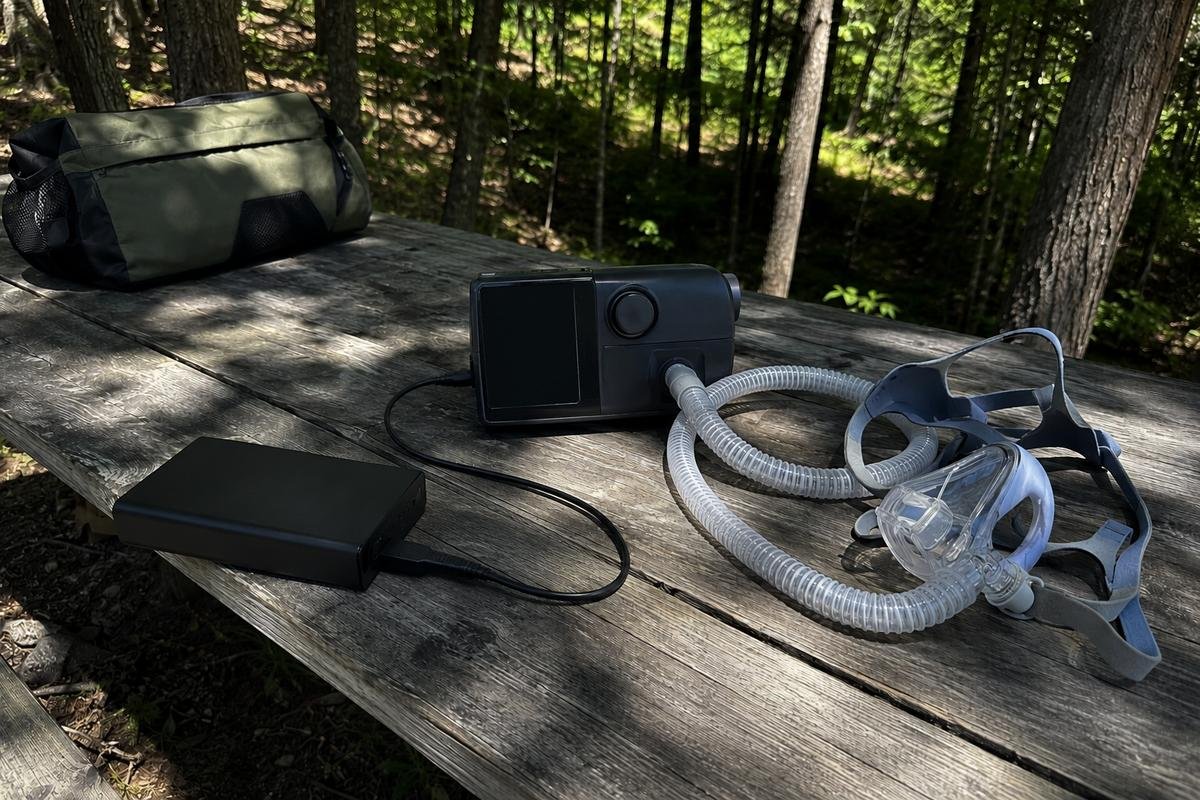
This guide is based on independent research, not hands-on testing. We compare published manufacturer specifications, cross-check them against verified customer reviews on retail sites and RV forums, and weigh each product on how long each one can actually run a CPAP across multiple nights of camping. We have not physically tested these units ourselves, and where the published specs and real-world owner reports disagree, we say so in the write-up.
CPAP Model Compatibility at a Glance
Not every backup battery connects to every CPAP machine the same way, and getting the wrong cable or port type can leave you stranded. The table below shows the connection type and typical DC voltage for the most common CPAP models, so you can confirm compatibility before you buy.
| CPAP Model | Connector Type | Typical Power Draw |
| ResMed AirSense 10 / AirMini | DC barrel (ResMed DC cable) | ~90-100W (12V-24V DC) |
| Philips Respironics DreamStation | DC barrel (Philips DC cable) | ~60-80W (12V DC) |
| Transcend Micro / Mini series | USB-C or DC barrel (model dependent) |
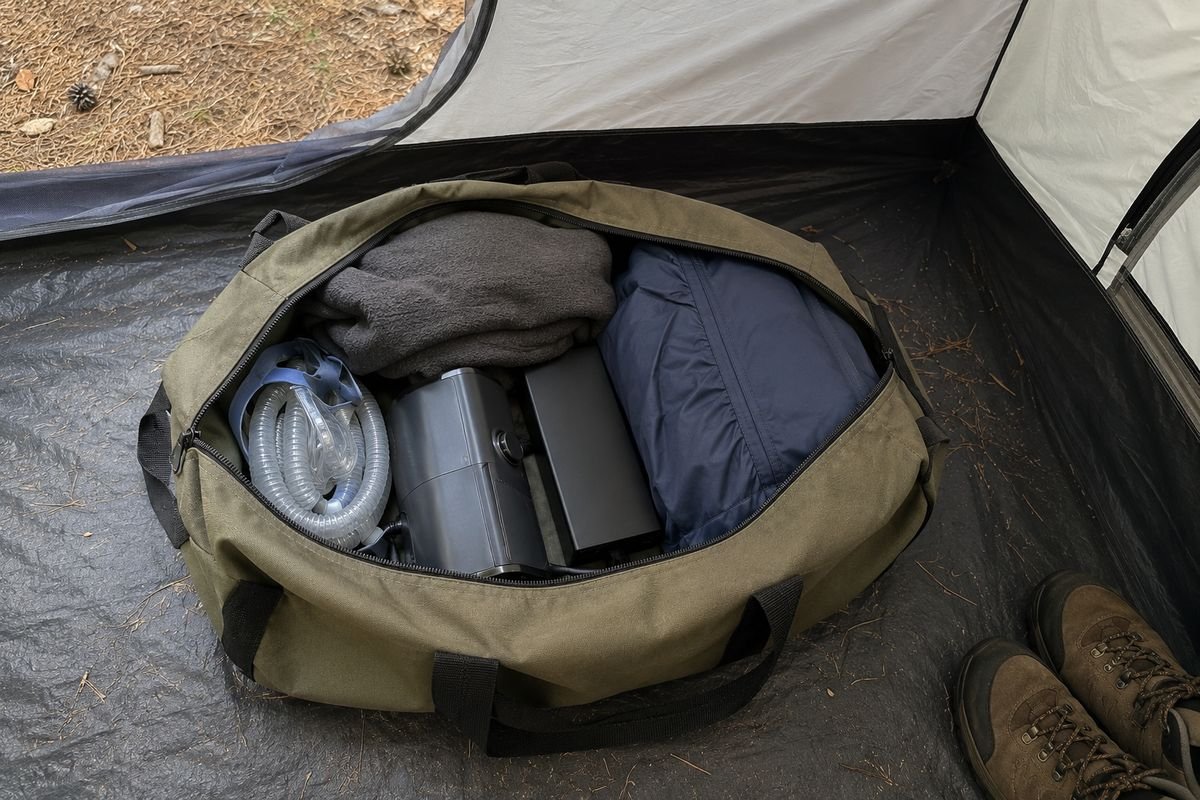
Quick Comparison: 5 Best CPAP Backup Batteries
Here is a fast look at all five batteries side by side. Capacity is measured in watt-hours (Wh). A bigger number means more power and more nights of sleep before you need to recharge.
| Battery | Best For | Capacity | Approx. Runtime* | Weight |
|---|---|---|---|---|
| Medistrom Pilot-24 Lite | Air travel & light packing | 95Wh | 1 to 2 nights | 1.4 lbs |
| Easylonger ES400 AIR | ResMed machine owners | 148Wh | 1 to 2 nights | |
| Freedom V2 CPAP Battery | Any CPAP brand | 100Wh (160Wh kit) | 1 to 3 nights | 1.5 to 2 lbs |
| Jackery Explorer 300D | Multi-night camping trips | 288Wh | 3 to 5 nights | 8.3 lbs |
| EcoFlow River 3 | Fast recharging off-grid | 245Wh | 2 to 4 nights | 7.8 lbs |
*Runtime estimates assume a CPAP without a heated humidifier, using around 30 to 40 watts per hour. Your real runtime will depend on your machine’s settings and whether you use a humidifier.
Who Needs a Backup CPAP Battery?
Who actually needs one comes down to how often you sleep somewhere without an outlet. Campers who sleep somewhere without an outlet, like a tent site or a boondocking spot, need one every single trip. People in areas with frequent storms or rolling blackouts need one at home, where an outage at 2am is the whole problem.
Frequent flyers who want a lightweight option for hotel rooms or layovers need something small enough to fit in a carry-on, TSA rules cap spare lithium batteries at 100Wh without airline approval, which most CPAP battery packs fall under. And RV owners who dry camp away from hookups need enough capacity to get through more than just one night. Whichever group you fall into, the right battery is the one that matches how many nights you actually need to cover.
How Long Will a CPAP Battery Last?
Most CPAP machines use about 30 to 40 watts every hour when the heated humidifier is off. That number can jump to 60 or even 80 watts an hour with the humidifier turned on. Here is an easy way to think about it: a 100Wh battery gives you roughly two to three hours of power for every 10 watts your machine uses. So a 100Wh battery without a humidifier can often get you through one full night. A bigger 250 to 300Wh battery can carry you through two, three, or even more nights.
The best way to know for sure is to check the wattage label on your own CPAP machine or its power adapter. Multiply that number by the hours you plan to sleep. That tells you how many watt-hours you need. Always add a little extra, just in case the night is colder than you expect, since cold weather makes batteries work harder.
If the Power Goes Out at Home
Most people buy a CPAP battery for camping, then a storm takes the power out at home and they discover they already own the answer. On a normal year the average U.S. household loses power roughly once, for a bit over two hours. In 2024 that average jumped to about eleven hours, nearly double the previous decade, with roughly 80 percent of those hours coming from major weather events.
Registering with your utility’s medical baseline program (search your utility’s name plus “medical baseline” or “medical certificate”) can get you a larger low-cost electricity allowance and earlier warning of planned shutoffs, but it will not restore your power any faster and will not provide a battery.
A battery is also the safer answer for a home outage than a generator, for one specific reason: carbon monoxide. Since 2009, portable generators have been linked to an estimated 765 non-fire carbon monoxide deaths in the U.S., about 40 percent of all CO deaths involving consumer products, and the CPSC has found compliance with voluntary automatic-shutoff standards to be minimal.
If you do run a generator, keep it at least 20 feet from the house with the exhaust pointed away, never in a garage, basement, crawlspace or shed, and never near a window, door or vent. A battery pack indoors covers the eight hours you actually need without that risk.
What to Look for in a Backup CPAP Battery
Five things to check, and the first two are really about your machine rather than the battery.
Capacity. Watt-hours are the size of the tank. A basic CPAP with the humidifier off burns roughly 30 to 40 watts an hour, so a 100Wh battery is about one night and 250Wh is closer to three. Switch the humidifier on and halve both numbers.
Compatibility. This is where the money gets wasted. The Medistrom is built around one machine family and needs its own cable. The Freedom V2 will work with almost anything provided you buy the right bridge cable. Check your exact model number against the battery’s list before you order, not after it arrives.
Output type. A battery that feeds your CPAP over DC skips the conversion to AC and back again, and you keep the 10 to 15 percent that conversion burns off as heat in an inverter. On a 100Wh battery that is most of an extra hour of sleep.
Weight and size. A dedicated CPAP battery is small enough to forget about in a carry-on. A power station is heavier, cheaper per watt-hour, and will charge your phone as well. If you drive to the site, take the power station. If you fly or walk in, weight decides it.
Noise. Power stations have a cooling fan. A medical battery generally does not. That is a non-issue on a shelf across the room and a real one two feet from your ear at three in the morning, which is where these tend to end up.
Dedicated CPAP Battery vs. Portable Power Station
These split into two camps, and picking the wrong camp is a more expensive mistake than picking the wrong model within it.
A dedicated CPAP battery, like the Medistrom Pilot-24 Lite, the Easylonger ES400 AIR, or the Freedom V2, is built for one job only: powering your CPAP. These batteries are small, light, and usually connect straight to your machine with a DC cable.
That direct connection wastes less energy than going through an inverter, so you get a little more sleep time out of every watt-hour. They also tend to run silently, since they do not need a fan to cool a big AC inverter. The tradeoff is price. You pay more per watt-hour for a dedicated battery than you would for a general power station.
A portable power station, like the Jackery Explorer 300D or the EcoFlow River 3, is built to power almost anything. You plug your CPAP’s normal power cord into an AC outlet on the unit, the same way you would at home.
These power stations usually hold more watt-hours for the price, and they can also charge your phone, run a small fan, or power a light. The tradeoffs are size and weight. They are bulkier to pack, and the fan that cools the inverter can sometimes be heard at night, especially under a heavier load like a humidifier.
If you fly often or backpack to your campsite, the lighter dedicated battery usually wins. If you drive to your campsite and want one battery that can do double duty for your whole camp kitchen and electronics, a power station usually makes more sense.
Tips to Make Your CPAP Battery Last Longer
A few small habits can stretch a single charge much further, which matters a lot when you are camping somewhere without an outlet for several days.
Turn off the heated humidifier. The heater inside your CPAP’s humidifier uses more power than the motor itself. Skipping it for a night or two can nearly double your battery’s runtime.
Lower the pressure setting if your doctor allows it. A lower pressure means the motor does less work, which uses less power over the course of the night.
Keep the battery warm. Cold weather makes any battery less efficient. Storing it inside your tent or trailer overnight, instead of in a cold vehicle, helps it deliver its full rated capacity.
Charge it fully before you leave. This sounds obvious, but a battery that starts a trip at 80 percent charge gives you 20 percent less sleep time than one that starts full.
Pack a backup plan. A small solar panel or a car charger adapter can top off your battery during the day, so you are not relying on a single charge to get you through a multi-night trip.
Safety Tips for Using a CPAP Battery While Camping
A backup battery is safe when you use it the right way. Keep these basics in mind.
Test it before you actually need it. Run your CPAP on battery power at home for a full night before your trip. This way, you already know it works and you know how long it lasts with your exact machine and settings.
Keep it away from water. Camping means rain, condensation, and spilled water bottles are all possible. Keep your battery in a dry bag or a sealed container when you are not using it.
Don’t leave it in extreme heat. A hot car in the summer can damage a lithium battery. Bring it inside your tent or trailer instead of leaving it in a parked vehicle.
Check the cable connection before bed. A loose cable can cause your CPAP to lose power in the middle of the night without warning. Give it a gentle tug to make sure it’s seated all the way in.
CPAP battery camping comes down to one calculation: what the machine draws each night, multiplied by the nights between charges.
Frequently Asked Questions
How can I power my CPAP while camping?
Four ways, and they suit different trips. A dedicated CPAP battery is the simplest and quietest. A portable power station costs more and runs other things as well. Shore power at a campground is the easy answer when you have it. And the trailer’s own house battery will do it through an inverter, at the cost of noise and efficiency.
The whole decision is laid out in the guide to running a CPAP off grid, which is the place to start if you are working this out from scratch.
Is there a portable power station for CPAP camping?
Yes, and it is the right answer for anyone who wants one box to run the CPAP, charge phones and keep a fan going. The trade is size and weight against flexibility. A dedicated CPAP battery is smaller, lighter and quieter, and does one job. The power station guide covers which ones actually last a night.
How long will a CPAP battery last during a power outage?
It depends on the battery size and your machine’s settings. A 100Wh battery usually lasts one night without a humidifier. A 250 to 300Wh power station can often last two to four nights. Turning off the heated humidifier stretches your runtime a lot.
Can I use a car battery to power my CPAP machine?
You can, but it takes extra equipment like an inverter, and it is not as safe or simple as a battery made for this job. A car battery can also drain your vehicle if you are not careful. A dedicated CPAP battery or portable power station is a safer and easier choice.
Do I need a special cable to connect my battery to my CPAP?
Sometimes, yes. Dedicated batteries like the Medistrom Pilot-24 Lite and Freedom V2 need a cable that matches your exact CPAP model. Power stations like the Jackery or EcoFlow usually just need your CPAP’s normal power cord plugged into an AC outlet on the unit.
Is a CPAP battery covered by insurance?
Coverage depends on your insurance plan. Some plans cover a backup battery as durable medical equipment if your doctor writes a prescription for it. Call your insurance company or CPAP supplier to check your specific plan.
What is the best CPAP battery for camping without a humidifier?
If you are camping for just one or two nights, a small dedicated battery like the Medistrom Pilot-24 Lite or Freedom V2 is light and easy to pack. For longer camping trips, a power station like the Jackery Explorer 300D gives you more nights of power and can charge other gear too.
Can I charge my CPAP battery with a solar panel?
Yes, if the battery accepts solar input. Most portable power stations, like the Jackery Explorer 300D and EcoFlow River 3, can be charged with a compatible folding solar panel. Dedicated CPAP batteries usually need to be charged with a wall outlet or a car adapter instead.
How many watt-hours do I need for a week-long camping trip?
If you have no way to recharge during the trip, you would need roughly 250 to 350 watt-hours per night without a humidifier, which adds up fast over a week. Most campers instead bring a mid-size battery, like the EcoFlow River 3, along with a solar panel or a car charger to top it off every day or two.
Will a battery back up damage my CPAP machine?
A battery made for CPAP use, or a power station with pure sine wave output, will not damage your machine. Problems only tend to happen with very cheap inverters that produce a rough, modified sine wave, which can cause some CPAP power supplies to run hot or shut down. Sticking with a pure sine wave battery avoids this issue entirely.
Get that sum right and CPAP battery camping stops being a worry you carry to bed with you.
Related guides
If you are still working out how to power a CPAP away from a hookup, these go deeper on the parts of the problem this guide only touches on.
- Best Portable Power Stations for CPAP Users. When you want one box that also charges phones and lights.
- Best Quiet Inverters for Overnight CPAP Use. If you already own a battery and just need clean AC.
- Best Solar Panels to Recharge a CPAP Battery. For trips longer than any single battery will cover.
- Best Smart Temperature Sensors for RVs in Storage. Cold cuts battery capacity, and this is how you see it coming.
Final Thoughts
The best backup battery for your CPAP machine depends on your trip. If you fly a lot or want the lightest possible option, a dedicated battery like the Medistrom Pilot-24 Lite or Easylonger ES400 AIR is a smart pick.
If you camp for several nights and want a battery that can do more than just power your CPAP, a portable power station like the Jackery Explorer 300D or EcoFlow River 3 gives you more power for your money. Whichever you choose, run your CPAP on it for a full night at home first. Finding out that the cable is wrong is a much smaller problem in your own bedroom than it is at a trailhead.
Quick Answers
Who Needs a Backup CPAP Battery?
Who actually needs one comes down to how often you sleep somewhere without an outlet. Campers who sleep somewhere without an outlet, like a tent site or a boondocking spot, need one every single trip.
How Long Will a CPAP Battery Last?
Most CPAP machines use about 30 to 40 watts every hour when the heated humidifier is off. That number can jump to 60 or even 80 watts an hour with the humidifier turned on.