
RV skirting is a wall of material that closes the gap between the bottom of your RV and the ground. It stops cold wind from blowing under the floor, where your water lines, holding tanks, and valves are exposed. If you stay in one place while the temperature drops below freezing, skirting is one of the simplest ways to protect your plumbing and make the floor feel warmer. It won't heat anything on its own, and it can cause real problems if it blocks a furnace vent or traps generator exhaust.
Restful RV is a participant in the Amazon Services LLC Associates Program, an affiliate advertising program designed to provide a means for sites to earn advertising fees by advertising and linking to Amazon.com.
This guide explains how RV skirting works, the main types and how they compare, how to measure and install it, and what to keep clear for safety. We built it from manufacturer manuals, U.S. government safety and energy guidance, and product listings checked on October 13, 2026. We haven't installed or tested these products ourselves. Where a detail comes only from a seller's listing, we say so.
Quick Answer
Yes, RV skirting works when you are parked for weeks in freezing weather. It blocks wind under the RV, which helps keep tanks and pipes from freezing. Snap-on vinyl or fabric kits are the easiest to put up and take down. Rigid foam board insulates best but is bulky and burns, so keep it away from heat. Before you close the gap, mark every furnace, water heater and generator vent so nothing covers it, and leave a way to reach your dump valves, the handles that drain your waste tanks.
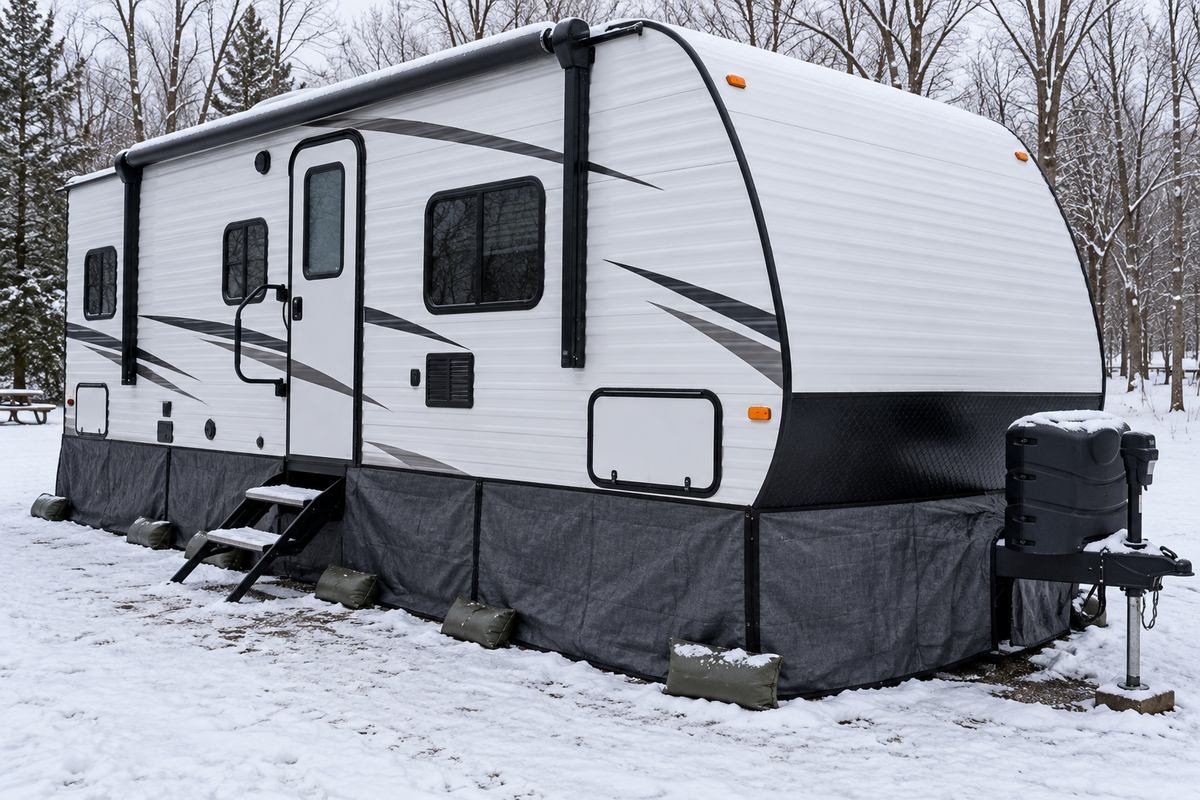
Table of Contents
What RV Skirting Does
Most RVs sit on wheels and jacks with an open space underneath. In cold weather, wind moves through that space and pulls heat away from the floor, the tanks, and any pipes that run outside the heated part of the RV. Skirting closes that space so the air under the RV stays still.
Still air is the key. Wind pulls heat away from the floor and tanks faster than calm air does. The area under a skirted RV usually stays a little warmer than the open air because some heat leaks down through the floor and stays trapped. That helps, but it has limits:
- Skirting doesn't make heat. In a long, hard freeze, the space under the RV can still drop below 32°F.
- It doesn't protect the water hose or the campground spigot outside the skirt. Those need their own protection.
- It works best on an RV that stays parked. You have to remove it before you drive.
Think of skirting as one layer in a winter plan, alongside a heated water hose, the RV's own tank heaters (if it has them), and a way to monitor the temperature underneath.
Do You Need to Skirt Your RV in Winter?
It depends on how you use the RV.
- Living in it or staying for weeks in freezing weather: skirting is worth it. This is what it's made for.
- Camping a night or two in the cold: usually not. Putting it up takes time, and the RV's furnace and tank heaters may be enough for short stays.
- Storing a winterized RV: no. Once you drain the water lines and add RV antifreeze, there's no water left to freeze. Our guide on how to winterize an RV covers that process.
What about an RV sold as "four-season" or with an enclosed, heated underbelly (a sealed bottom that wraps the tanks and pipes)? Those features help, but the labels aren't standardized, so the temperature ratings vary by brand. Check your owner's manual for the lowest temperature the RV is rated for. If you plan to stay in weather colder than that rating, skirting adds a safety margin.
Types of RV Skirting Compared
There are five common types. They differ in how well they insulate, how long they take to put up, and how easy they are to store.
Vinyl or Fabric Snap-On Skirting
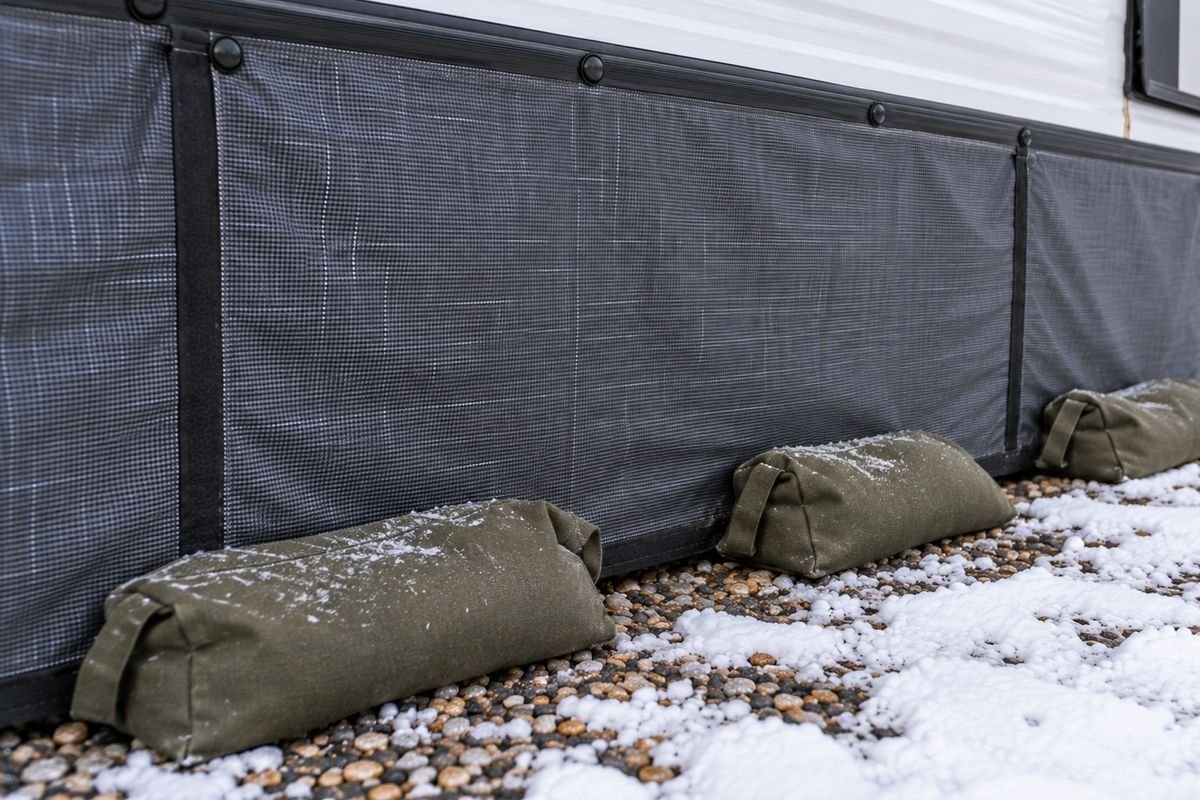
This is heavy vinyl or woven fabric that attaches to the RV with snaps, so you can remove it when you move. Some kits use adhesive studs, so you don't drill holes in the RV. It packs down small and can be reused for several seasons. Plain fabric blocks wind but doesn't insulate much on its own.
Inflatable Skirting
Inflatable skirting is a row of air-filled tubes that sit against the side of the RV. The trapped air adds a bit of insulation, and the tubes deflate to a small size for storage. A puncture can let a section go flat, so check the tubes and keep a patch kit on hand.
Rigid Foam Board
Foam board insulates better than any other common option. Building America, a U.S. Department of Energy program, lists typical R-values per inch of about 3.8 to 4.4 for expanded polystyrene (EPS), about 5 for extruded polystyrene (XPS), and about 6 for polyisocyanurate (polyiso). Those are the three common kinds of foam board. R-value measures how well a material slows heat loss, and higher numbers insulate better.
The downsides are size and fire risk. Full sheets are bulky to haul, and foam burns. The Department of Energy says foam board used outside needs a weatherproof facing, and foam used indoors must be covered with a fire-rated material like drywall. Skirting isn't a house wall, but the warning still matters: keep foam well away from anything hot.
Reflective Bubble Foil
Bubble foil, such as Reflectix, is light and easy to cut. It works by reflecting heat, but only when there's an air gap next to the foil. Reflectix explains that when the shiny side touches another surface, it conducts heat instead of reflecting it. Without an air gap, Reflectix says its two-layer bubble product adds only about R-1.1 per layer. That makes it better for filling small gaps or lining another type of skirting than for standing alone in very cold weather.
Plywood or Permanent Panels
Some people who live in one spot all winter build panels from plywood, metal, or vinyl siding. Panels stand up well to wind and snow but are heavy and can't travel with you. Some RV parks have rules about what you can put around your site, so ask before you build anything permanent.
| Type | Insulation | Setup | Storage | Main drawback |
|---|---|---|---|---|
| Vinyl or fabric snap-on | Low on its own, mainly blocks wind | Long first install, then fast | Rolls up small | Fasteners must be placed first |
| Inflatable | Moderate | Moderate | Deflates small | Can puncture |
| Rigid foam board | Highest (about R-3.8 to R-6 per inch) | Slow, lots of cutting | Bulky | Burns, so keep it away from heat |
| Reflective bubble foil | Low (about R-1.1 per layer without an air gap) | Fast | Rolls up | Needs an air gap to reflect heat |
| Plywood or permanent panels | Depends on what is behind them | Slow | Stays on site | Can't travel and may break park rules |
Which is best for winter? For most people who move a few times a season, a snap-on vinyl or fabric kit is the best balance of protection and convenience. If you're staying in one place through a very cold winter and don't mind the bulk, foam board gives the most insulation.
How to Measure for RV Skirting
Getting the size right matters more than the material. A skirt that's too short leaves a gap at the ground, and a gap lets wind back in.
- Level and park the RV first. Measure where it will sit for the winter, after you've set the jacks. The height changes once the RV is leveled.
- Measure the length of each side. Add the two long sides and the front and back ends to get the total distance around the RV.
- Measure the height in several spots. Measure from the bottom edge of the RV wall to the ground every few feet. Ground is rarely flat, so the tallest spot may be inches higher than the shortest.
- Add extra at the bottom. The skirt should lie on the ground or slightly past it so you can weigh down the bottom edge.
- Note what's in the way. Write down where the wheels, steps, jacks, hookups, and vents are.
Kits are often sold by RV length and by height. For example, the EZ Snap kit on Amazon comes in a 36 to 40 foot standard height version and a tall version for RVs that sit higher off the ground. The listing calls these standard and tall "clearance," meaning the distance from the bottom of the RV to the ground. Check your tallest height measurement against the kit's listed height before you order.
How to Install RV Skirting
Every kit has its own steps, so follow the instructions that come with yours. These are the general steps for a snap-on kit.
- Check your park's rules. Some parks limit skirting materials or require a certain look. Ask before you buy.
- Mark every vent and access point. Use tape or a marker to flag the furnace, water heater, and generator vents, the lower refrigerator vent if your RV has a propane refrigerator, the dump valves, the water inlet, and any service doors. These areas must stay open or reachable. The next section explains why.
- Clean the RV's lower wall. Wash off road grime and let it dry so fasteners stick well.
- Install the fasteners in mild weather. Adhesives bond poorly in the cold. As one example, 3M's data sheet for one of its heavy-duty VHB mounting tapes says the ideal application temperature is 70°F to 100°F and that applying it below 50°F isn't recommended. The EZ Snap listing advises putting the studs on while it's warm and letting them set for a couple of days.
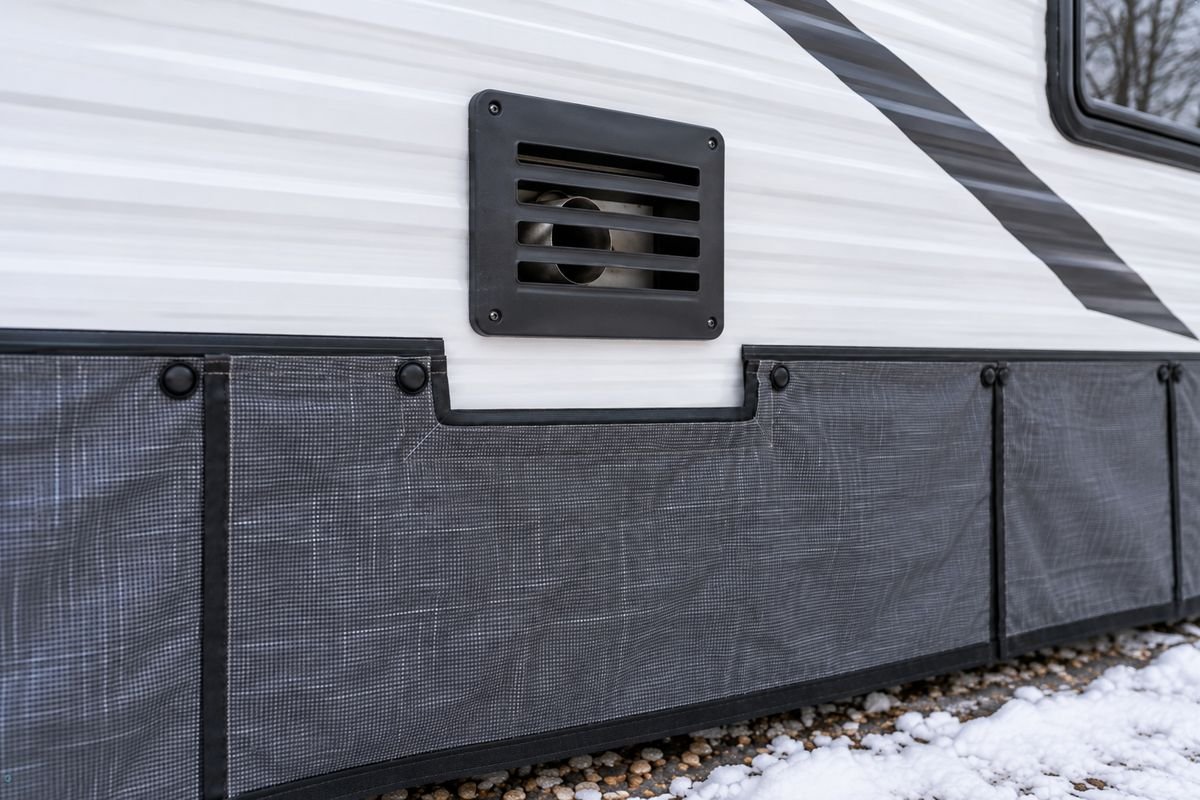
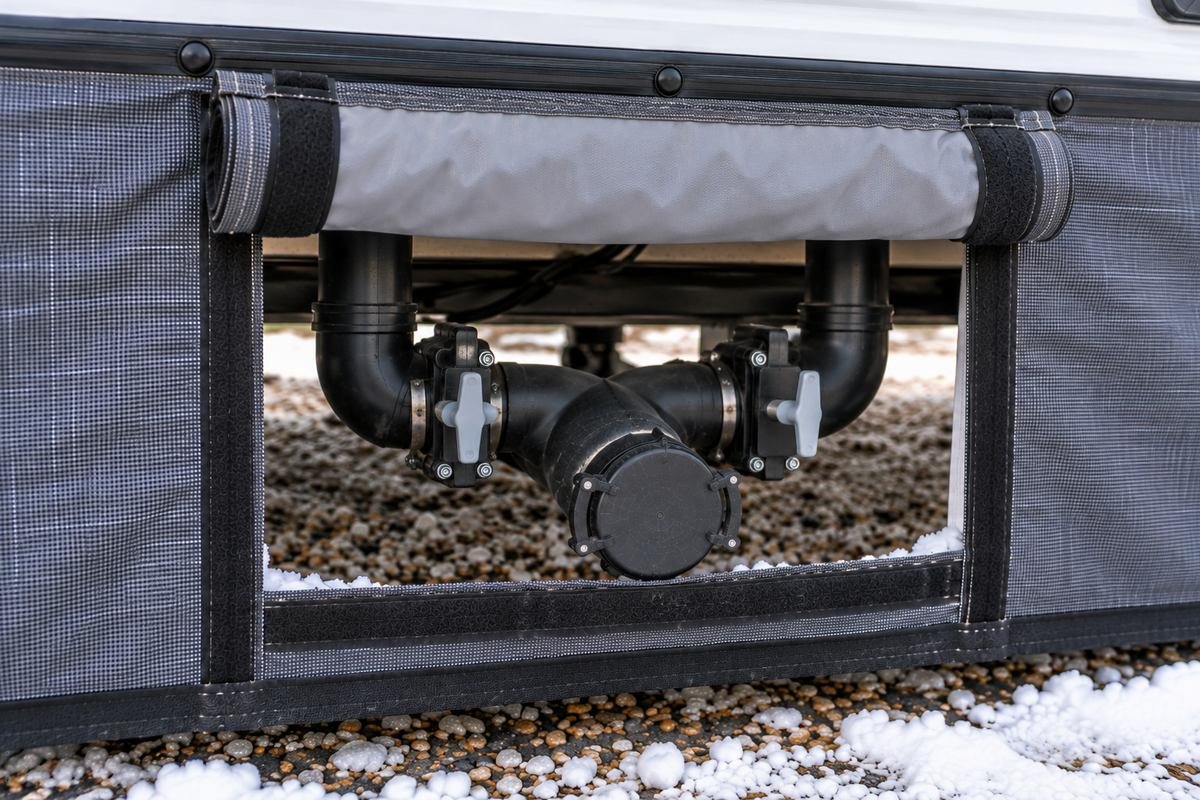
- Cut the skirting to fit. Cut around wheels, jacks, and steps. Cut permanent open holes around every vent you marked, with space on all sides. Use zippered or Velcro flaps only for access points like the dump valves and water inlet, never over a vent.
- Snap it on and seal the bottom. Weigh the bottom edge with sandbags or boards, or pin it to the ground if your site allows it, so wind can't lift it.
- Check it after storms. Look for torn panels, loose snaps, and snow piled against vents.
Keep Vents, Exhaust and Access Points Clear
Of everything in this guide, this section matters most. Your furnace, water heater, and generator burn propane or fuel and push exhaust out through vents on the side or bottom of the RV. That exhaust contains carbon monoxide (CO), a gas you can't see or smell.
- Furnace: Suburban's installation instructions for its SF furnaces say the air the furnace pulls in to burn fuel and the exhaust it pushes out must never be blocked, and the furnace must never run with its vent covered. Find the furnace vent on the outside wall before you install anything, and cut the skirting so the vent is fully open with space around it.
- Water heater: it also vents outside, usually through a vent in or beside its access door on the sidewall. Keep that door and vent fully clear, too.
- Generator: Cummins Onan's operator manual for one RV generator warns that "exhaust gas is deadly" and says barriers such as walls, snow banks, and other vehicles can cause exhaust to build up around the RV. A skirt can act as that kind of barrier. Never let the generator's exhaust pipe end inside the skirt or under the RV. If you can't keep the exhaust clear, don't run the generator with the skirting on.
Have working CO alarms inside the RV. Test them regularly and again before every cold season. The U.S. Consumer Product Safety Commission lists the warning signs of CO poisoning as headache, dizziness, weakness, nausea, vomiting, sleepiness, and confusion. If you notice them, get to fresh air right away and call 911.
Also leave a way to reach your dump valves, the sewer outlet, and your fresh water connection. A zippered or Velcro flap in the skirt makes this easy and saves you from pulling off panels every time you dump your tanks.
Propane is heavier than air, and the Texas Railroad Commission warns that its vapors can collect in low spots. A closed skirt creates that kind of space. Test your RV's propane leak detector, or add one if your RV doesn't have one, and don't enclose the propane tanks or regulator (the part that controls gas pressure, usually mounted near the tanks) inside the skirting.
Should You Heat the Space Under the Skirt?
Some RVers put a space heater or a work light under a skirted RV to keep the tanks warm. We don't recommend it. A space heater under the RV runs unattended and sits next to fabric, foam, and plastic. The U.S. Fire Administration says to keep anything that can burn at least 3 feet from heat sources and to turn space heaters off when you leave the room or go to bed. That's hard to do under a skirt, where a heater sits close to the skirting and runs while you sleep.
Safer ways to keep water flowing:
- A heated water hose. The Camco 25 ft heated drinking water hose lists freeze protection down to -20°F and a thermostat that only heats when needed. It plugs into a standard 120 volt outlet. Wrap the campground spigot, too, since the hose can't protect it.
- The RV's own tank heaters. Some RVs come with tank heater pads from the factory. Your owner's manual will say if yours has them and how to turn them on.
- A temperature sensor under the RV. A wireless sensor placed near the tanks tells you when the space is getting close to freezing. See our picks for RV temperature sensors and freeze alarms.
Moisture, Mice, Wind and Snow
A closed skirt changes the space under your RV in ways you need to watch.
- Moisture: snowmelt and damp ground can keep the area under the skirt wet. Look under the RV every few weeks for standing water or rust. If moisture becomes a problem inside the RV, see our guide to RV dehumidifiers.
- Mice: a sheltered space next to a warm floor can attract rodents looking for a way in. Check for droppings and chewed wires or hoses when you look under the RV. Our guide on keeping mice out of an RV covers sealing the gaps they use.
- Wind: a loose skirt flaps, tears, and pulls on its fasteners. Keep the bottom edge weighted and replace any snaps that pop off.
- Snow: snow piled against the skirt adds insulation, but it can also bury a vent. Clear snow away from every vent after each storm.
Can You Leave RV Skirting On All the Time?
You can leave it on for as long as the RV stays parked, as long as you keep checking the vents, moisture, and fasteners. You have to take it off before you move the RV. Driving with skirting attached can tear it off and may damage the fasteners or the RV's wall.
When the weather warms up, take it off, let it dry completely, and store it rolled up. Putting away wet skirting can lead to mildew. The EZ Snap listing says its adhesive studs can stay on the RV between seasons. Check your own kit's instructions.
How Much Does RV Skirting Cost?
We don't list prices because they change often. What you'll pay depends on a few things:
- The length and height of your RV. Longer and taller RVs need more material, and some kits are sold in length ranges.
- The material. Bubble foil and foam board are sold by the roll or sheet, so you pay for the material and cut it yourself. Kits usually cost more up front but include fasteners and are made to come off and go back on.
- Reuse. A kit you use for several winters spreads its cost over those seasons. Foam board that breaks or gets wet may need replacing.
- Extras. A heated water hose, a temperature sensor, and new CO alarm batteries are part of the cost of staying through the winter.
Check current prices on the listings linked below before you decide.
What to Buy
Skirting kits are a small category on Amazon, and the kit we found had only a few dozen ratings. We've noted that below so you can weigh it.
The Ones That Do the Work
- EZ Snap RV Skirting Kit: a no-drill kit with adhesive studs, snap caps, a roll of woven fabric skirting, and a Velcro strip for an access flap, according to the listing. It comes in standard and tall heights. There's little owner feedback so far.
- Camco heated drinking water hose: protects the part of your water line that skirting can't. It has a large base of owner feedback, shared between its 25 ft and 50 ft lengths. Choose the 50 ft length if your spigot is far away.
Worth Having
- Reflectix bubble foil, 24 inches by 25 feet: useful for filling gaps around wheels and steps or as a liner behind fabric skirting. Leave an air gap next to the foil so it can reflect heat.
- EZ Snap no-drill snap fasteners: extra studs for repairs or for making your own skirting from vinyl.
- A wireless temperature sensor under the RV, so you know when it's getting close to freezing. See our temperature sensor picks.
Skip
- Space heaters or heat lamps under the RV. They run unattended near flammable materials.
- Any skirting design that covers a vent. If a kit won't let you leave the furnace, water heater, and generator exhaust open, don't use it.
- Skirting that's too short for your RV. A gap at the ground lets the wind back in, so match the kit to your tallest measurement.
Quick Answers
Does RV skirting really work?
Yes, for RVs parked for weeks in freezing weather. It blocks wind under the RV, helping keep tanks and pipes from freezing and making the floor feel warmer. It doesn't create heat, so it works best with a heated hose and the RV's own tank heaters.
What can I use for RV skirting?
Common choices include snap-on vinyl or fabric kits, inflatable tubes, rigid foam board, reflective bubble foil, and plywood panels. Snap-on kits are the easiest to move with. Foam board insulates best but is bulky and flammable.
Do I need to skirt my RV if it's insulated for winter?
Not always. An enclosed, heated underbelly helps, but cold-weather ratings vary by brand. Check your owner's manual for the lowest rated temperature, and add skirting if you'll stay somewhere colder than that.
Can you leave RV skirting on all the time?
Yes, while the RV stays parked, as long as you check the vents, moisture, and fasteners. Remove it before you drive, and dry it fully before storing it.
At what temperature does an RV need to be winterized?
Water freezes at 32°F, so plan to winterize before overnight temperatures reach freezing if you're storing the RV. Skirting is for an RV you're using. If you're storing an RV, drain and winterize it instead.
The Bottom Line
RV skirting is worth it if you're spending weeks in one place in freezing weather. A snap-on vinyl or fabric kit suits most RVers, and foam board is the warmest choice if you don't mind the bulk. Whatever you choose, measure carefully, keep every vent and exhaust outlet open, test your CO alarms, and pair the skirt with a heated hose. For more cold-weather help, read our RV storage and security guide.