
RV steps get used more than almost any other part of a camper. Most owners never think about them until a step sags, bounces, or nearly throws someone into the gravel. The good news is that most step problems have simple fixes. A brace under the bottom step stops the bounce, and a handrail by the door makes every trip in and out safer. If your factory steps are worn out, a fold-down stair system that rests on the ground is the biggest upgrade you can make. Before you buy anything, measure from the ground to your door threshold, because that one number decides which steps will fit.
Restful RV is a participant in the Amazon Services LLC Associates Program, an affiliate advertising program designed to provide a means for sites to earn advertising fees by advertising and linking to Amazon.com.
Quick Answer
Most RV step problems come down to bounce, wear, or fit. A step brace or stabilizer under the bottom step stops most of the bounce. A grab handle by the door adds a hand hold for every trip in and out. If you are replacing the steps, measure from the ground to the door threshold and the inside width of the door frame first, then pick steps made for that height. Fold-down stairs that rest on the ground feel the most solid, and a portable step stool is the easy fix for a short first step.
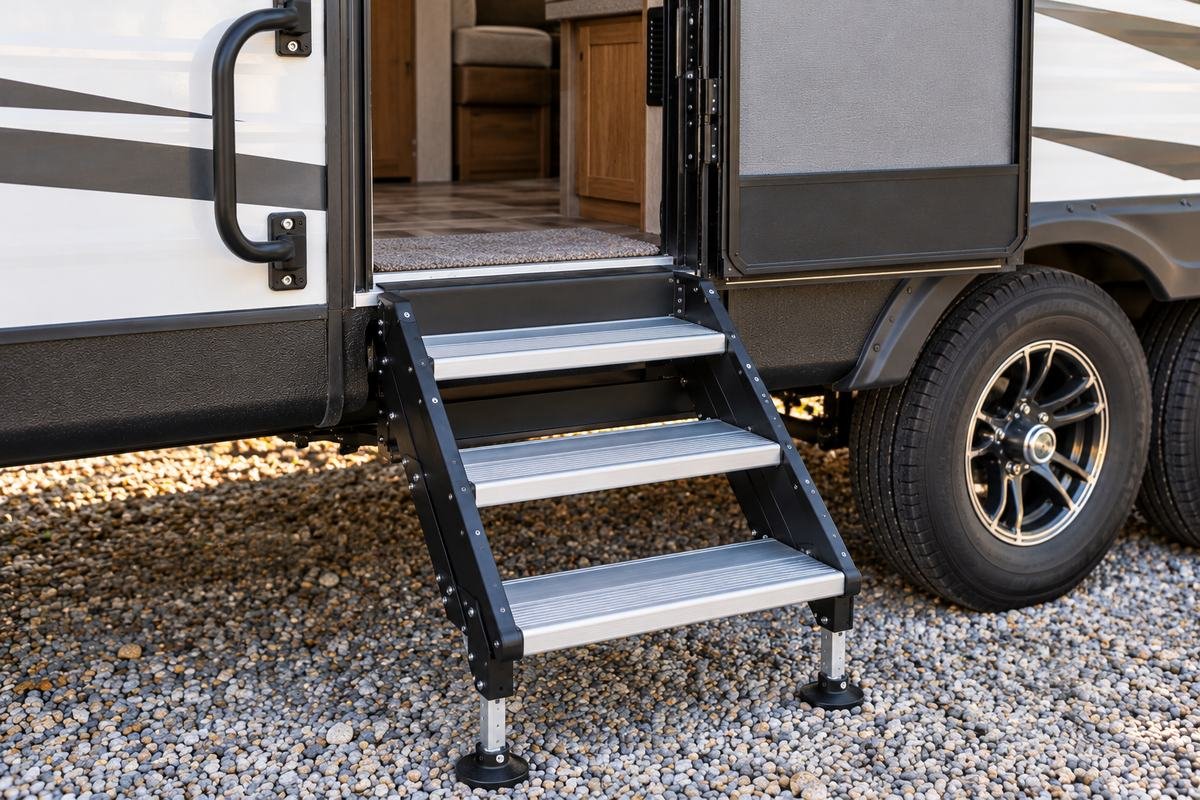
Table of Contents
Types of RV Steps
Most travel trailers and fifth wheels leave the factory with pull-out steps that slide out from under the door and hang from two brackets. They are compact and cheap to build, which is why they are everywhere. They also cause so many owners to complain about bouncing because the whole stair hangs from the frame with nothing touching the ground.
Manual Pull-Out Steps
These come as single, double, triple, or quad steps. You pull them out when you park and fold them back in before you drive. A common example is Lippert's Radius manual step, which has an 8-inch rise and is listed at 300 pounds. They work fine for most people, but they flex, and the pivots wear over time. Adding a stabilizer under the bottom step fixes most of the flex, which we cover below.
Electric Steps
Many motorhomes and some larger trailers have electric steps that extend when you open the door and fold away when you close it. Kwikee, a Lippert brand, is one of the best-known makers. They are convenient, especially when your hands are full, but they add a motor, a controller, and a door switch, all of which can fail. When they do, you may have to climb in without steps until the problem is fixed. We explain how they work in a section further down.
Fold-Down Stair Systems
Fold-down stairs, such as the Lippert Solid Step and the MORryde StepAbove, mount inside the door opening and swing down to rest on the ground. Because the feet sit on the ground, they feel more like a set of house stairs than a hanging step. The wide top step helps when you are carrying groceries or helping a child or pet inside. When you are ready to travel, the whole unit folds up into the doorway and locks in place.
The trade-offs are weight and fit. Lippert lists its Solid Step doubles and triples at about 50 to 55 pounds. When folded, they take up part of the doorway, and you may need to adjust your screen door to close over them. Lippert says you need at least 3/8 inch between the bottom of the entry and screen doors and the top of the threshold so the doors can still close. Lippert also says the extended threshold on its newer Solid Step 4.0 works over skirting, which helps if you put up RV skirting in cold weather.
Portable Step Stools
A portable step stool is a separate platform that sits on the ground under your door. It is the easiest fix when the first step is too high, and it costs far less than replacing the steps. Most have folding legs and several height settings. The downside is that it is one more thing to set out, pick up, and store, and it does nothing to stop the steps above it from bouncing.
| Type | Best for | Main drawback |
|---|---|---|
| Manual pull-out steps | Most trailers, light use | Bounce and wear without a stabilizer |
| Electric steps | Motorhomes, convenience | More parts that can fail |
| Fold-down stairs | Full-timers, anyone who wants solid footing | Heavy and must fit your door |
| Portable step stool | A first step that is too high | One more thing to carry and store |
How to Measure for New RV Steps
The most important number is the height from the ground to your entry door threshold, measured with the RV level and parked the way you normally camp. Steps are sold by that height. For the Lippert Solid Step, for example, the double fits roughly 22 to 28 inches, the triple fits 27 to 36 inches, and the quad fits 34 to 44 inches. Where the ranges overlap, consider whether you usually park on level pads or uneven ground.
Next, measure the door opening width from the inside edge of the frame to the inside edge on the other side. On the original Solid Step, Lippert's 26-inch size fits openings from 25 to just under 29 inches, and its 30-inch size fits 29 to 36 inches. The Solid Step 4.0 uses its own door sizes, so check its chart. For a replacement pull-out step, also measure the width of your current steps, the rise between steps, and how the brackets bolt to the frame, since mounting patterns vary.
Most RV steps have a rise of about 7 to 8 inches between treads. If your bottom step sits much higher off the ground than that, a step stool or a set of stairs that reaches the ground will make getting in much easier.
Weight Ratings and What They Mean
Every set of steps has a weight rating, and it is worth checking before you buy. The rating needs to cover the heaviest person who will use them, plus whatever they are carrying, plus the extra force of stepping down hard. Ratings vary a lot. Lippert lists its Radius manual steps at 300 pounds and its newer Solid Step 4.0 at 500 pounds, while some portable platforms claim much higher numbers.
Keep in mind that a high rating on a step stool only means the stool itself can take the load. It doesn't make the steps above it any stronger, and it won't help if the stool sits on soft ground and sinks on one side.
How to Stop RV Steps From Bouncing
Pull-out steps bounce because they hang from the frame with nothing underneath them. The fix is to give the bottom step something to rest on. The simplest option is a step brace, a small adjustable post that sits on the ground under the bottom step. Camco's Save-A-Step is a popular one. It adjusts from 4 5/8 to 8 inches and is rated at 1,000 pounds.
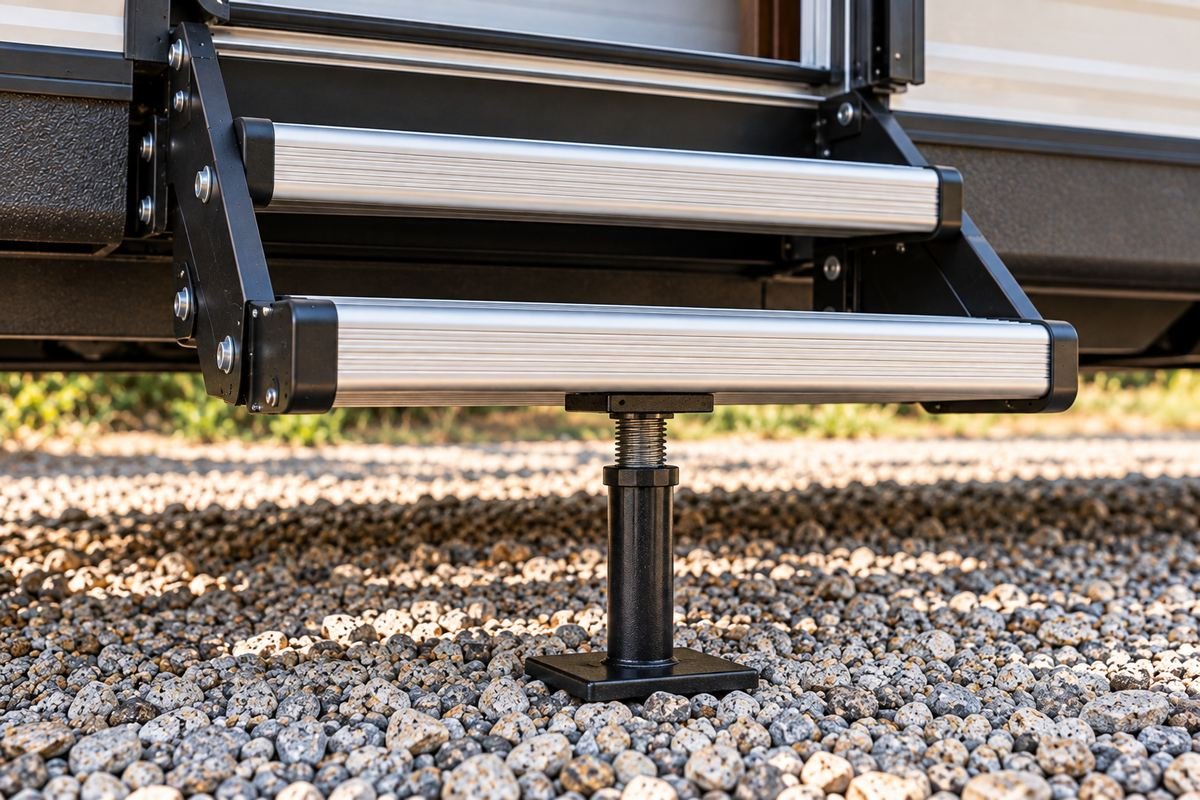
Another option is a stabilizer kit that bolts to the steps and has two adjustable legs. Lippert's Solid Stance kit adjusts from 5 to 14 inches and stays attached when you fold the steps away. Lippert says it fits its own double and triple steps, plus many other brands, but check the fit list for your steps before you buy.
Where you put the support matters. Put the support under the bottom step, since that end moves the most. It also helps to put down your RV's stabilizer jacks first. If the whole trailer is rocking, no step brace will make the steps feel solid. Our guide to RV leveling blocks explains how to level your RV before you set up.
Handrails and Better Grip
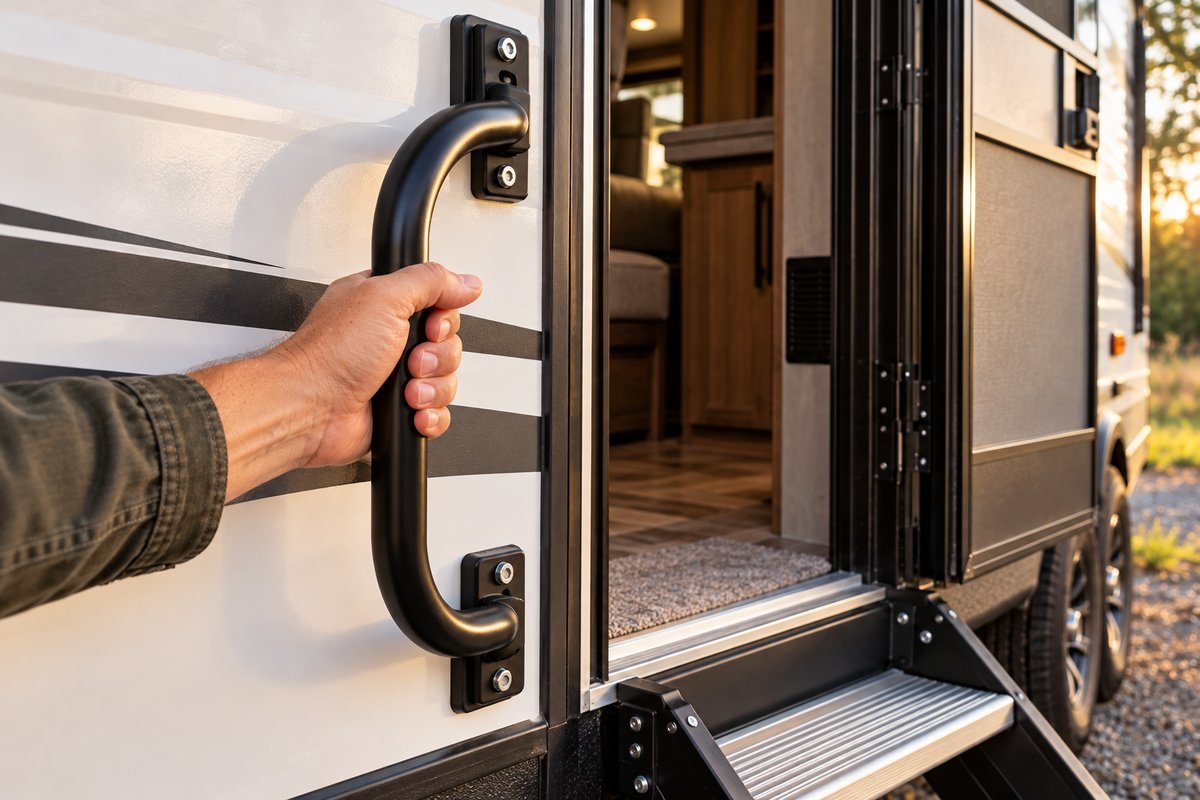
A grab handle by the door is one of the cheapest safety upgrades you can make. It gives you something to hold while you climb in and something to steady yourself on when you step down in the dark. Stromberg Carlson's Lend-A-Hand handles are a common choice, and the extended AM-533 version reaches out and down to give you a hand hold lower on the steps.
Step covers wrap around each tread, add grip, and catch some dirt before it gets inside. Make sure any cover fits the width and depth of your steps, and check that it doesn't prevent electric steps from folding all the way.
Be extra careful when the steps are wet or icy. Lippert's maintenance advice says to avoid using steps covered in ice, both because of the slip risk and because forcing icy steps open or closed can damage the mechanism. Clear ice before you step on them, or use another way in.
How Electric RV Steps Work
Many electric steps are run by a magnetic switch on the door. Open the door, and the step comes out. Close it, and the step folds away. A controller monitors how much power the motor draws, and when the step reaches the end of its travel or hits something, it shuts the motor off.
Many systems also have an override switch that keeps the step out while the door is closed, which is handy when you are going in and out a lot. On Kwikee's 47 series, the owner's manual explains that turning on the ignition retracts the step even with the override on, so you don't drive with the step out. Not every system works the same way, so check your own manual before relying on it.
Keeping Your Steps Working
Steps live close to the road, so they collect mud, salt, and grit. Rinse them off with mild soap and water now and then, and look over the brackets, bolts, and pivots for rust or wear before a trip. Tighten anything that has worked loose.
Lubrication is where the advice gets confusing, so go by your own step's manual. Lippert's general advice for steps is a silicone spray or dry lubricant that won't attract dirt, and it says to avoid grease. Kwikee's manual for its electric 47 series says something different. It calls for a moisture- and heat-resistant spray grease every 30 days and says silicone lubricants and WD-40 are not recommended for those steps.
Before You Drive Away
Forgetting to fold in manual steps is an easy mistake, especially on a busy travel day. A step left extended can catch on a curb, a post, or a gas pump island and damage both the steps and the RV. Make stowing the steps part of your walk-around before every departure, along with the stabilizer jacks, antenna, hookups, and wheel chocks.
If you use a portable step stool or step brace, add it to the same checklist. Both are easy to leave behind at a campsite.
What to Buy
For a stair system that rests on the ground, the Lippert Solid Step triple for 26-inch doors is a common choice for travel trailers. Measure your height and door width first so you get the right size.
To replace worn pull-out steps with the same style, look at the Lippert Radius double manual step, and match the width and mounting to what you have now.
To stop bounce on your existing steps, the Camco Save-A-Step brace is simple and inexpensive. If you have double or triple pull-out steps, the Lippert Solid Stance stabilizer kit stays mounted to the steps.
For a handrail, the Stromberg Carlson AM-533 extended assist rail gives a handhold that reaches lower than a standard grab handle.
If your first step is too high, an adjustable platform like this folding RV step stool sets to about 7, 8, or 9 inches. For grip and less dirt inside, the Camco wrap around step rug fits 18 inch wide steps.
RV Steps: Common Questions
How do I stop my RV steps from bouncing?
Place a step brace or stabilizer under the bottom step so it rests on the ground, and set up your RV's stabilizer jacks first. If the whole RV moves, the steps will too.
How do I measure for new RV steps?
Measure from the ground to the door threshold with the RV level, then measure the inside width of the door frame. Fold-down stairs are sold by those two numbers, and each model lists the height range it fits. For pull-out steps, also match the step width and mounting.
How much weight can RV steps hold?
It depends on the model. Lippert lists its Radius manual steps at 300 pounds and its Solid Step 4.0 at 500 pounds. Check the rating for your exact steps before relying on them.
Are electric RV steps worth it?
They are convenient, especially in a motorhome, but they have more parts that can fail. If you value simplicity, manual steps or fold-down stairs are easier to keep working.
Can I use a step stool with my RV steps?
Yes. A portable step stool under the door is a common fix when the first step is too high. Set it on firm, level ground and remember to pack it before you leave.
The Bottom Line
Good RV steps make every trip in and out of the camper easier and safer. For most owners, a brace under the bottom step and a handrail by the door solve the biggest complaints for very little money. If your steps are worn out or you want something that feels like real stairs, measure carefully and look at a fold-down system that rests on the ground. And whatever you use, fold it up or pack it away before you drive.