
An RV inverter converts the 12-volt power stored in your house batteries into 120-volt power, the same kind that comes out of a wall outlet at home. It lets you run a TV, a CPAP, a laptop, or a coffee maker when you are not plugged in at a campground. To pick one, add up the watts of everything you want to run at the same time, choose an inverter rated comfortably above that number, and make sure your batteries can supply that much power.
Restful RV is a participant in the Amazon Services LLC Associates Program, an affiliate advertising program designed to provide a means for sites to earn advertising fees by advertising and linking to Amazon.com.
That last part is easy to overlook. A big inverter is easy to buy, but every watt it delivers comes out of your batteries. The RV Inverter Sizer below does the math for you: check off what you want to run, and it shows the inverter size, how hard it pulls on your batteries, and roughly how long they will last.

Table of Contents
What an RV Inverter Does (and What It Does Not)
Your RV already has two power systems. The 12-volt system runs the lights, water pump, vent fans, and furnace fan from your house batteries. The 120-volt system runs the household outlets, the microwave, and the air conditioner, but normally only when you are plugged into shore power or running a generator.
An inverter bridges that gap. It takes battery power and converts it to 120-volt power so the outlets work without a hookup. It does not make power. Everything it supplies comes from your batteries, plus a little extra lost as heat during the conversion.
Do not confuse an inverter with a converter. Most RVs come with a converter, which does the opposite job. It takes 120-volt shore power and turns it into 12-volt power to charge the batteries and run the 12-volt system. Some units, called inverter chargers, do both jobs in one box.
Pure Sine Wave vs. Modified Sine Wave
Inverters come in two types, named for the shape of the power they make.
Pure sine wave inverters make smooth power that closely matches what comes out of a wall outlet. They run everything an outlet at home can run, including laptops, TVs, microwaves, and anything with a motor. They cost more.
Modified sine wave inverters make a rougher, stepped version of that power. Simple things like phone chargers and some heating appliances usually run fine on it. Electronics and motors may hum, run warmer, or not work properly, and some can be damaged over time.
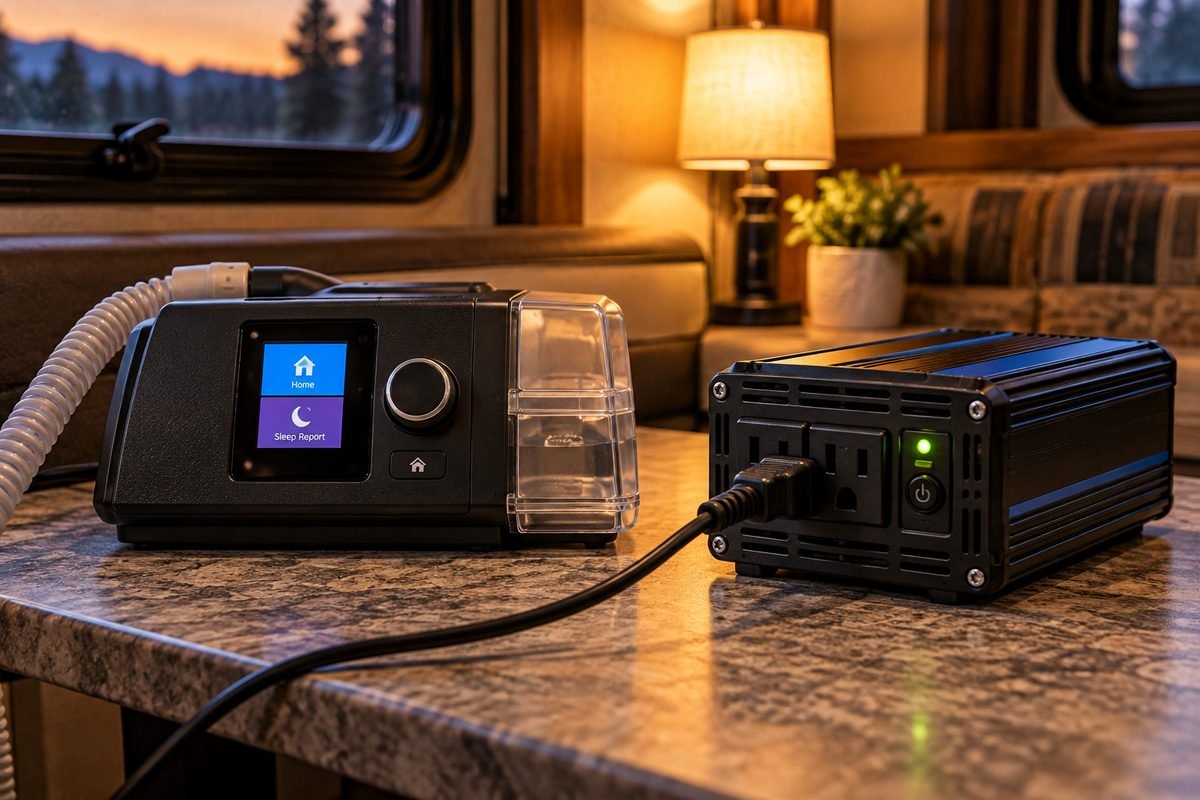
For an RV, buy a pure sine wave inverter unless you only need to charge phones. It saves you from guessing which device will fail. If you want to use a modified inverter for a specific device, check that device's manual first. ResMed, for example, says its newer CPAP machines can run on a modified sine wave inverter of at least 150 watts, but some older models with certain humidifiers need pure sine wave.
How to Size an RV Inverter
Sizing comes down to three numbers: your running watts, your startup surge, and some room to spare.
Running watts. Add up the watts of everything you plan to run at the same time, not everything you own. A CPAP and a TV overnight is one load. A coffee maker in the morning is a different load. Use the number on each appliance's label. For a microwave, use the input watts on the label inside the door or on the back. The big number on the front is cooking power, and the microwave pulls more than that from the outlet.
Startup surge. Motors, like the compressor in a residential refrigerator, can pull much more than their running watts for a moment when they start, often twice as much or more. Inverters list a surge or peak rating for this. Make sure it covers your running total plus the extra startup draw.
Room to spare. Do not plan to run an inverter at its full rating. Leave about 20 percent extra room above your total. Also check the continuous rating, not just the number in the product name. The Xantrex PROwatt SW 1000, for example, is rated for 900 watts continuous and 2,000 watts of surge.
As a rough guide, a 300-watt inverter covers a CPAP, a TV, and phone chargers. A 1,500-watt inverter can run a coffee maker or a toaster, one at a time. A 1,500 to 2,000 watt inverter runs a microwave or a hair dryer, depending on its input watts, but only if your batteries can supply it.
RV Inverter Sizer
Check what you want to run at the same time, change any wattage to match your own appliance labels, and enter your battery bank.
RV Inverter Sizer
Check everything you want to run at the same time. The watts are typical values, so change them to match the label on your own appliance.
RV Inverter Sizer by RestfulRV.com. Free to use. Results are estimates. Check your appliance labels and have a qualified RV technician install any hardwired inverter.
How Long Will Your Batteries Last?
An inverter pulls far more current from a 12-volt battery than most people expect. Because the voltage is so low, every 100 watts of 120-volt power takes roughly 9 amps from the battery, including energy lost inside the inverter. A 1,000-watt load pulls about 90 amps.
Good inverters are about 90 percent efficient, or a little better at their best, and they draw a small amount of power just to stay on, even with nothing plugged in. The Xantrex PROwatt SW models list less than 0.6 amps with no load. Turn the inverter off when you are not using it.
How much of your battery you can use depends on the type, as Victron explains:
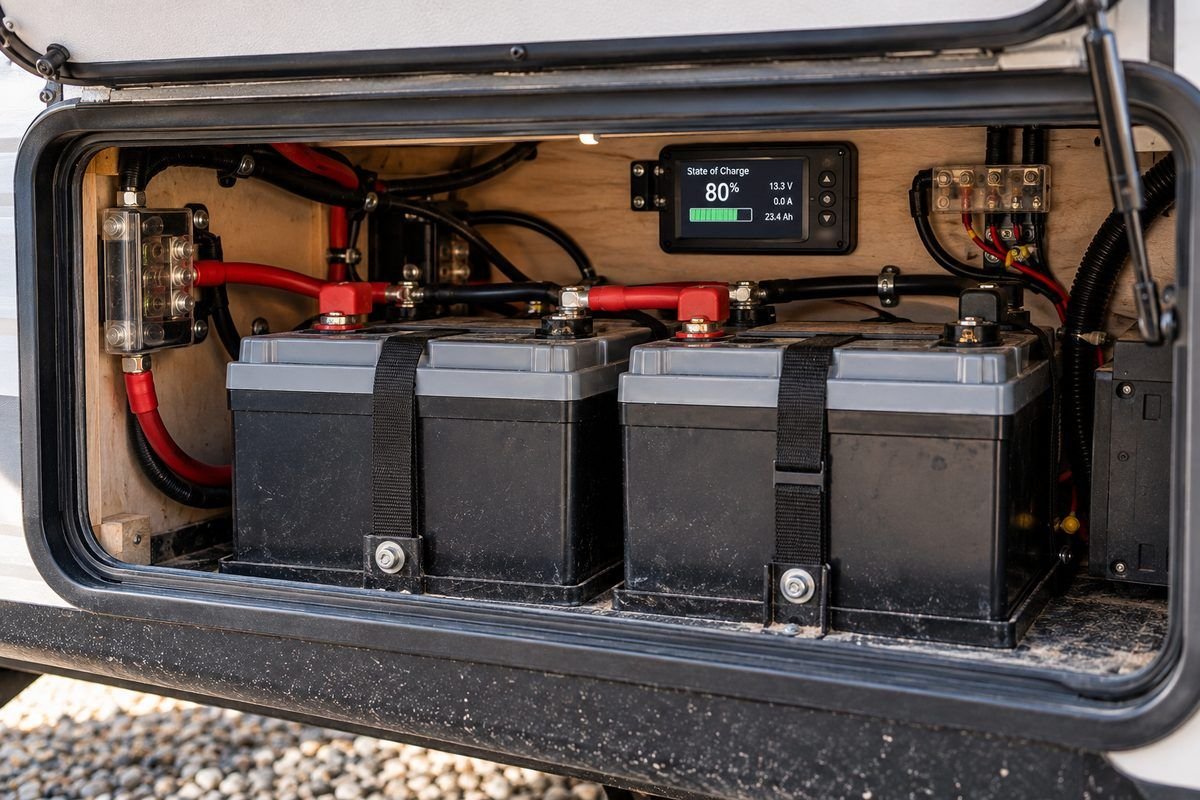
- Lead-acid and AGM batteries should only be drained to about half their rated capacity to protect their lifespan. A 200 amp-hour bank gives you about 100 usable amp hours.
- Lithium (LiFePO4) batteries can use 80 percent or more of their rated capacity. The same 200 amp-hour bank gives you about 160 usable amp-hours.
So a 200 amp-hour lithium bank running a 60-watt CPAP lasts about three nights of normal sleep. The same bank running a 1,500-watt hair dryer lasts well under two hours. That is why it is common to run high-watt items like microwaves, hair dryers, and coffee makers for only a few minutes at a time, or save them for when they have shore power or a generator running. If your batteries are older, our guide to testing your RV battery shows how to check what they can really hold.
Plug-In, Hardwired or Inverter Charger?
Plug-in inverters plug into a 12-volt outlet, like a car's accessory socket. They are small and need no installation, but the outlet limits them. A 150-watt plug-in model draws about 14 amps at full load, so make sure the fuse for your 12-volt outlet can handle it. They are fine for a laptop, a CPAP or phone chargers, and nothing bigger.
Hardwired inverters connect straight to the battery bank with heavy cables and a fuse. They range from a few hundred watts to 3,000 watts or more. Some have outlets on the front. Others feed some of the RV's own outlets, which need a transfer switch so they can change between shore power and the inverter.
Inverter chargers combine an inverter, a battery charger, and a transfer switch in one unit. When you plug in, they charge the batteries and pass shore power through. When you unplug, they automatically switch to inverter power. They are the cleanest setup for an RV that camps without hookups often, and the most involved to install.
Installing an Inverter: What to Have Done
A plug-in inverter needs no installation. Anything bigger connects to the batteries with thick cables and a fuse sized for the inverter, and anything that feeds the RV's 120-volt outlets ties into the electrical panel. That's 120-volt work, and mistakes can cause shocks or fires. Have a qualified RV technician or electrician do it.
What you can do is plan the job so the install goes smoothly:
- Use the sizer to settle on a size and confirm your battery bank can supply it.
- Decide which outlets you want powered. A single outlet near the TV and CPAP is simpler than wiring the whole RV.
- Pick a mounting spot close to the batteries. Short cables waste less power. The spot needs airflow and should stay dry.
- Ask the installer about the fuse, cable size, and transfer switch before the work starts, so you know what you are paying for.
- Check whether your RV is inverter-ready. Some RVs come with wiring or a spot already set aside for an inverter, which can lower the cost. Your owner's manual will say.
You can run a roof air conditioner from an inverter, but it requires a large inverter and a very large lithium battery bank. Treat that as a full electrical system project, not an inverter purchase. For most owners, a generator is the simpler way to run the AC away from hookups. Our RV generator guide shows what size you need.
What to Buy
These inverters are worth looking at for most RVs. Specs come from each maker's published data.
Inverters worth buying
BESTEK 300W Pure Sine Wave Inverter: A small plug-in pure sine wave inverter with two outlets and USB ports. Good for a CPAP, a laptop, or phone chargers from a 12-volt outlet. Remember, the 12-volt outlet, not the inverter, sets the real limit, so plan on about 150 watts from an outlet.
Xantrex PROwatt SW 1000: A hardwired pure sine wave inverter rated 900 watts continuous and 2,000 watts surge, with two GFCI outlets on the front. A good choice for a TV, CPAP, and laptop. The larger PROwatt SW 2000 is rated 1,800 watts continuous for microwave and hair dryer loads.
Victron Phoenix 12/1200 (120 volt): A compact pure sine wave inverter rated 1,000 watts continuous and 2,200 watts peak, with a GFCI outlet. Victron lists its eco mode standby draw at about 1 watt, which helps if you leave it on overnight.
Renogy 2000W Pure Sine Wave Inverter with UPS Transfer Switch: A 2,000-watt continuous inverter with a built-in transfer switch, so it can pass shore power through and switch to battery power when you unplug. It has two outlets plus a terminal block for hardwiring.
Worth having if you camp without hookups often
Xantrex Freedom XC 2000: An inverter charger with a 2,000-watt pure sine wave inverter, a built-in battery charger, and a 30-amp transfer relay. It charges the batteries on shore power and switches to inverter power automatically. It is a bigger install, but it is the cleanest setup for full-time use.
Skip
Cheap modified sine wave inverters for anything but phone charging. The savings are small, and you may end up replacing devices that hum, run hot or fail.
Oversized inverters you cannot feed. A 3,000-watt inverter on a single 100-amp-hour battery cannot deliver its rating for long. Size the battery bank first, then the inverter.
RV Inverter: Common Questions
What size inverter do I need for my RV?
Add up the watts of everything you will run at the same time, then choose an inverter with a continuous rating about 20 percent higher. A CPAP and TV need about 300 watts. A microwave or hair dryer needs about 1,500 to 2,000 watts, plus a battery bank that can supply it.
Do I need a pure sine wave inverter for an RV?
For most RVs, yes. Pure sine wave power runs electronics, microwaves, and anything with a motor the same way a wall outlet does. Modified sine wave inverters are cheaper but can make some devices hum, run hot, or fail.
How long will a 100-amp-hour battery run an inverter?
It depends on the load and the battery type. A lithium battery can deliver about 80 amp hours, and a lead-acid battery about 50. At 300 watts (about 28 amps), that is roughly 3 hours on lithium or a little under 2 hours on lead-acid.
Can I run my RV air conditioner on an inverter?
It is possible, but it takes a large inverter and a very large lithium battery bank, usually with solar or a generator to recharge it. For most RVers, running the air conditioner on shore power or a generator is far more practical.
What is the difference between an inverter and a converter?
An inverter turns 12-volt battery power into 120-volt household power. A converter does the opposite, turning 120-volt shore power into 12-volt power to charge the batteries. An inverter charger does both jobs in one unit.
The Bottom Line
Start with what you want to run, not with the biggest inverter you can afford. Most RVers who mainly need a CPAP, TV, and chargers are well served by a small pure sine wave inverter. If you want the microwave and coffee maker off-grid, plan for a 2,000-watt inverter and a matching battery bank, and have a qualified RV technician install it. If a CPAP is your main load, our guide to inverters for CPAP use covers that setup in more detail, and our RV solar panel kit guide covers how to refill the batteries the next day.