
Quick answer: Most 30-amp RVs with one roof air conditioner need an RV generator with about 3,000 to 4,000 running watts, an inverter design, and a TT-30R outlet. The Westinghouse iGen5000DFc and WEN DF480iX both fit that job. A 50-amp RV that runs two air conditioners needs much more, or careful load planning. Use the calculator below to size yours, and never run a generator inside or under the RV.
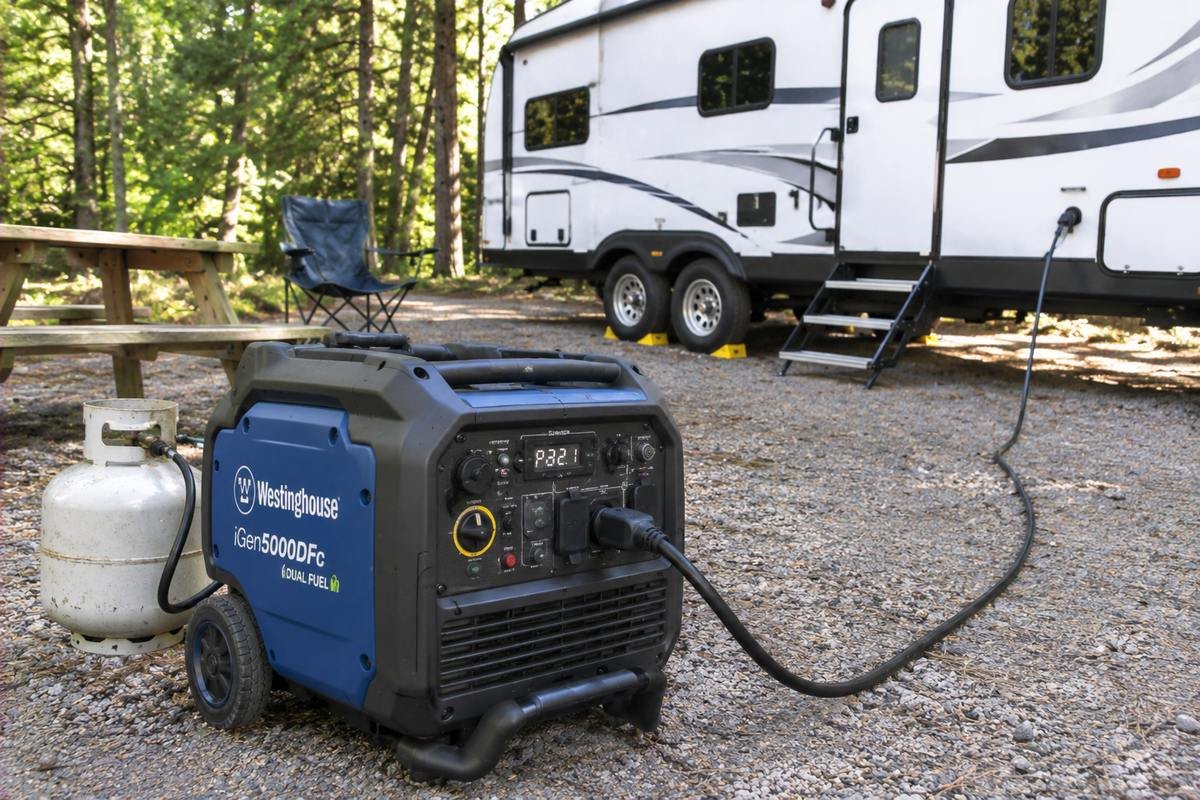
Table of Contents
An RV generator lets you run the air conditioner, microwave, and outlets when there is no campground hookup. Buying the right one comes down to four questions: how many watts you need, which plug your RV uses, how much noise your campground allows, and which fuel you want to carry. This guide answers all four, with a sizing calculator, plain explanations of the specs, and five picks for 30 amp and 50-amp RVs.
We have not tested these generators ourselves. The specs come from the makers, their manuals, and their Amazon listings. Safety advice comes from the U.S. Consumer Product Safety Commission (CPSC), and the noise rules come from the National Park Service regulations.
What size RV generator do you need?
Generators list two numbers. Running watts (also called rated watts) are what the generator can make all day. Starting watts (also called surge or peak watts) are a short burst for a few seconds, used when a motor such as an air conditioner compressor kicks on. You need enough of both.
Your RV's power cord sets the upper limit. Cummins, which builds the Onan generators found in many motorhomes, gives these numbers:
Swipe to see more →
| RV service | Most it can use | Generator size, per Cummins |
|---|---|---|
| 30 amp, 120 volts | About 3,600 watts | 2,500 to 2,800 watts is a common minimum with an AC. About 3,600 matches the RV. About 4,000 adds room for motors starting. |
| 50 amp, 120/240 volts (two 50-amp legs) | About 12,000 watts | 12,000 to 12,500 watts to use everything. Most portable generators make less, so plan your loads. |
The air conditioner is almost always the biggest load. Here is what two sources list for common RV roof units. The numbers differ, so we suggest planning for the higher one.
Swipe to see more →
| Roof AC size | Running watts | Starting watts | Source |
|---|---|---|---|
| 13,500 BTU | About 1,800 | About 3,500 | Micro-Air chart |
| 15,000 BTU | About 1,950 | About 4,000 | Micro-Air chart |
| 15,000 BTU | About 1,500 | About 3,500 | Cummins |
| 13,500 to 15,000 BTU | 1,200 to 2,400 | Not listed | Cummins sizing article |
Read your own AC's label
The sticker on your air conditioner lists its amps. Multiply the running amps by 120 to get running watts. For example, 15 amps times 120 volts is 1,800 watts. That number beats any chart, because it is your unit.
Then add whatever else will run at the same time. Cummins lists a microwave at 750 to 1,500 watts, a coffee maker at 900 to 1,200 watts, and a hair dryer at 1,200 to 1,875 watts. That is why the AC, microwave, and coffee maker together can trip a 30-amp RV even on shore power.
RV generator size calculator
Pick your RV's cord, your air conditioners, and anything else you plan to run at once. The calculator adds a margin for propane and high elevation, then tells you the running and starting watts to look for.
RV Generator Size Calculator
Answer a few questions to see the running watts and starting watts your generator needs. This is an estimate, not a wiring check.
Calculator by RestfulRV. AC figures are the higher numbers from Micro-Air's chart (13,500 BTU: 1,800 running and 3,500 starting watts. 15,000 BTU: 1,950 running and 4,000 starting). Appliance figures are the top of Cummins' ranges. We assume a soft starter cuts the AC start surge in half, which is more cautious than maker claims. Altitude loss uses Honda's figure of about 3.5 percent per 1,000 feet, and propane assumes 12 percent less output, the most our picks lose. Check the labels on your own appliances.
Inverter vs conventional generators
An inverter generator makes power, then cleans it up with electronics before it reaches the outlet. The engine speeds up and slows down to match the load. Westinghouse says this can cut fuel use in half compared with a traditional generator, and it also makes the generator quieter at light loads. Inverters are usually in a closed case, which helps with noise.
A conventional generator runs its engine at one steady speed no matter how much power you use. It costs less per watt and can make a lot of power, but it is much louder. That makes it a poor fit for most campgrounds.
For most RV owners, an inverter is the right choice. A conventional generator makes sense when you need a lot of power on private land, or when the same generator also backs up your house.
30-amp vs 50 amp: matching the plug
Look at the plug on your RV's power cord. A 30-amp plug has three prongs. A 50-amp plug has four. The generator needs a matching outlet, or you need an adapter.
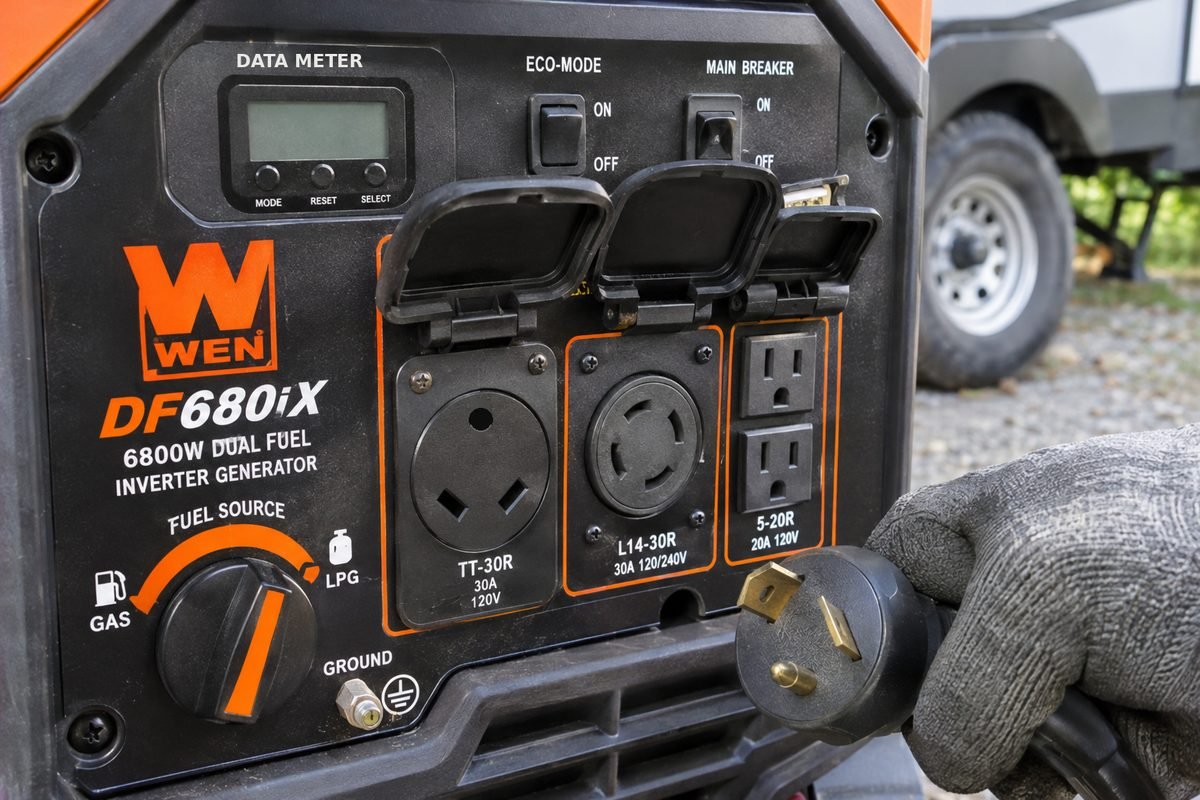
- TT-30R is the 30-amp RV outlet. A 30-amp RV cord plugs straight in. Most RV-ready inverter generators have one.
- 14-50R is the 50-amp RV outlet. It provides two 120-volt legs, each rated at 50 amps. Few portable generators have one. The Westinghouse WGen9500DF in our picks does.
- L14-30R is a round twist-lock outlet that puts out 120 and 240 volts. With an L14-30 to 50-amp adapter, it can feed both legs of a 50-amp RV, but only up to 30 amps per leg.
You can also run a 50-amp RV from a 30-amp generator with an adapter. The RV then has about 3,600 watts to work with, so you can run one air conditioner and some small loads, not both ACs. If you are not sure how your RV's legs and breakers are set up, ask an RV technician before you buy.
How quiet is quiet enough?
Noise is measured in decibels on the A scale, written dBA. Two things make spec sheet numbers hard to compare:
- Distance. Many makers measure at 23 feet (7 meters). Champion, for one, lists its 4500-watt dual-fuel inverter at 61 dBA at 23 feet. Sound drops about 6 dBA each time you double the distance in open air, so a generator 46 feet away is quieter than its spec says.
- Load. The lowest number is usually at a light load. Honda lists the EU2200i at 48 dBA at a quarter load and 57 dBA at its full rated load. An air conditioner pushes a generator toward the louder number.
Rules matter more than specs. In national parks, federal rule 36 CFR 2.12 bans running a generator above 60 dBA measured at 50 feet. Parks can also set generator hours, and many private campgrounds set their own quiet hours. Check the campground's rules before you go.
Want the quietest generator for your RV? Look for an inverter in a closed case, run it in economy mode when the AC is off, and set it as far from your camp and your neighbors as your cord allows.
Gas, propane, or dual fuel?
A dual fuel generator runs on gasoline or propane. Propane stores well and does not gum up the carburetor the way old gasoline can. Many RVers already carry propane tanks for the stove and furnace.
The catch is power. Every dual-fuel pick in this guide makes less on propane. The WEN DF480iX drops from 4,000 to 3,600 running watts, and the Westinghouse iGen5000DFc drops from 3,900 to 3,500. Across our picks, propane output is 10 to 12 percent lower. If you plan to run on propane, size by the propane number.
Elevation also cuts power. Honda says engine power drops about 3.5 percent for every 1,000 feet you climb. At 6,000 feet, that is about a 21 percent loss. Honda also says some engines need a dealer carburetor change to run well above 5,000 feet, and you must undo the change before running it lower. Check your generator's manual.
Quick comparison
Swipe to see more →
| Pick | Best for | Running watts | RV outlet | Weight |
|---|---|---|---|---|
| Westinghouse iGen5000DFc | Overall for 30-Amp RVs | 3,900 gas, 3,500 propane | TT-30R (30 amp) | About 106 lb |
| WEN DF480iX | Value for 30-Amp RVs | 4,000 gas, 3,600 propane | TT-30R (30 amp) | 78.5 lb |
| WEN DF680iX | Budget 120/240-Volt Inverter | 5,100 gas, 4,500 propane | TT-30R and L14-30R | 99.2 lb |
| Champion 6500-Watt RV Ready Inverter (201513) | Gas-Only Pick for 50-Amp RVs | 5,000 (gasoline only) | TT-30R and L14-30R | 102.1 lb |
| Westinghouse WGen9500DF | Most Power for 50-Amp RVs | 9,500 gas, 8,500 propane | 14-50R (50 amp) | 220 lb dry |
5 RV generators worth a look
All five were in stock on Amazon on 6 Nov 2026. All five are sold by Amazon. Watts, weights, and noise figures come from each maker or its listing.
This is the pick for most 30-amp travel trailers and fifth wheels with one roof air conditioner. Westinghouse rates it at 3,900 running watts on gasoline and 3,500 on propane. On gasoline, that covers the full 3,600 watts a 30-amp RV can use. On propane, it is just under that limit.
It has a TT-30R outlet, so a standard 30-amp RV cord plugs straight in. You also get a CO sensor that shuts the engine off, remote start with a key fob, and a digital display that shows fuel level and remaining run time. Westinghouse lists it as low as 52 dBA and says it can run in parallel with another iGen inverter.
Good
- Enough running watts for a full 30-amp RV
- Remote start and a CO sensor
- Dual fuel with a runtime display
Bad
- Over 100 pounds, so plan on two people to lift it into a truck
- No 50-amp outlet
The WEN gives you nearly the same usable power as our top pick in a lighter package. WEN rates it at 4,000 running watts on gasoline and 3,600 on propane in its manual, with 4,800 starting watts on gasoline. The Amazon listing gives the weight as 78.5 pounds, almost 30 pounds less than the Westinghouse.
It has a TT-30R outlet, four household outlets, a 12-volt outlet, two USB ports, and a tool-free propane connector. The WEN Watchdog sensor turns the engine off if carbon monoxide builds up. A fuel shutoff lets you run the carburetor dry before storage, and it can run in parallel with a second unit using WEN's parallel kit.
Good
- Lightest of our 30-amp picks
- Full 3,600 running watts even on propane
- Fuel shutoff for easier storage
Bad
- No remote start
- Heavier than a small 2,000-watt class inverter
This is the step up for owners who want more than 30 amps of power without a heavy open-frame generator. WEN rates it at 5,100 running watts on gasoline and 4,500 on propane, with 6,800 starting watts on gasoline.
It has both a TT-30R for a 30-amp RV and an L14-30R twist-lock outlet that puts out 120 and 240 volts. With the right adapter, that L14-30R can feed both legs of a 50-amp RV. At 5,100 watts it will not power everything a 50-amp coach can use, so plan your loads. It also has the WEN Watchdog CO shutoff and a fuel shutoff.
Good
- Feeds a 30-amp RV or, with an adapter, a 50-amp RV
- More power than any 30-amp pick
- CO shutoff and fuel shutoff
Bad
- Not enough to run a 50-amp RV at full load
- No built-in 14-50R outlet
This Champion is a 120/240-volt inverter for owners who want more than 30 amps and plan to run on gasoline. Champion rates it at 5,000 running watts and 6,500 starting watts, and lists it at 64 dBA measured from 23 feet. Champion says it runs up to 18 hours on a full tank.
It has a TT-30R for a 30-amp RV and an L14-30R twist-lock outlet rated at 20.8 amps at 240 volts. With an L14-30 to 50-amp adapter, that outlet can feed both legs of a 50-amp RV. Champion's CO Shield turns the engine off if carbon monoxide builds up, and Champion lists the power as under 3 percent THD, which means clean enough for laptops and other sensitive electronics.
Good
- Published noise rating at 23 feet
- Feeds a 30-amp RV or, with an adapter, a 50-amp RV
- CO shutoff and clean inverter power
Bad
- Gasoline only
- Pull start, no electric start
- Not enough to run a 50-amp RV at full load
This is a conventional open-frame generator, not an inverter. What you get for that is power. Westinghouse rates it at 9,500 running watts on gasoline and 8,500 on propane, and it has a 14-50R outlet, so a 50-amp RV cord plugs in with no adapter.
The tradeoffs are noise and size. Westinghouse lists it as low as 74 dBA, which is far louder than any inverter here, and it weighs 220 pounds dry. The listing does not mention a CO shutoff. It makes the most sense for long stays on private land, a base camp, or a home backup generator that also powers the RV now and then.
Good
- Enough power for two air conditioners
- Built-in 50-amp outlet
- Remote start
Bad
- Loud, and too loud for most campground quiet rules
- No CO shutoff listed
- Heavy open-frame design
Two small generators or one big one?
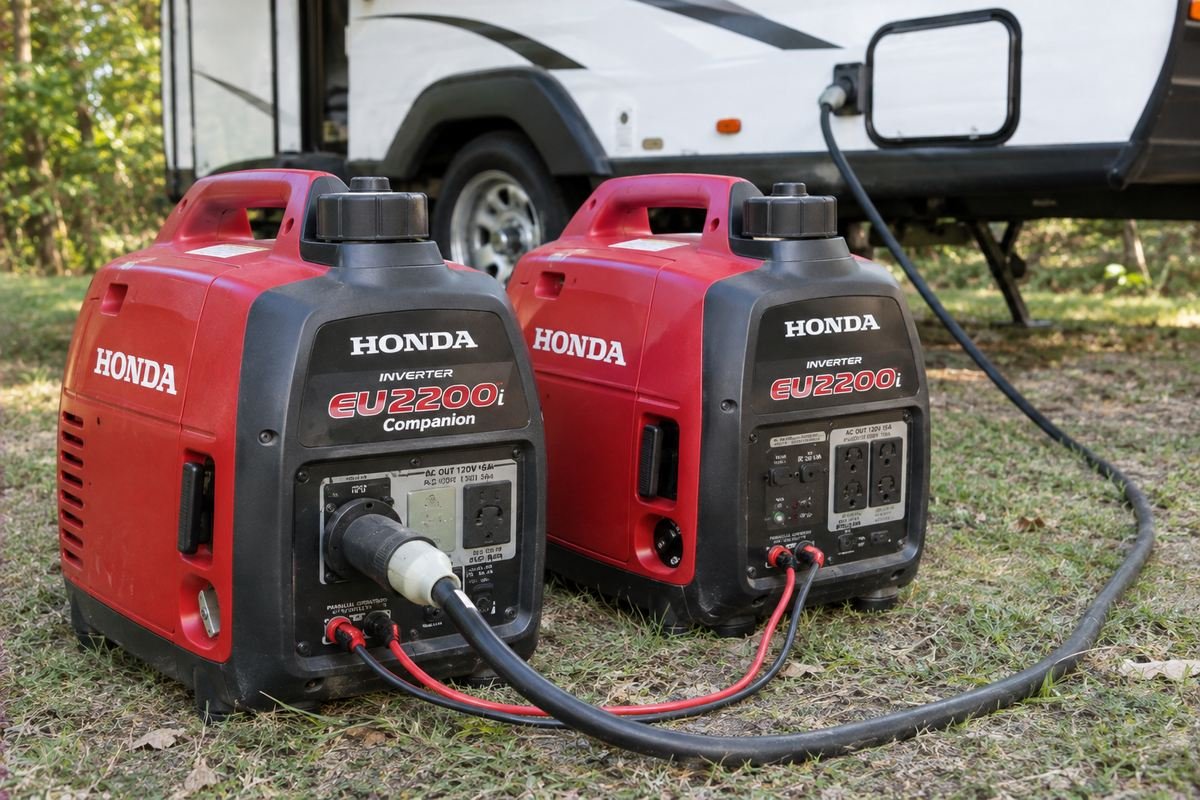
Many inverter generators can run in parallel. You link two of the same brand with a parallel kit, and their power adds up. Two Honda EU2200i generators make 3,600 running watts together (1,800 each), which matches a 30-amp RV. Honda sells a Companion version of the EU2200i with a 30-amp locking outlet for parallel use. A 30-amp RV cord with a TT-30 plug needs an adapter to fit it.
- Two small units: Each one is easier to lift (Honda lists the EU2200i at 46.5 pounds), and you only run both when the AC is on. You need two engines to maintain and a parallel kit.
- One larger unit: One engine, one fuel tank, and one thing to set up. But our 30-amp units weigh 78.5 and about 106 pounds, so lifting takes more effort.
If you already own one small inverter, adding a second matching unit is often the easiest way to run an air conditioner. A soft starter on the AC is another option. It makes the compressor start more gently. Micro-Air says its EasyStart cuts AC startup current by up to 75 percent and names the Honda EU2200i as an example of a small inverter it works with.
Built-in vs portable generators
Many motorhomes and some toy haulers come with a built-in generator, often a Cummins Onan, in its own compartment. It starts with a switch inside the RV, uses the RV's own fuel tank, and is already wired in. That is a real convenience.
Most travel trailers and many fifth wheels do not have one. Some are "generator prepped," which means the builder left space and some wiring for one. Adding a built-in generator involves fuel lines, exhaust, and 120-volt wiring, so it is a job for an RV dealer or a qualified technician. For most trailer owners, a portable inverter is simpler and can be used at home too.
Generator safety at the campsite
Generator exhaust contains carbon monoxide (CO), a gas you cannot see or smell. The CPSC's advice for home generators is to run them outside only, at least 20 feet from the house, with the exhaust pointed away from places people can enter. The same thinking applies to an RV.
- Never run a portable generator inside the RV, in a toy hauler garage, or under an awning.
- Point the exhaust away from your windows, door, and roof vents, and from your neighbor's RV.
- Buy a generator with a CO shutoff. It shuts off the engine when CO builds up around it. The CPSC estimates that generators certified to the PGMA G300-2018 and UL 2201 safety standards cut CO poisoning deaths by 87 percent and 100 percent. All four inverter picks in this guide have a CO shutoff.
- Test your RV's CO alarm. See our guide to the RV carbon monoxide detector.
- Refuel only when the engine is off and cool.
Common mistakes when buying an RV generator
- Buying by the big number. The WEN DF480iX, for example, is sold as a 4,800-watt generator, but it makes 4,000 running watts on gasoline. Size by running watts.
- Forgetting the propane drop. If you plan to run on propane, use the propane rating.
- Ignoring the plug. Check that the generator has a TT-30R, a 14-50R, or an L14-30R that works with an adapter for your RV.
- Buying more than 30 amps for a 30-amp RV. A 30-amp RV can use about 3,600 watts. A 9,000-watt generator will not change that.
- Not checking the weight. Our two 30-amp picks weigh 78.5 and about 106 pounds. Plan how you will lift it into the truck.
- Skipping the noise rules. A loud open-frame generator can break campground rules.
Troubleshooting common generator problems
- The generator shuts off when the AC starts. The start surge exceeds what it can provide. Turn off other loads first, take the generator out of economy mode, add a soft starter, or use a bigger or parallel setup.
- The generator will not start, or it stops right away. Check the oil with the generator on level ground. Many generators have a low oil shutoff that stops the engine when the oil is low. Then check the fuel valve and the choke. If the CO sensor tripped, move the generator to open air and find out why before you restart it.
- Your surge protector shows an open ground on the generator. Most inverter generators have a "floating neutral," meaning neutral and ground aren't tied together inside. Some RV surge protectors read that as a fault and cut power. RV electrical writer Mike Sokol recommends a generator bonding plug, a small plug made for this, in a spare generator outlet. See our RV surge protector guide for more.
- The generator runs rough at high elevation. The air is thinner, so the engine gets too much fuel. Check the manual for a high-altitude kit or adjustment.
- It will not start after storage. Old gasoline is a common cause. Use the fuel shutoff or the manual's storage steps before you put it away.
Frequently asked questions
What size generator do I need for a 30-amp RV?
A 30-amp RV can use about 3,600 watts. Cummins says 2,500 to 2,800 watts is a common minimum for a 30-amp RV with an air conditioner, and a generator with about 3,600 running watts matches the RV's full limit. Use the calculator above to check your own loads.
Can a 2,200-watt generator run an RV air conditioner?
Sometimes. A 2,200-watt inverter makes about 1,800 running watts, which is close to what a 13,500 BTU AC uses. The start surge is the problem. A soft starter on the AC, or two small inverters in parallel, makes it much more likely to work.
Can I run a 50-amp RV on a 30-amp generator?
Yes, with an adapter. You will only have about 3,600 watts, so you can run one air conditioner and small loads, not everything at once.
What is the quietest RV generator?
Look at inverter generators in a closed case. Honda lists the EU2200i at 48 dBA at a quarter load and 57 dBA at full rated load. Westinghouse lists the iGen5000DFc as low as 52 dBA. Makers measure at different loads, so compare numbers at the same load when you can.
How far should a generator be from the RV?
The CPSC tells homeowners to run generators at least 20 feet from the house with the exhaust pointed away. Use the same idea at camp. Keep the exhaust away from your RV's windows, door, and vents, and from your neighbors.
Is propane or gasoline better for an RV generator?
Propane stores longer and keeps the carburetor cleaner. Gasoline gives more power. Our dual-fuel picks make 10 to 12 percent fewer running watts on propane, so size by the propane number if you plan to use it.
Where to go next
The right RV generator matches your power cord, covers the running and starting watts of your air conditioner plus whatever else runs with it, and fits your campground's noise rules. Start with the calculator, then pick the generator type, then the model.
If you want quiet power for small loads instead, see our guides to the RV inverter and RV solar panel kits. If your AC struggles even on shore power, our RV air conditioner guide can help.